
Seasonal workers in Florida face a real challenge when filing for Chapter 7 bankruptcy. The courts look at your average monthly income over six months, which can work against you if you earn significantly more during peak seasons.
At Harnage Law, PLLC, we’ve seen how bankruptcy timing becomes critical for people with fluctuating paychecks. Understanding how the means test treats your irregular earnings could be the difference between qualifying for Chapter 7 relief and being forced into a repayment plan.
How Seasonal Income Affects Your Chapter 7 Qualification in Florida
The Means Test Does Not Forgive Seasonal Spikes
Florida’s Chapter 7 qualification hinges on Form B122A-1, which captures your current monthly income by averaging the past six months of earnings and annualizing that figure. If you earned $8,000 in June and July but only $2,000 in January and February, the court takes all six months, divides by six, multiplies by twelve, and compares that annual average to Florida’s 2026 median income limits by household size. For a single filer in Florida, the 2026 median is approximately $68,000 annually. A family of four faces a $114,761 threshold.
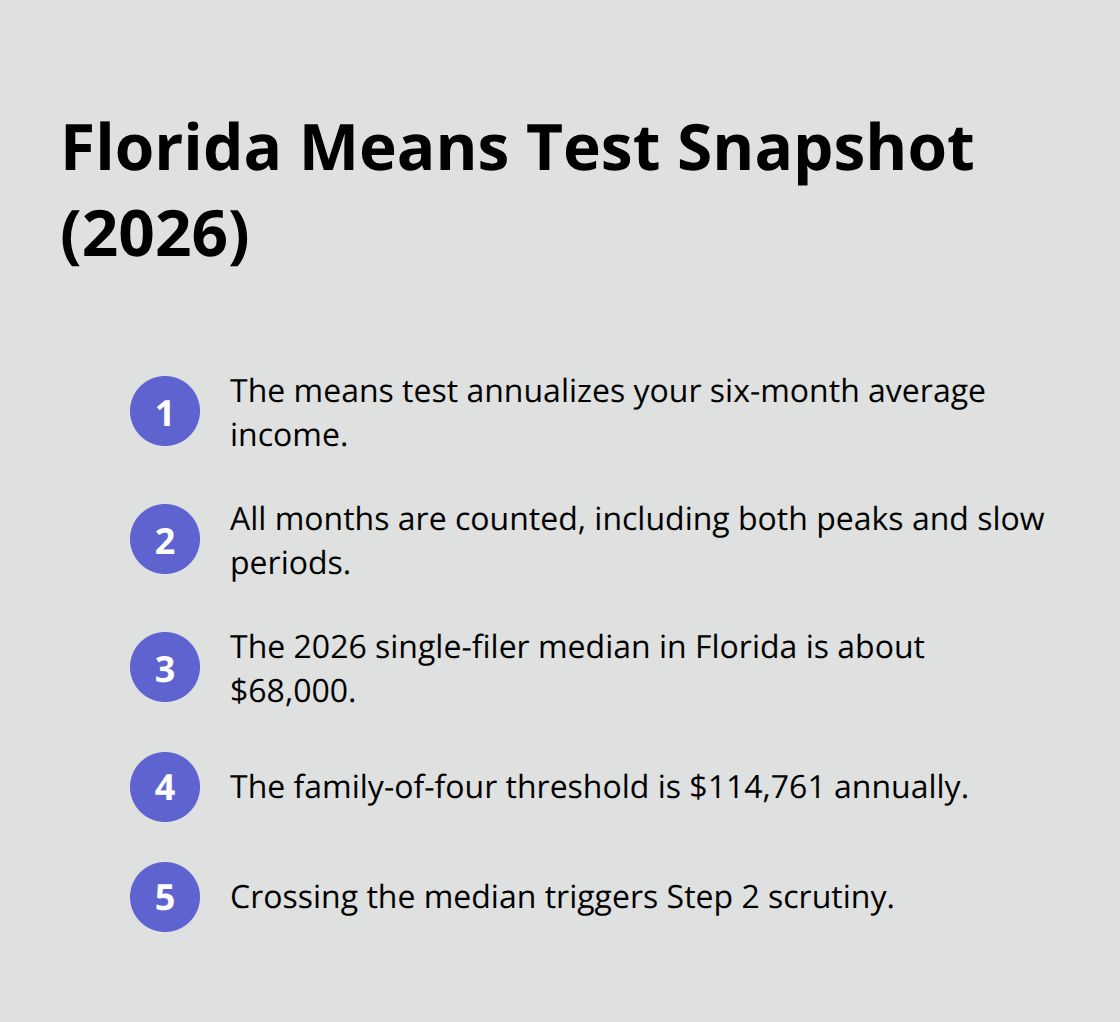
The problem is clear: a peak summer season can push your six-month average above the median, triggering Step 2 of the means test. At that point, the court scrutinizes every allowable expense and deduction to calculate your disposable income over 60 months. Seasonal workers cannot rely on their slowest months to qualify; the court demands the full picture, not cherry-picked data.
Tourism and hospitality workers in Florida face particular vulnerability because summer and winter peak seasons inflate their averages significantly. Construction workers encounter the same trap when they bunch projects into certain months. If your six-month average lands above the median, you do not automatically fail Chapter 7, but you enter a more complex analysis where housing costs, transportation, childcare, and secured debt payments are deducted using IRS standards and local Florida guidelines. The outcome depends entirely on whether those deductions reduce your disposable income below critical thresholds.
Documentation Determines Your Case Outcome
Seasonal filers often gather only their best months or only their worst months-a mistake that courts reject immediately. Courts in the Orlando Division and across Florida require a six-month profit-and-loss statement that breaks income down month by month, showing how peaks and valleys balance out over time. If you file during a slow month and your six-month lookback includes a banner season, the average still reflects that peak. Conversely, if you file during peak season, that high month gets baked into your average.
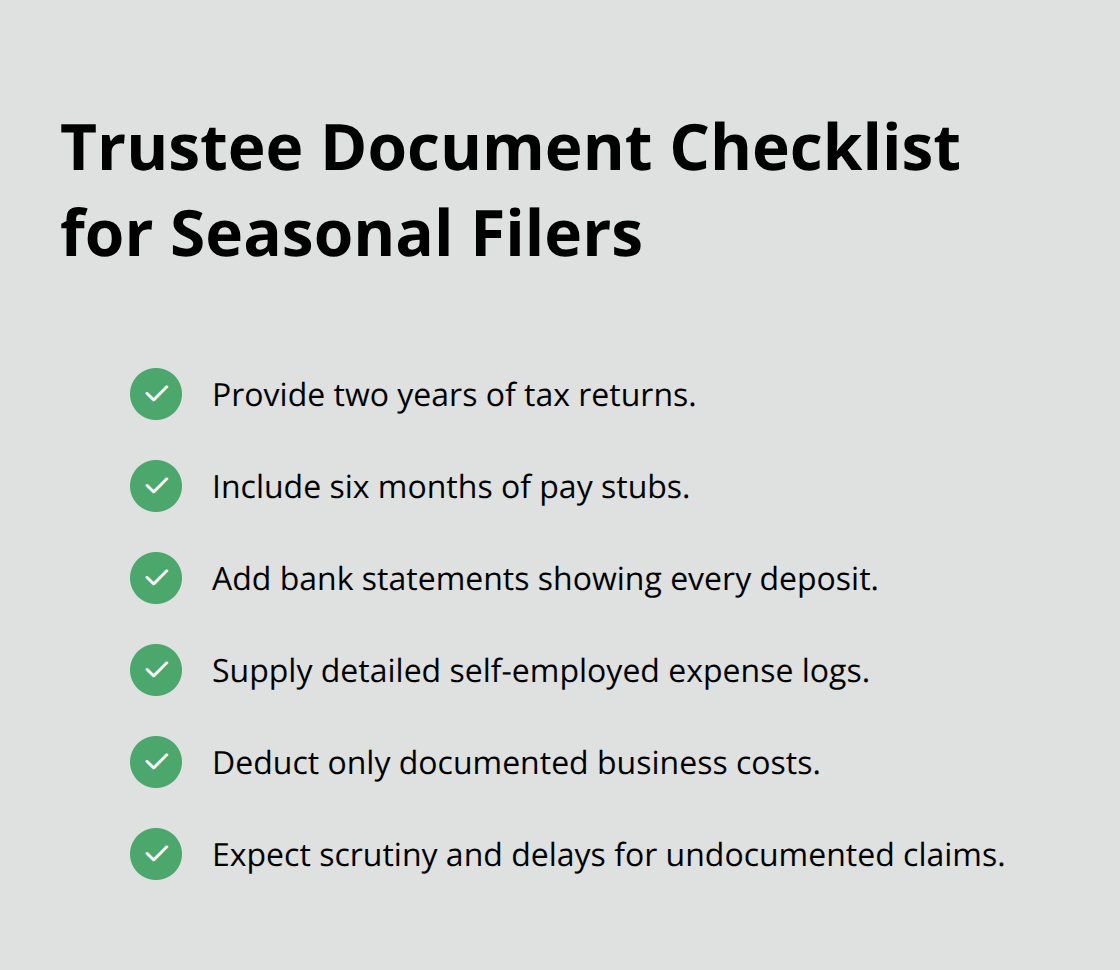
The trustee will request two years of tax returns, six months of pay stubs, bank statements showing all deposits, and if you are self-employed, detailed expense logs proving legitimate business deductions. Self-employed filers can reduce disposable income on the means test by deducting vehicle costs, office supplies, and marketing, but every deduction must be documented. Undocumented claims invite trustee scrutiny and delays.
If your income fluctuates wildly, prepare to explain the pattern with specifics: tourism peaks in winter and summer, retail spikes around holidays, construction follows weather and project schedules. The court respects honesty and clear documentation far more than vague claims about seasonal variation.
Strategic Filing Timing Strengthens Your Position
Chapter 7 is not automatically off the table for seasonal workers. If your six-month average falls below the median, you pass Step 1 automatically and avoid the detailed disposable income calculation altogether. A seasonal worker who earns $5,000 monthly on average over six months clearly qualifies if the median is $5,667 for a single filer.
Additionally, Step 2 deductions can be substantial. Mortgage or rent, utilities, transportation, childcare, health insurance, and secured debt payments all reduce disposable income. A seasonal worker with a mortgage and a car payment may find that after all allowable deductions, there is no disposable income left to fund a Chapter 13 repayment plan, which strengthens the Chapter 7 case.
Filing immediately after a slow season means your six-month lookback includes months of lower earnings, potentially lowering your average and improving your chances of passing Step 1. Filing after peak season works against you. This is not manipulation; it is legal case planning that accounts for how the means test actually functions.
Understanding which six-month period the court will examine-and how your income cycle aligns with that period-shapes your entire filing strategy. The next section explores how to document your income patterns and present them to the court in a way that reflects your true financial situation.
Building Your Income Documentation and Filing Timeline
Gather Six Months of Complete Financial Records
Seasonal workers who succeed in Chapter 7 bankruptcy maintain meticulous income records that span a full earning cycle, not just convenient months. Start collecting six months of pay stubs, bank statements showing every deposit, and if self-employed, a month-by-month profit and loss statement that breaks down revenue and expenses. The trustee assigned to your Orlando Division case will scrutinize these documents to verify the income figure on Form B122A-1. Gaps or missing months signal red flags and invite delays.
Construction workers should compile invoices and project completion dates showing when jobs paid out. Hospitality workers need tip records alongside wage stubs. Gig workers require PayPal, Stripe, or app-based payment confirmations. If you cannot produce clean documentation for all six months, the trustee will estimate your income upward, which works against you.
Understand How Courts View Seasonal Patterns
Many seasonal filers assume the court understands their industry’s natural rhythms. It does not. You must prove your income patterns with numbers. The trustee examines whether your documentation accurately reflects how your earnings fluctuate throughout the year. Vague claims about seasonal variation fail; specific, documented patterns succeed.
Calculate Your Six-Month Lookback Window
Filing timing is not theoretical strategy-it is arithmetic that directly affects your means test outcome. If your industry peaks in December and January, filing in March means your six-month lookback covers September through February, capturing two peak months and four slower months. Filing in July means your lookback spans January through June, potentially capturing only one peak month. Run this calculation before you file.
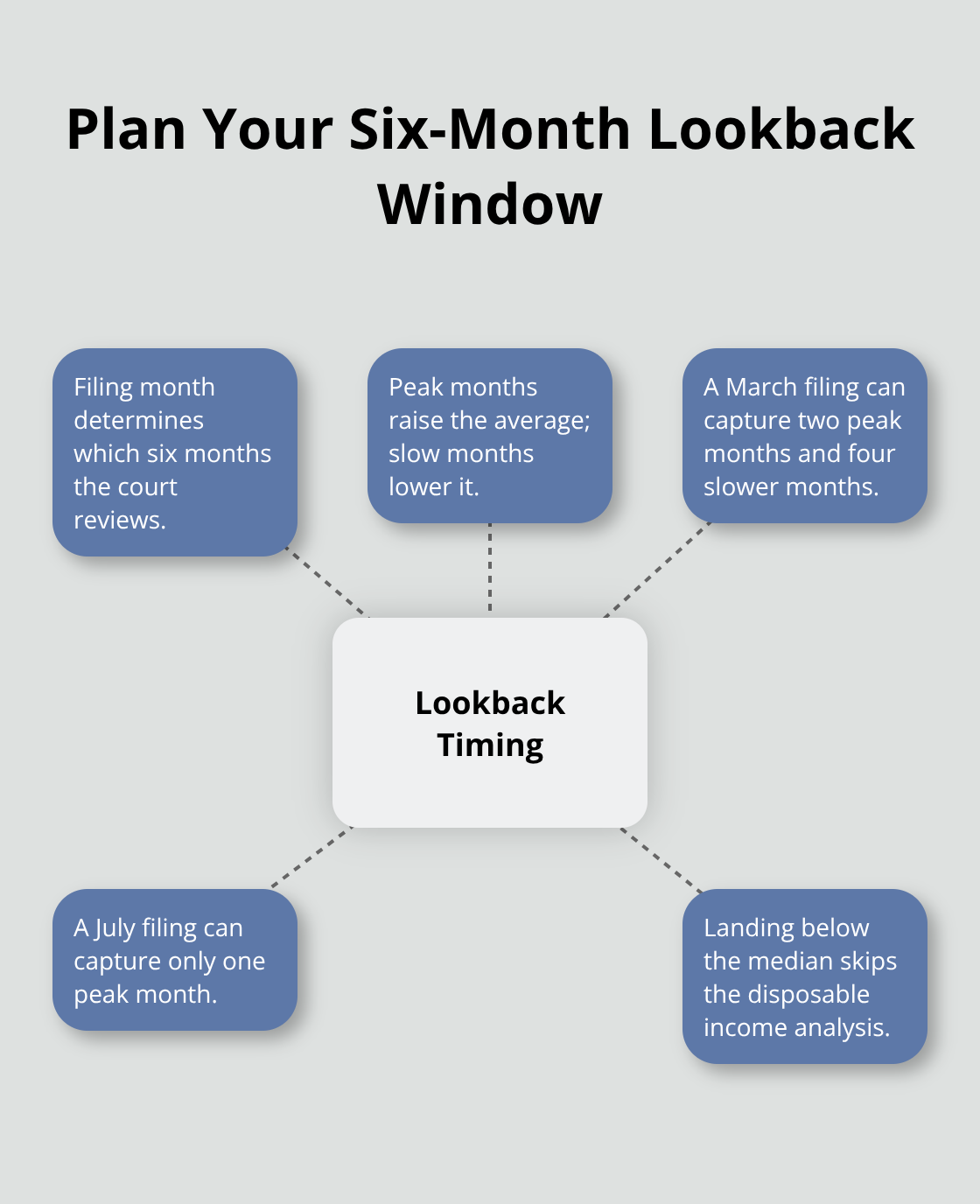
IRS standards for housing, transportation, and childcare deductions apply uniformly across Florida, so reducing your current monthly income through strategic timing is often your strongest lever. Once you pass Step 1 by landing below the median, you avoid the disposable income analysis altogether. A single filer with a six-month average of $67,000 passes Step 1 against Florida’s $68,000 median; a single filer averaging $69,000 does not. That $2,000 gap (roughly $333 per month) can mean the difference between Chapter 7 discharge in three to five months and a mandatory Chapter 13 repayment plan lasting three to five years.
Map Your Income Cycle Before Filing
Mapping your income cycle against the six-month lookback window before filing shapes your entire case outcome. Filing one month earlier or later can reshape whether you qualify for Chapter 7 or face a Chapter 13 repayment plan. This timing decision requires understanding exactly which months the court will examine and how your peak and slow seasons align with that window. Once you have identified the optimal filing window, the next step involves presenting your financial situation to the court in a way that reflects your true circumstances-a process that requires careful coordination with your attorney and clear communication about how your income actually flows throughout the year.
Which Industries Face the Toughest Chapter 7 Challenges in Florida
Tourism and Hospitality Workers Battle Peak-Season Income Spikes
Tourism and hospitality workers dominate Florida’s seasonal economy, and they face the harshest means test dynamics. Hotels, restaurants, and attractions see winter peaks from December through February when tourists flood South Florida, and summer surges when families vacation. A server earns $4,000 monthly in January but drops to $2,000 in September. The six-month average becomes $3,000 monthly or $36,000 annually, which passes Step 1 against Florida’s $68,000 median for a single filer. However, if that same worker files in March after earning $5,000 in February, and the six-month lookback captures two peak months, the average climbs to $3,500 or $42,000 annually. Still below the median, but the timing shift cost $500 per month in average income.
For a family of four in hospitality, the stakes rise because the 2026 median income threshold reaches $114,761. A couple both working hospitality with combined peak-season income of $8,000 monthly might average $6,000 across six months, or $72,000 annually. That passes Step 1 easily. If both workers file after a banner winter season, the six-month average could reach $7,000 or $84,000 annually, still below the threshold but closer to triggering Step 2 scrutiny.
Tip income complicates documentation further. The trustee requires written records of tips, not just credit card receipts, because cash tips vanish without proof. Hospitality workers who cannot produce six months of documented tip records face trustee estimates that assume higher income, pushing their averages upward and threatening qualification.
Construction Workers Face Quarterly Income Bunching
Construction workers encounter different seasonal pressures. In Florida, construction peaks in fall and spring when weather permits large projects, then slows in summer heat and winter holidays. A contractor earns $7,000 monthly during project phases but only $3,000 in slow months. The six-month average calculation penalizes workers who bunch income into specific quarters. A contractor filing in April captures September through February, potentially including both a fall peak and winter slowdown, averaging $5,000 or $60,000 annually. Filing in July means the lookback spans January through June, capturing spring peaks and early summer slowdown, potentially averaging $5,500 or $66,000 annually. That one-month difference adds $6,000 to the annualized figure.
Self-employed construction workers face additional complexity because they must deduct legitimate business expenses on Schedule J to reduce disposable income. Vehicle costs, fuel, equipment maintenance, and subcontractor payments all count as deductions if documented with invoices and receipts. A sole proprietor with $60,000 gross income but $15,000 in business expenses shows net income of $45,000, which strengthens Chapter 7 qualification. However, the trustee scrutinizes these deductions heavily. Undocumented claims or expenses that appear personal rather than business invite challenges and delays.
Retail Workers Struggle Against Extreme Seasonal Swings
Retail and holiday-based employment creates the most predictable seasonal pattern in Florida. Retail peaks from October through December as holiday shopping drives sales, then crashes in January through March. A retail worker earns $2,500 monthly in November and December but only $1,200 in February and March. Filing in September captures the slowest months, lowering the six-month average. Filing in December captures peak months, raising the average.
For a retail worker with household size of three, the 2026 median income is approximately $91,000 annually. An average of $18,000 over six months annualizes to $216,000, which far exceeds the threshold and triggers mandatory Step 2 analysis. That same worker filing after peak season with a six-month average of $15,000 annualizes to $180,000, still well above the median. Retail workers struggle to pass Step 1 unless they have substantial household expenses that reduce disposable income significantly. The timing strategy that works for hospitality and construction fails for retail because the seasonal swing is so severe.
Chapter 13 Offers Flexibility for Extreme Seasonal Income
A retail worker’s best path forward often involves Chapter 13, which allows a repayment plan tailored to fluctuating income. The court can adjust payments during slow months and increase them during peak season, accommodating the industry’s natural rhythm in a way Chapter 7 cannot. This flexibility makes Chapter 13 the stronger option for workers whose seasonal swings push them above the median income threshold, regardless of their actual ability to repay debt.
Final Thoughts
Seasonal income does not automatically disqualify you from Chapter 7 bankruptcy in Florida, but it demands careful planning and honest documentation. The means test compares your six-month average income to Florida’s median thresholds, and that average shifts based on which months fall within your lookback window. A hospitality worker earning $3,000 monthly on average passes Step 1 against the $68,000 single-filer median, while a construction worker with documented business expenses reduces disposable income enough to qualify despite peak-season earnings.
Bankruptcy timing matters because filing one month earlier or later reshapes your six-month average and determines whether you qualify for Chapter 7 discharge or face a three-to-five-year repayment plan. The court examines the numbers you present, not your industry’s natural rhythms. Gather six months of complete financial records now, map your income cycle against the lookback window, and understand how your peak and slow seasons align with the filing date (self-employed filers must document every business expense with invoices and receipts, while hospitality workers need written tip records).
We at Harnage Law, PLLC help seasonal workers navigate these complexities by evaluating your specific income patterns, calculating your six-month average accurately, and identifying the optimal filing window for your situation. Contact us for a confidential consultation to discuss how seasonal income affects your Chapter 7 eligibility in Florida and what bankruptcy timing means for your fresh start.