
Contractors often face unique challenges when pursuing debt resolution through Chapter 7 bankruptcy in Florida. Your income fluctuates, comes from multiple sources, and doesn’t fit the standard W-2 mold that bankruptcy courts typically evaluate.
At Harnage Law, PLLC, we help self-employed individuals navigate how their actual earnings affect eligibility. This guide walks you through income calculation, threshold requirements, and strategies to present your financial situation accurately.
How Contractor Income Affects Your Chapter 7 Eligibility in Florida
The Six-Month Lookback and Income Averaging
The bankruptcy court ignores what you report on your tax return as net profit. What matters is your current monthly income over the six months before filing, calculated according to strict federal rules. For contractors, the court takes your gross business receipts, subtracts ordinary and necessary business expenses, and averages the result across six months. If you earned $8,000 one month and $12,000 the next, the court uses the average-not your highest month. This lookback period is critical because it shapes your entire means test outcome. If your income dropped sharply just before filing, waiting one or two months can lower your average considerably and improve your odds of passing the means test.
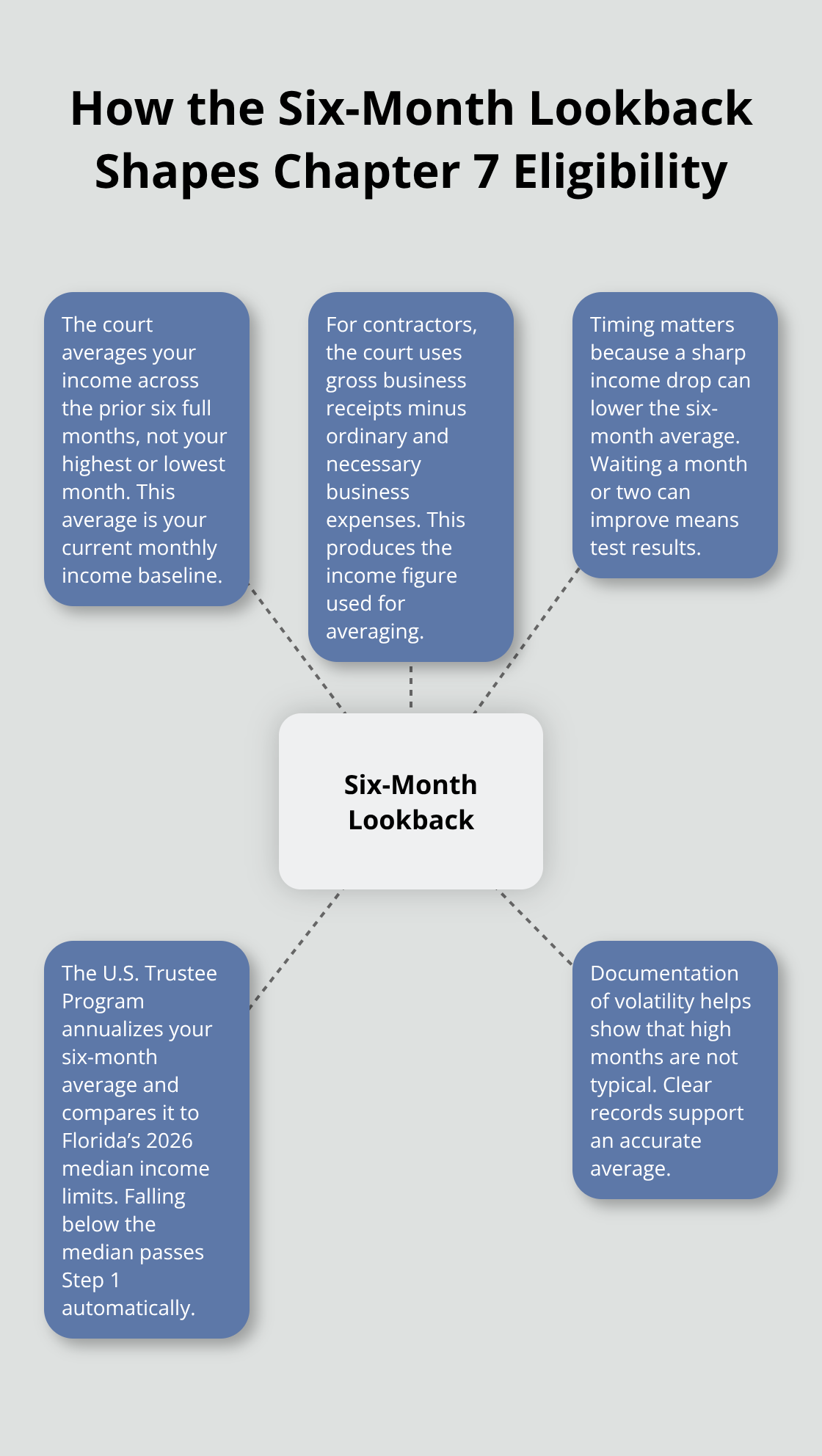
The U.S. Trustee Program uses this six-month average to annualize your income, then compares it to Florida’s 2026 median income limits. For a household of four, that median is $114,761 annually. If you fall below the median for your household size, you automatically pass Step 1 of the means test and face no presumption of abuse under 11 U.S.C. § 707(b).
Multiple Income Streams and Household Contributions
When you work with multiple clients or projects, each dollar counts toward your current monthly income. If your spouse also earns income and contributes regularly to household expenses, that income gets included too. The court applies a marital adjustment only if your spouse’s income does not regularly go toward supporting the household-a rare scenario. If you file jointly with a spouse earning $3,000 monthly while you earn $5,500, the court uses the full $8,500 as your combined current monthly income for the six-month lookback. This is why timing and filing status matter. Self-employed filers often overlook income sources like rental income, dividends, interest, royalties, or pension distributions-all of which count toward current monthly income. Some income does not count: Social Security retirement, SSDI, SSI, and certain disability payments are excluded, which can significantly lower your current monthly income and help you pass the means test. Contractors who receive government benefits or are approaching retirement age may find that excluding protected income makes a substantial difference in their bankruptcy eligibility.
How IRS Standards Replace Your Actual Business Expenses
The bankruptcy court does not deduct every business expense you incur. In Step 2 of the means test, the court uses IRS National and Local Standards to determine allowable expenses, not your actual spending. Your housing deduction is based on IRS standards for your county, not your actual mortgage or rent. Your transportation deduction follows IRS vehicle standards, not what you actually spend on gas and maintenance. This framework standardizes the calculation across all filers and prevents manipulation. However, the IRS standards can be surprisingly generous, especially in high-cost areas like South Florida. If you live in Miami-Dade or Broward County, your housing standard may allow $1,200 to $1,500 monthly, even if your actual rent or mortgage is lower. Contractors with high legitimate expenses-such as vehicle loans for work vehicles, health insurance premiums, childcare for dependents, or ongoing secured debt payments-can deduct these amounts in full. The key is that these deductions must be documented and tied to actual obligations. A contractor with two vehicle loans, a mortgage, and health insurance premiums can see disposable income drop substantially, even if current monthly income appears high on paper. This is why many contractors with six-figure annual income still qualify for Chapter 7 in Florida: the allowable deductions reduce their disposable income below the threshold, eliminating any presumption of abuse. Understanding how these deductions work sets the stage for evaluating whether your specific income and expense situation qualifies you for Chapter 7 or whether alternative options like Chapter 13 make more sense for your circumstances.
Does Your Contractor Income Disqualify You From Chapter 7 in Florida
Florida’s 2026 Median Income Thresholds
Florida’s 2026 median income limits set the first hurdle contractors face, and they vary significantly by household size according to the U.S. Trustee Program. A single contractor must stay at or below $69,876 annually to pass Step 1 automatically. A household of two has a $86,523 threshold. Four people: $114,761. Six people: $136,961.
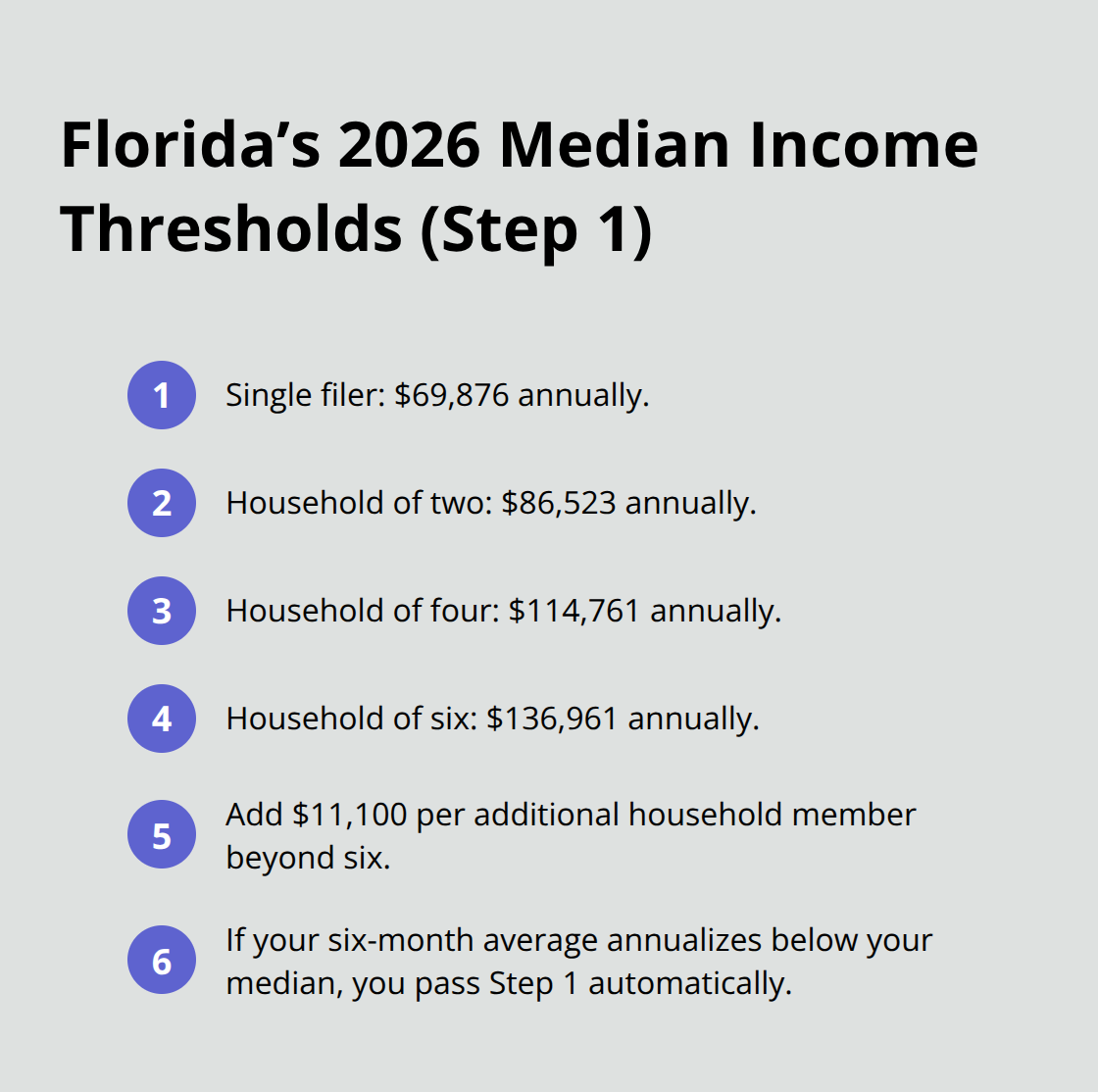
For each additional family member beyond six, add $11,100 annually. These thresholds matter because if your six-month averaged income falls below your household’s median, you qualify for Chapter 7 without further scrutiny. Contractors with seasonal work often benefit here. A roofing contractor earning $15,000 monthly during Florida’s busy season but only $2,000 during summer can average far below the median over six months, securing automatic qualification.
Filing Timing and Income Averaging Strategy
Filing timing becomes tactical when you understand how the six-month lookback works. If you know your income will drop sharply in the coming weeks, waiting can lower your six-month average and lock in your qualification. Conversely, if you just completed a major project and income is artificially high, filing immediately captures a lower average. The U.S. Trustee Program updates these medians every six months, so verify current thresholds on justice.gov/ust before calculating your position. Exceeding the median does not mean disqualification, though many contractors believe it does.
Step 2: When Income Exceeds the Median
Step 2 of the means test applies only if you exceed the median, and this is where the real opportunity emerges for self-employed filers with legitimate expenses. The calculation takes your current monthly income, subtracts allowable expenses using IRS standards, and determines what remains each month over a 60-month period. For disposable income to trigger presumed abuse, the five-year total must exceed $17,150 according to Official Form 122A-2. Below that threshold and you qualify for Chapter 7 despite appearing over-income on paper.
How Deductions Lower Disposable Income
A contractor household with $130,000 annual income but $2,400 monthly in mortgage payments, $600 in vehicle loans, $400 in health insurance, and $300 in childcare expenses might see disposable income drop to just $800 monthly, totaling $48,000 over five years. That exceeds the $17,150 threshold, triggering presumed abuse. However, if the same contractor has an additional $1,200 monthly in secured debt payments or legitimately higher housing costs in Miami-Dade County (where IRS standards allow substantial housing deductions), disposable income could fall below the threshold, eliminating abuse entirely. This is why contractors with high income still qualify: their business-related obligations and legitimate expenses reduce what the court considers available for creditors.
Seasonal Income Volatility and Documentation
Seasonal contractors face additional complexity because income fluctuates month to month. A contractor earning $8,000 one month and $15,000 the next creates an uneven picture, but the six-month average is what counts. If three months show strong income and three months show weak income, the court averages them all together. Document this volatility carefully because it demonstrates that your high-income months do not represent your reliable monthly earnings. Many contractors mistake their best month for their typical month when calculating qualification, inflating their apparent income and creating unnecessary concern about Chapter 7 eligibility. The actual six-month lookback provides a far more accurate picture and often reveals qualification despite apparent high income. Understanding your actual income pattern and the expenses tied to your contracting work sets the stage for evaluating whether your specific situation qualifies you for Chapter 7 or whether alternative options like Chapter 13 make more sense for your circumstances.
Building Your Financial Documentation for Chapter 7
The Gap Between Tax Accounting and Bankruptcy Accounting
Contractors often make a critical mistake: they assume the bankruptcy court will understand their income the way their accountant does. Tax returns show net profit after deductions, but the means test operates on gross business receipts minus only ordinary and necessary business expenses-a fundamentally different calculation. This gap between tax accounting and bankruptcy accounting trips up self-employed filers who fail to prepare properly. Your tax return serves as a starting point, not the complete picture the court needs.
You must gather six months of bank statements showing deposits from all clients and projects, deposit slips documenting the timing and source of each payment, and a clear breakdown of business expenses paid during that same period. The U.S. Trustee Program requires this level of detail because seasonal contractors can manipulate their filing date to artificially lower income or claim expenses that blur the line between personal and business spending.
Strategic Filing Timing and Income Patterns
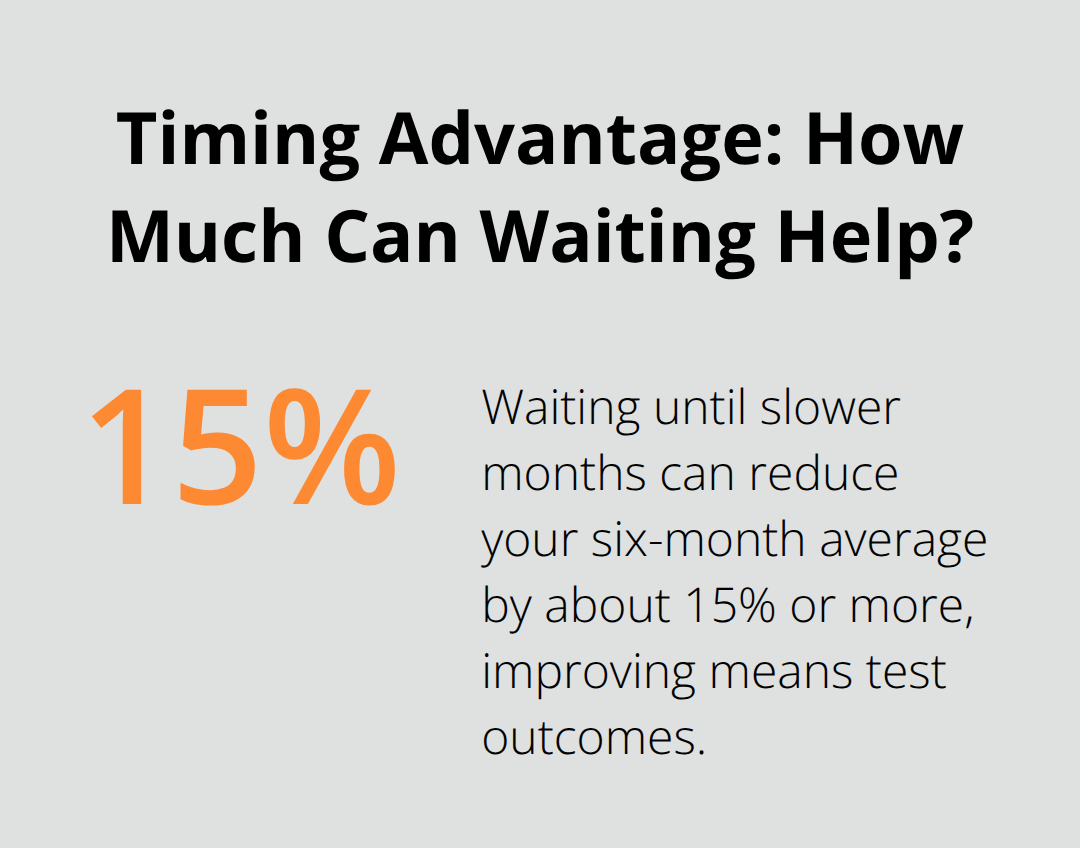
A contractor who files in January after a strong December might appear over-income, but filing in March after a slow January and February could lower the six-month average by 15 percent or more. This is not manipulation-it reflects legitimate income patterns. Conversely, a contractor who knows income will spike in the coming months should file sooner to capture a lower average.
The U.S. Trustee Program updates median thresholds every six months, so verify current figures on justice.gov/ust before calculating your position. Filing timing becomes tactical when you understand how the six-month lookback works. If you know your income will drop sharply in the coming weeks, waiting can lower your six-month average and lock in your qualification.
Documentation That Supports Your Actual Situation
Document everything: client invoices, payment receipts, mileage logs, equipment purchases, insurance policies, vehicle loan papers, health insurance premiums, and childcare agreements. The IRS standards used in Step 2 of the means test require proof of legitimate obligations. A vehicle loan reduces disposable income, but you must show the actual loan agreement and current payment amount. Health insurance premiums reduce disposable income, but the court needs documentation proving the monthly cost.
Without these documents, the trustee will use default IRS standards that may not reflect your actual situation, potentially inflating your disposable income and triggering a presumption of abuse. Many contractors believe their business profit margin or their years in business affect Chapter 7 eligibility-neither is relevant. The court cares only about current monthly income over the past six months and allowable monthly expenses going forward.
Presenting Your Financial Picture Accurately
If you earned $200,000 last year but only $60,000 over the past six months due to a slow period or a major project ending, the court uses $60,000. If your business expenses were $30,000 over those six months, the court deducts $30,000 from gross receipts, not the $80,000 you claimed on last year’s tax return. This distinction matters enormously for your qualification outcome.
A roofing contractor’s income pattern differs from a software consultant’s, and a real estate agent’s income differs from both. Each requires a tailored approach to documenting the six-month lookback accurately. Generic bankruptcy forms filled out without contractor-specific context often understate allowable deductions or overstate income, leading to unnecessary Chapter 13 conversions or case dismissals.
Creating a Clear Summary for the Trustee
The court sees dozens of W-2 filers monthly but far fewer self-employed individuals, which means your documentation must be exceptionally clear. Include a one-page summary showing your six-month income calculation month by month, your business expense breakdown with supporting receipts, your household size and dependents, and a list of all ongoing monthly obligations like vehicle loans, mortgages, and childcare. This summary, paired with your actual bank statements and expense receipts, tells the trustee exactly how you arrived at your current monthly income figure and eliminates ambiguity.
Many contractors pass the means test not because their income is low but because their documentation is thorough and their deductions are properly substantiated. The trustee evaluates your case based on what you present, so clear, organized financial records directly influence whether you qualify for Chapter 7 or face conversion to Chapter 13.
Final Thoughts
Contractor income affects Chapter 7 eligibility in Florida through a calculation that most self-employed filers misunderstand initially. Your six-month averaged income, not your tax return profit, determines whether you pass the means test, and Florida’s 2026 median thresholds provide the first qualification gate. Step 2 deductions using IRS standards often reduce your disposable income below the abuse threshold, which means contractors with substantial income still qualify for Chapter 7 debt resolution when they document their business expenses and household obligations properly.
The gap between tax accounting and bankruptcy accounting trips up many self-employed individuals who fail to present their actual business receipts and expenses to the court. Filing timing matters significantly because seasonal income fluctuations can shift your six-month average considerably, and a contractor earning $200,000 annually but only $60,000 over the past six months qualifies based on the lower figure. Vehicle loans, health insurance premiums, childcare costs, and mortgage payments reduce disposable income dollar for dollar, which explains why many high-income contractors achieve debt resolution through Chapter 7.
If you face financial challenges in Florida as a contractor, start by gathering six months of bank statements, business expense documentation, and a clear breakdown of your household obligations. We at Harnage Law, PLLC help self-employed individuals navigate this process by presenting your financial picture accurately to the bankruptcy court and guiding you through every step of Chapter 7 from income calculation through discharge. Contact us at https://chapter7florida.com/chapter-7-bankruptcy-means-test-calculator/ to discuss your specific situation and determine whether Chapter 7 offers the fresh start you need.
