Filing for Chapter 7 bankruptcy in Florida is a structured process with clear stages. Each step has specific requirements and deadlines you need to follow.
We at Harnage Law, PLLC have guided hundreds of Floridians through these Florida Chapter 7 steps. This guide breaks down what happens at each stage so you know exactly what to expect.
Step 1: Check if Chapter 7 Works for You in Florida
The means test is the first real hurdle you’ll face, and it’s not theoretical-it’s a concrete calculation based on your household income compared to Florida’s median. If your monthly income falls below Florida’s median for your household size, you pass the means test automatically and can file Chapter 7. The U.S. Trustee Program publishes these median income figures, which vary significantly between a single person and a family of four. Even if you earn above the median, you can still qualify if your disposable income after allowed expenses stays low enough according to Form B122A-2, the official means test calculation form. The bankruptcy code bases this assessment on IRS expense standards and Census Bureau data, not on what you think you can afford.
Your previous bankruptcy history shapes your timeline for filing again. If you filed Chapter 7 before, you must wait eight years from your prior discharge date to file another Chapter 7, though Chapter 13 becomes available after just three or four years depending on your circumstances. Florida law protects significant assets through exemptions, so you won’t necessarily lose everything in the process. Your primary residence receives unlimited homestead protection up to half an acre in a city or 160 acres elsewhere if you’ve owned it for at least 1,215 days (newer homeowners face a federal cap of $214,000). You can exempt up to $5,000 in vehicle equity, $1,000 in personal property, and most retirement accounts like 401(k)s and IRAs remain completely protected from creditors.
Understanding these eligibility requirements sets the foundation for your next move. Once you confirm that Chapter 7 makes sense for your situation, Florida law requires you to complete a mandatory credit counseling course before you can file your petition.
Step 2: Take the Credit Counseling Course Before Filing
The U.S. Trustee Program maintains a list of approved credit counseling agencies you must use before filing your petition-shopping around for the cheapest option or using an unapproved provider wastes time and money since the court will not accept it. You need to complete this course before you file, not after, which means scheduling it early in your process. Most approved agencies in Florida offer courses online, by phone, or in person, and many can complete the session in a single appointment lasting one to two hours. The course costs between $50 and $100 depending on the agency, though some adjust fees based on income if you qualify for a fee waiver. Once finished, you receive a certificate of completion that becomes part of your official filing documents-without this certificate, the court will not accept your bankruptcy petition.
The counseling session itself focuses on budgeting basics, debt management alternatives, and understanding what Chapter 7 actually does and does not accomplish. Counselors ask about your income, expenses, and debts, then review your options including debt consolidation or a repayment plan before bankruptcy becomes necessary. This isn’t a judgment session; counselors work through your specific situation without pressure, and the conversation remains confidential. The certificate you receive contains your case number reference and the counselor’s signature, which you’ll file with the court as Official Bankruptcy Form 106Sum. With this requirement completed, you can now move forward to gathering the financial documents the court requires for your petition.
Step 3: Collect Your Financial Records
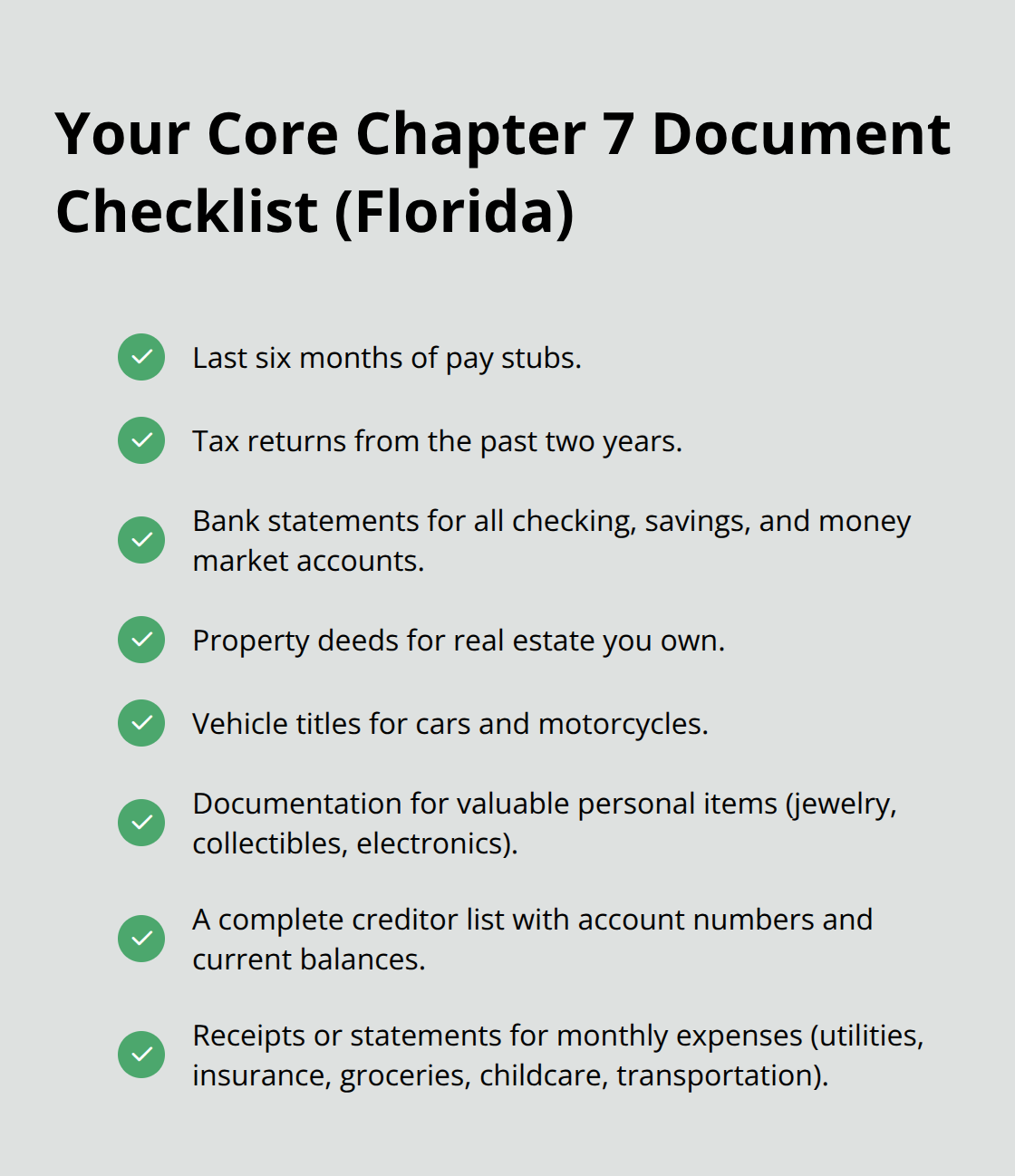
The court demands documentation, not estimates or guesses about what you owe. Gather your last six months of pay stubs, tax returns from the past two years, and bank statements for every account you own, including checking, savings, and money market accounts. The bankruptcy trustee assigned to your case will review these documents to identify nonexempt assets and verify your income calculations on Form B122A-1, the official statement of your current monthly income.
Without these records, you’ll face delays or court rejection of your petition. Start collecting these documents now rather than scrambling later, since some financial institutions take weeks to provide statements for older periods.
Your asset documentation matters just as much as income records. Locate property deeds for any real estate you own, vehicle titles for all cars and motorcycles, and documentation for valuable personal items like jewelry, collectibles, or electronics worth more than a few hundred dollars. Create a complete list of every debt you owe, including creditor names, account numbers, and current balances-the court requires this information on the creditor matrix filed with your petition. Document your monthly expenses with receipts or bank statements showing utility bills, insurance payments, groceries, childcare, and transportation costs. This expense documentation becomes critical for completing Form B122A-2, the means test calculation that determines your Chapter 7 eligibility.
Organize everything in a folder or digital file before meeting with an attorney, since organized documentation speeds up the filing process and reduces legal fees. Once you have your financial records in order, you’ll move to the next critical step: completing the official bankruptcy forms that the court requires for your petition.
Step 4: File Your Petition and Activate Court Protection
The official bankruptcy forms are not optional templates you can modify-they are mandatory documents with specific formatting requirements set by the federal court system. You must complete Form 106Sum (Summary of Your Assets and Liabilities), Form 106A/B (Property), Form 106C (Personal Property), Form 106D (Creditors Holding Unsecured Debts), Form 106E/F (Creditors Holding Secured Debts), Form 106Sum-Supp (Statistical Summary), Form 106Declaration (your sworn statement), Form 106I (Income), Form 106J (Expenses), Form 106J-2 (Expenses for Dependents), Form 106B122A-1 (Current Monthly Income), Form 106B122A-2 (Means Test Calculation), and Form 106B122B-1 (Current Monthly Income for Chapter 11). The Southern District of Florida requires wet signatures on your petition and pre-petition statement under Federal Rule of Bankruptcy Procedure 2017-1, meaning electronic signatures do not satisfy the court’s requirements. Incomplete or incorrectly filed forms trigger rejection letters from the clerk’s office, which delays your filing by weeks.
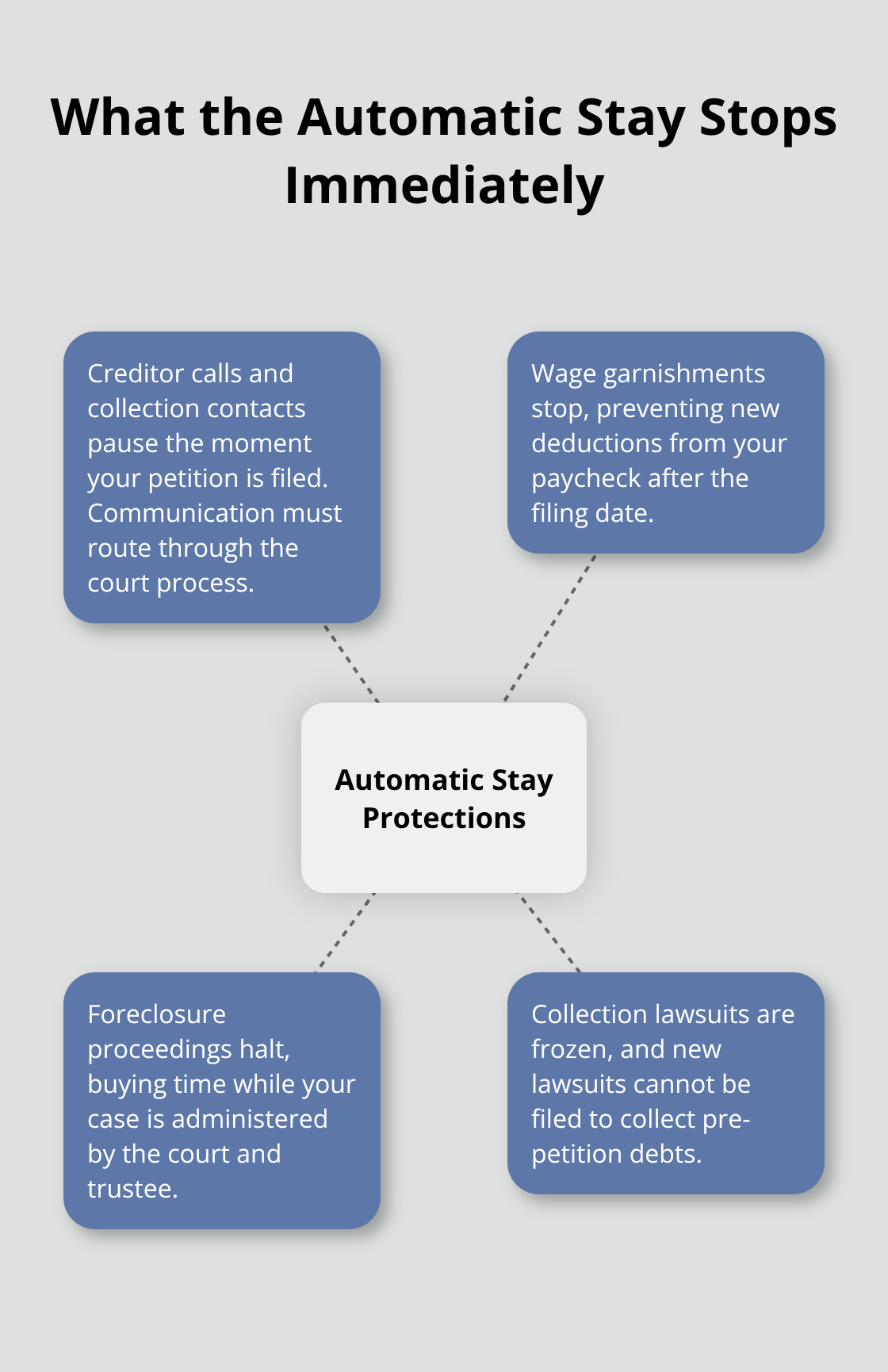
Your Chapter 7 filing fee totals $338, consisting of a $245 filing fee, a $78 administrative fee, and a $15 trustee surcharge according to the U.S. Courts fee schedule. The clerk’s office accepts only money orders or cashier’s checks payable to Clerk, U.S. Bankruptcy Court-no personal checks, credit cards, or cash sent by mail. You can pay the full amount upfront or request installment payments using the Local Form Application for Individuals to Pay the Filing Fee in Installments, with your initial payment equaling at least half the filing fee. The automatic stay activates immediately upon filing your petition, stopping creditor calls, wage garnishments, foreclosure proceedings, and collection lawsuits the moment the court receives your documents.
Within 14 days of filing, you must submit any remaining balance using a cashier’s check or money order, and the clerk will assign a Chapter 7 trustee to your case who will review your assets and manage any property liquidation.
Once the court assigns your trustee and your automatic stay takes effect, you’ll receive notice of your 341 meeting of creditors-the next critical stage in your bankruptcy journey.
Step 5: Meet Your Trustee at the 341 Meeting
The 341 meeting of creditors takes place roughly 21 to 40 days after you file your petition, and creditors rarely attend despite the formal name. The U.S. Trustee’s office schedules this meeting and sends you notice with the date, time, and location in advance. You’ll meet with the Chapter 7 trustee assigned to your case, who verifies your income and expenses, reviews your petition, and identifies any nonexempt assets that might be sold to pay creditors. Bring your government-issued photo ID and proof of your Social Security number to this meeting, as the trustee must verify your identity before proceeding. The trustee may also request recent pay stubs or bank statements if your financial situation has changed since filing.
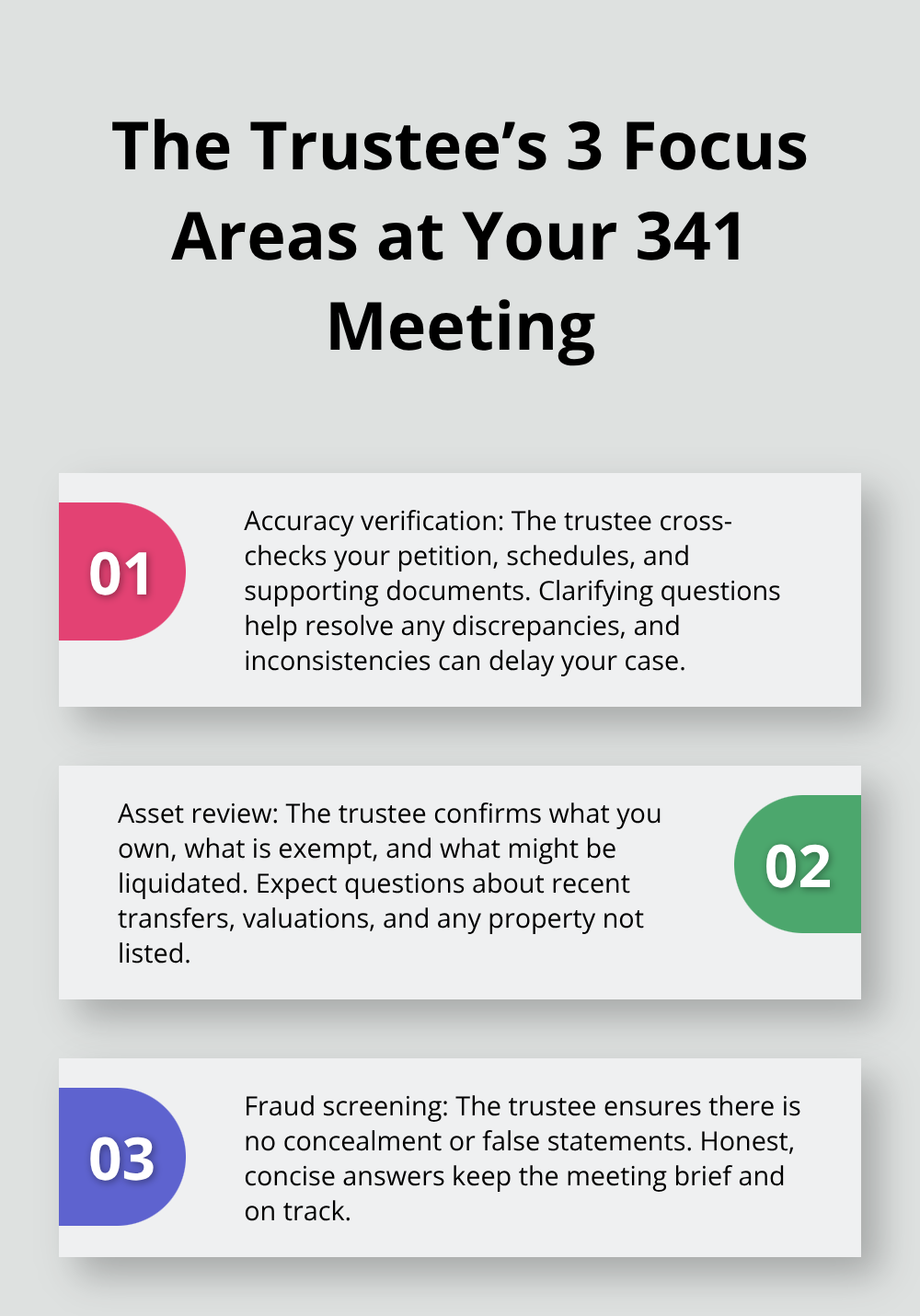
The trustee’s questions focus on three core areas: whether your financial information is accurate, whether you own any property worth liquidating, and whether you’ve committed fraud or hidden assets. Expect questions about your income sources, your monthly expenses, any recent property sales or gifts, and whether creditors have sued you or garnished your wages. Answer honestly and directly without volunteering extra information you weren’t asked about.
Most 341 meetings last between five and fifteen minutes, and the trustee will tell you at the meeting whether your case qualifies for a no-asset discharge (meaning creditors receive nothing and your debts disappear). If the trustee identifies nonexempt property, they’ll explain what gets sold and how proceeds are distributed to creditors, then move forward with the next required step in your bankruptcy journey.
Step 6: Complete Your Second Required Course
The debtor education course differs fundamentally from the credit counseling you completed before filing. Credit counseling prepared you to understand your options before bankruptcy; debtor education teaches you financial management after discharge so you avoid repeating the same debt patterns. The U.S. Trustee Program maintains an approved provider list specifically for debtor education courses in Florida, and you must use an approved agency or the court will reject your certificate. Most approved providers charge between $50 and $100 for the course, though some offer reduced fees based on income. You have until 60 days after your 341 meeting of creditors to complete this course and file your certificate with the court.
The debtor education course typically runs two to four hours and covers budgeting, credit management, and rebuilding credit after discharge. You can take it online, over the phone, or in person depending on the provider’s offerings, and many Florida agencies offer evening or weekend sessions to fit your schedule. Complete the course and request your certificate immediately after finishing, since filing deadlines do not extend for late submissions. File your certificate of completion, officially called the Certification of Completion of a Personal Financial Management Course, with the bankruptcy court before the 60-day deadline expires. Without this certificate on file, the court will not grant your discharge even if everything else in your case is perfect-treat this deadline with the same urgency as your initial filing, since the final step of your bankruptcy journey depends on it.
Step 7: Your Discharge and Life After Bankruptcy
Your discharge order arrives within three to six months after your 341 meeting, though the exact timeline depends on whether the trustee identifies nonexempt assets to liquidate. Once the court issues your discharge, most of your debts vanish permanently and creditors can no longer pursue collection efforts against you. However, certain debts survive discharge regardless of your Chapter 7 filing: child support and alimony obligations remain your responsibility, most student loans persist unless you prove undue hardship, criminal fines continue, and taxes owed to federal or state governments generally stay intact. Debts you incur after filing your petition also remain since the discharge only covers pre-filing obligations. Co-signers on your debts receive no protection from your discharge, meaning lenders can still pursue them for repayment.
Rebuilding credit after discharge requires intentional action rather than waiting for time to pass. Your bankruptcy remains on your credit report for ten years, but your credit score typically recovers faster than most people expect-many filers see scores improve within one to two years through responsible borrowing. Secured credit cards designed for people rebuilding credit offer a practical first step; you deposit $300 to $500 as collateral, receive a matching credit limit, and make on-time monthly payments to demonstrate reliability to lenders. Avoid payday loans and predatory lending products that target bankruptcy filers, since these trap you in expensive debt cycles that contradict your fresh start. Your discharge represents genuine financial freedom, not a temporary reprieve-the key to protecting that fresh start involves living within your means and maintaining an emergency fund of $1,000 to $2,000 to prevent future financial crises.
With your discharge complete and your financial foundation stabilized, the final phase of your bankruptcy journey focuses on protecting your gains and avoiding common pitfalls that pull filers back into debt.
Final Thoughts
You now understand the Florida Chapter 7 steps from start to finish, but knowledge alone doesn’t protect your assets or meet court deadlines. Common mistakes derail filers at critical moments: missing the 60-day deadline for your debtor education course, failing to bring required documents to your 341 meeting, submitting incomplete forms that trigger rejection letters, or misunderstanding which assets Florida law allows you to keep. These errors cost time, money, and emotional energy when proper planning prevents them entirely.
At Harnage Law, PLLC, we guide clients through each phase of Chapter 7 bankruptcy with personalized attention to your specific financial situation. We handle the complex form completion, ensure your filing meets all Southern District of Florida requirements, and prepare you for every meeting and deadline so you know exactly what to expect. We stop creditor harassment, prevent wage garnishments, and halt lawsuits while protecting the assets Florida law allows you to keep.
The sooner you understand your options and begin the process, the sooner you can access the fresh start that Chapter 7 provides. Contact Harnage Law, PLLC to schedule a consultation and discuss how we can guide you through your bankruptcy journey with confidence and clarity. Your path to financial freedom begins with a single conversation.