Freelancers and consultants in Florida face unique financial pressures that traditional employees never encounter. Irregular paychecks, mounting debt, and no safety net can push you toward bankruptcy faster than you’d expect.
Chapter 7 bankruptcy offers a legitimate path to file for relief and start fresh. We at Harnage Law, PLLC help self-employed professionals navigate this process and rebuild their financial lives.
Financial Challenges Freelancers and Consultants Face in Florida
Irregular Income Creates Cash Flow Chaos
Freelancers and consultants operating in Florida face financial instability that salaried workers simply do not experience. Your income fluctuates wildly month to month, creating a cash flow nightmare that makes budgeting nearly impossible. One month you land a $15,000 project; the next month you earn $2,000. This unpredictability forces many self-employed professionals to carry credit card balances just to cover basic expenses during slow periods. According to the Federal Reserve, about 40 percent of Americans cannot cover a $400 emergency without borrowing or selling something, but this number climbs significantly higher for freelancers whose income lacks consistency.
Without a steady paycheck, you cannot build the financial cushion that traditional employees accumulate. Debt compounds quickly because you turn to credit cards and personal loans to bridge income gaps, and those balances grow faster than your variable earnings can shrink them. The problem worsens because many freelancers fail to set aside money for taxes, discovering in April that they owe thousands they cannot pay. Self-employment income creates unique tax obligations, with self-employment taxes alone consuming 15.3 percent of your net profit, yet most freelancers do not budget for this obligation until the bill arrives.
Sole Proprietorship Exposes Your Personal Assets
Freelancers operating as sole proprietors carry unlimited personal liability for business debts. If a client sues you or you cannot pay a vendor, your personal assets sit completely exposed. This differs from corporations or limited liability companies, which shield personal assets from business claims. Most freelancers never formalize their business structure, treating their income as personal earnings and their debts as personal obligations. This creates a dangerous situation where business failure directly triggers personal bankruptcy.
Without business structure, you also lack employee benefits that provide a safety net. You pay 100 percent of your health insurance premiums instead of splitting costs with an employer. Retirement savings depend entirely on your discipline and cash flow, meaning many months you contribute nothing to a 401k equivalent. Paid time off does not exist; every hour you do not work generates zero revenue. These missing benefits drain your finances in ways that are difficult to quantify until you face a medical emergency or job loss.
Credit Card Debt Spirals Out of Control
Freelancers accumulate debt differently than employees because income volatility forces reliance on credit during downturns. You cannot negotiate a lower mortgage payment or skip a car payment when work dries up for three weeks. Credit card companies offer lines of credit that feel like solutions, so you use them repeatedly until you owe $35,000 across multiple cards with interest rates between 18 and 24 percent. The average American household carries $6,929 in credit card debt according to Experian data, but self-employed individuals frequently carry multiples of this amount.
Business-related debts also accumulate differently; you may owe vendors, contractors, or clients who have not paid you yet, creating a cascading effect where your debt grows faster than your income. Many freelancers in Florida face wage garnishment threats from credit card companies or collection agencies because they lack the employer protections that shield traditional employees. Your bank account can be levied, and creditors can pursue aggressive collection tactics without the limitations that apply to salaried workers. This financial pressure builds until Chapter 7 bankruptcy becomes the only realistic path forward-a process that offers relief through debt discharge and protection from creditor actions.
How Chapter 7 Bankruptcy Works for Self-Employed Professionals in Florida
Understanding the Means Test for Freelancers
The means test determines whether you qualify for Chapter 7, and for freelancers, this calculation hinges on your six-month average income compared to Florida’s household median. If your average gross income over the past six months falls below the state median, you automatically qualify for Chapter 7. If you exceed the median, you must subtract allowable business expenses from your gross income to calculate disposable income; if the result is still below the threshold, you still qualify. Documentation becomes critical at this stage. You need two years of tax returns, a detailed six-month profit and loss statement showing month-by-month gross revenue and total business expenses, and bank statements that support your numbers. Many freelancers fail at this stage because they lack organized records or attempt to estimate expenses rather than providing actual documentation.
The trustee will scrutinize your P&L statement against your bank deposits, so commingled personal and business accounts create major problems. Separate your finances before filing to avoid delays and disputes over income analysis. This separation demonstrates to the court that you maintain clear business practices and understand your actual financial position.
Filing Costs and Pre-Filing Requirements
The filing itself involves specific costs: a $245 filing fee, a $75 administrative fee, and a $15 trustee surcharge, totaling $335. You can pay in installments with the final payment due within 120 days, extendable to 180 days if needed. Pre-filing credit counseling from an approved agency is required within 180 days before you file, though emergencies may waive this requirement in limited cases. This counseling session helps you understand your options and prepares you for the bankruptcy process ahead.
The Chapter 7 Timeline and Court Process
You submit your petition and schedules to the bankruptcy court, which triggers an automatic stay that immediately stops creditor actions, wage garnishments, and lawsuits. About 21 to 40 days after filing, you attend a creditors’ meeting, often conducted by Zoom in the Orlando Division. The trustee will ask about your ongoing business income, whether your business still operates, and how you calculated your figures on the P&L statement. In the Orlando Division, most Chapter 7 cases move from petition to discharge in approximately three to five months. During this time, the trustee evaluates your non-exempt assets for liquidation.
Asset Protection Through Florida Exemptions
Florida offers strong protections for debtors filing Chapter 7. You receive an unlimited homestead exemption if you own your home for 1,215 days or more, a $1,000 personal property exemption, a $1,000 vehicle equity exemption, and a $4,000 wildcard exemption you can apply to any property. For freelancers with business equipment, Florida does not offer a tools-of-the-trade exemption, so equipment may be at risk unless it falls within these basic exemptions. However, the trustee may abandon property that costs more to sell than it generates, so low-value equipment often stays with you. This means your essential business tools frequently remain protected through practical economics rather than legal exemption.
Tax Debts and the Discharge Process
Self-employment taxes and older income tax debts require careful attention; self-employment taxes are generally non-dischargeable, but some income tax debts older than three years may discharge if they meet specific age, filing, and non-fraud criteria. Once the discharge is entered, unsecured debts disappear, but liens on property survive the discharge, meaning secured creditors can still pursue claims against property securing their loans. Understanding which debts will actually disappear helps you plan your financial recovery and identify which obligations you must address through other means. The discharge itself marks the beginning of your fresh start, but your path forward depends on the strategies you implement immediately after the court enters your discharge order.
Rebuilding Your Credit and Business After Chapter 7 in Florida
Secured Cards and Credit Union Products Accelerate Recovery
Your discharge order arrives, and the weight lifts immediately. Unsecured debts vanish, creditors stop calling, and wage garnishments end. The real work starts now. Credit rebuilding after Chapter 7 requires deliberate action, not passive waiting. Most people show measurable improvement within two years through specific strategies rather than hoping their score recovers naturally.
Start with a secured credit card from a credit union, which typically requires a cash deposit matching your credit limit, usually between $500 and $2,500. Credit unions offer rebuilding products specifically designed for post-bankruptcy filers because they understand that bankruptcy does not reflect permanent financial irresponsibility. Make small purchases on this card monthly, then pay the full balance immediately. This demonstrates to lenders that you handle credit responsibly now.
After six to twelve months of perfect payment history, request an upgrade to an unsecured card or apply for a vehicle loan from the same credit union. Vehicle loans carry lower interest rates than credit cards and report to all three credit bureaus, accelerating your score recovery. Experian data shows that individuals with post-bankruptcy secured cards and one installment loan reach 650-plus credit scores within eighteen to twenty-four months, assuming zero missed payments.
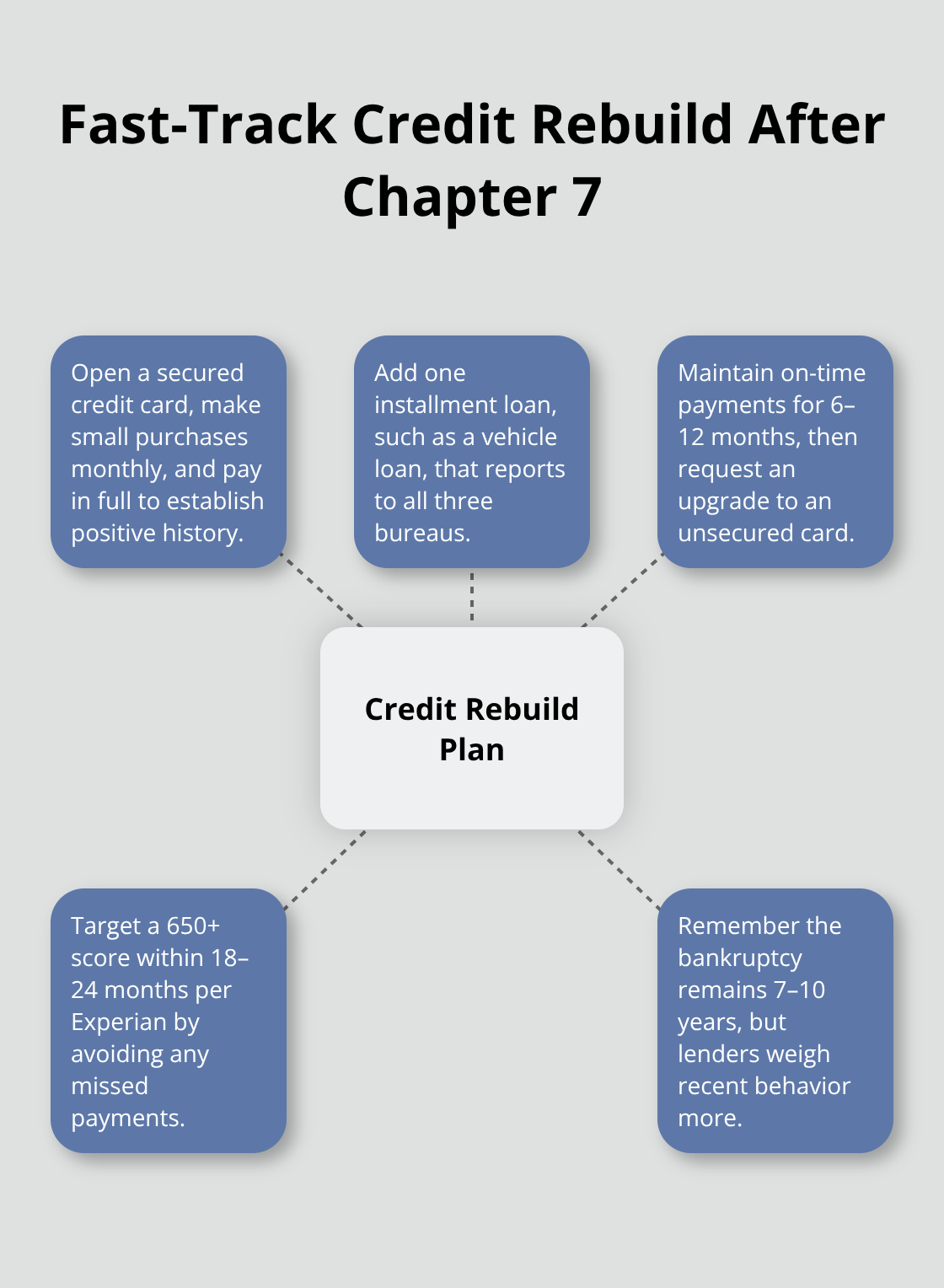
Your credit report still shows the bankruptcy for seven to ten years, but lenders care far more about what happens after discharge than the bankruptcy itself.
Separate Finances and Implement Professional Systems
Restarting your freelance or consulting business requires honest assessment of what failed before bankruptcy. Many freelancers filed because they underpriced services, failed to collect payment from clients, or mixed personal and business finances so thoroughly that they could not track profitability. Do not repeat these mistakes.
Separate business and personal bank accounts immediately, using a dedicated business account for all client payments and business expenses. This separation costs nothing and provides clarity that prevents future debt accumulation. Price your services higher than before, even if this feels uncomfortable. If you charged $50 per hour before bankruptcy, raise rates to $65 or $75 per hour. Clients respect rate increases when you communicate value confidently, and raising prices eliminates the desperation that leads to accepting bad clients or late payers.
Establish Payment Terms That Protect Cash Flow
Implement a payment system requiring deposits before work starts, with remaining balance due upon completion. Freelancers who operate on net-30 or net-60 payment terms frequently accumulate receivables that never materialize into cash. Deposits eliminate this risk and signal professional boundaries to clients.
Keep detailed expense records from day one, using accounting software like QuickBooks or Wave, both of which integrate with business bank accounts and cost nothing to minimal amounts monthly. When your next tax season arrives, you will have precise numbers rather than estimates, preventing tax surprises that triggered debt accumulation before.
Form an LLC to Shield Future Assets
Consider forming an LLC after bankruptcy stabilizes, typically one to two years post-discharge. This structure shields personal assets from future business liabilities and demonstrates to clients that you operate professionally. The modest formation costs and annual filing fees (which vary by state) provide substantial protection that sole proprietorship cannot offer, making this investment worthwhile as your business grows.
Final Thoughts
Chapter 7 bankruptcy offers self-employed workers in Florida a legitimate path to discharge unsecured debts and stop creditor harassment permanently. The process works because it addresses the root problem: debt accumulation that your variable income cannot support. Filing for relief eliminates credit card balances, medical debts, and personal loans that have spiraled beyond recovery, while your business continues operating and Florida’s strong exemptions protect your home, vehicle, and essential business equipment from liquidation in most cases.
After discharge, your financial recovery depends on deliberate action rather than passive waiting. Secured credit cards from credit unions rebuild your score within two years when paired with perfect payment history, and raising your service rates, implementing client deposits, and using accounting software prevent the underpricing and cash flow problems that triggered bankruptcy initially. Forming an LLC within one to two years post-discharge shields future business assets and signals professional credibility to clients.
We at Harnage Law, PLLC guide freelancers and consultants through every stage of this process, helping you understand whether Chapter 7 qualifies for your situation, preparing the documentation the trustee requires, and navigating the creditors’ meeting with confidence. Contact Harnage Law, PLLC for a confidential consultation to review your income patterns, asset situation, and debt structure and determine whether Chapter 7 offers the fresh start you need.