Lenders and bankruptcy courts in Florida scrutinize your income documentation closely. The paperwork you submit can make or break your Chapter 7 filing, which is why getting it right matters.
We at Harnage Law, PLLC help clients navigate this process with clear chapter guidance on what documents you need and how to present them properly.
What Documents Prove Your Income Stability in Florida
Court Requirements for Income Documentation
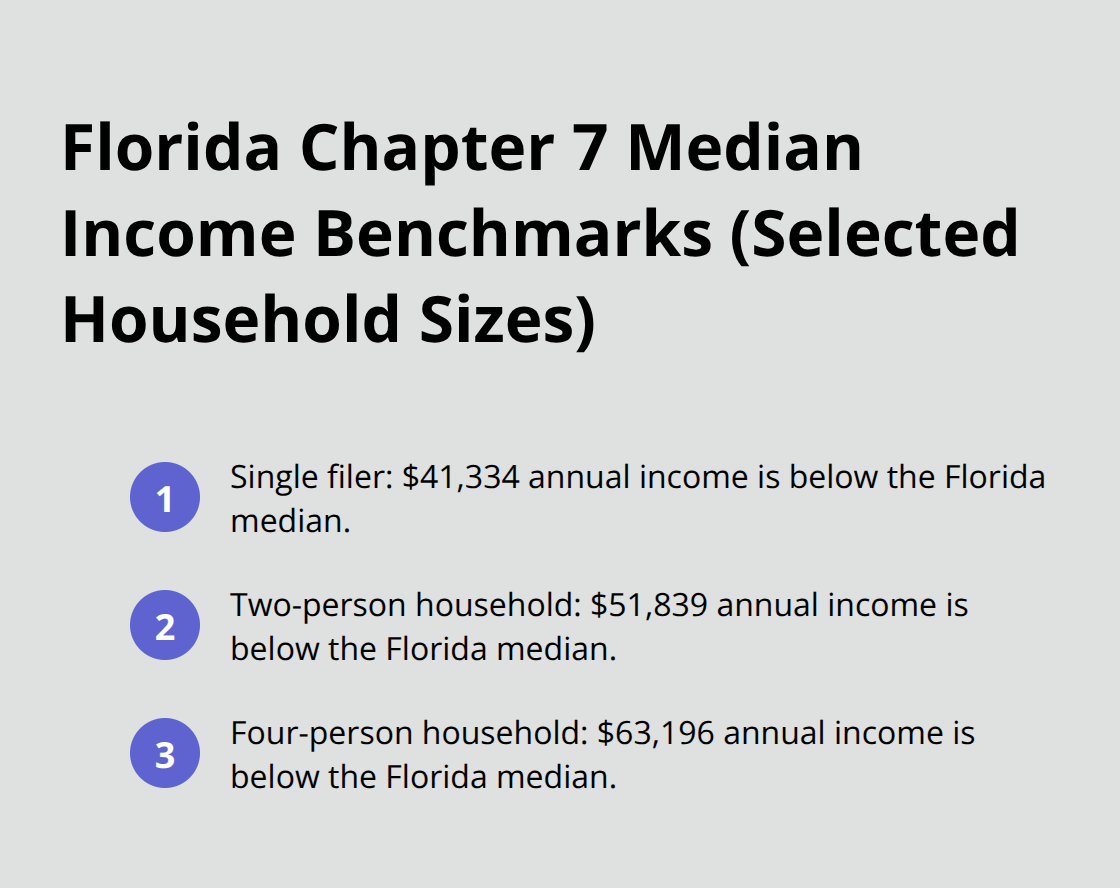
The court needs concrete evidence that your income is real and consistent. Federal Rules of Bankruptcy Procedure require you to file pay statements from every employer within 60 days before filing, along with tax returns and a detailed Statement of Current Monthly Income. For Chapter 7 eligibility in Florida, the court calculates your average monthly income over the past six months and compares it to Florida median income thresholds set by household size. If you earn $41,334 annually as a single person, $51,839 for two household members, or $63,196 for four members, you fall below the median and likely qualify for Chapter 7.
The Six-Month Averaging Window
The court uses this six-month averaging window because it reveals income stability rather than relying on a single month’s earnings. If your income has dropped recently, waiting one or two months might bring your average below the median and help you pass the means test without additional calculations. Self-employed individuals face stricter documentation requirements and must provide tax returns for the past two years, current profit-and-loss statements, and business bank statements to show ongoing income patterns. The court treats self-employment income skeptically, so your records must clearly demonstrate that your business generates consistent revenue month after month.
Bank Statements and Direct Deposit Records
Your bank statements and direct deposit history are equally important because they show where your money actually comes from and how it flows into your household. Pull six months of statements from every account you use to receive income, and highlight deposits from employers or clients to establish a visual record of consistent inflows. If you receive contributions from a spouse or household member toward expenses, document those transfers because they count as household income under federal law. The court wants to see that money arrives predictably and at roughly the same amounts each pay period.
Managing Variable Income and Discrepancies
If you have variable income from freelance work, seasonal employment, or commissions, calculate the average over the past six months and prepare to explain why that average represents your normal earning capacity. For example, if you earned $3,500 in slow months and $5,200 in busy months, your six-month average might be $4,200 (which is what the court will use). Any discrepancies between your pay stubs, tax returns, and bank statements will raise red flags with the trustee at your 341 creditors meeting, which happens 21 to 50 days after filing. Gather all documents before filing and have an attorney review them for consistency and completeness to avoid delays or dismissal.
How to Prove Your Income Stays Consistent Month After Month in Florida
What the Court Actually Examines
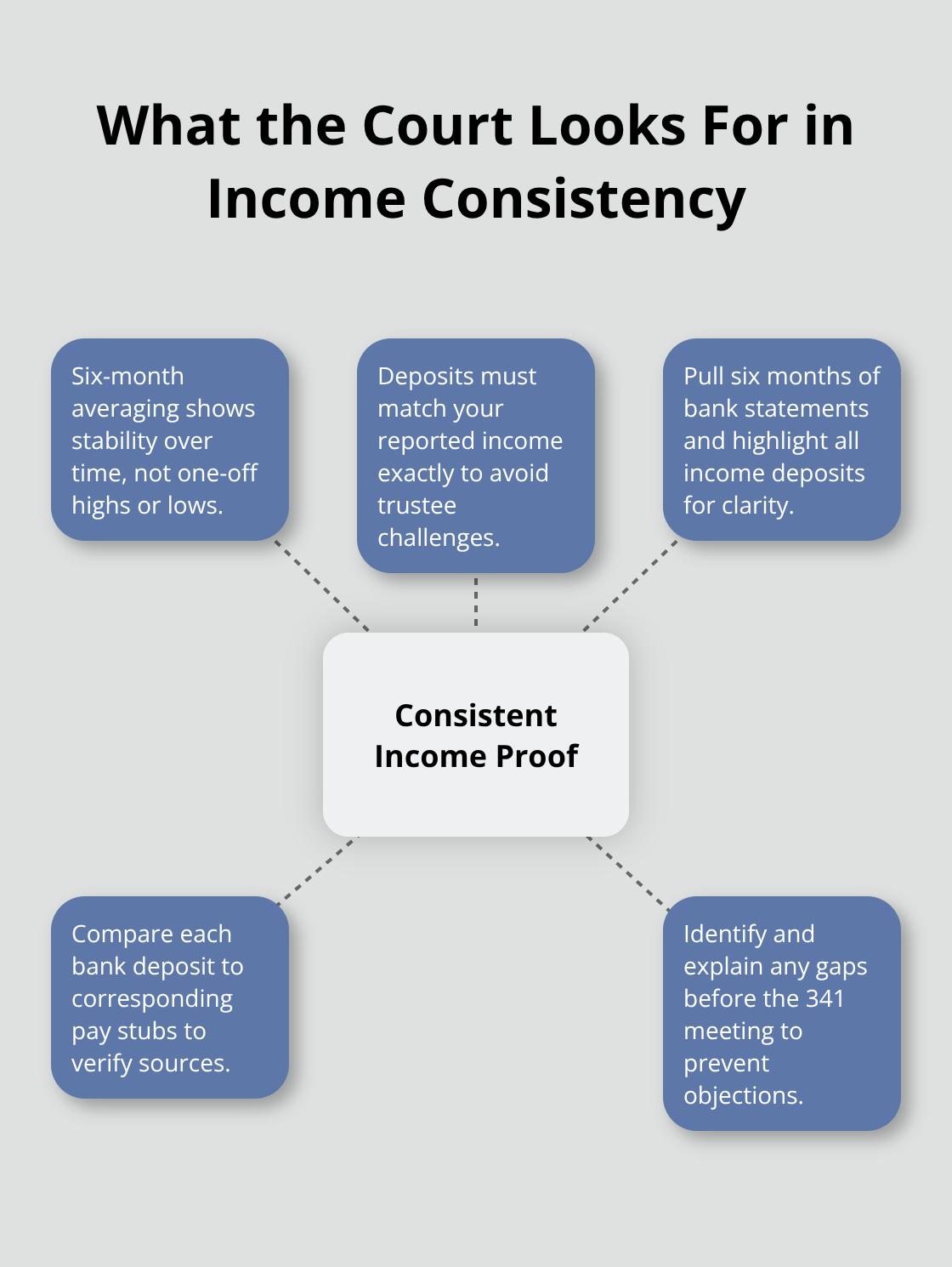
The court ignores your best month and your worst month-it wants proof that your income flows reliably into your account. Federal bankruptcy law requires calculating your average monthly income over the past six months, which is why consistency matters far more than peaks and valleys. If your pay stubs show $3,200 one month and $3,100 the next, that demonstrates solid stability. The trustee will scrutinize your bank deposits against your reported income, so every dollar must match. Start by pulling six months of bank statements and highlighting all deposits from employers or income sources, then compare those deposits to your pay stubs. Any gap between what you reported earning and what actually hit your account creates problems at the 341 meeting.
Documenting Household Income From Multiple Sources
If you receive regular contributions from a spouse or household member toward family expenses, those deposits count as household income under 11 U.S.C. § 101(10A), so document them clearly with a note explaining the relationship and the payment arrangement. This documentation strengthens your case by showing the full financial picture available to support your Chapter 7 filing. The court recognizes that many households rely on multiple income streams, and your paperwork should reflect that reality.
Handling Variable and Seasonal Income
Variable or seasonal income requires a different approach. If you work in construction, retail, or commission-based sales, calculate your average earnings across all six months, including slow periods. Courts recognize that seasonal workers earn less in winter or summer, so they accept lower averages if the pattern is predictable and documented. However, if you earned $6,000 monthly for three months and $1,500 for the other three, your six-month average is only $3,750-which is what the court will use for the means test, even if you’re confident next year will be better. Document your industry’s seasonal patterns with past tax returns or employer statements that show this is normal.
Addressing Employment Changes and Income Gaps
Employment changes and gaps hurt your credibility far more than variable income does. If you left a job three months ago and started a new one, the court will average your income from both positions across the full six-month window. If you were unemployed for part of that period, your average drops accordingly. The solution is to wait until your six-month average improves naturally or to provide evidence that your new income is stable and ongoing. An offer letter from your current employer showing your salary, a recent promotion with written confirmation, or a contract guaranteeing future work all strengthen your position. If you experienced a temporary layoff or illness that reduced your earnings, include a letter explaining the circumstances and documenting your return to normal income. Courts recognize that life happens, but they need proof that your current income will actually support your Chapter 7 filing.
Moving Forward With Your Documentation
The strength of your income documentation directly influences how the trustee views your case at the 341 meeting and whether your filing proceeds smoothly. Gathering complete, consistent records now prevents delays and objections later in the process.
Common Documentation Mistakes That Cost You Time and Money in Florida Chapter 7 Filings
Missing or Outdated Pay Stubs
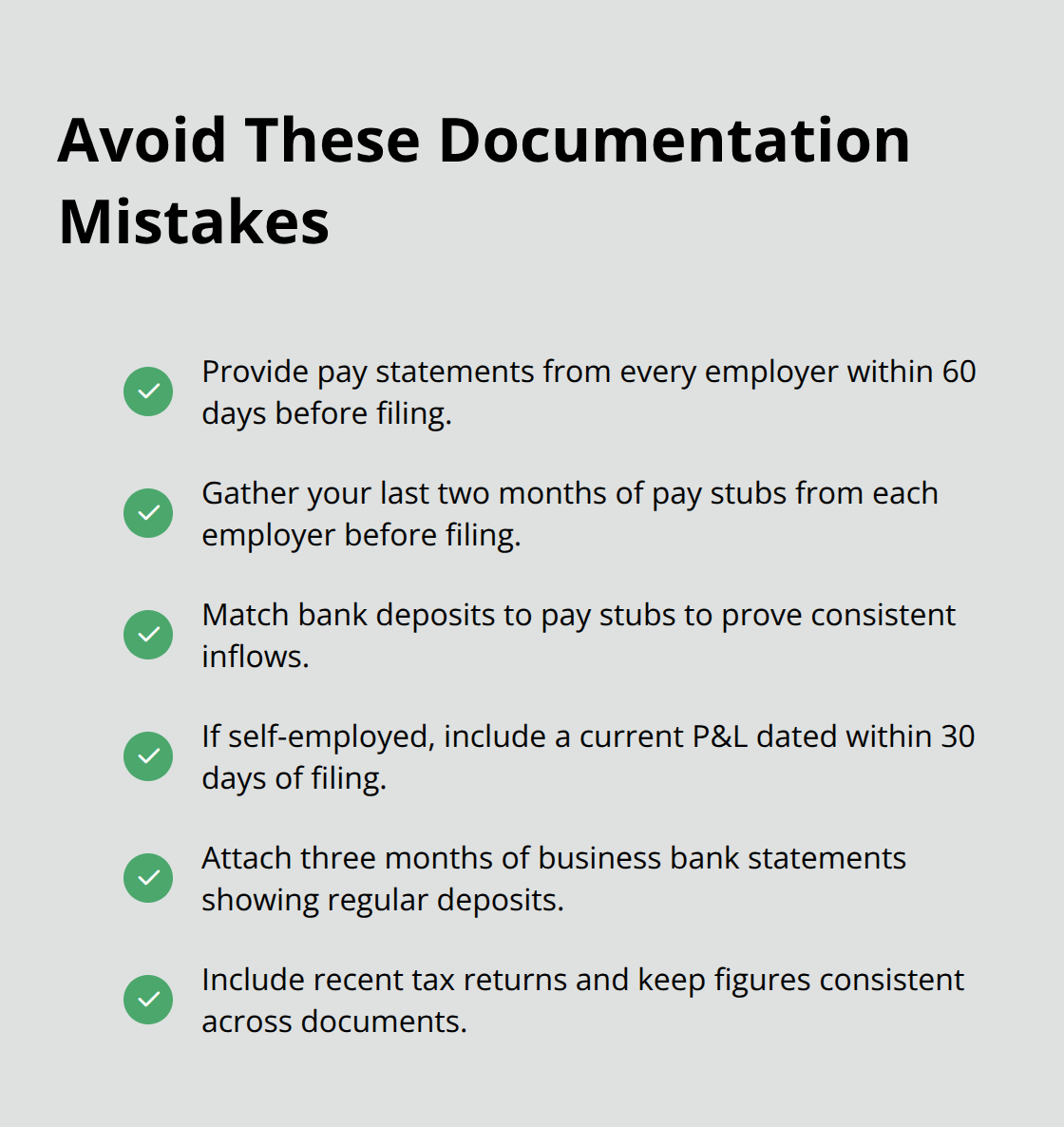
Missing or outdated pay stubs rank as the single most common reason courts delay or reject income documentation in Florida Chapter 7 cases. Federal Rules of Bankruptcy Procedure require pay statements from every employer within 60 days before filing, and the trustee will request them at your 341 meeting if they’re not in your petition. If your most recent pay stub is three months old, the court assumes your income has changed and demands updated documentation to verify you still earn what you reported. Self-employed filers compound this problem by submitting tax returns without current profit-and-loss statements or recent business bank statements, forcing the trustee to question whether the business still produces income. Pull your last two months of pay stubs from each employer before filing, and if you’re self-employed, prepare a current P&L statement dated within 30 days of filing along with three months of business bank statements showing consistent deposits.
Mismatches Between Your Documents
Discrepancies between your pay stubs, tax returns, and bank deposits destroy your credibility faster than anything else. If your pay stub shows $3,200 monthly but your bank statements reveal only $2,800 hitting your account, the trustee will demand an explanation at the 341 meeting, and you’ll struggle to answer convincingly. Wage garnishments, child support deductions, or health insurance premiums cause these gaps, so document every deduction on your pay stub and explain it clearly in writing before filing. The bigger problem emerges when your reported annual income on tax returns doesn’t match your six-month average on pay stubs. If you earned $48,000 last year but your current six-month average is $32,000, the trustee will ask whether your income is declining and whether you can actually support a Chapter 7 filing. Gather all documents before filing and compare them line by line, then contact an attorney if numbers don’t align.
Unreported Income Sources
Failing to report all income sources (including spouse income in joint filings, regular household contributions from non-debtors, or side gigs) creates the final trap. Federal law under 11 U.S.C. § 101(10A) counts household income from anyone whose earnings support family expenses, so hiding a spouse’s $2,000 monthly salary or a roommate’s $500 contribution to rent will backfire when the trustee discovers it during the creditors meeting or document review. List every income source your household receives, no matter how small, and provide documentation for each one.
Final Thoughts
Income documentation forms the foundation of your Chapter 7 bankruptcy filing in Florida. The documents you pull now-pay stubs, tax returns, bank statements, and proof of household contributions-determine whether your case moves forward smoothly or faces delays and trustee objections. Courts demand concrete evidence that your income is real, consistent, and sufficient to support your filing, which is why completeness and accuracy matter far more than having the highest earnings.
The path forward starts with pulling six months of financial records and comparing them carefully for discrepancies before you file. Variable income, employment changes, and household contributions all have solutions-you simply need to document them properly and prepare clear explanations for the trustee. Address gaps in your documentation now rather than scrambling to explain them at your 341 meeting.
We at Harnage Law, PLLC provide chapter guidance tailored to your specific financial situation, helping you gather the right documentation and present your case with confidence. Contact us today to discuss your income documentation and explore how bankruptcy can offer you relief from overwhelming debt.