Self-employment income complicates bankruptcy in ways that traditional W-2 employees never face. The IRS scrutinizes your earnings differently, and the courts apply stricter rules to your debt elimination options.
At Harnage Law, PLLC, we see self-employed filers rejected from Chapter 7 regularly because their income calculations don’t match what the court expects. Understanding how your business income affects your eligibility matters before you file.
How the Six-Month Income Average Determines Your Chapter 7 Eligibility in Florida
The bankruptcy court ignores what you earned last month or what you hope to earn next month. It calculates your average income over the six calendar months immediately before you file. For self-employed filers in Florida, this calculation determines whether you qualify for Chapter 7 or face a Chapter 13 repayment plan instead. The court pulls your self-employment income from your tax returns and profit-and-loss statements, then divides the total by six to establish your current monthly income.
If that average falls below Florida’s median income threshold for your household size, you pass the means test automatically and can file Chapter 7. For a single-person household in Florida, the median income is approximately $41,334 annually as of 2026-about $3,444 monthly. If you exceed that threshold, the court applies deductions for living expenses and business costs to determine whether disposable income remains.
Where Self-Employed Filers Stumble on Deductions
This is where many self-employed filers fail. The court allows deductions based on IRS expense standards and your actual costs (such as health insurance), but only if you document them thoroughly. Legitimate business expenses like rent, utilities, supplies, insurance, and marketing reduce your reportable income on the means test. However, the trustee will scrutinize every deduction you claim.
You cannot claim personal expenses as business costs. Mixing personal and business finances gives trustees ammunition to challenge your numbers and recalculate your income upward. The trustee compares what you claim on your Schedule C tax form against your bank deposits and withdrawals to verify accuracy.
Documentation That Passes Trustee Review
Bring two years of complete tax returns and six months of detailed profit-and-loss statements showing monthly gross revenue and total business expenses for each month. Bank statements for those same six months are non-negotiable-they verify your P&L figures. If your bank records don’t match your P&L, the trustee will reject your expense deductions.
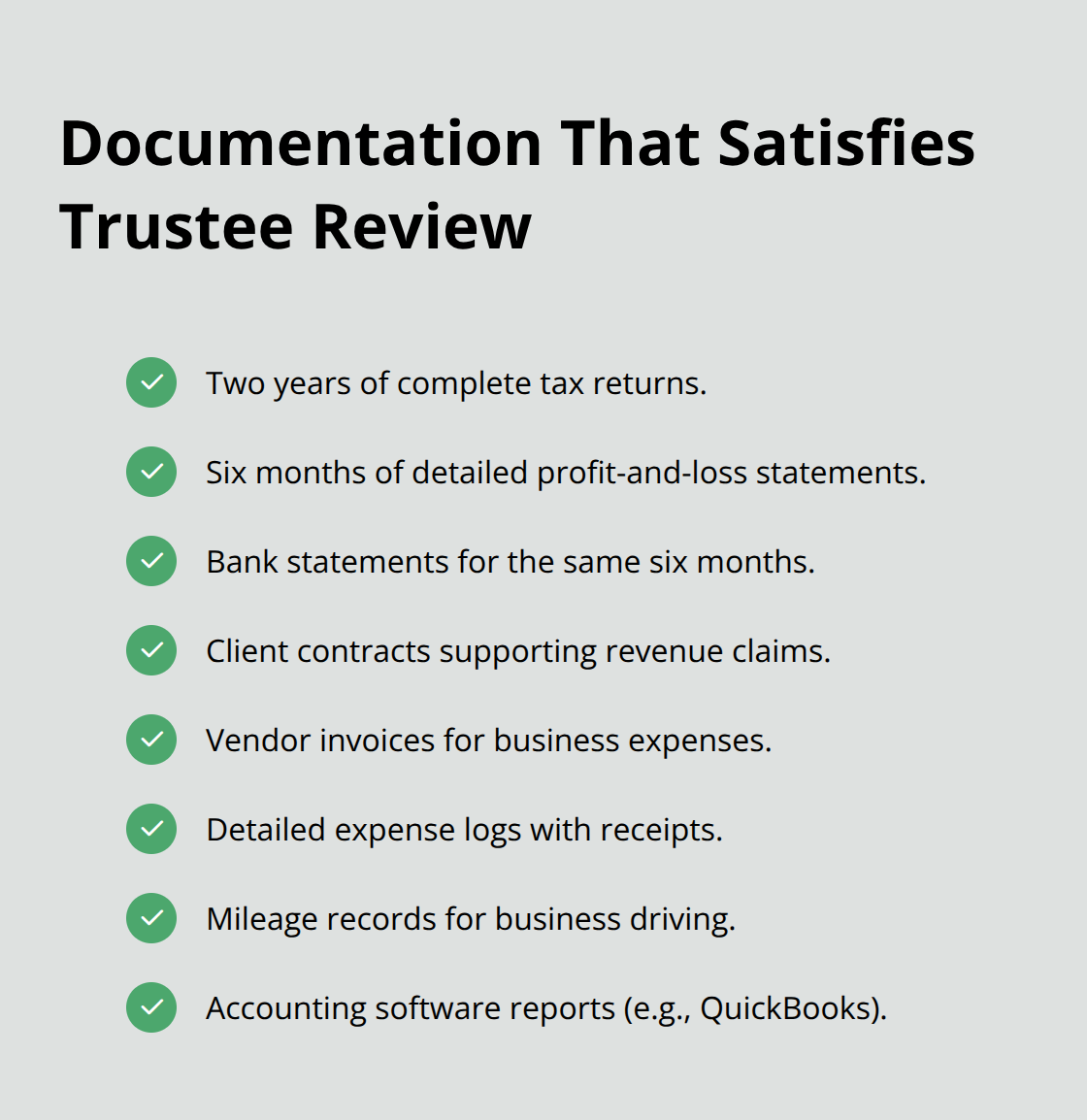
Include client contracts, vendor invoices, and detailed expense logs for anything you claim as a business cost. If you drive for income, keep mileage records separate from personal driving. Many self-employed filers use QuickBooks or similar accounting software to track income and expenses monthly, which makes the six-month P&L template straightforward and defensible.
What Happens at Your 341 Meeting
The 341 creditor meeting in the Orlando Division typically occurs by Zoom. Trustees ask direct questions about how your income figures were calculated and whether your business currently operates. You must answer under oath. Self-employed filers who arrive without organized documentation or vague answers about their income calculations face trustee objections that delay or derail their Chapter 7 discharge.
Separate your personal and business bank accounts before you file. This single step prevents the trustee from questioning whether your reported expenses actually relate to your business or represent personal spending disguised as deductible costs. The trustee’s ability to verify your numbers directly from bank records determines whether your deductions hold up under scrutiny, which then affects your eligibility for Chapter 7 or forces you toward Chapter 13 alternatives.
What Happens to Your Business Debts and Assets in Chapter 7
Sole Proprietorship Creates Personal Liability for Business Debts
Sole proprietors face a harsh reality that incorporated business owners avoid: your business debts become your personal debts. When you operate as a sole proprietor, the IRS and the bankruptcy court treat your business income and business liabilities as one entity. A vendor invoice owed by your landscaping business is legally identical to a credit card you personally guaranteed. The Chapter 7 trustee views all of it the same way-as claims against your personal bankruptcy estate.
This matters because it expands what creditors can pursue and what the trustee can liquidate. If you personally guaranteed a business loan, that guarantee may survive Chapter 7, meaning the lender can still pursue you even after discharge. An LLC or S-corporation absorbs liability and shields your personal assets from certain creditor claims. However, most lenders require personal guarantees anyway, so the liability protection of an entity structure often disappears the moment you sign loan documents.
Equipment and Tools Fall Outside Florida’s Exemptions
Florida has no tools-of-trade exemption, which means your business equipment lacks the specific protection that other states offer. A personal property exemption of $1,000 and a vehicle equity exemption of $5,000 (plus a possible $4,000 wildcard) apply to all debtors, including self-employed filers. If you operate a photography business with $8,000 in camera equipment or a plumbing business with $15,000 in specialized tools, those assets exceed your exemptions and become property of the bankruptcy estate. The trustee can liquidate them to pay creditors.
Your ability to continue earning income after Chapter 7 depends on whether your essential income-producing assets fall within exemption limits. Many self-employed filers discover too late that their business equipment will be sold, forcing them to rebuild their enterprise from scratch. Calculate the liquidation value of every tool, vehicle, and piece of equipment you use for income before filing. If the total significantly exceeds available exemptions, Chapter 13 becomes the more practical option because it allows you to keep all assets while making a repayment plan over three to five years.
Professional Licenses and Ongoing Business Operations
Professional licenses and certifications generally survive bankruptcy because they represent credentials, not property. However, licensing boards in Florida may require disclosure of your bankruptcy filing, and some boards impose restrictions or require additional reporting. A contractor’s license, real estate license, or medical license typically remains valid after Chapter 7 discharge, but you must be truthful about the bankruptcy when renewing or applying for new credentials.
Operating your business during the bankruptcy process depends on whether you have nonexempt assets available for liquidation. If the trustee determines your business has minimal nonexempt value, you may continue operations while the case proceeds. If your business assets exceed exemptions significantly, the trustee will liquidate them, and your business effectively stops. Chapter 7 typically concludes in three to five months in the Orlando Division, so even if operations pause, the disruption is temporary rather than permanent.
Rebuilding After Asset Liquidation
After discharge, you can restart your business immediately with borrowed capital, business credit, or personal savings, though rebuilding creditworthiness takes time. Many self-employed filers receive business credit offers within months of discharge. Responsible use and timely payments help restore your credit profile faster than you might expect. The decision between sole proprietorship and entity structure should happen before financial trouble arrives, not during bankruptcy, but understanding how Chapter 7 treats your current business structure determines whether liquidation will force you to rebuild from nothing or whether Chapter 13 offers a path to preserve your income-producing assets while addressing your debts.
When Chapter 7 Won’t Work for Self-Employed Filers in Florida
The Means Test Disqualifies Many Self-Employed Filers
The means test disqualifies many self-employed filers from Chapter 7 before they ever appear in court. If your six-month average income exceeds Florida’s median for your household size and your deductible business expenses fail to bring you below the disposable income threshold, the court will deny your Chapter 7 petition. For a single filer in Florida, that median sits at approximately $41,334 annually. Self-employed individuals earning $50,000 or $60,000 annually often assume Chapter 7 is out of reach, but the calculation is more complex. The court subtracts IRS-standardized living expenses and your documented business costs from gross income. A landscaper earning $55,000 annually with $18,000 in vehicle maintenance, fuel, equipment rental, and insurance might still qualify if those expenses reduce disposable income below the threshold.
Documentation Problems Sink Chapter 7 Applications
The documentation problem is real and common. Self-employed filers fail the means test not because their income is too high, but because they cannot prove their expenses with bank statements, invoices, and mileage logs. If you claim $5,000 in deductions when your actual business expenses total $18,000, the trustee will recalculate upward and reject your Chapter 7 filing. The trustee’s scrutiny of self-employment deductions is far more aggressive than scrutiny of W-2 income. If you cannot substantiate every dollar you deduct, Chapter 13 becomes your only viable option.
Why Chapter 13 Protects Your Business Assets Better
Chapter 13 serves self-employed filers with volatile or moderate income far better than struggling through a failed Chapter 7 attempt. A Chapter 13 repayment plan runs three to five years depending on whether your income falls below or above the Florida median, and it allows you to keep all your business assets, equipment, and income-producing tools regardless of exemption limits. This matters enormously if your business equipment exceeds the $1,000 personal property exemption and $5,000 vehicle exemption available in Florida. A contractor with $12,000 in tools, a plumber with specialized equipment, or a photographer with camera gear will lose everything in Chapter 7 liquidation but keeps all assets in Chapter 13.
Aligning Payments With Seasonal Income Fluctuations
The plan payment is calculated from your disposable income after business expenses, meaning you pay what you can realistically afford while your business continues operating. Self-employed filers with seasonal income benefit from Chapter 13 because you can propose a plan that accounts for slow months. A landscaper earning $8,000 monthly March through October but only $2,000 monthly November through February can structure payments that align with cash flow rather than average income. Chapter 13 also stops foreclosure, prevents wage garnishment, and halts creditor lawsuits immediately upon filing, which gives you breathing room to stabilize your business. The automatic stay takes effect the moment you file and protects both you and your business from collection actions.
When Chapter 7 Remains the Faster Path
If your self-employment income is genuinely stable and you pass the means test, Chapter 7 remains the faster path to debt discharge (typically three to five months in the Orlando Division). But if your income fluctuates, your business assets exceed exemptions, or your deductions cannot withstand trustee scrutiny, Chapter 13 is not a fallback option-it is the superior choice for protecting your livelihood while addressing your debts over a realistic repayment horizon.
Final Thoughts
Self-employment income fundamentally changes how bankruptcy works, and the path you choose determines whether you protect your livelihood or lose your business assets. The six-month income average, business expense documentation, and Florida’s limited exemptions create a different landscape than W-2 employees face. Your eligibility for Chapter 7 depends on whether your income falls below Florida’s median threshold and whether you can substantiate every business deduction with bank statements and invoices.
If the means test disqualifies you or your business equipment exceeds Florida’s exemption limits, Chapter 13 often provides superior debt elimination while preserving your income-producing assets and allowing your business to continue operating. A sole proprietor with $12,000 in tools loses everything in Chapter 7 liquidation but keeps all assets in a Chapter 13 repayment plan. The automatic stay stops creditor harassment, wage garnishments, and lawsuits the moment you file, giving your business breathing room to stabilize.
Before filing, gather two years of tax returns, six months of profit-and-loss statements, and bank statements showing your actual income and expenses. Separate your personal and business finances immediately, calculate the liquidation value of every tool and piece of equipment you use for income, and test different six-month income averages to see how timing affects your eligibility. Contact us at https://chapter7florida.com to schedule a free consultation and understand which option protects your specific situation.