
Chapter 7 bankruptcy can offer a fresh financial start, but not everyone qualifies. Several Chapter 7 bankruptcy restrictions may prevent you from filing or discharging your debts.
We at Harnage Law, PLLC help Florida residents understand what could block their case before they invest time and money in the process. Income limits, previous filings, and certain debt types create real barriers that affect your eligibility.
Does Your Income Disqualify You from Chapter 7 in Florida
The Means Test as Your Primary Barrier
The means test acts as the primary gatekeeper that determines whether you can file Chapter 7 in Florida. This calculation compares your household income to the state median income for your household size and deducts allowable living expenses to find your disposable income. If the test shows you have money left over each month after basic expenses, the court may conclude you can afford a Chapter 13 repayment plan instead. The means test uses six months of your recent income to establish a baseline, so temporary spikes matter significantly. A bonus, overtime pay, or seasonal work in the past six months will inflate your income figures and potentially trigger a presumption of abuse.
How Florida’s Income Thresholds Work
Florida’s median income thresholds vary by household size. For a single person in Florida, the median income sits around $65,000 annually as of 2024, though exact figures update regularly through the U.S. Trustee Program. A family of four faces a higher threshold, approximately $125,000. If your current monthly income exceeds these state medians, you automatically proceed to the second stage of the means test, where the court calculates whether you have disposable income.
Many filers assume income above the median means automatic disqualification, but that assumption is incorrect. The means test allows you to deduct specific living expenses: housing, utilities, food, transportation, childcare, and insurance. These deductions follow standardized IRS guidelines, not what you actually spend. The IRS allowances may fall below your real costs, which creates a gap that works against you.
When Disposable Income Triggers Abuse Presumptions
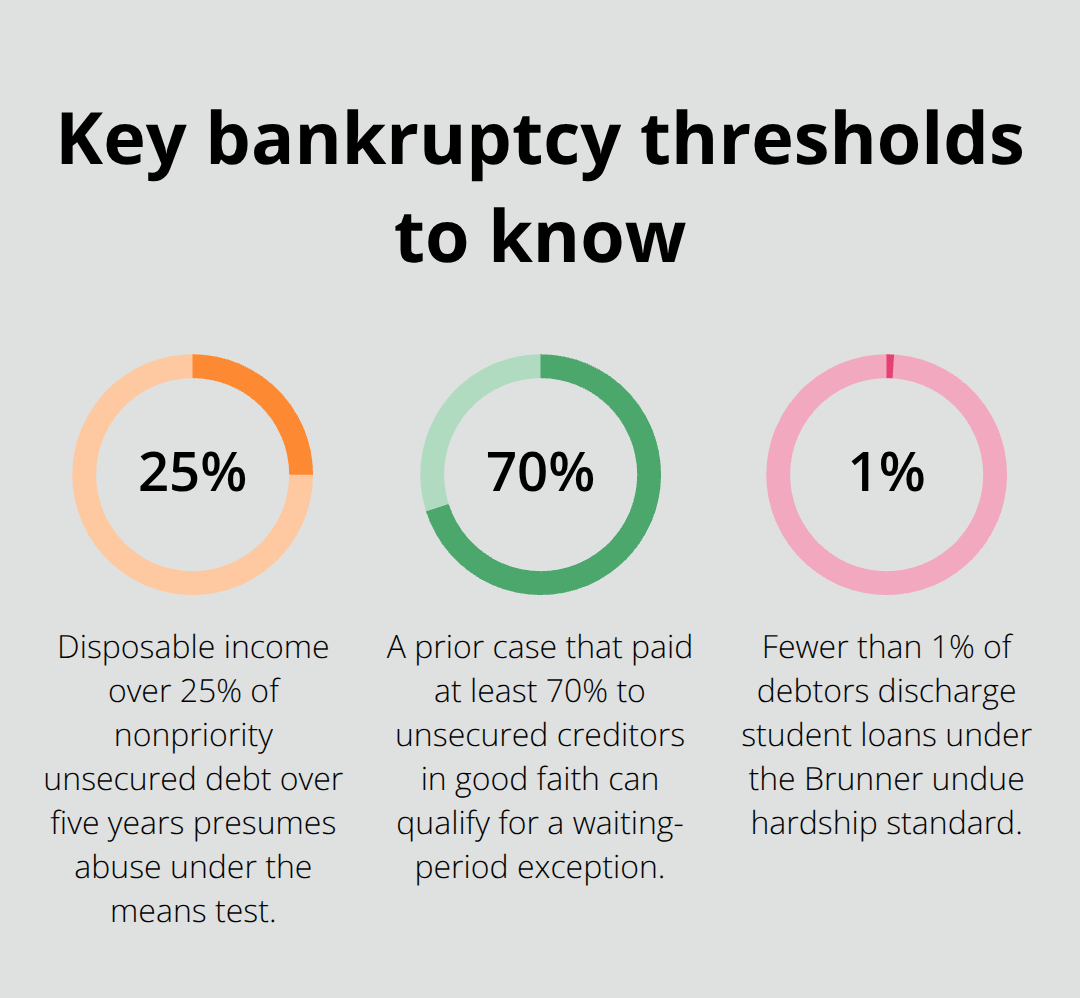
If your disposable income-income minus allowable deductions-exceeds 25 percent of your nonpriority unsecured debt (or $10,275, whichever is greater) over five years, the means test presumes abuse. This presumption is not final. You can rebut it by showing special circumstances, such as a serious medical condition, military service obligations, or other hardships that require expenses beyond the IRS standards. However, rebuttal requires documentation and court approval, adding complexity and cost to your case.
Your Options When Income Blocks Chapter 7
Failing the means test does not end your bankruptcy journey. You retain options. Chapter 13 remains available regardless of means test failure. Under Chapter 13, you propose a repayment plan based on what you can genuinely afford, and unsecured debts not paid through the plan may be discharged after three to five years. This path requires discipline and steady income, but it works for individuals whose Chapter 7 path closed.
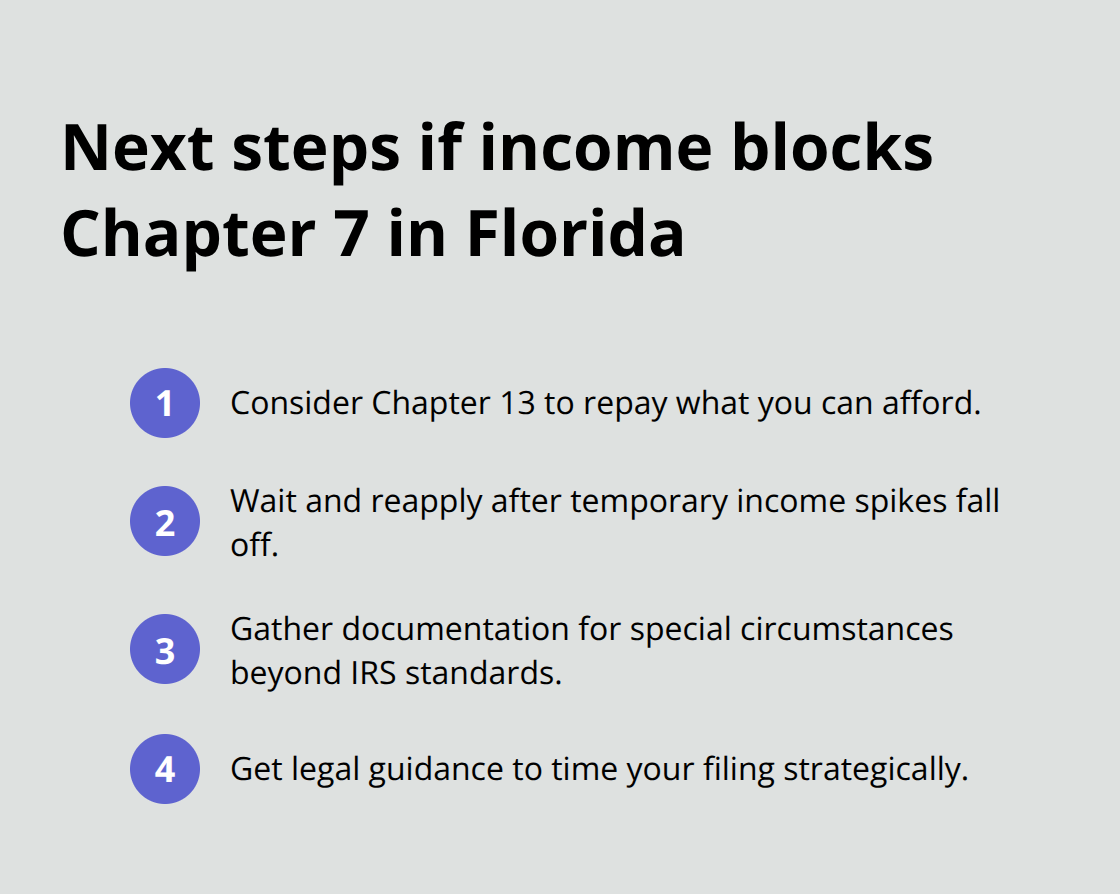
Alternatively, if your income spike was temporary (a one-time bonus, inheritance, or short-term job), you can wait several months and reapply when your six-month income average drops. Timing is tactical here. If you received a large bonus in January, filing in July will include that bonus in your calculation. Filing in August might exclude it.
Some people attempt to lower their means test by increasing allowable deductions. This strategy fails. The IRS standards are fixed by location and family size; you cannot manipulate them. What you can do is document actual expenses that exceed the IRS allowance and present evidence to the court for special circumstances relief. Medical bills, court-ordered support payments, or care for a disabled family member may qualify. The court reviews these claims skeptically, so documentation must be thorough and credible.
Even if income appears to block your Chapter 7 eligibility, previous bankruptcy filings and timing restrictions may present additional obstacles that affect your overall bankruptcy strategy.
Prior Bankruptcy Filings and Waiting Periods in Florida
The Eight-Year Rule for Chapter 7 Discharges
Filing Chapter 7 a second time triggers strict timing rules that block many filers from obtaining a discharge. The federal bankruptcy code sets mandatory waiting periods between filings, and these periods depend on which chapters you filed previously and which chapter you file now. If you filed Chapter 7 and received a discharge within the past eight years, you cannot file Chapter 7 again and receive a discharge until that eight-year window closes, measured from filing date to filing date. Someone who discharged debts through Chapter 7 in January 2018 cannot obtain another Chapter 7 discharge until January 2026. These timelines are strict and calculated to the exact date, so precision matters when determining your eligibility.
Shorter Waiting Periods for Other Prior Chapters
If your prior case was Chapter 12 or Chapter 11, the waiting period drops to six years instead of eight. This distinction creates meaningful differences in your timeline. The exception to these waiting periods exists only if your prior case paid 100 percent to unsecured creditors or paid at least 70 percent in good faith with your best efforts. Most Chapter 7 cases pay far less, making this exception rare in practice.
Chapter 13 as Your Alternative Path
Chapter 13 offers a faster route when Chapter 7 timing blocks you. If you filed Chapter 7 previously, you can file Chapter 13 after waiting just four years, not eight. This shorter window makes Chapter 13 a viable path for filers whose prior Chapter 7 discharge falls within the eight-year barrier.
The prior dismissal no-file rule also restricts repeat filings: if your previous case was dismissed within 180 days because you willfully failed to appear in court or comply with court orders, you cannot file again for 180 days from that dismissal date. This rule prevents strategic abuse of the system.
Special Orders and Immediate Filing Opportunities
A bankruptcy judge can issue a special order forbidding you to file again, though this remains uncommon. If your prior case closed without receiving a discharge and was not dismissed for willful disobedience or failure to appear, you can file immediately with no waiting period at all. Many filers do not realize this exception exists and unnecessarily delay filing when they could proceed right away. The timing calculation creates complexity, which is why reviewing your prior case outcome matters before investing in another filing. Understanding these restrictions helps you determine whether certain debts remain blocked from discharge or whether alternative strategies could work better for your situation.
Debts That Survive Chapter 7 Discharge in Florida
Student Loans Remain Your Responsibility
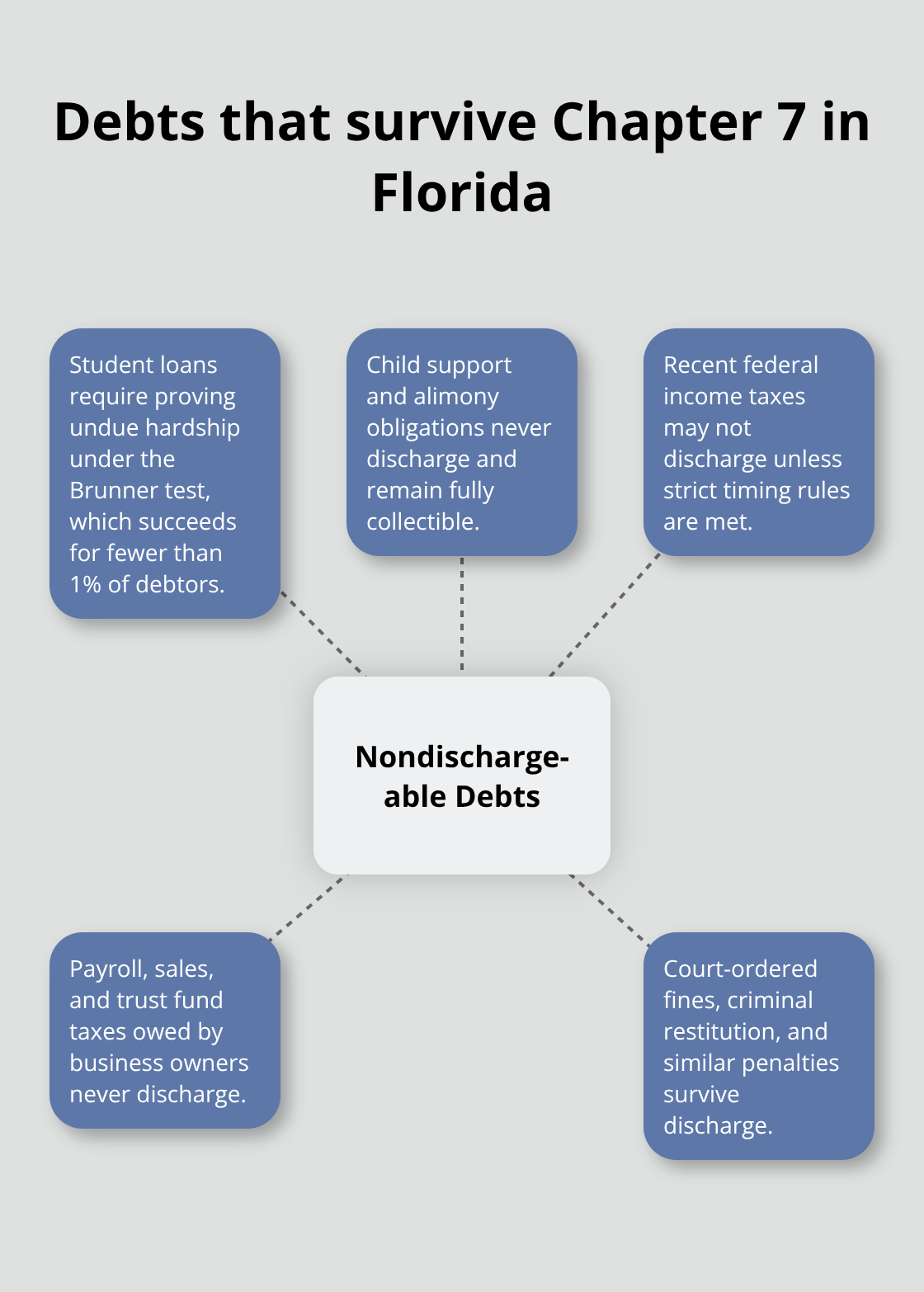
Chapter 7 discharge eliminates most debts, but federal law carves out specific obligations that remain your responsibility even after the court grants discharge. The bankruptcy code under 11 U.S.C. § 523(a) lists nondischargeable debts with precision, and these restrictions apply regardless of your financial hardship or the amount owed. Student loans present the most common nondischargeable debt category. Federal student loans, private student loans, and Parent PLUS loans all survive Chapter 7 discharge unless you prove undue hardship through the Brunner test, a standard so restrictive that fewer than 1 percent of debtors successfully discharge educational debt according to data from the Federal Reserve. The test requires you to show that repaying the loan creates an unreasonable burden on you and your dependents, that circumstances prevent you from maintaining a minimal standard of living while repaying, and that your situation will persist for a substantial portion of the repayment period. Courts interpret undue hardship narrowly, making educational debt functionally permanent in most Chapter 7 cases.
Family Support Obligations Never Discharge
Child support and alimony obligations never discharge, period. The bankruptcy code treats family support as a priority that supersedes all other debts. If you owe $50,000 in back child support and $100,000 in credit card debt, Chapter 7 eliminates the credit cards but leaves the full child support obligation intact. The trustee cannot liquidate assets to pay child support arrears ahead of other creditors because family support claims are categorically nondischargeable under 11 U.S.C. § 523(a)(5).
Recent Tax Debts and Court-Ordered Penalties
Recent tax debts also resist discharge. Income taxes become dischargeable only if the tax year ended more than three years before you filed bankruptcy, you filed the tax return more than two years before filing bankruptcy, and the IRS did not assess the tax within 240 days before your bankruptcy filing. This three-year lookback rule means 2023 tax debts filed in 2026 might discharge, but 2024 taxes almost certainly will not. Payroll taxes, sales taxes, and trust fund taxes owed by business owners never discharge regardless of age. Court-ordered fines, restitution for criminal conduct, and penalties imposed by courts also survive discharge.
What This Means for Your Fresh Start
These restrictions mean your fresh start excludes debts tied to family obligations, education, recent tax years, and criminal liability. Understanding which debts in your situation will discharge and which will survive allows you to make informed decisions about whether Chapter 7 addresses your primary financial problems or whether alternative strategies might work better for your circumstances.
Final Thoughts
Income limits, prior bankruptcy filings, and nondischargeable debts create real obstacles that block many Florida filers from Chapter 7 relief. The means test calculates whether you have disposable income after allowable expenses, and exceeding Florida’s median income thresholds pushes you toward Chapter 13 instead. If you filed Chapter 7 within the past eight years, the waiting period prevents you from obtaining another discharge until that window closes.
Student loans, child support, alimony, and recent tax debts survive discharge regardless of your financial situation, meaning these obligations follow you even after the court grants relief. Chapter 7 bankruptcy restrictions require careful analysis before you file, and attempting to navigate them alone risks dismissal, wasted filing fees, and delayed relief. The bankruptcy process demands precise calculations, accurate documentation, and strategic timing that most people cannot manage without guidance.
Contact Harnage Law, PLLC to discuss your options and determine whether these restrictions block your case. We review your income, prior filings, and debt composition to identify your actual eligibility and the best path forward. Your fresh start may be closer than you think, but only if you understand which restrictions apply to your situation.