
Losing your car in Chapter 7 bankruptcy isn’t inevitable. Many filers keep their vehicles by understanding Florida’s exemption laws and taking the right steps before and during the filing process.
At Harnage Law, PLLC, we’ve helped countless clients keep car Chapter 7 protection strategies that actually work. This guide walks you through six proven methods to protect your vehicle and maintain the transportation you need.
Understanding Florida’s Motor Vehicle Exemption Laws
Florida’s approach to vehicle protection in Chapter 7 bankruptcy differs sharply from homestead protection, and this gap matters significantly for your filing strategy. While Florida offers unlimited protection for primary residences owned at least 1,215 days, the state provides only $1,000 in vehicle equity exemption. This $1,000 threshold applies to actual cash value, not the loan balance, meaning a car worth $8,000 with a $6,000 loan leaves $2,000 in unprotected equity. The exemption amount gets calculated using real market values from sources like Kelley Blue Book or Edmunds, not what you originally paid or what you owe. If your vehicle’s equity exceeds $1,000, a bankruptcy trustee can liquidate the car to pay creditors unless you take protective action.
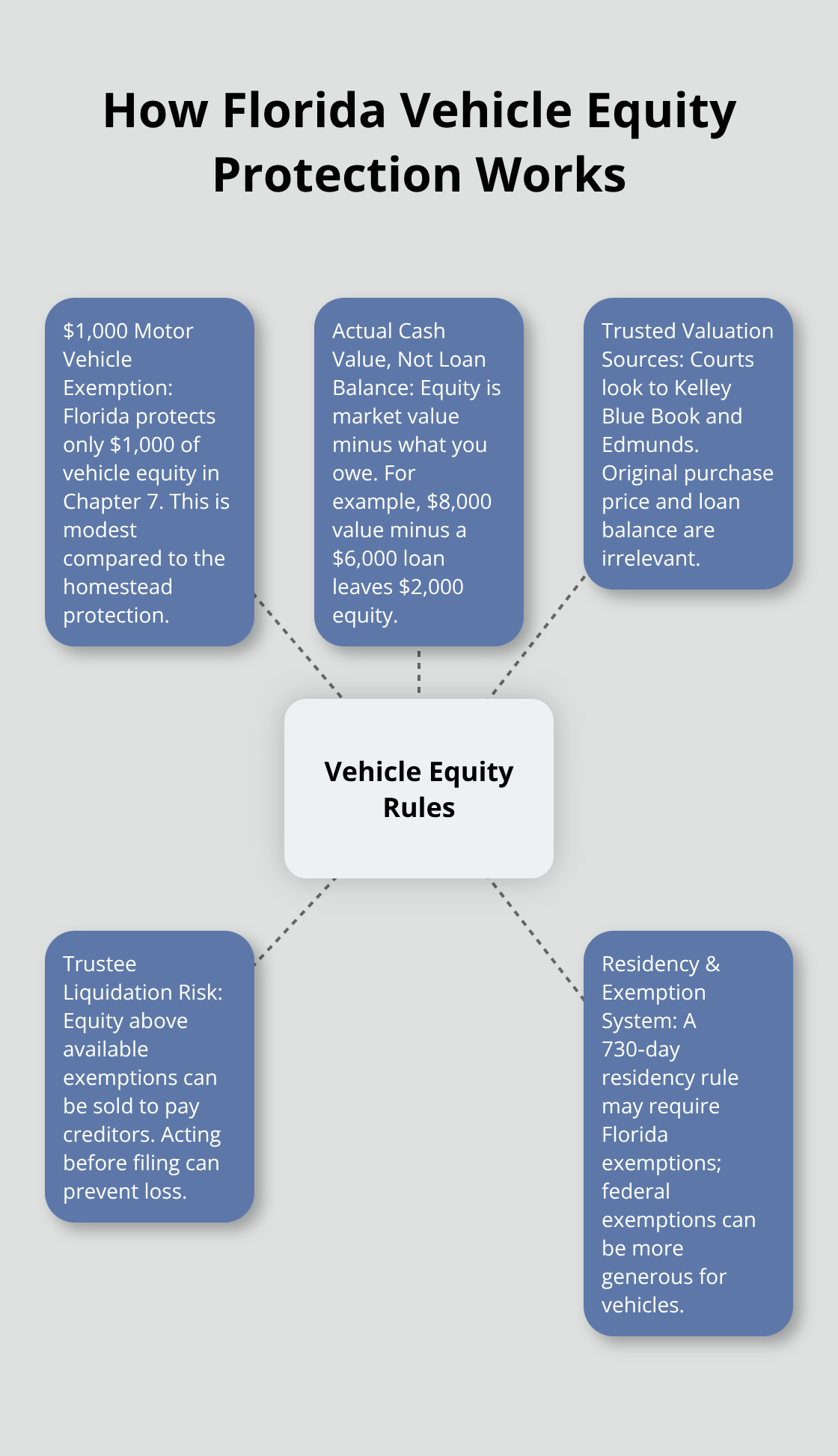
Your residency status determines whether Florida’s $1,000 exemption applies at all. If you’ve lived in Florida for at least 730 days before filing, you must use Florida exemptions. However, if you haven’t met this residency requirement, you may qualify for federal exemptions instead, which protect $4,450 in vehicle equity-a substantially better outcome. Joint ownership complicates these calculations because each owner’s exemption applies separately, potentially doubling protection in community property situations. Timing your Chapter 7 filing becomes critical when you’re close to the 730-day residency threshold, particularly if federal exemptions offer stronger vehicle protection for your specific situation.
With your exemption picture clear, the next step involves filing that exemption claim correctly on your bankruptcy petition to lock in the protection you’ve identified.
1. File Your Exemption Claim Correctly and On Time
Schedule C on your bankruptcy petition serves as your legal declaration of which assets you protect from the trustee. This single document determines whether you keep your car or lose it. Florida law requires you to list the vehicle’s actual cash value from Kelley Blue Book or Edmunds, not your loan balance or original purchase price. Many filers undervalue their vehicles to appear safer, but this strategy backfires when the trustee discovers the discrepancy and challenges the exemption claim. Courts reject exemptions based on inaccurate valuations, leaving your vehicle unprotected regardless of how legitimate your claim should have been.
Documentation proves your exemption claim withstands court scrutiny and prevents the trustee from attacking it. Gather a current Kelley Blue Book or Edmunds valuation report showing your vehicle’s condition and market value before you file. Include maintenance records, accident history, and mileage details that support the valuation you report on Schedule C. The U.S. Bankruptcy Court for the Southern District of Florida expects filers to provide evidence within days of filing if challenged.
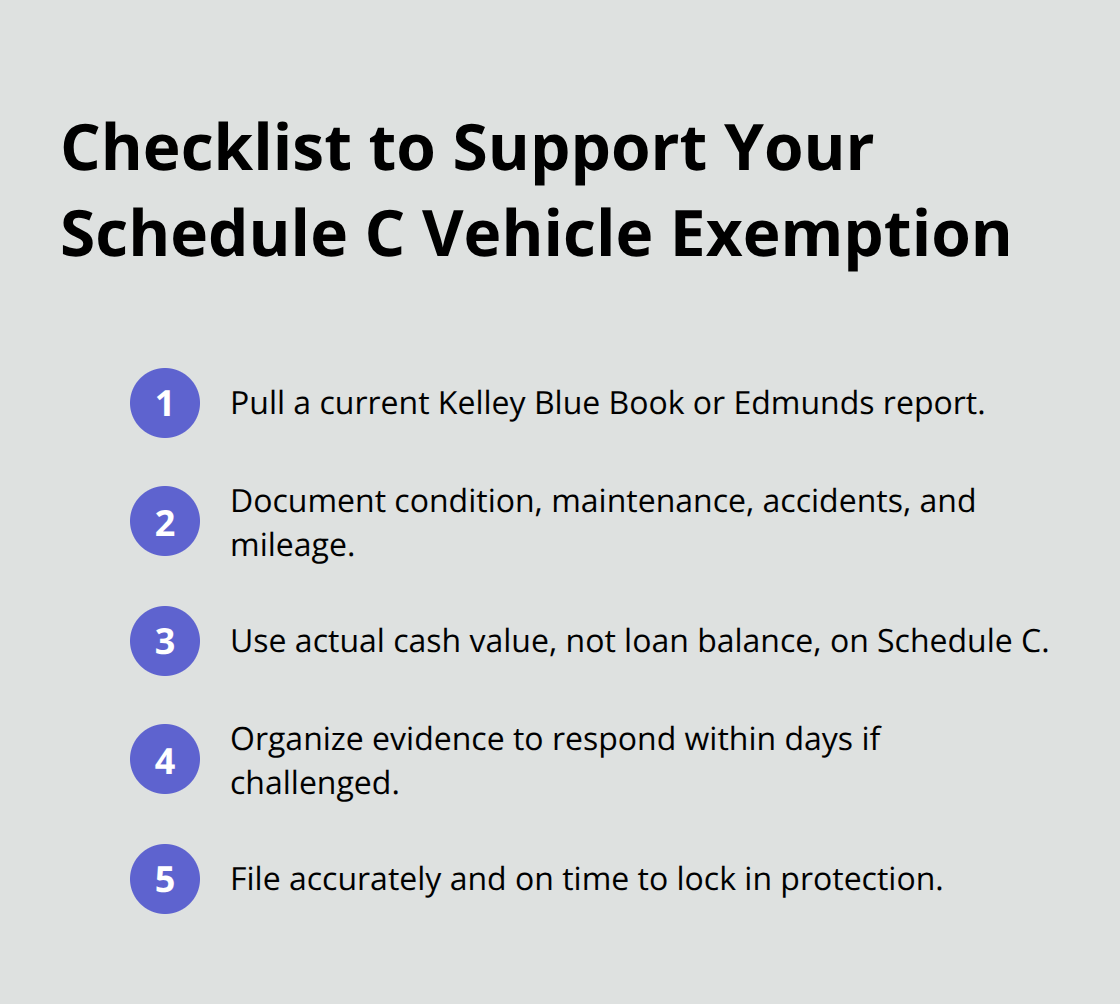
Waiting until the trustee questions your numbers puts you in a defensive position with less time to respond.
Accurate valuations and solid documentation form the foundation of vehicle protection, but they only work if you file them on time and with precision. The next step involves a different strategy: reducing your vehicle’s equity below the exemption threshold before the trustee can claim it.
2. Reduce Your Vehicle’s Equity Below the Exemption Threshold
The most aggressive strategy to protect your car involves lowering its equity before filing Chapter 7. If your vehicle has $3,000 in equity and Florida’s exemption covers only $1,000, paying down that extra $2,000 in other secured debts shifts your financial picture dramatically. Equity equals the car’s actual cash value minus what you owe on it, so reducing what you owe directly reduces what the trustee can claim. Many filers focus on unsecured debts like credit cards and medical bills, overlooking that paying down a second mortgage, personal loan, or furniture financing can free up equity protection for your vehicle. The timing of when you file matters enormously because the trustee calculates equity based on valuations at your filing date.
Strategic filing windows exist within the means test calculations that govern Chapter 7 eligibility, and understanding these windows lets you control when your financial snapshot gets locked in. If your vehicle’s value fluctuates seasonally or you expect it to depreciate, filing during a month when values dip on Kelley Blue Book or Edmunds strengthens your position. Some filers wait until after major vehicle repairs are completed and documented to show legitimate value reduction, while others file immediately after market shifts that lower comparable vehicle prices in their area. The key involves gathering current valuation reports from multiple sources before filing so you understand exactly where your equity stands and whether waiting weeks or months for depreciation makes financial sense for your situation. This preparation positions you to negotiate redemption terms with your lender from a position of strength.
3. Negotiate a Redemption Agreement With Your Lender
Redemption under Section 722 of the Bankruptcy Code gives you a powerful option that many Chapter 7 filers overlook: paying your lender the vehicle’s current fair market value instead of the full loan balance to keep the car. This strategy works when you’re underwater on your loan, meaning you owe more than the vehicle is worth. If your car is valued at $6,000 on Kelley Blue Book but you owe $9,000, redemption lets you pay only $6,000 to own the vehicle free and clear while the remaining $3,000 debt gets discharged. The lender receives the car’s actual value, you eliminate the excess debt, and you keep reliable transportation without ongoing loan obligations. However, redemption requires upfront cash or secured financing, which presents the real challenge during bankruptcy when liquid funds are scarce.
Finding redemption financing demands creativity because traditional lenders won’t fund redemptions during active bankruptcy cases. Credit unions sometimes offer redemption loans to members with established accounts, particularly if you’ve maintained good standing during your filing. Family loans or personal financing from friends or relatives represent the most realistic path forward, as they avoid the credit complications of traditional lending during bankruptcy. The court approval process for redemption moves quickly once you and your lender agree on terms-you file a redemption agreement with the court, and assuming no objections from the trustee, the transaction closes within 30 to 60 days. The timeline matters significantly because redemption must complete before your Chapter 7 discharge (typically 4 to 6 months from filing), so securing financing early prevents last-minute complications that could force you to surrender the vehicle instead.
If redemption financing proves impossible, reaffirming your auto loan offers a different path to keep your vehicle while maintaining the payment structure your lender prefers.
4. Reaffirm Your Auto Loan to Keep Making Payments
Reaffirmation means you agree to keep paying your car loan after your Chapter 7 discharge, and your lender agrees not to repossess the vehicle as long as payments arrive on time. This differs fundamentally from ride-through, where you simply continue making payments without any formal court agreement-ride-through leaves you vulnerable because the lender can repossess without notice if they choose to enforce the debt post-discharge. The U.S. Bankruptcy Court for the Southern District of Florida requires reaffirmation agreements to be filed on official forms and signed by you, your lender, and your attorney before your discharge becomes final. Most reaffirmation cases in the Southern District proceed without a hearing if you have legal representation and your income clearly covers the monthly payment, but the court will schedule a hearing if your documented expenses exceed your income or if you represent yourself. The filing deadline matters significantly-reaffirmation must occur before your discharge, typically 4 to 6 months after filing, so delaying negotiations with your lender creates unnecessary pressure and risk.
Reaffirmation carries real consequences that many filers underestimate before signing. If you reaffirm and later lose your job or face financial hardship, you cannot discharge the reaffirmed debt in a future bankruptcy for seven years, leaving you personally liable for any shortfall if the lender repossesses and sells the vehicle. For example, if you reaffirm a $15,000 loan on a car worth $10,000 and later default, the lender sells the car for $9,500 and pursues you for the $5,500 difference through wage garnishment or bank levies. You should only reaffirm if your post-bankruptcy budget genuinely accommodates the monthly payment without strain, and you should gather recent pay stubs and expense documentation before meeting with your lender to prove your ability to pay. Before you commit to ongoing liability, review your reaffirmation terms carefully to confirm the agreement makes financial sense for your situation.
With reaffirmation terms understood, the wildcard exemption offers another layer of protection for vehicle equity that many filers overlook entirely.
5. Layer Your Exemptions for Maximum Vehicle Protection
Florida’s wildcard exemption provides $4,000 in additional protection that covers your vehicle equity when it exceeds the $1,000 motor vehicle exemption. You can dedicate this wildcard amount entirely to your vehicle if that’s your priority. However, the wildcard disappears if you’ve already claimed Florida’s homestead exemption on your primary residence, which eliminates this option for most Chapter 7 filers in Florida. Don’t assume you can stack protections without understanding your specific exemption status first. If you haven’t claimed homestead protection or own no home, the $4,000 wildcard becomes critical for covering vehicle equity that exceeds the $1,000 motor vehicle exemption.
Federal exemptions offer a completely different calculation that sometimes produces better results than Florida’s state exemptions. The federal system protects $4,450 in vehicle equity, which gives you $3,450 more protection than Florida’s $1,000 threshold if you qualify to use federal exemptions instead. You qualify for federal exemptions only if you haven’t been a Florida resident for 730 days before filing, meaning recent relocations to Florida from other states can work in your favor. Combining exemptions requires careful planning because you cannot mix and match between state and federal systems-work with your attorney to calculate which system protects your vehicle better before filing your bankruptcy petition. If your vehicle’s equity falls between $1,000 and $4,450, federal exemptions eliminate the trustee’s ability to liquidate your car entirely, making residency timing a legitimate strategic filing consideration.
When your exemptions cover your vehicle’s equity, you’ve secured one protection layer. The next strategy involves evaluating whether surrendering your vehicle and replacing it after discharge makes better financial sense for your long-term situation.
6. When Surrender Makes Financial Sense
Surrendering your vehicle in Chapter 7 bankruptcy becomes the smarter choice when the car’s value has dropped significantly below what you owe or when monthly payments would strain your post-discharge budget beyond recovery. If you’re underwater by $4,000 or more on a vehicle that’s aging poorly, the trustee likely won’t liquidate it anyway since the costs of sale exceed the equity available. Surrendering eliminates ongoing secured debt obligations, prevents future repossession risk, and removes a monthly payment that could otherwise derail your fresh financial start. Many Chapter 7 filers fixate on keeping their current vehicle without calculating whether that commitment makes sense given their projected income after discharge. The honest assessment involves comparing the vehicle’s remaining useful life against your ability to maintain insurance, registration, and repairs while rebuilding your credit score.
Auto financing becomes available immediately after your Chapter 7 discharge closes, though interest rates will initially reflect your bankruptcy history. Subprime lenders specifically target post-bankruptcy borrowers and typically approve loans within days, with rates ranging from 12% to 29% depending on your credit score and down payment amount. Your credit score will jump 40 to 100 points within the first year after discharge as negative payment history ages and the bankruptcy filing itself becomes less recent, making refinancing into better rates feasible within 12 to 24 months.
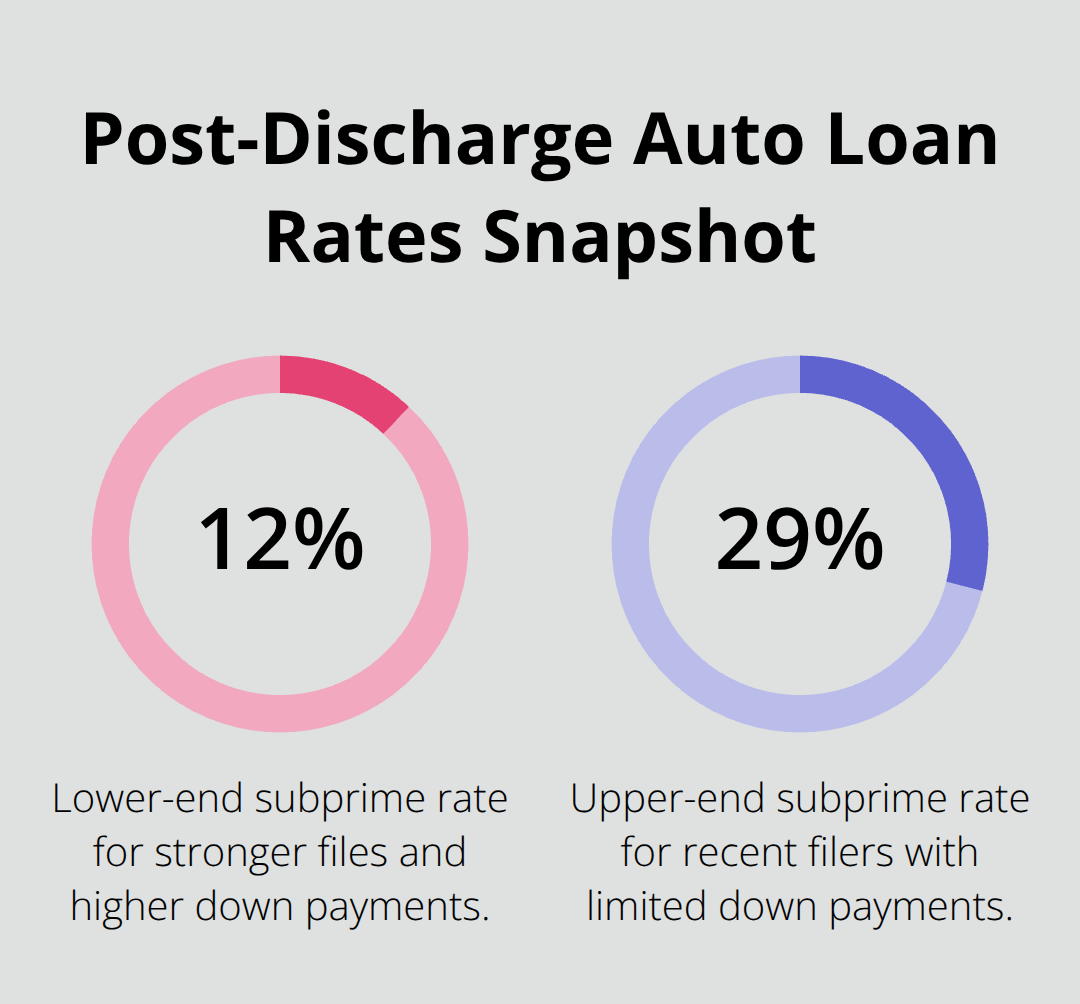
Putting down $1,500 to $3,000 at purchase significantly reduces lender risk and qualifies you for lower rates even with fresh bankruptcy on your credit report. Try purchasing a reliable used vehicle priced between $8,000 and $12,000 rather than chasing new cars, since depreciation hits new vehicles hardest and used cars in this range hold value better while remaining affordable on modest post-bankruptcy income.
Wait 30 to 60 days after discharge before purchasing to allow your credit to stabilize and to ensure your discharge paperwork processes completely through creditor systems. This waiting period positions you to move forward with your vehicle and financial future from a position of strength.
Final Thoughts
Your Schedule C exemption claim must accurately reflect your vehicle’s current market value from Kelley Blue Book or Edmunds before your discharge closes, so verify this documentation immediately after filing. Contact your lender within the first two weeks to discuss whether redemption or reaffirmation works for your situation, since both options require court approval before your case concludes. Maintaining current insurance and vehicle registration throughout your bankruptcy demonstrates to the court that you treat the vehicle as a legitimate asset worth protecting.
Your credit score will improve steadily after discharge, typically gaining 40 to 100 points within the first year as negative payment history ages and positions you to refinance into better interest rates within 12 to 24 months. Avoid taking on additional secured debt immediately after discharge, since your goal involves rebuilding stability rather than accumulating new obligations that could trigger another bankruptcy filing. Long-term vehicle ownership after Chapter 7 requires a sustainable budget that accounts for insurance premiums, maintenance costs, fuel expenses, and your reaffirmed loan payment if you chose that route.
We at Harnage Law, PLLC guide clients through every decision point to help you keep car Chapter 7 protection strategies tailored to your specific situation and Florida residency status. Contact us to discuss how we can help you protect your vehicle while rebuilding your financial foundation. Schedule your consultation with our team today.