
Filing for Chapter 7 bankruptcy in Florida doesn’t mean losing the retirement savings you’ve built over decades. Federal and state laws protect most retirement accounts from creditors, even when you’re going through bankruptcy.
At Harnage Law, PLLC, we help clients understand which retirement funds stay protected and which ones face risk during a bankruptcy filing. The difference between qualified and non-qualified accounts can save or cost you hundreds of thousands of dollars.
Which Retirement Accounts Stay Protected in Florida Chapter 7
Federal law shields most retirement accounts from creditors during Chapter 7 bankruptcy, and Florida law reinforces this protection. The Employee Retirement Income Security Act, enacted in 1974, covers employer-sponsored plans like 401(k)s, 403(b)s, and pension plans. These ERISA-qualified accounts receive unlimited protection in bankruptcy, meaning creditors cannot touch them regardless of how much money sits inside. Florida law goes further by protecting IRAs, SEP-IRAs, and other self-directed retirement accounts up to $1,512,350 across all retirement plans combined as of 2022. The federal government raises this cap every three years, so the current limit is higher. This substantial threshold means most people filing Chapter 7 in Florida keep their entire retirement balance intact.
ERISA Plans Offer the Strongest Shield
Your 401(k) receives protection because it meets ERISA standards, assuming your employer contributed to the plan. Money you contributed yourself also qualifies for protection under ERISA. The trustee appointed to your case cannot liquidate these funds to pay creditors, even if you have significant non-exempt assets elsewhere. Pension plans from your employer function the same way, with full protection during bankruptcy. Request the plan document from your employer’s human resources department and bring it to your attorney if you’re uncertain whether your specific plan qualifies under ERISA. Plans established before 1974 or certain government employee plans may have different rules, making verification important before filing.
IRAs and Self-Directed Accounts Have Limits
Traditional IRAs and Roth IRAs receive protection up to the federal cap of $1,512,350 across all IRA accounts combined. If your IRA balance exceeds this limit, the excess becomes available to the trustee to pay creditors, though this scenario affects very few people filing bankruptcy. Money transferred into an IRA from a 401(k) rollover maintains its protected status. However, contributions you made to an IRA from non-retirement income may face different treatment depending on when you made the contribution.
The Risk of Moving Retirement Funds
Money withdrawn from any retirement account and placed into a regular savings or investment account loses its protected status immediately. This is why moving funds out of retirement accounts before filing creates serious risk, even if you intended to protect them. Understanding which accounts stay protected and which ones become vulnerable allows you to make informed decisions about your financial strategy before filing Chapter 7.
What Happens to Different Types of Retirement Accounts in Chapter 7 in Florida
ERISA Plans Receive Absolute Protection
The moment you file Chapter 7 bankruptcy in Florida, the bankruptcy code treats your retirement accounts based on their structure and origin, not on how much money they contain. ERISA-qualified employer plans like 401(k)s and 403(b)s receive absolute protection because federal law recognizes them as retirement security devices that creditors cannot touch. This protection applies regardless of your account balance, your income level, or how much unsecured debt you discharge. The trustee assigned to your case cannot liquidate these funds to satisfy creditor claims, making ERISA plans the safest retirement vehicles during bankruptcy.
IRAs and Self-Directed Accounts Face Exemption Caps
IRAs follow a different path with the $1,512,350 federal exemption cap as of 2022, which increases every three years to account for inflation. Traditional IRAs, Roth IRAs, SEP-IRAs, and SIMPLE IRAs all fall under this umbrella protection. The critical distinction emerges when you look at money that has left the retirement system entirely. Once funds exit a qualified retirement account and land in a checking account, savings account, or brokerage account, they lose all bankruptcy protection immediately.
Non-Exempt Accounts Create Real Risk
This shift in protection status is not a technicality but a fundamental change in how the bankruptcy code treats your assets. A trustee can seize non-exempt funds sitting in regular accounts, but that same money would have remained completely safe had it stayed in your 401(k) or IRA. Florida’s exemptions for non-retirement savings accounts are limited and unhelpful for most debtors. The state offers no blanket protection for investment accounts or savings above what qualifies as personal property, meaning substantial balances become liquidation targets.
The Damage of Early Withdrawals
Withdrawing $50,000 from your 401(k) to pay off credit cards before filing Chapter 7 turns that protected money into taxable income and creates a non-exempt asset the trustee can seize. You face both the immediate tax hit and the loss of funds that would have remained yours throughout bankruptcy. Recent bankruptcy practice shows that courts scrutinize large transfers into retirement accounts within two years of filing, viewing them as potential asset-hiding schemes. The trustee can challenge these transfers and recover funds if evidence suggests intentional fraud.
The Safest Path Forward
The safest approach is leaving retirement funds exactly where they are and allowing the bankruptcy discharge to eliminate debts without touching the protected accounts. This strategy preserves the full retirement balance while achieving debt relief through legal channels rather than depleting decades of savings. Understanding which accounts stay protected and which ones become vulnerable allows you to make informed decisions about your financial strategy before filing Chapter 7. The next section explores the specific steps you should take before and during your Chapter 7 filing to maximize retirement fund protection.
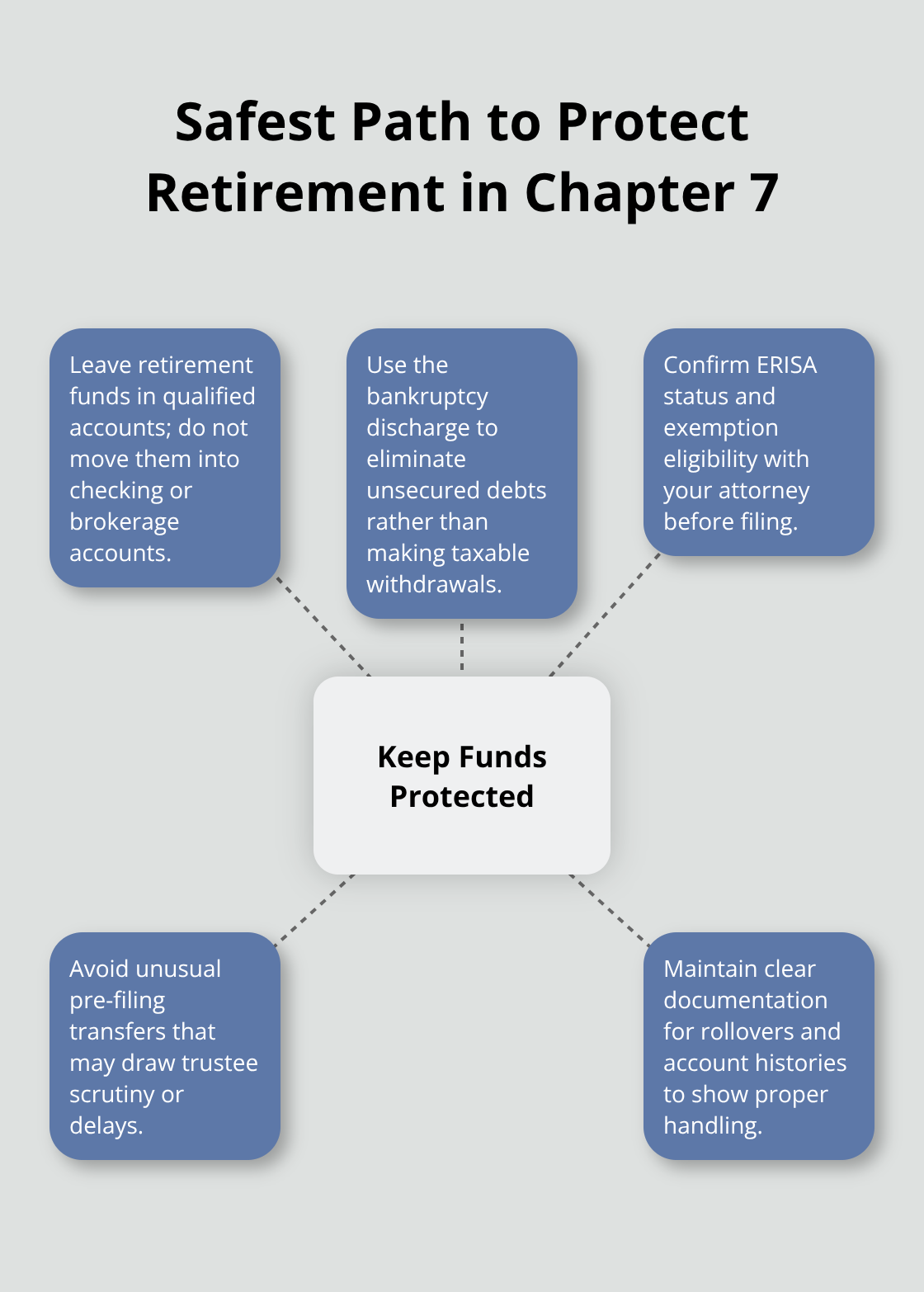
Protecting Your Retirement Accounts Before Filing Chapter 7 in Florida
Consolidate Multiple Retirement Accounts Into One Plan
Consolidating multiple retirement accounts into a single plan before filing Chapter 7 in Florida simplifies documentation and strengthens your protection strategy. If you have old 401(k)s from previous employers scattered across different financial institutions, rolling them into your current employer’s plan or into a traditional IRA creates a cleaner paper trail for the trustee and your attorney. The bankruptcy code protects consolidated accounts the same way it protects fragmented ones, but having everything in one place reduces the chance of miscommunication or missed accounts during the filing process. Avoid the temptation to move money between accounts in the months immediately before filing, as trustees scrutinize transfers made within two years of bankruptcy. The U.S. Trustee’s office has intensified oversight of pre-filing transfers, and unusual account activity can trigger requests for detailed explanations that delay your case. Complete any consolidation at least six months before filing and keep all documentation showing the transfer was a standard rollover, not an attempt to hide assets.
Never Withdraw Funds to Pay Debts
Withdrawing funds from retirement accounts to pay debts before filing Chapter 7 ranks among the most damaging mistakes debtors make in Florida. A $30,000 withdrawal from your 401(k) to settle credit card debt costs you the $30,000 itself, plus federal income tax withholding of 20 percent immediately, plus potential early withdrawal penalties of 10 percent if you’re under 59.5 years old, plus state income tax, and finally the loss of that money to the trustee if it sits in a regular account when you file. That $30,000 protected asset becomes a $21,000 taxable liability and a non-exempt asset the trustee can seize, creating a triple loss. File Chapter 7 instead and let the bankruptcy discharge eliminate the credit card debt entirely while your retirement funds remain untouched and growing.
Document Every Retirement Account You Own
Create a detailed inventory of every retirement account you own, including account numbers, current balances, and the financial institution holding each account. Provide this list to your attorney at least two weeks before your filing date so there’s time to verify ERISA status and confirm exemption eligibility. Your attorney will use this information to complete the bankruptcy schedules accurately and prevent the trustee from later claiming accounts were hidden or omitted from your petition.
Final Thoughts
Filing Chapter 7 bankruptcy in Florida protects your retirement savings through multiple layers of federal and state law. ERISA-qualified plans like 401(k)s and 403(b)s receive unlimited protection, while IRAs stay safe up to $1,512,350 across all accounts combined as of 2022. The key to preserving these funds lies in understanding which accounts remain protected and which ones become vulnerable the moment money leaves the retirement system.
The most critical decision you make happens before your bankruptcy filing. Withdrawing funds to pay debts, moving money between accounts, or consolidating retirement savings in the wrong way can permanently destroy protections that would otherwise keep your nest egg intact. A single $50,000 withdrawal costs you far more than the $50,000 itself when you factor in taxes, penalties, and trustee seizure of non-exempt funds.
We at Harnage Law, PLLC help clients navigate Chapter 7 bankruptcy while protecting their retirement assets and rebuilding their financial future. Contact us today for a consultation to discuss how Chapter 7 can work for your specific situation and preserve the retirement security you’ve worked years to build.
