Chapter 7 bankruptcy offers a fresh financial start, but understanding discharge timing in Florida is essential to your recovery plan. The path from filing to debt elimination follows a specific timeline with predictable milestones.
We at Harnage Law, PLLC help clients navigate this process with clarity about what to expect and when. This guide breaks down the discharge timeline, explains which debts disappear, and shows you how to rebuild after your case closes.
How Long Does Chapter 7 Take in Florida
Pre-Filing Requirements and Initial Steps
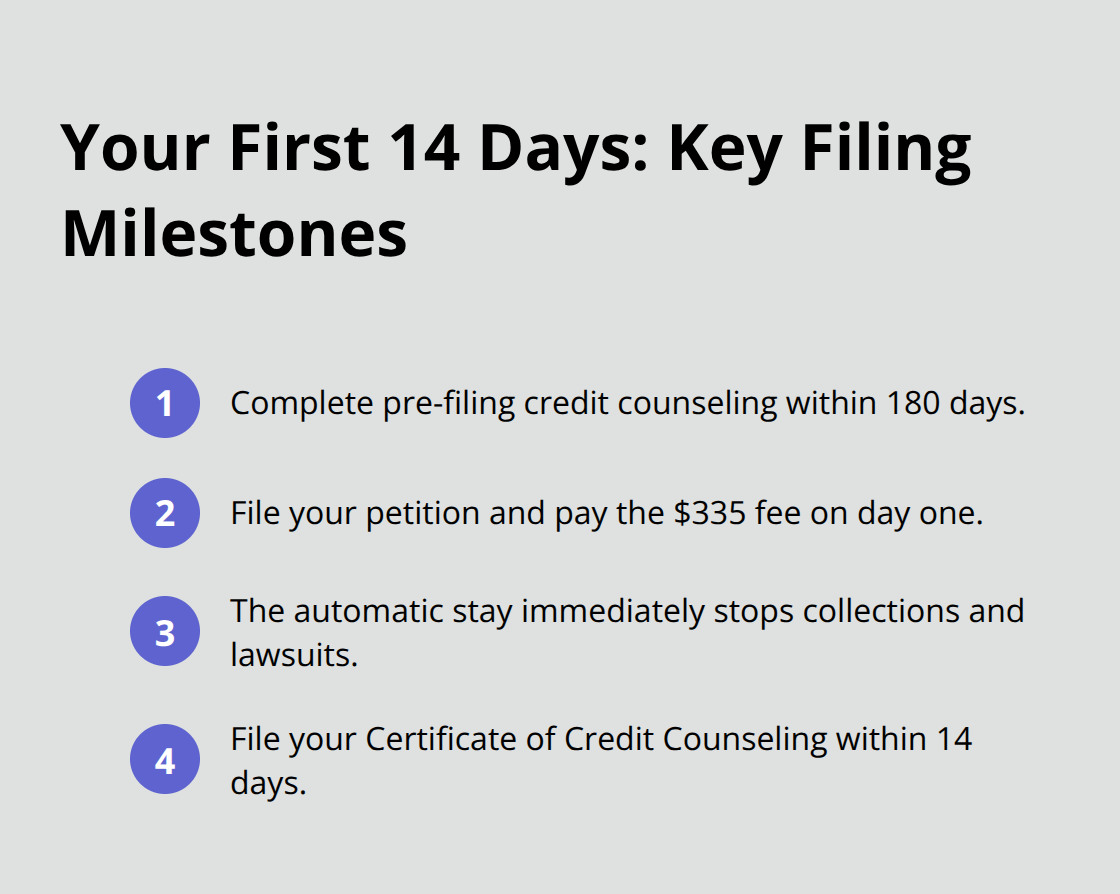
You must complete pre-filing credit counseling within 180 days before filing, which takes about 60 to 90 minutes through an approved agency. On day one, you file your petition and pay the $335 filing fee ($245 filing fee, $75 miscellaneous administrative fee, and $15 trustee surcharge). The automatic stay takes effect immediately, stopping all collection calls, wage garnishments, and lawsuits. Within 14 days, you must file your Certificate of Credit Counseling.
The 341 Meeting and Statement of Intention
Your 341 meeting, formally called the Meeting of Creditors, occurs roughly 21 to 40 days after filing. This is not a court hearing but a meeting with the Chapter 7 Trustee and creditors where you answer questions about your finances under oath. You must bring photo identification and your schedules. Within 30 days of filing or by the 341 meeting date, you file your Statement of Intention, describing whether you’ll surrender or keep secured property like a car or home. Then you have 30 days after the 341 meeting to perform what you stated.
Post-Filing Coursework and Discharge Timeline
Within 60 days after the first 341 meeting date, you complete the post-filing Financial Management Course from an approved provider (available online, in person, or by phone). The discharge order typically arrives 60 to 90 days after your 341 meeting, assuming no creditor or trustee objects. This discharge is permanent and stops collection of qualifying debts. Reaffirmation agreements, if needed to keep secured property, must be completed within 60 days of the 341 meeting.
Timeline Variations and Case Specifics
Most Chapter 7 cases in Florida are no-asset cases, meaning you have no nonexempt property to liquidate, which actually speeds up the process. Missing deadlines causes case dismissal and leaves your debts undischarged, so meeting each deadline is non-negotiable. The federal Bankruptcy Code sections 727 and 523 govern what gets discharged and what doesn’t. Courts in Jacksonville, Ocala, and Daytona Beach follow Southern District of Florida procedures, which remain consistent across the state. Filing for Chapter 7 prevents costly mistakes and ensures you meet every deadline, protecting your fresh start.
Now that you understand the timeline from filing to discharge, the next critical question becomes: which debts actually disappear when your discharge order arrives, and which ones survive the bankruptcy process?
What Gets Eliminated in Your Chapter 7 Discharge
The Power of Your Discharge Order
Your discharge order is a permanent injunction from the federal court that prohibits creditors from collecting debts you owe. The moment it arrives-typically 60 to 90 days after your 341 meeting-those qualifying debts vanish from your legal obligations. This is not a suggestion or temporary relief; it is a binding court order that eliminates your personal liability for discharged debts. The discharge order reaches you, your creditors, the U.S. Trustee, and the Chapter 7 Trustee handling your case, so everyone knows the debts are gone.
Debts That Disappear in Chapter 7
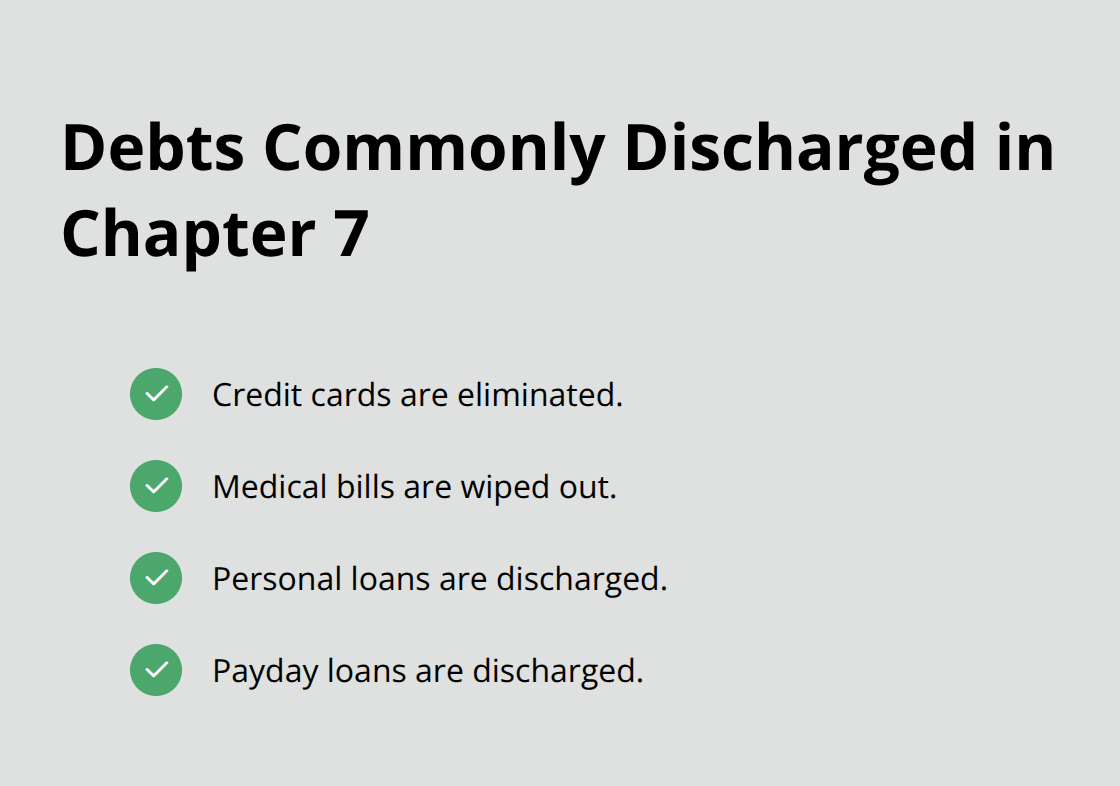
Most unsecured debts vanish under Chapter 7, which means credit cards, medical bills, personal loans, and payday loans are eliminated. If no creditor or trustee objects during the roughly 60-day window after your 341 meeting, the discharge becomes automatic with no hearing required. This is why the vast majority of Chapter 7 cases result in discharge-there is simply nothing to object to in straightforward financial situations.
Debts That Survive Bankruptcy
Certain debts are explicitly non-dischargeable under federal law and will survive your bankruptcy no matter what. Alimony and child support obligations cannot be discharged because family law takes priority over bankruptcy protection. Most federal and state income taxes from the past three years remain your responsibility, though older taxes may qualify for discharge depending on filing dates. Student loans from the U.S. Department of Education and other government-backed educational programs stay with you unless you can prove undue hardship, which courts rarely grant.
Debts Creditors Must Challenge Actively
Debts arising from fraud or misrepresentation (such as loans obtained through false financial statements) are not automatically discharged-creditors must file an adversary proceeding within the deadlines to challenge their discharge. Willful and malicious injury debts, fines and penalties, and overpayments of government benefits like Social Security or unemployment compensation also survive. The critical point is this: if a creditor wants to argue a debt is non-dischargeable, they must file a complaint in the bankruptcy court within 60 days after your 341 meeting or they lose the right to object. Most creditors do not pursue these objections, meaning even some debts that technically could be challenged actually get discharged simply because the creditor fails to act.
Understanding which debts vanish and which ones remain sets the stage for your next critical phase: what happens to your financial life once the discharge order arrives and your case officially closes.
Life After Discharge: Rebuilding on Solid Ground
Your discharge order closes one chapter and opens another. The debts vanish, but your financial life requires deliberate action to move forward successfully. The first 12 months after discharge are critical because this is when you establish patterns that either accelerate your recovery or pull you backward. Fannie Mae data shows that borrowers who file Chapter 7 must wait four years before qualifying for a mortgage, though extenuating circumstances can reduce this to two years. This waiting period exists because lenders view recent bankruptcy filers as higher-risk borrowers, but it does not mean you cannot rebuild credit during this time. In fact, rebuilding starts immediately and happens fastest when you take specific, measurable steps rather than waiting passively for time to pass.
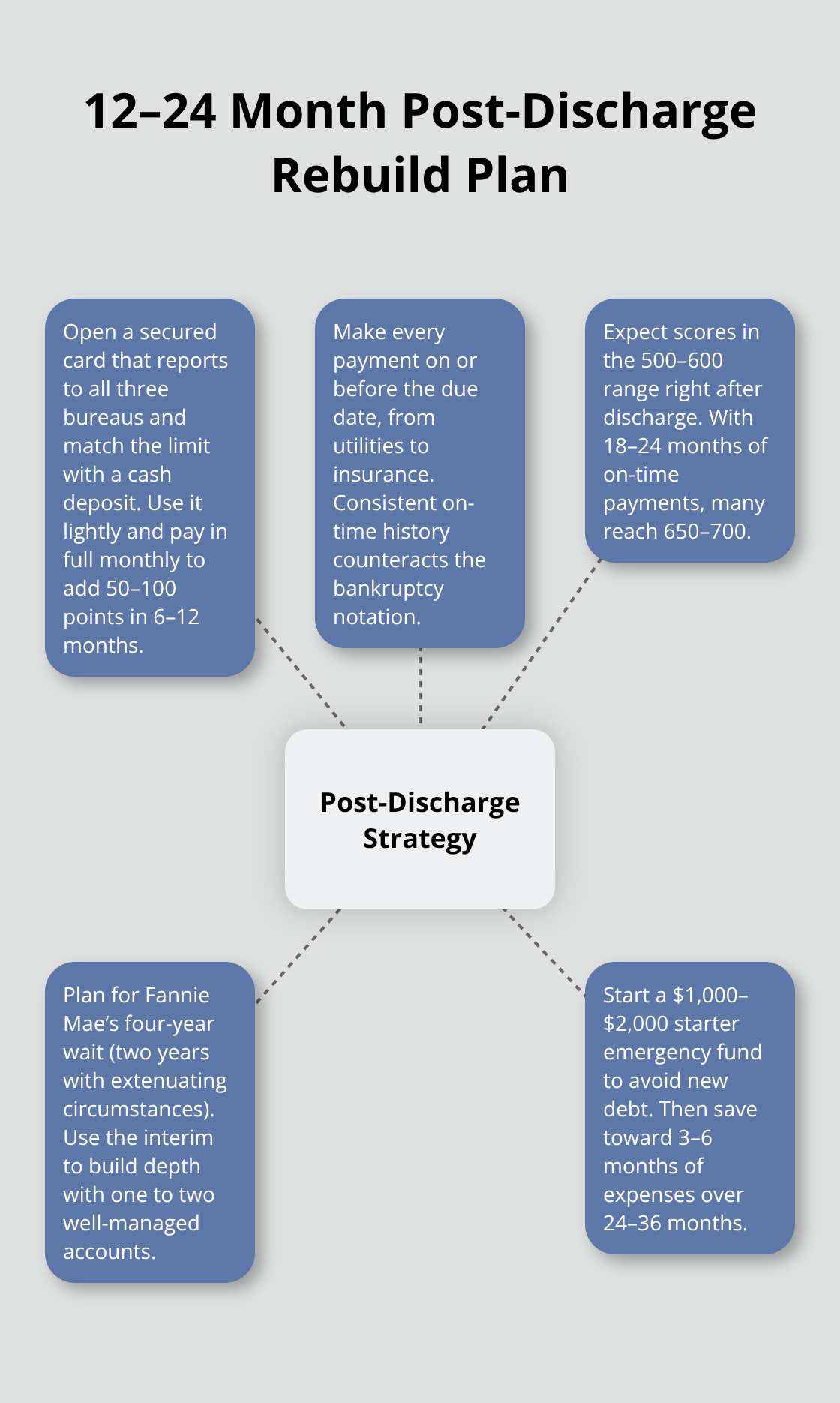
Your credit score will likely fall between 500 and 600 immediately after discharge, which feels devastating but recovers faster than most people expect if you execute a focused strategy.
Secured Credit Cards and Payment Discipline
Secured credit cards serve as your primary tool for the first year after discharge. You apply for a secured card that reports to all three credit bureaus and requires a cash deposit equal to your credit limit, typically between $200 and $2,500. You use it for small, recurring charges like a gas station or grocery store visit, then pay the full balance every month without exception. This demonstrates responsible behavior to lenders and rebuilds your score by 50 to 100 points within six to twelve months. Simultaneously, you must become obsessive about payment deadlines because every on-time payment from this point forward directly counteracts the bankruptcy on your credit report. Utility bills, insurance payments, and any other recurring obligation must be paid on their due date or earlier. Within 18 to 24 months of consistent on-time payments, your score typically reaches 650 to 700, making you eligible for conventional credit products and mortgage pre-qualification.
Mortgage Eligibility and Long-Term Planning
The Fannie Mae guidelines confirm that after three years post-discharge, you can access limited cash-out refinances and principal residence purchases under certain LTV ratios, but reaching that milestone requires flawless payment discipline from month one. You should avoid the temptation to take on new debt quickly or to apply for multiple credit products simultaneously, as each application triggers a hard inquiry that temporarily lowers your score. You focus instead on depth with one or two accounts rather than breadth across many accounts. Your financial management course completion certificate, which you received before discharge, becomes your proof of financial literacy to future lenders, so you keep it accessible and organized with your other important documents. Many lenders specifically ask whether you completed post-bankruptcy counseling, and having this documentation ready strengthens your application.
Building Emergency Savings and Financial Resilience
The psychological shift from debtor to rebuilder happens when you stop viewing your discharge as failure and start viewing it as a reset button that gave you the legal right to start fresh. This mindset directly influences your decisions about spending, saving, and long-term financial planning. Your next priority after stabilizing credit is establishing a cash reserve, beginning with a starter emergency fund of $1,000 to $2,000. This prevents unexpected expenses from forcing you back into debt or credit card reliance. Once you reach this baseline, you shift focus to building three to six months of living expenses in savings, a goal that takes 24 to 36 months for most post-discharge debtors but is absolutely achievable with intentional monthly contributions.
Final Thoughts
Your Chapter 7 discharge in Florida represents a legal reset, not a financial failure. The timeline from filing to discharge typically spans three to four months, with your discharge order arriving 60 to 90 days after your 341 meeting. Understanding discharge timing in Florida helps you plan your financial recovery with realistic expectations rather than uncertainty.
The debts that vanish under your discharge order are permanent-creditors cannot pursue them, wage garnishments stop, and collection calls end. The debts that survive, like child support and recent taxes, require separate planning, but knowing this distinction upfront prevents surprises later. Your financial recovery accelerates when you take action immediately after discharge rather than waiting passively.
Secured credit cards, consistent on-time payments, and building emergency savings form the foundation of your rebuilding strategy. Within 18 to 24 months of disciplined financial behavior, your credit score climbs from the 500s into the 650 to 700 range, positioning you for mortgage qualification within the four-year Fannie Mae waiting period. Contact Harnage Law, PLLC for a consultation and let us help you navigate discharge timing and your complete financial recovery.