Losing your job while carrying debt creates real financial pressure. Filing for Chapter 7 bankruptcy relief in Florida can help you eliminate unsecured debts, but unemployment adds complexity to the process.
At Harnage Law, PLLC, we guide clients through how unemployment benefits interact with bankruptcy law. This guide walks you through what happens to your benefits, your eligibility for discharge, and how to rebuild after filing.
How Unemployment Affects Your Chapter 7 Eligibility in Florida
The Means Test and Your Six-Month Income Average
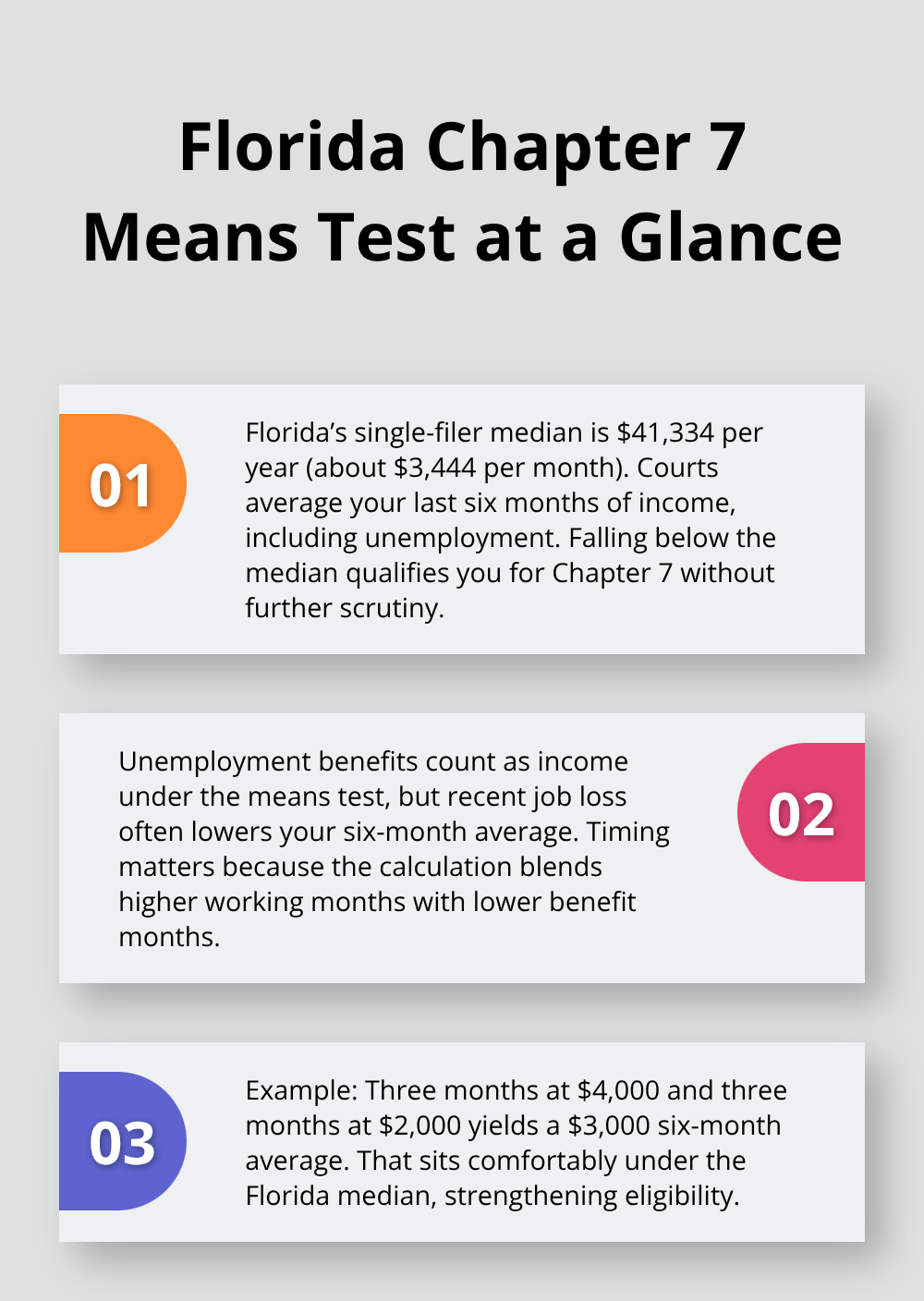
The means test acts as the gatekeeper for Chapter 7 bankruptcy in Florida, and unemployment benefits directly influence whether you pass it. Courts calculate your average monthly income over the six months before filing, then compare that figure to Florida’s median household income. For a single person in Florida, that median sits at $41,334 annually, or roughly $3,444 per month. If your six-month average falls below this threshold, you automatically qualify for Chapter 7 without further scrutiny.
Unemployment benefits count as income under the means test, but here’s the practical advantage: many unemployed filers see their income actually drop below the state median once they stop working. The timing of your job loss matters significantly. If you lost employment within the last six months, your average income calculation includes both your working months and unemployment months, which typically lowers your overall average. A filer who earned $4,000 monthly for three months, then collected $2,000 in unemployment for three months, shows a six-month average of $3,000-comfortably under Florida’s median.
How Courts Apply the Calculation
Courts in the Middle, Northern, and Southern Districts of Florida apply this calculation consistently, meaning the math works in your favor when income has recently declined. If your six-month average lands above the state median, you still have a pathway to Chapter 7 through the second part of the means test. After establishing your income level, the court subtracts necessary living expenses using standards from the IRS and Census Bureau. Rent, utilities, food, transportation, and other essentials reduce your disposable income.
Disposable Income and Chapter 7 Qualification
For most unemployed filers, these expenses consume nearly all remaining income, leaving little or nothing available to repay creditors. If your disposable income over 60 months falls below $7,475, you pass the means test and qualify for Chapter 7. Unemployment actually strengthens your case-living on benefits typically generates minimal disposable income after expenses. The court recognizes that someone earning unemployment cannot realistically fund a Chapter 13 repayment plan, making Chapter 7 the logical choice.
Asset Protection During Unemployment
Florida exemptions protect significant assets during bankruptcy, including your primary residence under the homestead exemption, retirement accounts like 401(k) plans, and unemployment benefits themselves once received. This combination of favorable means-test treatment and strong asset protection makes Chapter 7 the practical option for most unemployed Floridians carrying unsecured debt like credit cards and medical bills. Understanding whether your unemployment benefits continue during the bankruptcy process requires examining how the trustee treats ongoing income sources and what reporting obligations you face as a benefit recipient.
Your Unemployment Benefits During Chapter 7 in Florida
Unemployment benefits continue flowing during your Chapter 7 bankruptcy in Florida. The bankruptcy filing itself does not stop your unemployment payments, and the state continues processing your claim based on your jobless status, not your bankruptcy status. This separation matters for unemployed filers because your income stream remains intact throughout the bankruptcy process, which typically lasts three to four months. However, the trustee assigned to your case views ongoing unemployment income as a financial resource that could theoretically fund living expenses, so transparency about this income becomes non-negotiable.
Disclosing Your Income Sources
When you file your bankruptcy petition, you must disclose all sources of income on your schedules, including unemployment benefits. The trustee uses this information to verify that you genuinely qualify for Chapter 7 under the means test and to assess whether any assets can be liquidated to pay creditors.
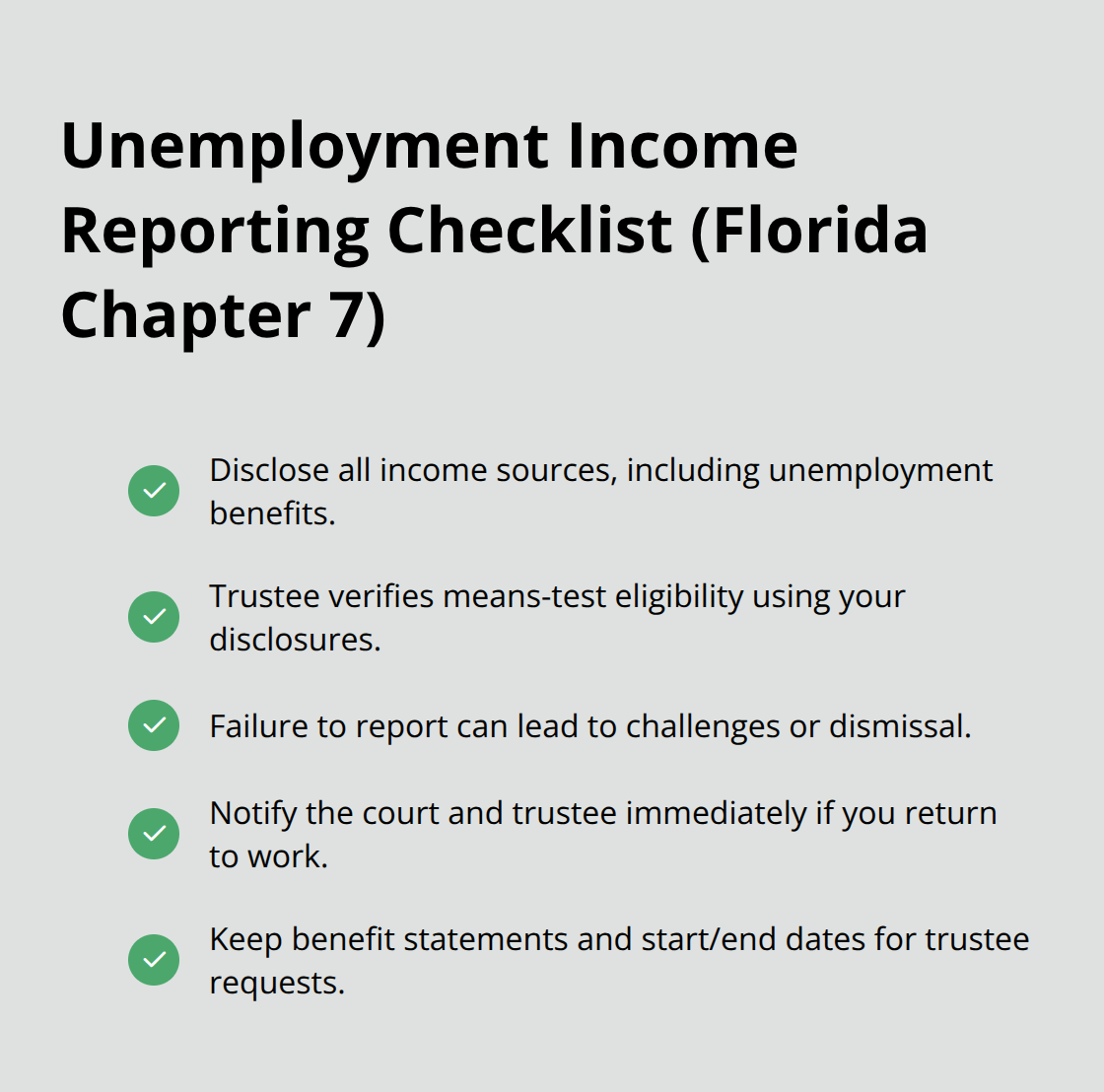
If you fail to report unemployment income, the trustee can challenge your filing or even recommend dismissal, which would leave you without a discharge and still liable for your debts. Courts in Florida’s Middle, Northern, and Southern Districts take income reporting seriously because the means test depends entirely on accurate financial disclosure.
Reporting Changes in Employment Status
Your reporting obligations continue after filing. If you return to employment during the bankruptcy process, you must notify the court and your trustee immediately because a sudden income increase could theoretically affect the discharge, though most cases proceed unaffected if employment begins late in the process. The trustee also reviews your expenses against your reported income to confirm that your disposable income calculation was correct at filing.
Documentation and Trustee Requests
When living on unemployment benefits, your expenses typically consume nearly all of your income, which supports your Chapter 7 eligibility and demonstrates why Chapter 13 would be unworkable for you. Document your unemployment status through your state benefit statements and keep records of when your benefits began and ended, as the trustee may request this documentation during the case. If your unemployment runs out before your discharge is granted, notify your attorney immediately so the trustee understands your financial situation has shifted further downward.
Preparing for Your Initial Consultation
Bring all unemployment documentation to your initial consultation so your attorney can verify your income figures against the means test calculations and ensure your petition is filed accurately from the start. Accurate documentation at this stage prevents complications later and strengthens your case for Chapter 7 discharge. With your unemployment income properly reported and your assets documented, the trustee can move forward with confidence that your case meets all eligibility requirements and that you qualify for the debt relief you need.
Rebuilding Credit and Financial Stability After Chapter 7 in Florida
Restoring Your Credit Score Post-Discharge
Your Chapter 7 discharge eliminates unsecured debts, but your credit score takes an immediate hit. The discharge itself appears on your credit report for ten years, and your score typically drops 130 to 200 points immediately after filing, according to data from the Consumer Financial Protection Bureau. However, this damage is temporary if you act deliberately. Start rebuilding within 30 days of discharge by obtaining a secured credit card, which requires a cash deposit but reports to all three credit bureaus. Deposit $500 to $1,000 and use the card for small purchases you pay off monthly. After 12 months of perfect payments, many issuers convert secured cards to unsecured accounts and return your deposit.
Pull your credit report from all three bureaus through AnnualCreditReport.com and dispute any errors. Unemployment may have caused missed payments before your filing, and those negative marks gradually fade as time passes. After two years of on-time payments post-discharge, your score typically recovers to the 600 to 650 range, making you eligible for conventional financing again. Avoid co-signing loans or taking on new debt too quickly; lenders view post-bankruptcy borrowers as high-risk for five to seven years, so accepting higher interest rates initially is the cost of rebuilding access to credit.
Building Your Budget on Limited Income
A realistic budget becomes non-negotiable when living on unemployment benefits while rebuilding credit. Use the 50/30/20 framework: allocate 50 percent of your income to necessities like housing and food, 30 percent to discretionary spending, and 20 percent to savings and debt repayment. For someone earning $2,000 monthly in unemployment, this means $1,000 for essentials, $600 for discretionary activities, and $400 for emergency savings.
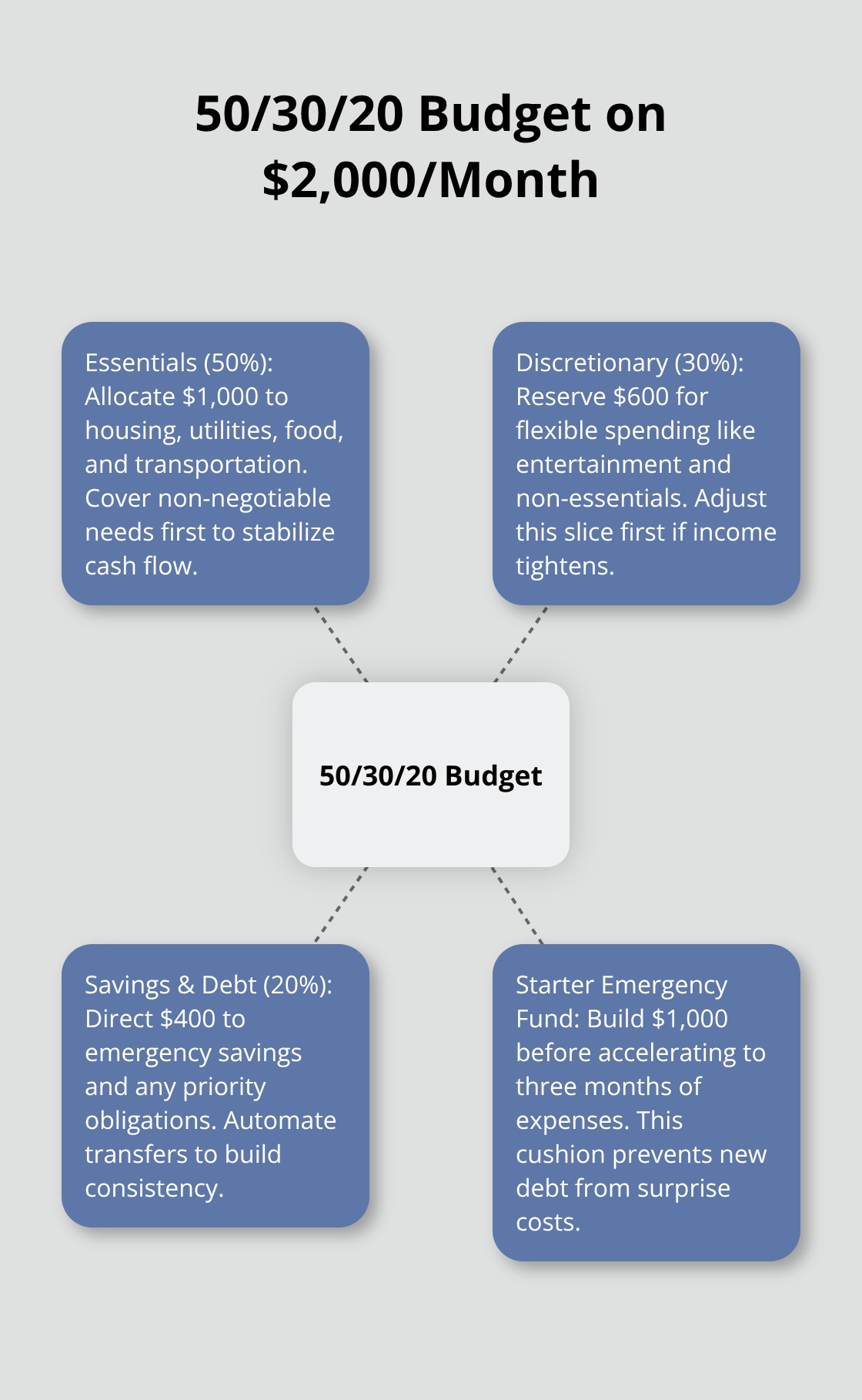
Build your emergency fund to $1,000 first, then accelerate it to three months of expenses before aggressively rebuilding credit. Many unemployed filers prioritize credit card rebuilding over emergency savings, leaving themselves vulnerable to new debt when unexpected expenses arise. Track every dollar using free tools like Mint or YNAB to identify spending leaks.
Planning Around Your Unemployment Timeline
Unemployment benefits typically run 26 weeks in Florida, so calculate exactly when your benefits end and plan your financial strategy around that timeline. If reemployment occurs before benefits exhaust, redirect half of new income to your emergency fund immediately. This approach prevents you from overextending yourself when income suddenly increases.
Accessing Financial Resources and Assistance Programs
The Florida Department of Economic Opportunity offers free financial counseling through approved agencies, and completing their debt education course can lower your bankruptcy filing fee. These resources provide accountability and structure during your transition from unemployment to employment and beyond. Financial counseling helps you identify spending patterns and develop strategies tailored to your situation (income level, debt history, and employment prospects). Approved agencies in your district can connect you with job training programs and employment resources that accelerate your return to work. Taking advantage of these free services strengthens your financial foundation and positions you for sustainable recovery after discharge.
Final Thoughts
Filing for Chapter 7 bankruptcy while unemployed in Florida works in your favor more often than you might expect. Your unemployment benefits strengthen your means test case by lowering your six-month income average, making Chapter 7 the practical path to discharge unsecured debts like credit cards and medical bills. Florida’s strong exemptions protect your primary residence, retirement accounts, and the unemployment benefits themselves, giving you real asset protection during the filing process.
The real work starts after discharge when your credit score recovers faster than most people assume, reaching the 600 to 650 range within two years if you rebuild deliberately through secured credit cards and on-time payments. Your unemployment timeline matters strategically, so calculate when benefits end and plan your financial recovery around that date. If reemployment occurs, redirect half of new income to savings immediately rather than increasing spending, and build an emergency fund before aggressively pursuing credit rebuilding to prevent sliding back into debt.
Contact us for a free consultation to review your income, debts, and assets against Florida’s means test and exemptions and determine whether Chapter 7 offers you genuine file relief. We assess your situation and outline exactly what to expect from filing through discharge. Financial recovery after unemployment is possible, and Chapter 7 bankruptcy can be the tool that makes it happen.