
Filing for Chapter 7 bankruptcy doesn’t mean losing everything you own. Florida law protects many of your assets through exemptions that allow you to keep your home, vehicles, retirement accounts, and other essential property.
At Harnage Law, PLLC, we help clients understand which assets are protected and which ones may be at risk. This guide walks you through Chapter 7 asset exemptions in Florida so you can make informed decisions about your financial future.
What Florida Law Protects When You File Chapter 7
Florida’s bankruptcy exemptions rank among the most generous in the nation, and understanding what you can keep forms the foundation of protecting your assets. Florida has opted out of the federal bankruptcy exemption system, meaning you must use Florida exemptions exclusively if you’ve lived in the state for at least two years before filing. This distinction matters because Florida’s protections often exceed federal alternatives. Your homestead property receives unlimited protection if you’ve owned it for at least 1,215 days before filing, with one critical requirement: the property cannot exceed 0.5 acres in a municipality or 160 acres outside city limits. If you haven’t owned the home for 1,215 days yet, Florida law still protects up to $170,350 of home equity, which substantially exceeds the federal cap of $31,575. Your retirement accounts remain fully exempt under Florida law regardless of balance, including 401(k)s, 403(b)s, IRAs, and other ERISA-qualified plans. The federal bankruptcy exemption for IRAs currently caps at $1,711,975 per person for filings between April 1, 2025 and March 31, 2028, but Florida’s protection is complete, making this a significant advantage for savers. Social Security benefits, veterans benefits, workers’ compensation, and unemployment assistance remain completely protected from creditors, and these protections continue even after deposit into a bank account if you keep them separate from other funds.
Motor Vehicles and Personal Belongings
Your vehicle receives $1,000 of equity protection under Florida law, or $2,000 if you’re married filing jointly. If your car exceeds the exemption amount, the trustee may attempt to liquidate it, but you can combine the vehicle exemption with Florida’s wildcard exemption to increase protection. The wildcard provides $4,000 of additional personal property protection per individual, or $8,000 for married couples filing jointly, and this amount applies toward vehicle equity if you choose not to claim the homestead exemption. Personal property like furniture, clothing, electronics, and household goods receive up to $1,000 of aggregate protection, or $4,000 if you forgo the homestead exemption. Jewelry is limited to $2,125, and tools of the trade for self-employed individuals receive up to $3,175 of protection. These limits preserve the essentials you need to rebuild, not luxury items or investment goods.
What Actually Gets Liquidated in Chapter 7
The trustee focuses on nonexempt assets: second vehicles beyond the exemption cap, investment properties, valuable jewelry exceeding limits, and substantial cash savings not protected by exemptions. Most Chapter 7 cases in Florida end with minimal or no liquidation because clients’ assets fall within exemption limits. When liquidation occurs, the trustee typically sells property within three to six months after your creditors meeting, deducts trustee fees around 25 percent of proceeds plus sale costs, then distributes remaining funds to unsecured creditors. Understanding your state’s exemptions upfront allows you to structure your finances strategically before filing-many clients work with bankruptcy counsel to shift property into protected categories when possible. The next section addresses common misconceptions about asset loss, clarifying what actually happens to your belongings during the Chapter 7 process.
What Property Stays Protected During Chapter 7
Vehicle Equity and Strategic Exemption Stacking
Florida law shields far more of your property than most people realize, and the specifics depend on how you value and document your assets before filing. Your vehicle protection works differently than many assume-the $1,000 exemption for a single vehicle or $2,000 for married couples only covers equity, meaning the amount your car is worth minus what you owe on the loan. If you own a vehicle outright worth $8,000, you lose $7,000 in value unless you combine protections strategically. The wildcard exemption becomes your second tool here: choosing not to claim the homestead exemption grants you $4,000 of wildcard protection per person, which stacks with your vehicle exemption to shield up to $5,000 total in vehicle equity. This matters enormously for people who drive older paid-off cars or trucks. Kelley Blue Book valuations determine your vehicle’s worth, so pull an accurate assessment before filing-trustees challenge inflated values, and low estimates work against you.
Household Goods and Personal Items
Household goods receive $1,000 of aggregate protection, which covers furniture, appliances, clothing, books, and electronics combined, not per item. Most families stay well under this limit because everyday belongings depreciate quickly; a five-year-old couch worth $200 and a television worth $300 consume most of your allowance. The $2,125 jewelry limit eliminates protection for investment-grade pieces or heirlooms valued above that threshold, forcing difficult choices about what matters most. Tools of the trade protection at $3,175 applies only to equipment essential for your occupation-a carpenter’s table saw qualifies, but a second workshop setup does not.
Creating Your Asset Inventory
Documentation transforms these protections from theory into reality. You must create a detailed inventory of every asset you own, listing replacement value rather than original purchase price, because that’s what the trustee uses. For vehicles, use Kelley Blue Book’s trade-in value, not retail. For real estate beyond your homestead, research comparable sales on Zillow or through a local real estate agent to establish current market value. You should photograph valuable items and keep receipts for recent purchases, as trustees may request proof when values seem questionable. The 341 creditors meeting, held roughly 30 to 40 days after filing, is where your trustee examines these valuations-arriving prepared with documentation prevents challenges and demonstrates you’ve handled your case seriously.
What Happens When Assets Exceed Exemptions
Most Chapter 7 cases result in no asset liquidation because clients’ property falls within exemption limits, but this outcome depends entirely on accurate valuation and proper classification before filing. When nonexempt assets do exist, the trustee liquidates them within three to six months after your creditors meeting, deducts trustee fees around 25 percent of proceeds plus sale costs, then distributes remaining funds to unsecured creditors. Understanding how much Chapter 7 bankruptcy costs upfront allows you to structure your finances strategically before filing-many clients work with bankruptcy counsel to shift property into protected categories when possible. The next section addresses common misconceptions about asset loss, clarifying what actually happens to your belongings during the Chapter 7 process and separating fact from fear.
What You Actually Lose in Chapter 7 Bankruptcy
Fear drives most misconceptions about Chapter 7 asset loss, and fear rarely matches reality. Many people believe that filing means losing your home, emptying your bank accounts, and forfeiting retirement savings, when in fact Florida’s exemption laws protect the vast majority of what matters. Understanding what actually happens separates fact from the worst-case scenarios that circulate online.
Your Home Stays Protected
Your home remains with you if you have equity within exemption limits and stay current on mortgage payments. Florida’s unlimited homestead exemption for property owned 1,215 days before filing protects a home worth $500,000 with $200,000 in equity completely-the trustee cannot seize it. The only scenario where you lose your home occurs if the mortgage lender forecloses due to missed payments, which is a separate creditor action unrelated to bankruptcy exemptions. This distinction matters enormously because many people conflate foreclosure with bankruptcy asset loss when they are entirely different processes.
Bank Accounts and Protected Income Sources
Bank accounts face scrutiny, but only nonexempt funds get liquidated. Social Security deposits, veterans benefits, unemployment payments, and workers compensation remain protected even after deposit into checking or savings accounts, provided you keep them separate from other income and document their source. A typical Chapter 7 filer with $15,000 in a savings account loses nothing if those funds came from Social Security or disability benefits; the trustee cannot touch them. The key to preserving these funds lies in maintaining separate accounts or clear records showing which deposits came from protected sources.
Retirement Accounts Remain Completely Exempt
Retirement accounts receive complete protection under Florida law regardless of balance, including 401(k)s, 403(b)s, IRAs, and Roth IRAs. The federal cap of $1,711,975 per person for traditional and Roth IRAs combined applies in Florida, but most people never approach that threshold. Your pension from a previous employer remains fully exempt, as do health savings accounts and education savings accounts. The trustee cannot force you to liquidate retirement funds to pay unsecured creditors because Florida law and federal bankruptcy code classify these accounts as off-limits.
What Actually Gets Liquidated
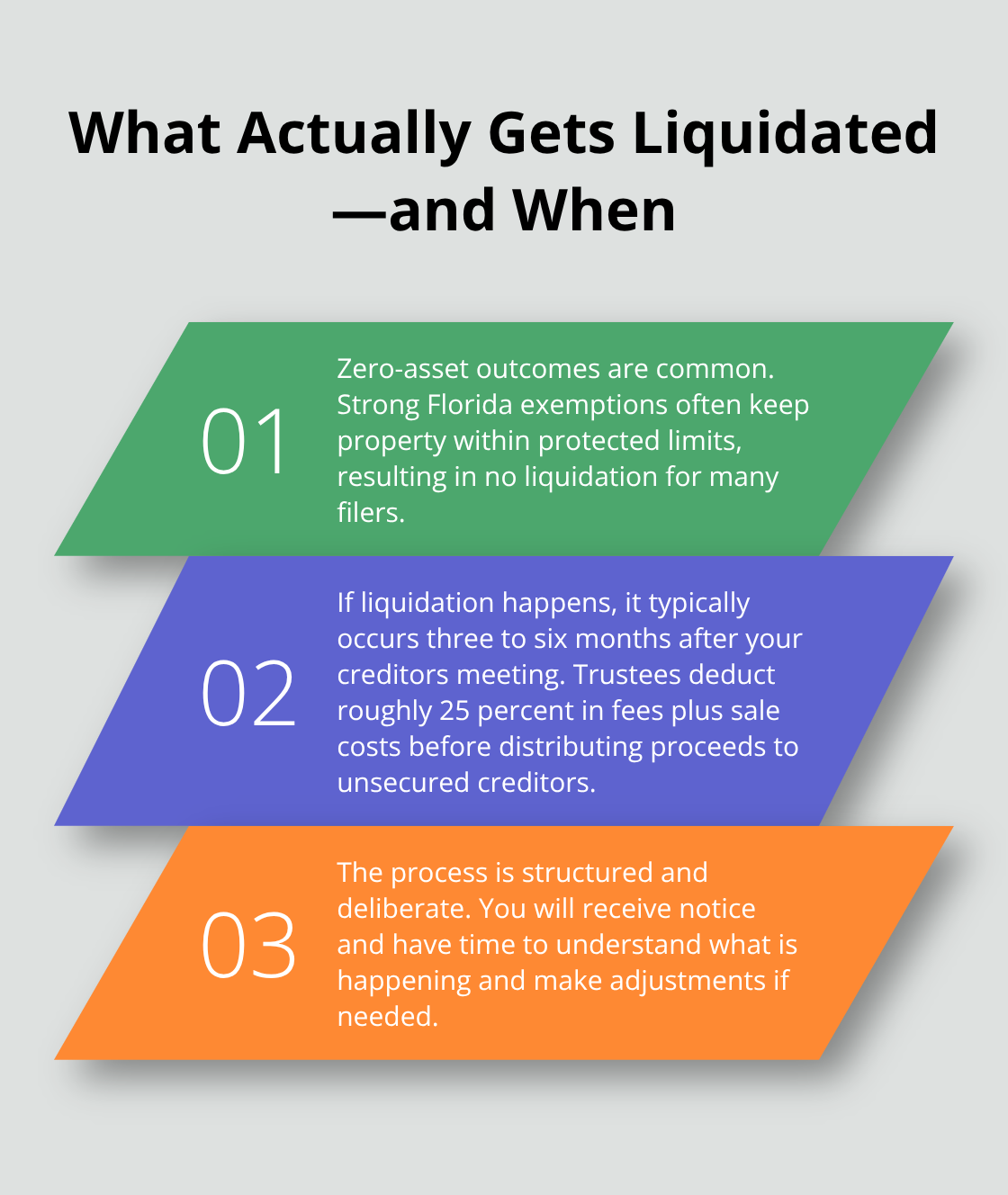
What actually gets liquidated are nonexempt assets like substantial cash savings beyond what exemptions protect, second vehicles, investment real estate, or valuable jewelry exceeding the $2,125 limit. Most Chapter 7 cases result in zero asset liquidation because clients’ property falls squarely within exemption limits. When liquidation does occur, it happens three to six months after your creditors meeting, and the trustee deducts roughly 25 percent in fees plus sale costs before distributing remaining funds to creditors. This process takes time and follows strict procedures, giving you months to understand what’s happening and adjust if needed.
The Reality Behind the Myths
The reality is far less dramatic than the myths suggest. Chapter 7 protects far more property than most people realize, and understanding these protections transforms your approach to filing. Your essential assets-home, vehicles, retirement savings, and household goods-remain protected under Florida law when you file strategically and document your property accurately.
Final Thoughts
Florida’s exemption laws provide substantial protection for your assets during Chapter 7 bankruptcy, allowing you to keep your home, vehicles, retirement accounts, and essential personal property. The key to maximizing this protection lies in understanding which assets fall under exemptions, documenting their current values accurately, and filing with a clear picture of what you own. Most Chapter 7 filers in Florida retain the property that matters most because Chapter 7 asset exemptions are designed to preserve the foundation you need to rebuild financially.
We at Harnage Law, PLLC understand that navigating Chapter 7 bankruptcy feels overwhelming when you’re facing financial hardship. Our firm guides clients through every step of the process, helping you understand which assets are protected and how to structure your filing to maximize those protections. We focus on stopping creditor harassment, preventing wage garnishments, and halting lawsuits so you can move forward without constant pressure from creditors.
Contact Harnage Law, PLLC today to discuss how Chapter 7 asset exemptions can protect your property and help you move toward financial recovery. During your initial consultation, we examine your assets, explain which exemptions apply to your property, and outline exactly what happens during the Chapter 7 process. This personalized approach ensures you understand your rights and the realistic outcomes for your case before committing to filing.