Losing your job doesn’t mean you’re stuck with overwhelming debt. Many people assume bankruptcy timing requires steady income, but that’s simply not true in Florida.
We at Harnage Law, PLLC know that zero income doesn’t disqualify you from Chapter 7 relief. You can still discharge credit cards, medical bills, and personal loans while protecting your assets through Florida exemptions.
Does Zero Income Disqualify You from Chapter 7 in Florida?
The short answer is no. Florida’s Chapter 7 eligibility system doesn’t punish you for having zero income-it actually works in your favor. The median income test, which uses Census Bureau data through the Department of Justice, sets income thresholds by household size. As of April 2024, a single person in Florida needs to earn below $62,973 annually to pass this first hurdle. A two-person household sits at $77,639. With zero income, you automatically fall well below these thresholds, meaning you clear the first test without question. This matters because it moves you straight to the means test, where your actual situation gets evaluated fairly based on your real expenses, not hypothetical income levels.
The Means Test Works Differently Than Most People Think
The means test isn’t designed to trap low-income filers-it measures disposable income after essential expenses. The Department of Justice provides specific allowances for housing, groceries, healthcare, childcare, and other necessities using region-specific standards. Your county in Florida affects these allowable amounts, which means a filer in Miami may have different expense allowances than someone in Jacksonville. With zero income, your disposable income calculation becomes straightforward: zero income minus your legitimate monthly expenses equals zero or negative disposable income. The threshold for passing is simple-if your total disposable income over 60 months falls below $9,075, you qualify for Chapter 7. With no income, you’ll almost certainly hit this mark.
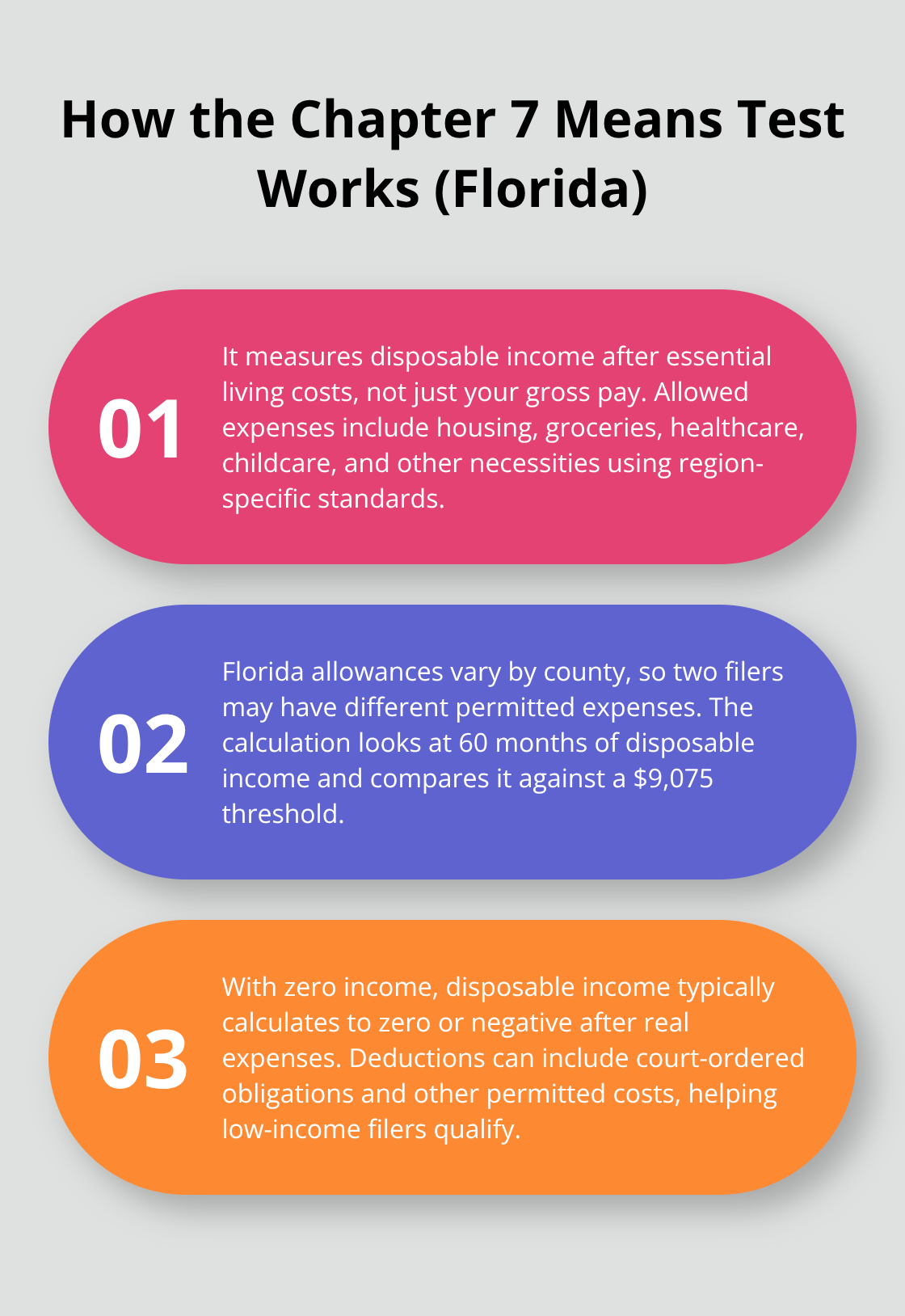
The means test actually protects you by allowing real deductions for court-ordered obligations like child support, employer-required retirement contributions, and caregiver expenses for elderly or disabled family members.
Why Unemployment Doesn’t Lock You Out
Many people delay filing because they think they need to find work first. That’s backwards. Filing while unemployed often strengthens your case because it demonstrates your financial situation clearly. If your income dropped over the last six months, this actually helps your means test calculation. The system looks at your average monthly income over the last six completed months and annualizes it by multiplying by 12. A recent job loss means lower average income, which strengthens your position. You must file copies of your most recent tax return with the trustee, and you’ll attend a 341 meeting under oath, but this meeting focuses on your debts and assets, not your employment status. Social Security payments don’t count toward means test income (according to Department of Justice guidelines), which is another advantage for those receiving benefits. Chapter 7 discharge typically arrives within three to six months, giving you a fresh start before you need to rebuild employment. Understanding these mechanics prepares you for the next phase-identifying which debts you can actually discharge through Chapter 7.
What Debts Vanish When You File Chapter 7 with Zero Income in Florida
Unsecured Debts That Disappear Completely
Chapter 7 eliminates unsecured debts entirely when you file with zero income. Credit card balances, medical bills, and personal loans vanish through discharge, and creditors cannot pursue collection after your case closes. The Department of Justice distinguishes between secured debts (tied to property like homes or cars) and unsecured debts (not backed by collateral). Unsecured debts make up the majority of what Chapter 7 erases for no-income filers.
Medical debt represents a massive burden for unemployed individuals. The average American medical bill sent to collections exceeds $2,500 according to consumer credit data. Credit card companies rarely negotiate with zero-income debtors, but Chapter 7 forces resolution through the trustee system. When you file, a bankruptcy trustee reviews your nonexempt assets and distributes proceeds to creditors. With zero income and minimal assets, most unsecured creditors receive nothing-and that’s the point. They accept the discharge rather than fight an unwinnable case.
Payday Loans and Personal Loans
Personal loans and payday loans fall into the same category and get wiped out completely. Payday loans carry average annual percentage rates of 400 percent according to the Consumer Financial Protection Bureau, making them particularly destructive for unemployed individuals. The debt compounds faster than traditional credit cards because of these predatory rates. Chapter 7 stops the interest accrual immediately upon filing and eliminates the entire balance at discharge.
Tax Debts and Student Loans: Different Rules Apply
Tax debts and student loans require careful attention because they carry different rules than standard unsecured debts. Most federal income tax debts cannot be discharged in Chapter 7 unless they meet strict criteria-the tax must come from a return filed at least three years before filing, the assessment must be at least 240 days old, and you must have owed the tax for at least three years. State tax debts follow similar timelines under Florida law. However, certain tax penalties and interest may be discharged even when the underlying tax debt survives.
Student loans present an even higher barrier to discharge. Courts can only eliminate them if you prove undue hardship using the Brunner test, which requires showing you cannot maintain a minimal standard of living, the hardship will likely persist throughout the repayment period, and you made good-faith efforts to repay. Federal courts rarely grant student loan discharge, making Chapter 7 unsuitable for those whose primary debt is educational.
The Business Debt Exception
If you carry primarily nonconsumer debt like business tax liabilities or IRS debts exceeding 50 percent of your total debt, you may qualify for Chapter 7 without passing the means test under the business debt exception. Since 2016, Assistant U.S. Trustees have scrutinized these claims more carefully, so documentation of your debt composition matters significantly. This distinction between consumer and nonconsumer debt can shift your entire filing strategy, which is why understanding your specific debt profile becomes essential before moving forward with asset protection planning.
What You Actually Keep When You File Chapter 7 in Florida
Florida Exemptions Protect Your Essential Assets
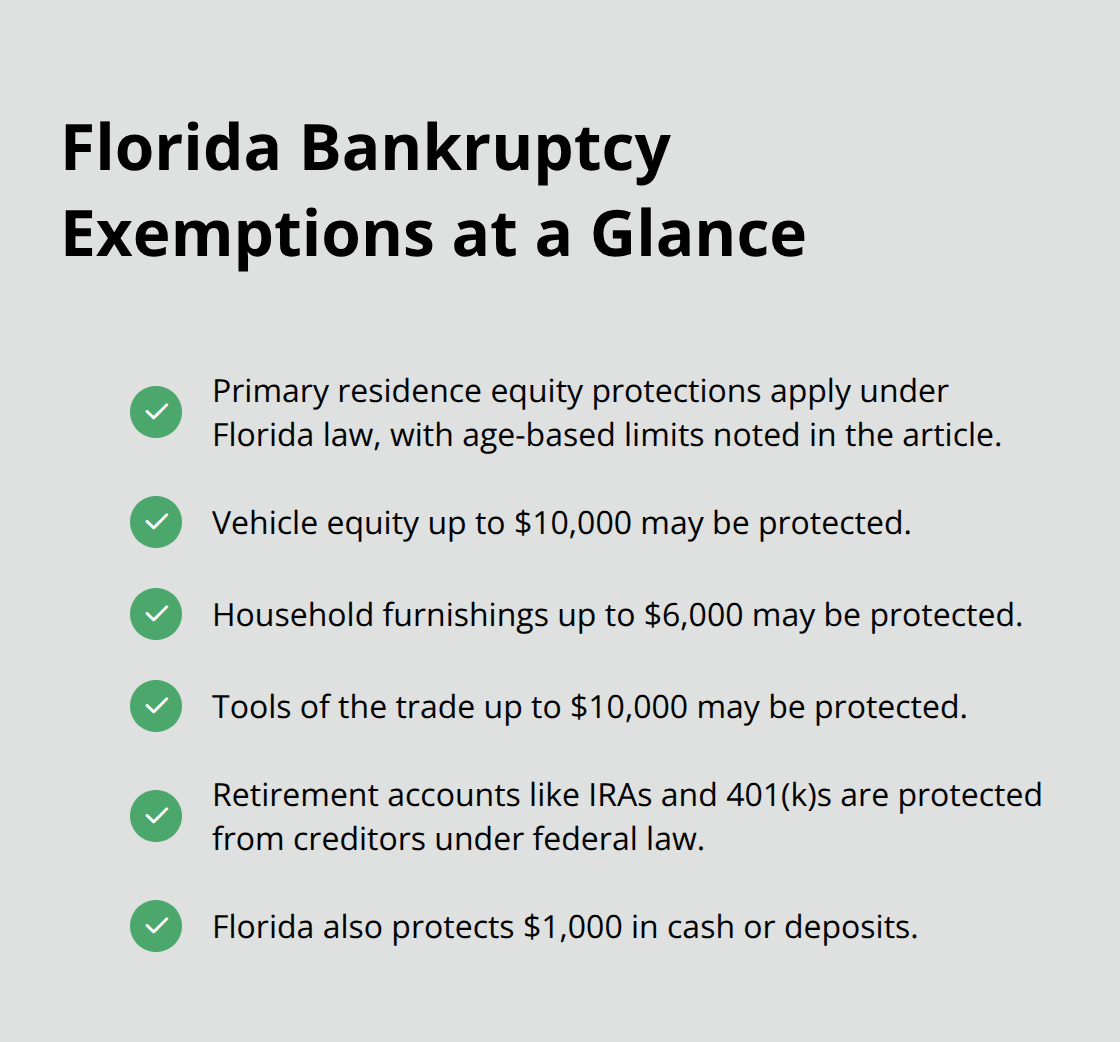
Florida’s bankruptcy exemptions shield far more than most zero-income filers realize, which is why filing during unemployment often makes financial sense rather than waiting for employment that may take months. The state allows you to exempt your primary residence up to $175,000 in equity (or $1,075,000 if you’re over 65), meaning your home stays protected even when you have zero income and unsecured debts pile up. Personal property exemptions in Florida cover your vehicle up to $10,000, household furnishings up to $6,000, and tools of your trade up to $10,000 if self-employment becomes part of your recovery plan. These protections represent concrete amounts that shield real assets, not theoretical concepts.
Your retirement accounts, including IRAs and 401(k)s, remain protected from creditors entirely under federal law, regardless of your current income level. Florida also protects $1,000 in cash or deposits, which provides breathing room after discharge.
The bankruptcy trustee reviews your nonexempt assets and distributes proceeds to creditors, but with zero income and protected assets, most filers retain everything they need to rebuild.
The Automatic Stay Stops Creditor Contact Immediately
Chapter 7 stops wage garnishment immediately through what’s called an automatic stay, which prevents creditors from pursuing collection the moment your filing becomes official. For unemployed individuals, this protection matters less in practice but protects you if you secure employment during the four-to-six month discharge period. Medical debt collectors and credit card companies cannot contact you once you file, which ends the constant harassment that often drives zero-income individuals to consider bankruptcy in the first place.
Florida law prohibits creditors from pursuing collection efforts after discharge, making this relief permanent rather than temporary. Your financial fresh start begins the day the trustee closes your case, typically three to six months after filing.
Credit Recovery Happens Faster Than Expected
Rebuilding credit occurs faster than most people expect-many filers see credit scores improve within twelve months because the bankruptcy eliminates the negative payment history that dragged scores down. Secured debts like mortgages and car loans survive Chapter 7, meaning you can reaffirm these debts to keep the property, or you can surrender the collateral and walk away. This choice gives you control over which assets matter most to your recovery plan.
Final Thoughts on Chapter 7 Filing in Florida
Filing for Chapter 7 with zero income requires three concrete steps before you reach discharge. First, you’ll complete a free consultation to assess your situation and confirm Chapter 7 makes sense for your debt profile. We at Harnage Law, PLLC review your debts, assets, and income to determine whether you qualify and clarify bankruptcy timing to prevent costly mistakes before paperwork gets filed.
Next comes mandatory credit counseling, which you must complete before filing your petition. The Department of Justice approves specific agencies that provide this counseling, and the process takes roughly two hours. You’ll receive a certificate proving completion, which becomes part of your filing documents, and then you attend a 341 meeting under oath with the bankruptcy trustee and your creditors (this meeting focuses on your debts and assets, not your employment status).
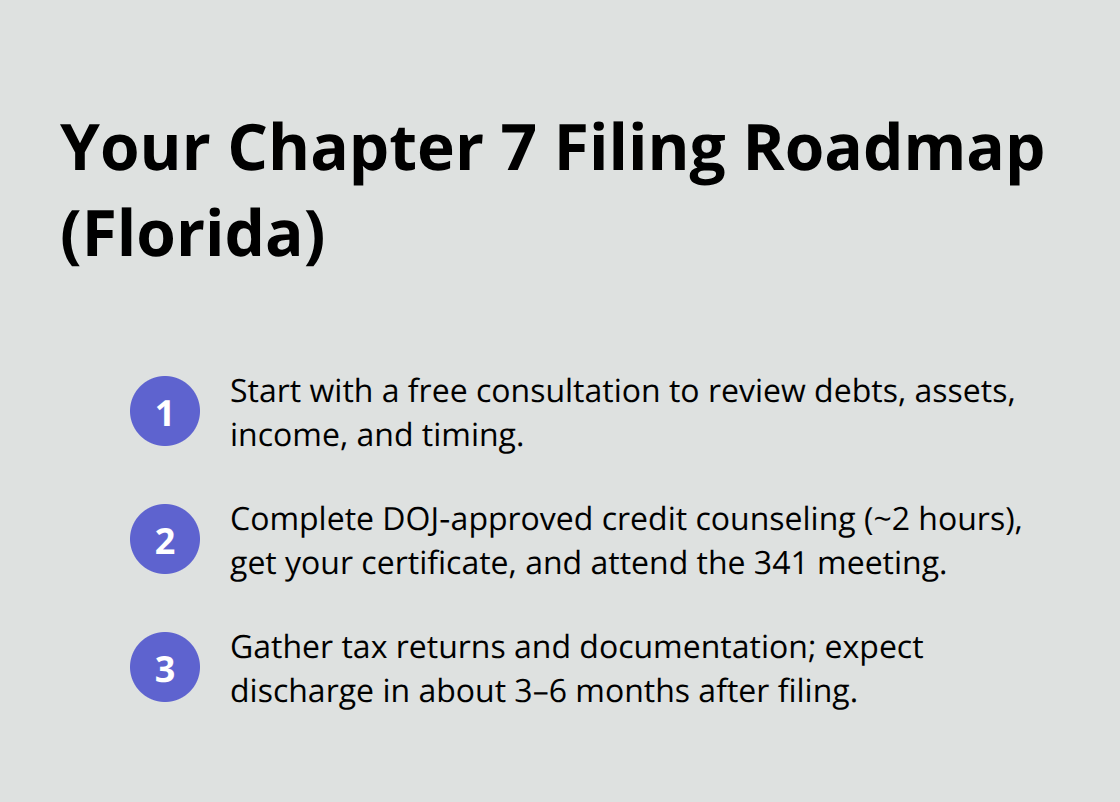
Documentation matters significantly throughout this process. You’ll need copies of your most recent tax return, proof of zero income if applicable, and a detailed list of all debts and assets. After the trustee closes your case, typically within three to six months, your discharge becomes final and creditors cannot pursue collection. Contact us at Harnage Law, PLLC to schedule your free consultation and begin your path toward financial recovery.