
Filing for Chapter 7 bankruptcy in Florida doesn’t mean losing your retirement savings. Federal and state laws protect most pension plans from creditors, but the rules are complex and full of traps.
We at Harnage Law, PLLC help clients understand exactly which retirement accounts stay safe and which ones don’t. This guide breaks down the real protections available to you.
How Pension Protection Works in Chapter 7 Bankruptcy in Florida
ERISA-Qualified Plans Receive Unlimited Federal Protection
ERISA-qualified employer plans receive the strongest federal protection available. These plans include 401(k)s, 403(b)s, defined benefit pensions, profit-sharing plans, and ESOPs. Under 11 U.S.C. § 522(b)(3)(C), these accounts are essentially unlimited in their protection-the trustee cannot touch them regardless of how much money sits inside. This federal shield applies uniformly across all states, including Florida.
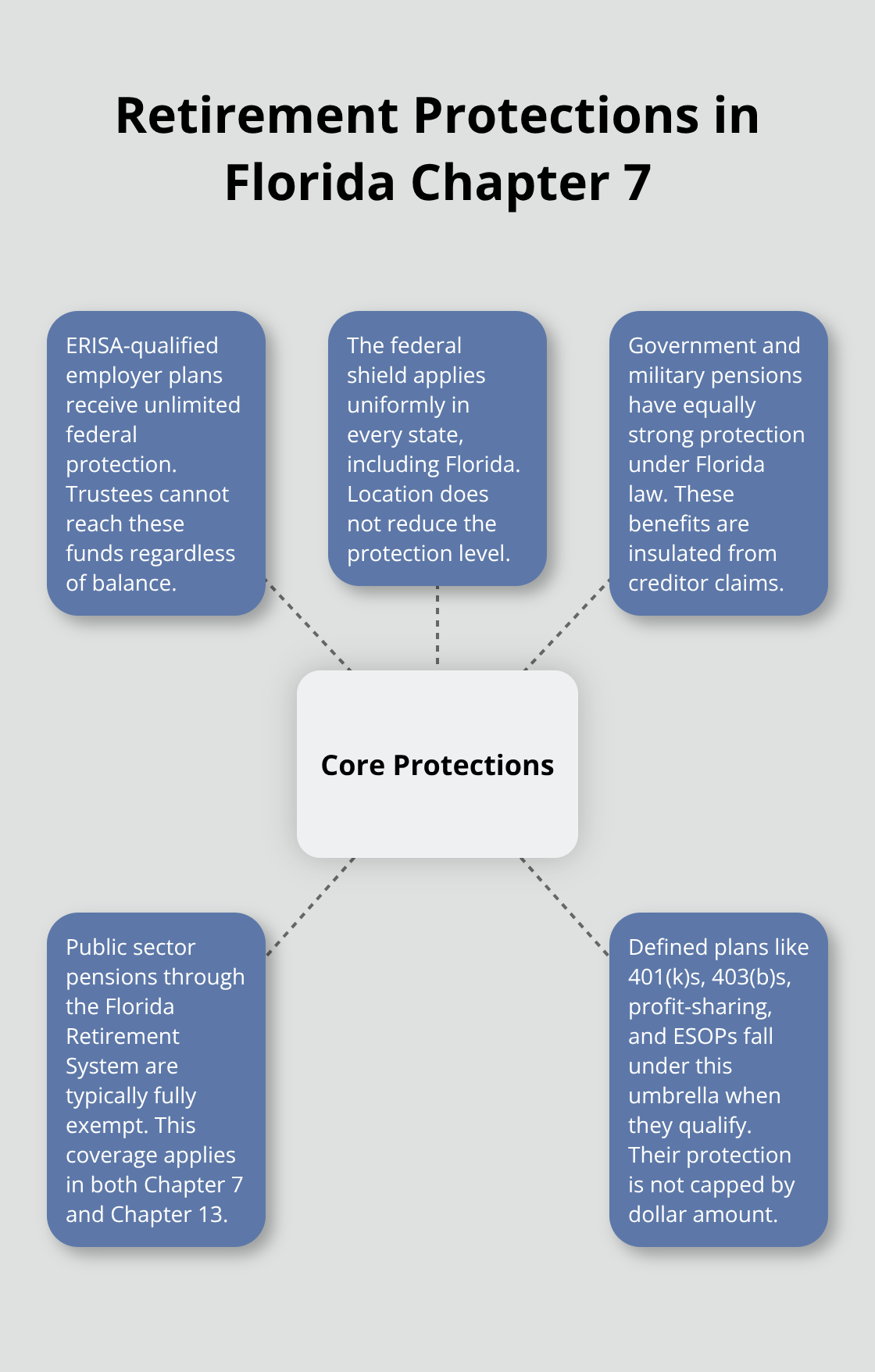
Government and military pensions enjoy equally robust protection under Florida law. Teachers, state employees, firefighters, and municipal police officers typically have their pensions fully exempt from creditor claims. These public sector pensions come through the Florida Retirement System or equivalent state plans and receive comprehensive protection in both Chapter 7 and Chapter 13 cases.
IRAs and Self-Employed Plans Have Different Limits
Traditional IRAs and Roth IRAs receive significant but capped protection in Florida. As of March 31, 2028, the federal exemption limit stands at $1,711,975 per person across all IRA accounts combined. If you hold $2 million in IRAs, only $1,711,975 remains protected, and the excess becomes available to the trustee. Self-employed retirement plans like Solo 401(k)s, SEP-IRAs, and SIMPLE IRAs receive the same unlimited protection as their corporate counterparts because they meet ERISA requirements.
Florida Law Strengthens Retirement Account Protections
Florida Statute § 222.21 strengthens these protections at the state level by exempting qualifying retirement accounts from creditor claims while preserving their tax-exempt status. The critical word is qualifying-not every account labeled retirement receives automatic protection. Employer plans must meet ERISA or IRC requirements to qualify. Non-retirement investment accounts, regular brokerage accounts, and funds commingled with non-protected assets lose their exemption status.
Timing and Documentation Determine What You Keep
Large contributions to retirement accounts within two years before filing can trigger scrutiny from the trustee, who may investigate whether you moved money into retirement accounts specifically to shield it from creditors. Withdrawals made before filing create serious problems. Once funds leave the protected retirement environment, they become non-exempt assets subject to liquidation. Tax refunds tied to retirement withdrawals may also lose protection. Documentation matters enormously. Gather recent statements, plan documents proving your plan qualifies, two to four years of contribution and withdrawal history, and proof of tax-exempt status before filing. Timing your filing correctly ensures rollovers and transitions are completed and well-documented so funds remain protected throughout the bankruptcy process.
The distinction between protected and unprotected retirement funds shapes your entire bankruptcy strategy. Understanding which accounts the trustee can and cannot reach determines whether you move forward with confidence or face unexpected asset loss. The next section addresses the misconceptions that lead many filers to make costly mistakes before they even file their petition.
Common Misconceptions About Pension Protection in Chapter 7 Bankruptcy in Florida
ERISA Plans Don’t Protect Everything You Think They Do
Most people filing Chapter 7 in Florida believe their entire pension is safe, but that confidence often rests on incomplete information. ERISA-qualified plans like 401(k)s and 403(b)s do receive unlimited protection, yet IRAs have a $1,711,975 cap per person as of March 31, 2028. If you hold $2.5 million across multiple IRAs, the trustee can liquidate $788,025 to pay creditors. Public employee pensions through the Florida Retirement System are fully exempt, but only if they truly qualify as public employee pensions.
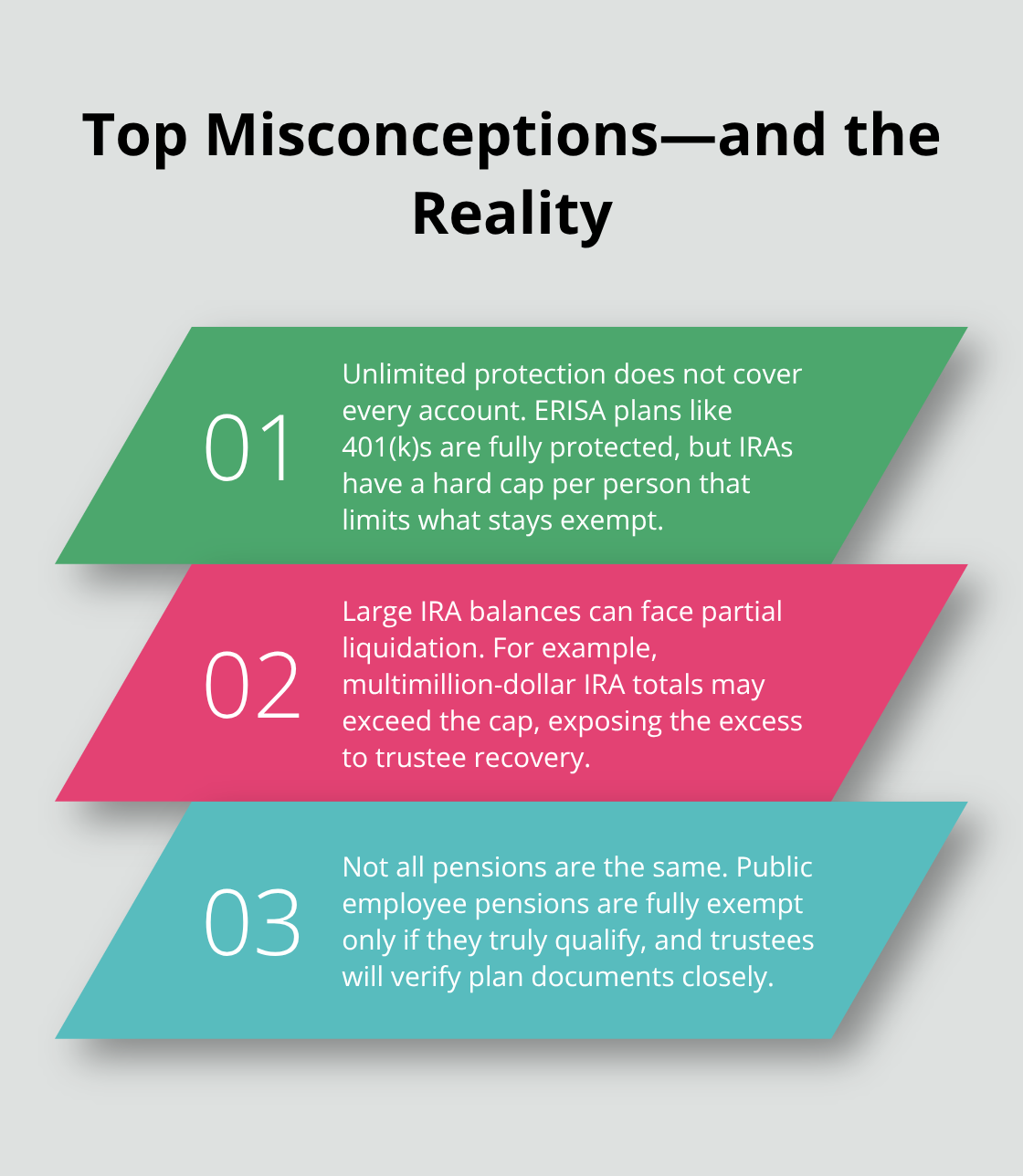
A former government contractor with a private 401(k) isn’t automatically protected the same way a state teacher is. The distinction matters because the trustee will examine your plan documents carefully.
Account Names Mislead Filers About Real Protection
Many people conflate pension plans with regular investment accounts. A brokerage account labeled retirement savings receives zero bankruptcy protection. The account name doesn’t determine the exemption-the plan’s legal structure does. Solo 401(k)s, SEP-IRAs, and SIMPLE IRAs are protected if they meet IRS requirements, but a self-employed person who simply saved money in a regular savings account gets no retirement exemption. This confusion leads filers to overestimate what the trustee cannot reach.
Timing Withdrawals Creates Permanent Asset Loss
Withdrawing funds from a protected retirement account before filing makes those funds non-exempt and vulnerable to liquidation. The trustee can reach money that left the protected environment, even if you intended to use it for living expenses. Large contributions made within two years before filing also trigger trustee scrutiny. If you deposited $500,000 into an IRA in the year before filing, the trustee will investigate whether this was genuine retirement saving or asset hiding.
Documentation Determines Your Defense Against Trustee Claims
Documentation becomes your defense in these situations, which is why gathering statements, plan qualification letters, and contribution history before filing protects you from losing assets to legitimate trustee claims. Clients who arrive at their bankruptcy attorney’s office without this paperwork face significant delays and risk. The trustee needs proof that your plan qualifies under ERISA or IRC requirements. Without it, accounts that should be protected may face liquidation. Proper documentation also shields you from accusations of fraudulent transfers or last-minute asset hiding.
The line between protected and unprotected retirement funds shapes your entire bankruptcy strategy. Understanding which accounts the trustee can and cannot reach determines whether you move forward with confidence or face unexpected asset loss. The next section addresses the practical steps you can take to maximize pension protection during your Chapter 7 filing.
Protecting Your Retirement Before Filing in Florida
The Two-Year Lookback Rule Controls Your Filing Timeline
The timing of your Chapter 7 filing in Florida directly controls how much retirement protection you actually receive. Filing too early or too late can cost you tens of thousands of dollars in unprotected assets. The two-year lookback rule gives the trustee authority to scrutinize any contributions you made to retirement accounts within 24 months before your filing date. If you deposited $300,000 into an IRA 18 months before filing, the trustee can investigate whether this was genuine retirement saving or a deliberate attempt to hide assets from creditors. The investigation itself creates delays, legal fees, and stress even if your contributions were completely legitimate.
Many filers make the critical mistake of rushing to file immediately after a job loss or financial crisis without considering whether waiting a few months would protect significantly more assets. If you received a severance package, inheritance, or settlement within the past 24 months, holding off on filing allows that two-year window to close so the trustee cannot question those contributions. Conversely, if creditors are actively garnishing your wages or threatening foreclosure, waiting may not be realistic. This tension between timing and urgency requires careful analysis with your bankruptcy attorney before you file the petition.
Separate Protected Accounts From Non-Protected Savings
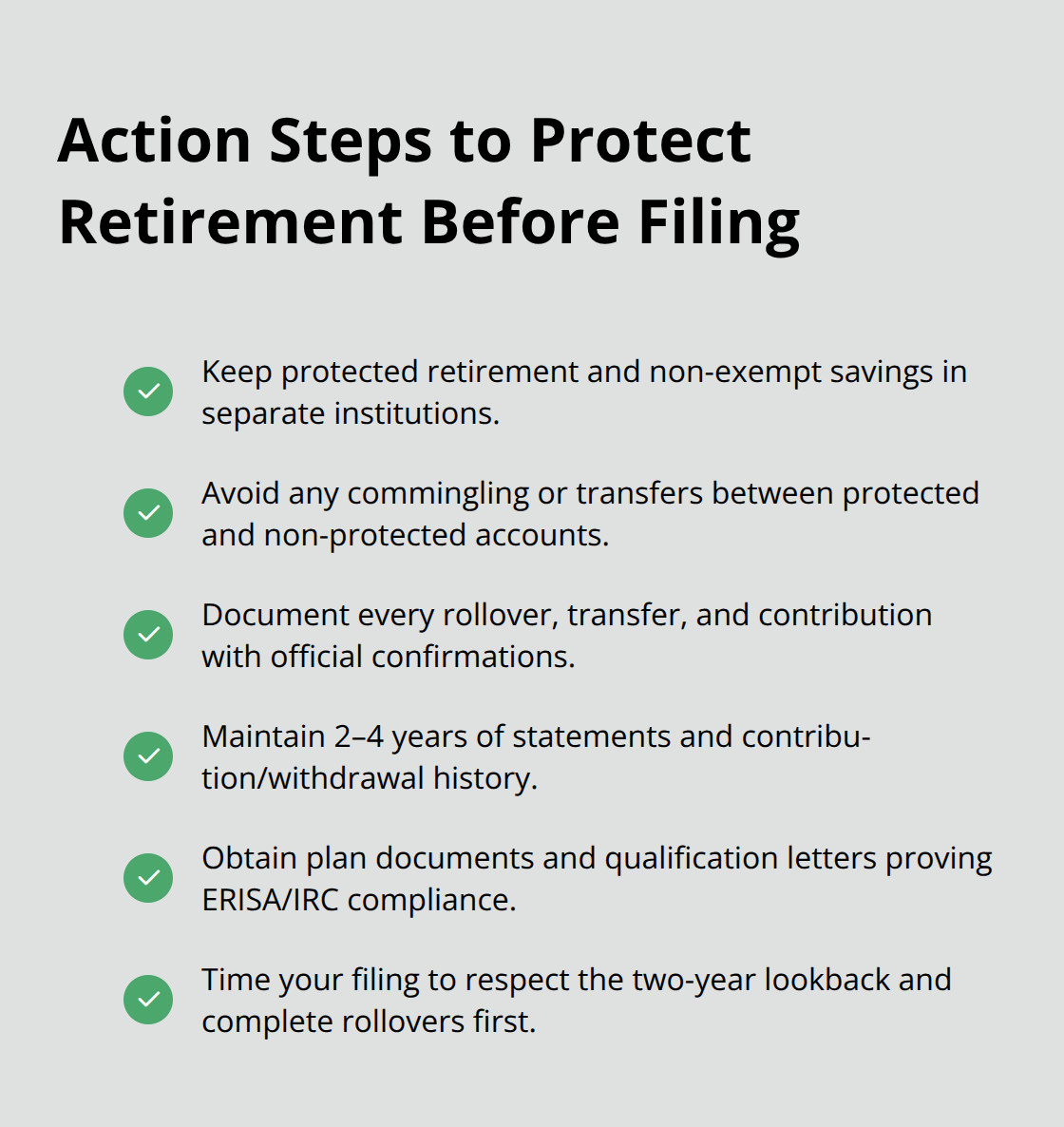
Separating protected retirement accounts from non-protected savings accounts before filing creates a clear paper trail that protects you from trustee challenges. Commingling funds destroys exemption protection entirely. If you have $500,000 in a protected 401(k) and $100,000 in a regular savings account, those accounts must remain completely separate in different financial institutions. Transferring money between them or using one account to pay bills while the other sits idle creates confusion that the trustee will exploit.
Establish separate accounts at different banks for non-exempt savings so the distinction is unmistakable on your bank statements. Document every rollover, transfer, and contribution with written confirmation from your financial institution showing the date, amount, and receiving account.
This documentation becomes your defense if the trustee questions your account structure later.
Gather Complete Account Documentation Before Filing
Bring statements from every retirement account you own dating back at least four years when you meet with your bankruptcy attorney. Your attorney will review these statements to identify which accounts qualify for protection under ERISA or IRC requirements and which ones do not. Some plans that appear to be retirement accounts fail to meet legal qualification standards, meaning the trustee can reach them despite their names.
Your attorney will also identify inherited IRAs, which receive different protection than accounts you personally funded, and non-spouse beneficiary IRAs, which have their own exemption rules. This detailed account-by-account analysis prevents surprises during your bankruptcy case and ensures you claim every available exemption on your filing documents. Harnage Law, PLLC guides clients through this process to protect retirement assets and prevent unexpected losses during Chapter 7 proceedings.
Final Thoughts
Florida’s pension protection laws give you real tools to safeguard retirement savings during Chapter 7 bankruptcy, but only if you understand the rules before you file. ERISA-qualified plans like 401(k)s and 403(b)s receive unlimited federal protection that the trustee cannot touch, while public employee pensions through the Florida Retirement System remain fully exempt. IRAs have a $1,711,975 cap per person as of March 31, 2028, meaning large IRA balances face partial liquidation, and the two-year lookback rule controls your filing timeline.
The most costly mistakes happen before you file. Withdrawing funds from protected accounts, commingling retirement savings with non-protected money, or failing to document your plan’s qualification status can permanently destroy exemptions you thought were safe. Timing your Chapter 7 filing correctly allows the two-year scrutiny window to close on recent contributions, protecting assets that would otherwise be vulnerable.
Contact Harnage Law, PLLC to discuss your specific situation and receive personalized guidance on protecting your retirement assets. Our team reviews your account statements, plan documents, and contribution history to map your exemptions before you file. When you file Chapter 7 in Florida with proper preparation, your retirement savings remain intact while qualifying debts are discharged.