
Losing your car in Chapter 7 bankruptcy isn’t inevitable. Florida law gives you multiple ways to keep your vehicle, and we at Harnage Law, PLLC help residents navigate these options every day.
This guide shows you six concrete strategies to keep your car through Chapter 7, from calculating equity correctly to negotiating with trustees.
Understanding Florida’s Motor Vehicle Exemption Laws
Florida Statute 222.25 protects $5,000 of your vehicle’s equity in Chapter 7 bankruptcy, effective July 1, 2024, following SB 158 signed by Governor DeSantis. This increase from the previous $1,000 limit means more debtors can keep their cars without liquidation. You calculate your vehicle’s equity by taking its current market value according to Kelley Blue Book or NADA guides and subtracting any outstanding loan balance or liens. If your car is worth $12,000 and you owe $8,000, your equity is $4,000-well within the $5,000 exemption, so you keep the vehicle. If your equity exceeds $5,000, you can still protect additional amounts using Florida’s $4,000 wildcard exemption if you don’t claim the homestead exemption.
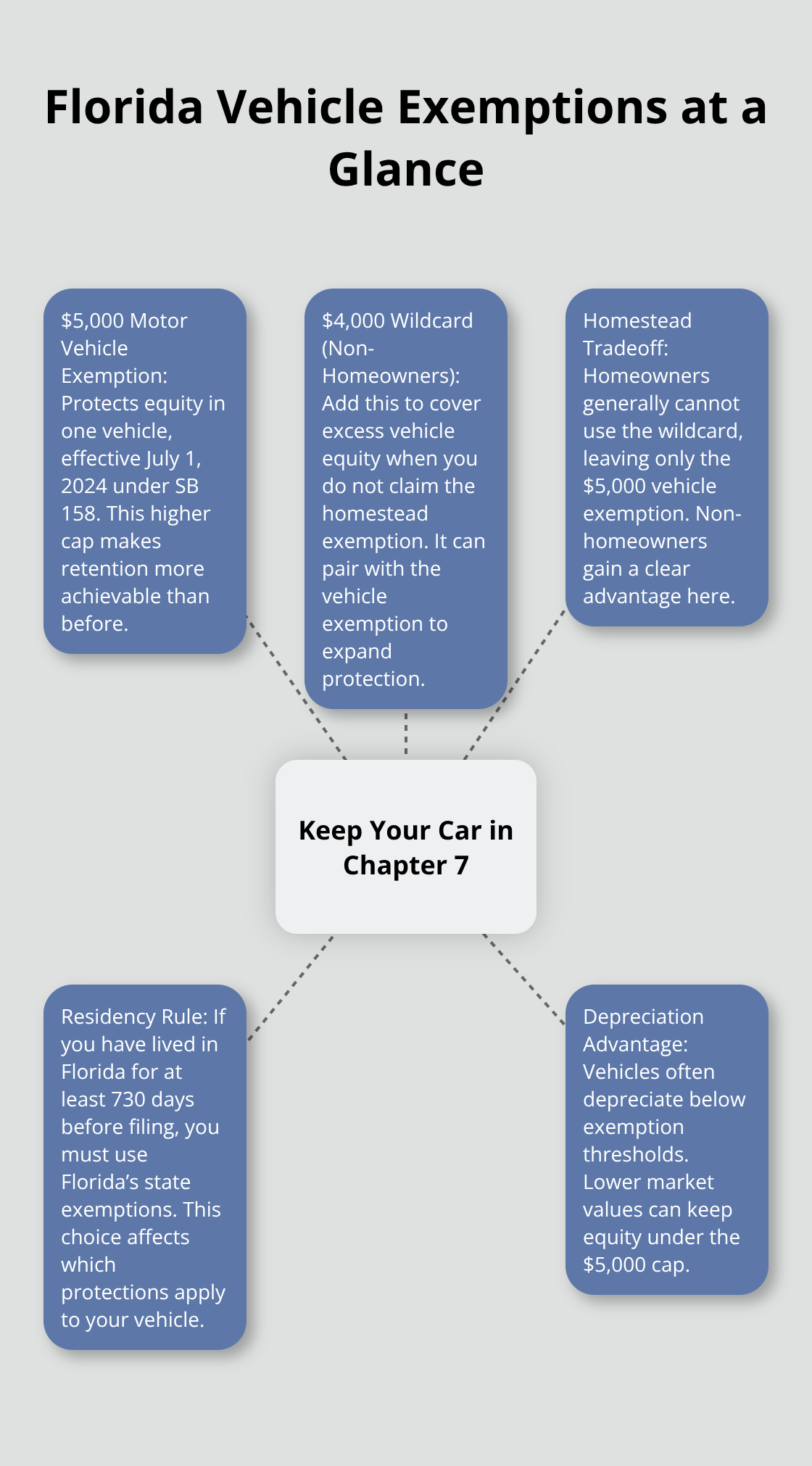
Florida’s unlimited homestead exemption significantly changes your vehicle protection strategy. Homeowners who’ve owned their property for 1,215 days can exempt unlimited equity in their home, which means they cannot use the wildcard exemption to boost vehicle protection. Non-homeowners gain a major advantage: they can combine the $5,000 vehicle exemption with the $4,000 wildcard exemption, protecting up to $9,000 in total assets. If you’ve been a Florida resident for at least 730 days before filing, you must use Florida’s state exemptions rather than federal exemptions. Vehicle depreciation often keeps equity well below the $5,000 threshold, which means most debtors find that Florida’s exemptions provide sufficient protection without needing additional strategies.
Now that you understand how Florida’s exemptions work, the next step involves calculating your specific vehicle’s equity before you file.
Strategy 1: Calculate Your Vehicle’s True Equity Before Filing
Your vehicle’s equity determines whether you keep it in Chapter 7, so getting this number right matters. Start with Kelley Blue Book or NADA Guides to find your car’s current market value-use the trade-in value, not the retail price, since that’s what a trustee would realistically receive if selling your vehicle. A 2018 Honda Civic trading in at $12,500 gives you a solid baseline. Next, subtract every dollar you owe: your loan balance, any liens from creditors, and even outstanding repair bills if they’re secured against the vehicle. If you owe $9,200 on that Civic, your equity is $3,300, which sits comfortably under Florida’s $5,000 exemption.
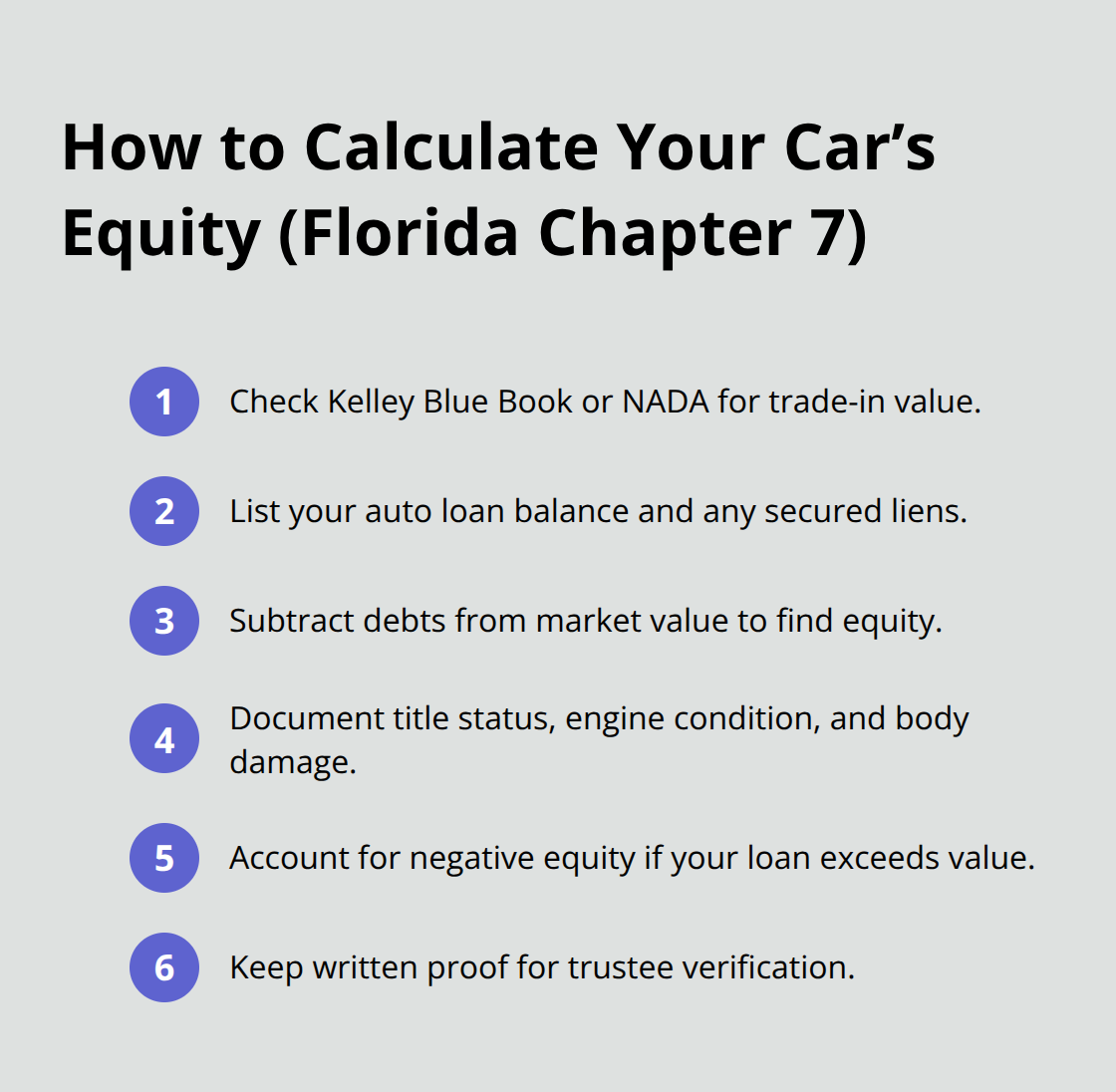
Vehicle condition affects valuation more than you’d expect in bankruptcy court. A car with a clean title, working engine, and minimal body damage supports a higher valuation than one needing repairs. Trustees verify values independently, so inflating your car’s condition wastes time and damages credibility with the court. Negative equity-owing more than your car is worth-works in your favor during Chapter 7. If you financed a vehicle at 8% interest and drove it off the lot, depreciation may have already pushed you underwater within months.
A car purchased for $25,000 that’s now worth $20,000 with a $22,000 loan balance means negative equity of $2,000. Trustees typically abandon interest in underwater vehicles because liquidating them generates nothing after loan payoff, making the effort pointless. This means you keep your car without needing exemptions or negotiation. Calculate your exact position before filing so you and your attorney know which protection strategy applies to your situation. Many debtors discover their equity is far lower than expected once they account for current market values and outstanding liens, which brings us to the timing question: when should you actually file?
Strategy 2: Time Your Filing to Maximize Exemption Protection
Rushing to file Chapter 7 before you’re ready hands trustees ammunition to challenge your case, especially if you’ve recently purchased a vehicle. Trustees scrutinize vehicle purchases within two years of filing because they look for signs you’re hiding assets or transferring value to friends and family. If you bought a car six months ago for $15,000 cash and now claim it’s worth only $8,000, the trustee will investigate the discrepancy and may question whether the vehicle actually belongs to you or was financed by someone else. Recent vehicle acquisitions raise red flags even when legitimate, forcing you to produce purchase agreements, loan documents, and payment histories that slow your case and create unnecessary complications. The safer approach involves filing when your vehicle purchases are older and well-documented.
The 90-day preferential transfer rule doesn’t directly apply to vehicle purchases, but timing still matters for loan payments. If you’ve aggressively paid down your auto loan in the months before filing, trustees may view this as an attempt to reduce equity and shelter assets from the bankruptcy estate. Strategic timing means filing when your financial situation has stabilized rather than immediately after making large vehicle-related transactions. Waiting six to twelve months after a vehicle purchase or significant loan payment allows you to file with a cleaner financial history and reduces trustee scrutiny over your vehicle’s legitimacy and value. This approach protects your car more effectively than rushing to file while recent transactions remain fresh in court records, which brings us to a more aggressive strategy: using Florida’s wildcard exemption to cover any excess equity your vehicle might have.
Strategy 3: Boost Vehicle Protection with the Wildcard Exemption
Florida’s wildcard exemption provides $4,000 in additional protection for any assets you choose, and non-homeowners should apply this strategically to cover vehicle equity that exceeds the $5,000 motor vehicle exemption. If you don’t claim the homestead exemption because you rent or own property outside Florida, you gain access to this $4,000 wildcard benefit alongside your $5,000 vehicle exemption, creating a combined $9,000 shield for your car. This combination matters most when your vehicle’s equity falls between $5,000 and $9,000, a range where the base exemption alone leaves you exposed. Homeowners cannot access the wildcard exemption, so they remain limited to the $5,000 vehicle protection unless they pursue redemption or reaffirmation. Non-homeowners gain a genuine advantage here that homeowners simply don’t have, making the wildcard exemption one of the most underutilized tools in Florida bankruptcy law.
A practical example shows how this works: suppose you own a paid-off truck worth $7,500 and rent your apartment. Your $5,000 vehicle exemption covers most of the value, leaving $2,500 in equity exposed to the trustee. You apply your $4,000 wildcard exemption to that remaining equity, protecting the full $7,500 with $1,500 of wildcard exemption unused for other personal property. The trustee abandons the vehicle because liquidation costs and administrative fees exceed the minimal non-exempt equity, meaning you keep your truck. If that same truck belonged to a homeowner, the homestead exemption prevents wildcard use, and the vehicle faces potential liquidation unless the owner negotiates with the trustee or pursues redemption.
Understanding whether you qualify for wildcard protection requires honest assessment of your homestead status before filing-a calculation that determines whether your vehicle remains safely protected or becomes vulnerable to the bankruptcy estate. Once you know your exemption position, you can explore whether reaffirming your auto loan makes sense for your situation.
Strategy 4: Reaffirm Your Auto Loan to Keep Your Financed Vehicle
Reaffirmation means you voluntarily agree to remain legally responsible for your car loan after Chapter 7 discharge, essentially opting out of the bankruptcy’s debt-elimination benefit for that specific loan. When you reaffirm, you sign a formal agreement with your lender stating you’ll continue making monthly payments on the vehicle as if bankruptcy never happened. This strategy works best when your car’s market value exceeds its loan balance and you want to keep the vehicle without risking repossession. Lenders typically prefer reaffirmation because it guarantees payment continuation, and many will offer better terms or waive fees if you agree to reaffirm before your case closes. The court must approve your reaffirmation agreement, and you have a 60-day rescission period after discharge to change your mind and cancel the agreement without penalty.
Reaffirmation carries real risk that ride-through and redemption don’t: you remain personally liable for the full loan balance if your car is totaled or depreciates below what you owe. If you reaffirm a $15,000 loan on a car worth $12,000 and total the vehicle in an accident, your insurance covers only the $12,000 market value, leaving you responsible for the $3,000 shortfall even though the car no longer exists. Ride-through, an alternative where you keep making payments without reaffirming, avoids this liability but offers no legal protection if your lender decides to repossess despite your timely payments.
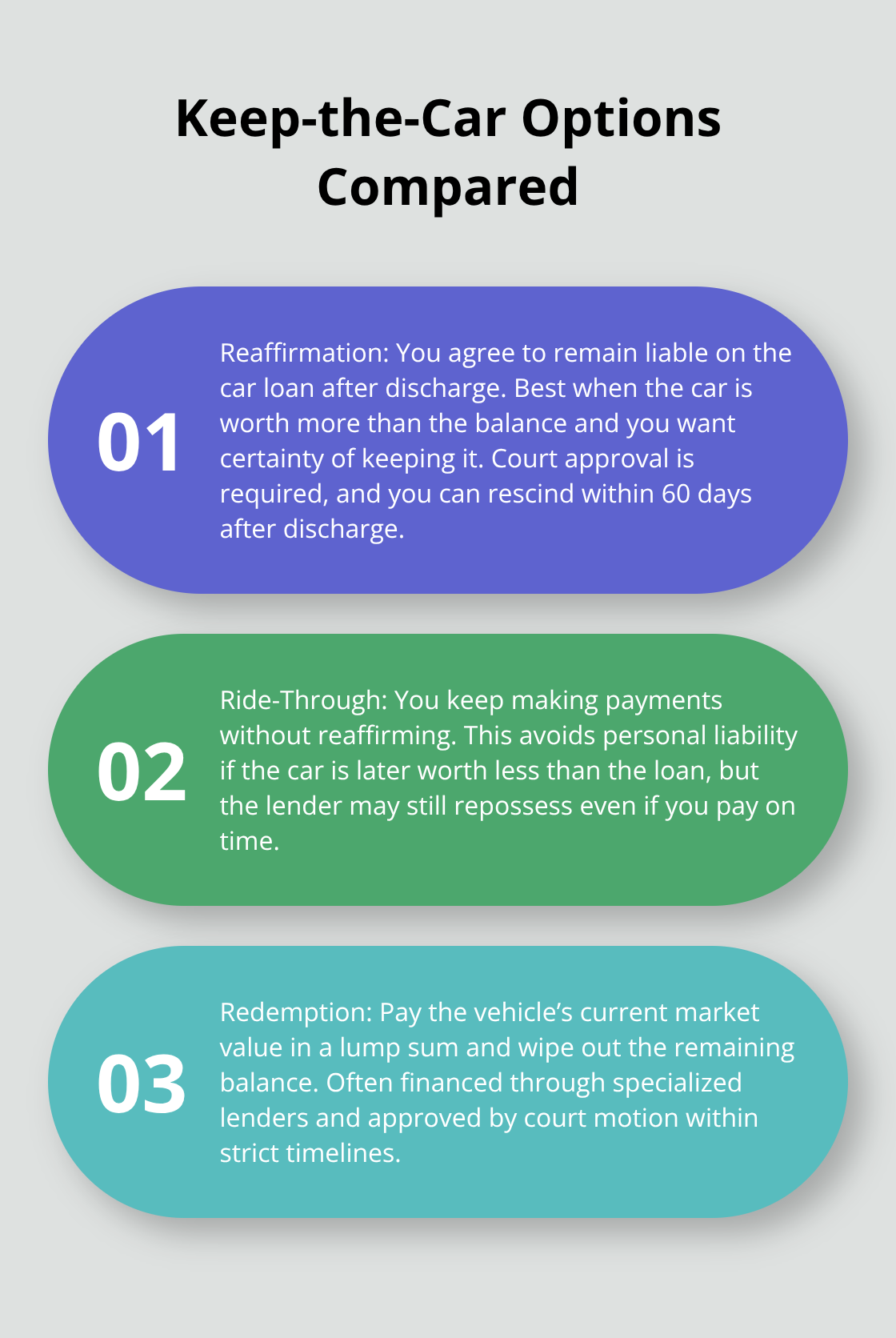
Redemption lets you pay the vehicle’s fair market value in a lump sum instead of the full loan balance, eliminating future risk entirely. Lenders frequently refuse reaffirmation for borrowers with poor credit or high loan-to-value ratios, forcing you toward redemption or ride-through instead.
When your lender refuses reaffirmation, redemption becomes your most practical path forward to keep your vehicle while eliminating the excess debt burden.
Strategy 5: Consider Redemption to Keep Your Car at Current Value
Redemption allows you to pay your vehicle’s current fair market value in a lump sum instead of the full loan balance, eliminating the gap between what you owe and what the car is actually worth. If you owe $12,000 on a vehicle worth $8,000, redemption lets you pay $8,000 to the lender and keep the car free and clear. This strategy works only if you have the cash available or can secure redemption financing from a lender willing to fund bankruptcy filers. The process requires filing a motion with the bankruptcy court, and most courts approve redemption requests within 30 to 60 days if your valuation is reasonable and supported by market data. Redemption eliminates your personal liability for the excess debt, meaning the $4,000 difference disappears entirely rather than following you after discharge.
Finding lenders who finance redemption can be challenging since many traditional banks won’t work with bankruptcy filers, but specialized lenders and some credit unions do offer redemption financing at rates typically ranging from 12% to 18% depending on your credit score and down payment. Calculate whether redemption actually saves money by comparing the total cost of redemption financing against reaffirmation: if redemption financing charges $3,000 in interest over the loan term but eliminates a $4,000 excess debt burden, you come out ahead financially. The tight timeline matters because you must file your redemption motion before your case closes, usually within 60 days of your Chapter 7 filing, so waiting delays the process and risks missing the deadline. Courts take redemption seriously and require accurate vehicle valuations using Kelley Blue Book or NADA Guides, so arrive with documentation supporting your car’s fair market value. Moving quickly with redemption paperwork and lender applications positions you to secure financing and complete the redemption before your case concludes, protecting your vehicle and eliminating excess debt simultaneously, which brings us to negotiating directly with the trustee when your equity exceeds all available exemptions.
Strategy 6: Negotiate with the Trustee When Your Equity Exceeds Exemptions
Trustees don’t liquidate vehicles for the sake of it-they evaluate whether selling your car generates enough money to justify the effort and costs. When your vehicle’s equity exceeds Florida’s $5,000 exemption, the trustee must weigh the vehicle’s sale price against liquidation expenses including auction fees (typically 10% to 15% of sale proceeds), administrative costs, and trustee compensation. A vehicle with $6,000 in non-exempt equity might net only $4,500 after these deductions, making liquidation financially pointless. Many trustees abandon interest in vehicles with minimal excess equity because the math simply doesn’t work-they’d spend resources and time to recover very little for creditors. This economic reality becomes your strongest negotiating position when your equity slightly exceeds the exemption threshold.
Offering to pay the trustee the non-exempt equity amount directly keeps your vehicle and resolves the trustee’s interest without forcing a sale. If your car has $7,000 in equity and you’re $2,000 over the exemption, you can propose paying the trustee $2,000 in installments over your bankruptcy case, typically resolved within 60 days. Trustees often accept these payments because they recover funds faster than waiting for vehicle liquidation and auction proceeds, and you retain transportation without the disruption of losing your car. You should document your vehicle’s current market value using Kelley Blue Book or NADA Guides before meeting with your trustee-arriving with solid valuation data strengthens your negotiating position and demonstrates you’ve calculated equity accurately. Most Chapter 7 cases in Florida result in no asset liquidation, and strategic negotiation over vehicle equity keeps your transportation intact while satisfying the trustee’s obligation to creditors, setting the stage for what happens next at your official creditor meeting.
Final Thoughts on Keeping Your Car Through Chapter 7
Before you file, you should gather documentation showing your vehicle’s current condition and market value. Take photos of your car inside and out, noting any damage or mechanical issues that affect valuation, then pull your Kelley Blue Book or NADA Guides valuation with the date and calculate your exact equity by subtracting your loan balance and any liens. This preparation prevents surprises during your case and gives your attorney the information needed to recommend the right protection strategy for your situation.
Your attorney plays the central role in choosing whether you should reaffirm, pursue redemption, negotiate with the trustee, or rely on exemptions to keep your car through Chapter 7. Each strategy carries different costs and risks, and the right choice depends on your vehicle’s equity, your income, and your lender’s willingness to work with you. An experienced bankruptcy attorney reviews your specific numbers and recommends the approach that protects your transportation while minimizing your financial burden after discharge.
The 341 meeting, officially called the meeting of creditors, includes questions about your vehicle, and the trustee will ask about your car’s value, your loan balance, and whether you intend to keep it. Answer honestly and directly, bringing your valuation documentation to support your numbers, and contact Harnage Law, PLLC to discuss your vehicle protection strategy and learn how we can help you keep your car through Chapter 7 bankruptcy.