
Filing Chapter 7 bankruptcy in Florida doesn’t mean losing your car. Many people assume their vehicle will be seized, but Florida law provides strong protections that can help you keep your car through the process.
At Harnage Law, PLLC, we’ve guided countless clients through keeping their vehicles during Chapter 7. The key is understanding your exemptions and taking the right steps before and after filing.
How Florida’s Vehicle Exemption Protects Your Car
Understanding Florida’s $5,000 Vehicle Exemption
Florida’s motor vehicle exemption ranks among the strongest in the nation, and it’s the primary reason most people filing Chapter 7 keep their cars. As of 2026, Florida protects up to $5,000 in vehicle equity for those who don’t claim the homestead exemption. This means if your car’s market value minus your loan balance equals $5,000 or less, the trustee cannot liquidate it. If your vehicle is worth $8,000 and you owe $4,000, your equity is $4,000-which falls completely within the exemption. The trustee has no incentive to sell a car with protected equity because the proceeds would go entirely to you, not creditors.
How Equity Calculations Work
Your equity is calculated as the current fair market value of your vehicle minus what you still owe on it. Courts typically use Kelley Blue Book values for this calculation, though trustees sometimes apply wholesale values rather than retail prices. If you have negative equity (your loan balance exceeds the car’s value), the vehicle has virtually no equity to protect, which actually works in your favor since the trustee won’t liquidate an asset with no benefit to creditors. The practical takeaway is this: calculate your car’s current value using Kelley Blue Book, subtract your outstanding loan balance, and if the result is $5,000 or less, your vehicle is fully protected under Florida law.
Financed vs. Owned Vehicles
The distinction between financed and owned vehicles matters less than most filers think. Financed vehicles receive the same exemption protection as owned vehicles; the key factor is the equity amount, not ownership status. This protection applies whether you own the car outright or still have an active loan, as long as you’re current on payments at the time you file. If you own your car outright with no loan and it’s worth more than $5,000, the non-exempt equity may be at risk (though the trustee must weigh liquidation costs against potential recovery). Understanding this distinction helps you determine whether your specific vehicle will survive the bankruptcy process intact.
Three Proven Ways to Protect Your Vehicle in Chapter 7 in Florida
Calculate Your Vehicle Equity Before Filing
The exemption alone doesn’t protect your car-you need an active strategy. The most straightforward approach is maximizing your exemption by keeping your vehicle equity within Florida’s $5,000 protection. If your car is worth $9,000 and you owe $5,000, you have $4,000 in equity, which means you’re fully covered and the trustee cannot touch it. If that same car is worth $9,000 but you only owe $2,000, your $7,000 equity exceeds the exemption by $2,000. In this scenario, the trustee could liquidate the vehicle, though many trustees skip this step if sale costs and administrative expenses would consume most of the proceeds.
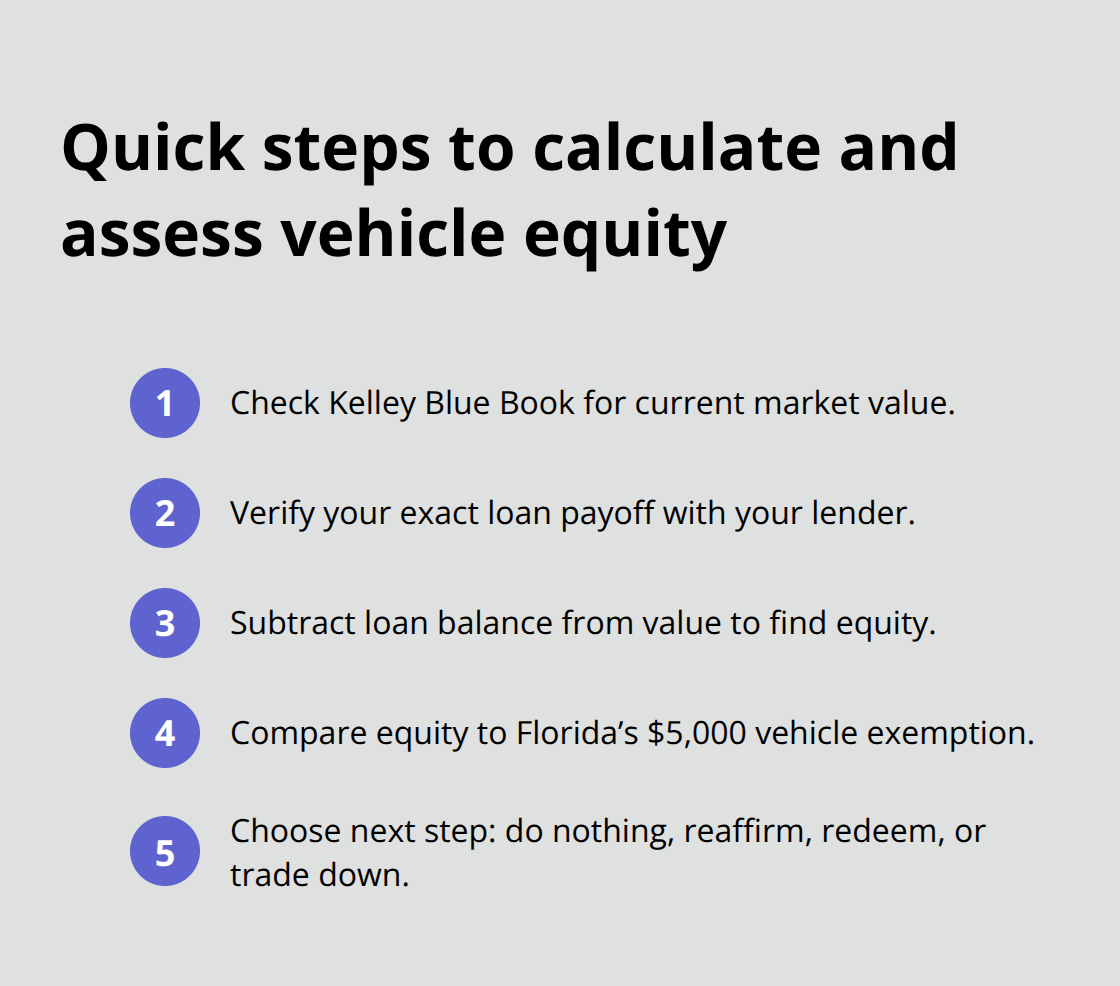
Run the numbers before filing: check Kelley Blue Book for your vehicle’s current value, verify your loan balance with your lender, and calculate the gap. This single calculation determines whether you face liquidation risk.
Reaffirm Your Loan to Keep Your Vehicle
If your equity exceeds the exemption, reaffirmation keeps your vehicle by allowing you to continue the existing loan after bankruptcy discharge. You sign a reaffirmation agreement with your lender, remain personally liable for the debt, and keep making monthly payments as if bankruptcy never happened. The critical downside is this: if you default on the reaffirmed loan after discharge, you cannot discharge that debt again for eight years under Chapter 7 rules.
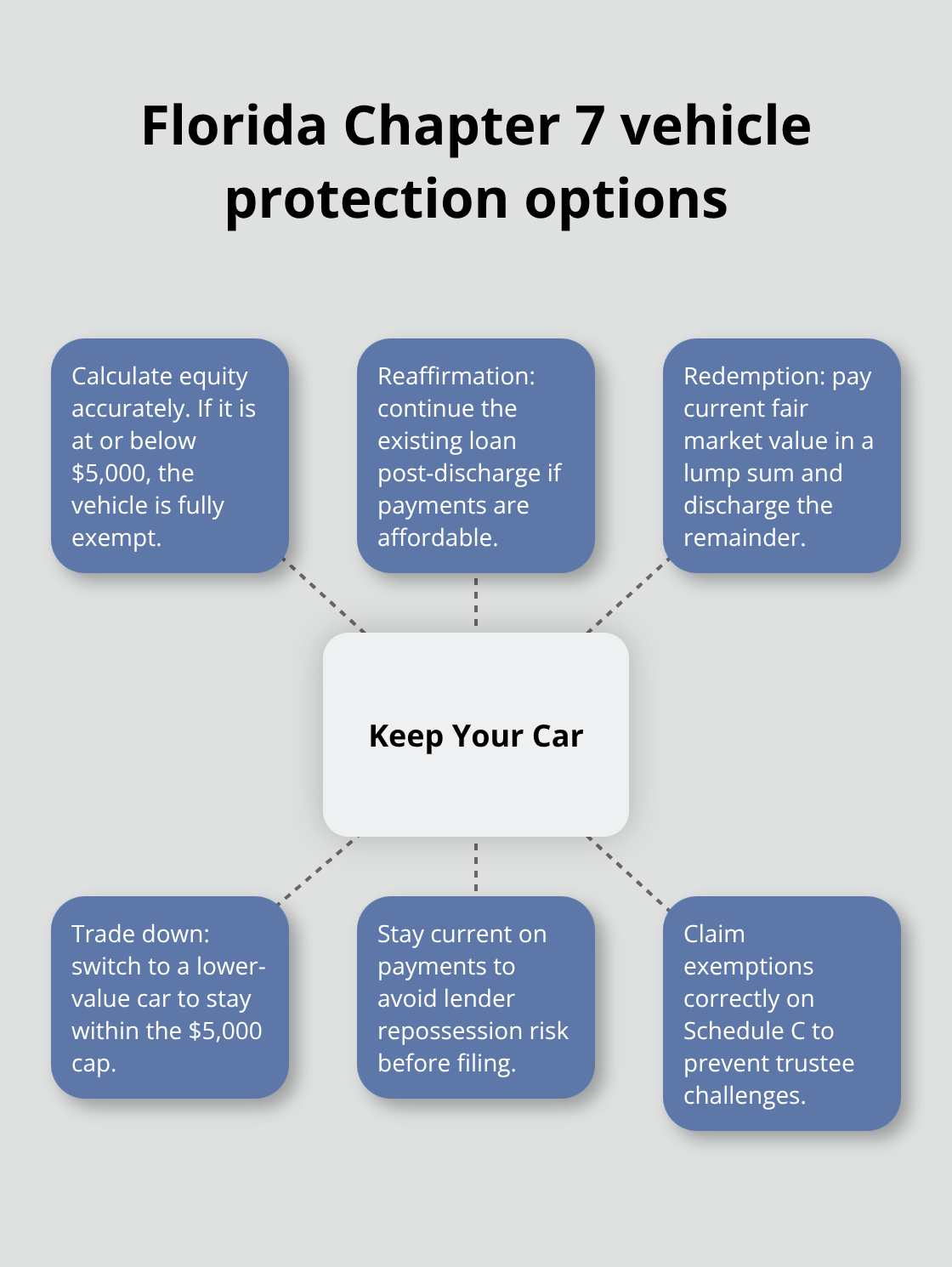
Reaffirmation only works if you can reliably afford the payments for the loan’s remaining term.
Use Redemption to Pay Fair Market Value
A third option, redemption under 11 U.S.C. Section 722, lets you keep the vehicle by paying the lender a lump sum equal to the car’s current fair market value, discharging the rest of the debt. Redemption makes sense when your vehicle’s market value is significantly lower than what you owe-for example, owing $12,000 on a car worth $7,000. You pay $7,000 once and own the car free and clear, eliminating years of payments. Most Chapter 7 filers lack the cash for redemption upfront, though redemption financing companies exist to bridge this gap (though their interest rates typically exceed 20 percent).
Trade Down Your Vehicle to Eliminate Risk
The cleanest strategy remains keeping your vehicle within the exemption limit before filing. If you currently own a car worth $8,000 with $1,000 equity and face bankruptcy, trading it in for a $4,000 vehicle eliminates exemption concerns entirely while still providing reliable transportation. This approach removes the uncertainty that comes with high-equity vehicles and simplifies your bankruptcy filing. The next section covers common mistakes that put vehicles at risk-mistakes you can avoid with proper planning and attention to detail.
Common Mistakes That Put Your Vehicle at Risk
Inaccurate Vehicle Valuation on Your Bankruptcy Forms
Protecting your vehicle through Chapter 7 bankruptcy requires accuracy in your paperwork and clarity about what you own. Many filers lose vehicles they could have kept because they made preventable errors during the filing process. The most common mistake is incomplete or inaccurate disclosure of your vehicle on the bankruptcy schedules. When you file Chapter 7, you must list every asset, including your car, on Schedule A/B. If you understate your vehicle’s value, the trustee may discover the discrepancy during the Meeting of Creditors and question whether you concealed assets.
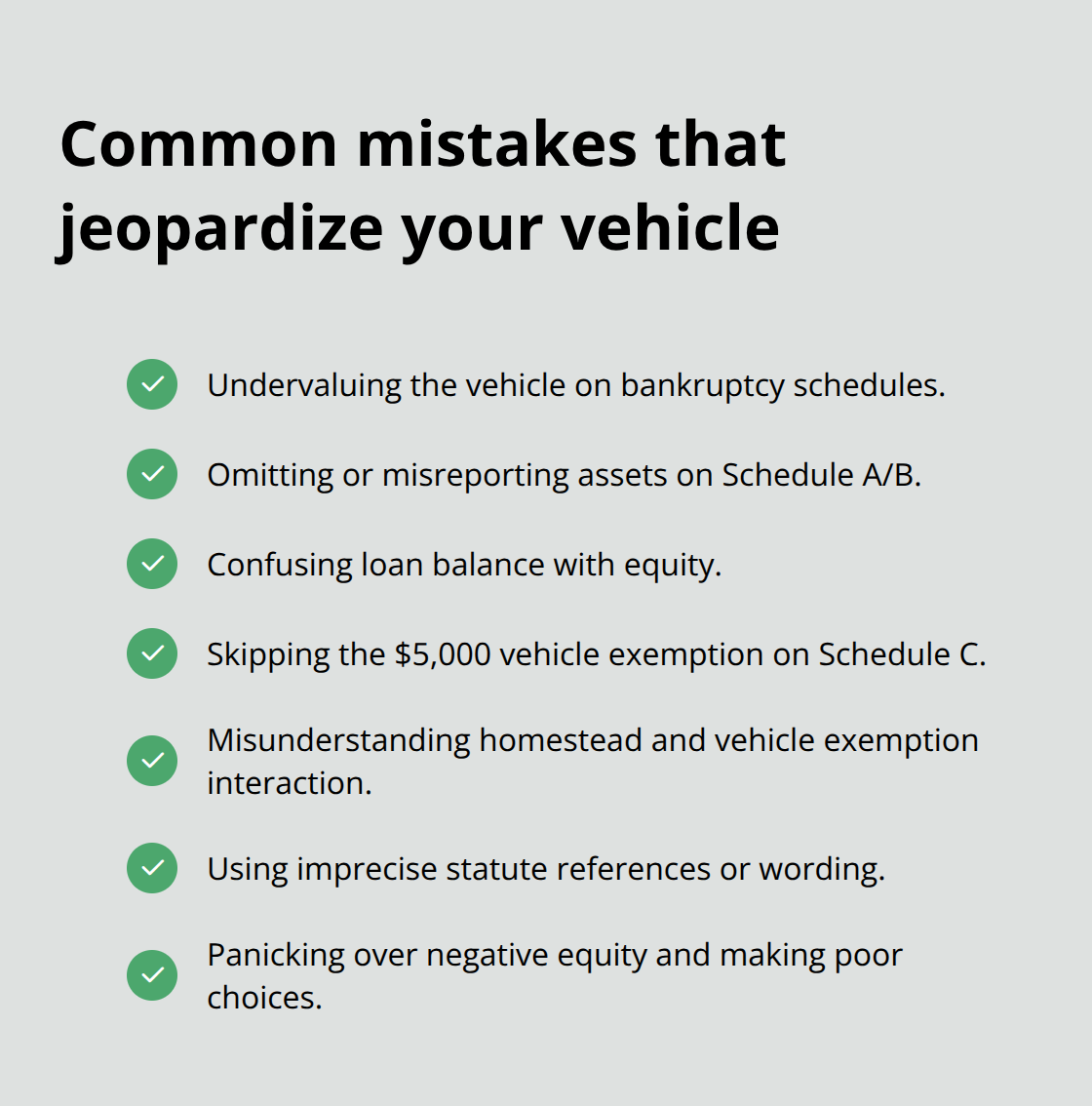
If you fail to claim your exemption properly on Schedule C, the trustee treats your vehicle equity as unprotected property available for liquidation.
Courts in Florida’s Middle District have seen cases where filers listed a vehicle worth $6,000 as worth $3,000 to stay under the $5,000 exemption limit. When the trustee checked Kelley Blue Book and found the actual value was $7,500, it triggered a liquidation proceeding the filer could have avoided with honest disclosure and proper exemption claims. Obtain an accurate valuation using Kelley Blue Book or NADA Guides before filing, list that value on your schedules, and claim the full $5,000 Florida vehicle exemption on Schedule C if you have equity.
Confusing Loan Balance with Vehicle Equity
Another critical mistake involves confusing equity with loan balance, which leads filers to believe their financed vehicle is at risk when it actually isn’t. Your loan balance has nothing to do with exemption protection-only equity matters. If you owe $9,000 on a car worth $8,500, your equity is negative $500, meaning the trustee cannot and will not liquidate because there is nothing to recover. Yet filers often panic about high loan balances and fail to claim exemptions they desperately need.
Overlooking Homestead Exemption Interactions
A third mistake is overlooking how the homestead exemption interacts with vehicle protection. Florida allows you to claim either the homestead exemption on your home or a $5,000 vehicle exemption plus a $1,000 personal property exemption if you don’t own a home. Some filers claim homestead protection but then fail to claim the vehicle exemption on a financed car, thinking they cannot use both. This is false-you can use homestead for your home and still claim the $5,000 vehicle exemption if your home equity exceeds the homestead limit.
Improper Exemption Claims on Schedule C
The fix requires reviewing your total assets before filing, determining which exemptions maximize your protection, and ensuring every exemption claim appears on Schedule C with precise language matching Florida statute MCL 600.5451(1)(g). Failing to do this invites trustee scrutiny and potential liquidation of assets you could have protected. The difference between keeping and losing your vehicle often comes down to whether you claim your exemptions correctly and disclose your assets honestly.
Final Thoughts
Florida’s $5,000 vehicle exemption makes it possible for most filers to keep their car through Chapter 7 bankruptcy when they calculate equity accurately and claim exemptions properly on their schedules. The strongest protection comes from understanding that equity-not loan balance-determines whether the trustee can liquidate your vehicle, and from disclosing your assets honestly from the start. We at Harnage Law, PLLC work with clients to review their specific vehicle situation, verify whether their equity falls within Florida’s exemption limits, and determine whether reaffirmation or redemption fits their circumstances.
Your vehicle protection strategy begins with obtaining an accurate valuation using Kelley Blue Book, calculating your equity by subtracting your loan balance from that value, and confirming whether your car falls within the exemption. If your equity stays at or below $5,000, the trustee cannot touch your vehicle and you can keep car Chapter 7 without additional steps. If your equity exceeds the exemption, reaffirmation or redemption can still help you retain the vehicle depending on your financial situation and loan terms.
For personalized guidance on protecting your vehicle and determining whether Chapter 7 bankruptcy fits your situation, contact Harnage Law, PLLC to discuss your options and move toward a fresh financial start.