
Filing Chapter 7 bankruptcy doesn’t mean losing your home. Florida law offers powerful protections for homeowners, and the right strategy during bankruptcy can help you keep your house while eliminating crushing debt.
At Harnage Law, PLLC, we guide homeowners through the process of protecting their primary residence during Chapter 7. This guide walks you through the specific steps that work in Florida courts.
1. Florida’s Homestead Exemption Protects Unlimited Home Equity
Florida’s homestead exemption stands as one of the strongest asset protection laws in the country, fundamentally changing how Chapter 7 bankruptcy works for homeowners. If you have owned your primary residence for at least 1,215 days before filing, Florida law protects an unlimited amount of home equity-the bankruptcy trustee cannot force a sale of your home to pay creditors, regardless of how much equity you have built. This unlimited protection applies as long as your property does not exceed 0.5 acres within city limits or 160 acres outside city limits, which covers the vast majority of residential homes in Florida. The federal bankruptcy code offers far weaker protection, capping homestead exemptions at around $27,900 per person in most states.
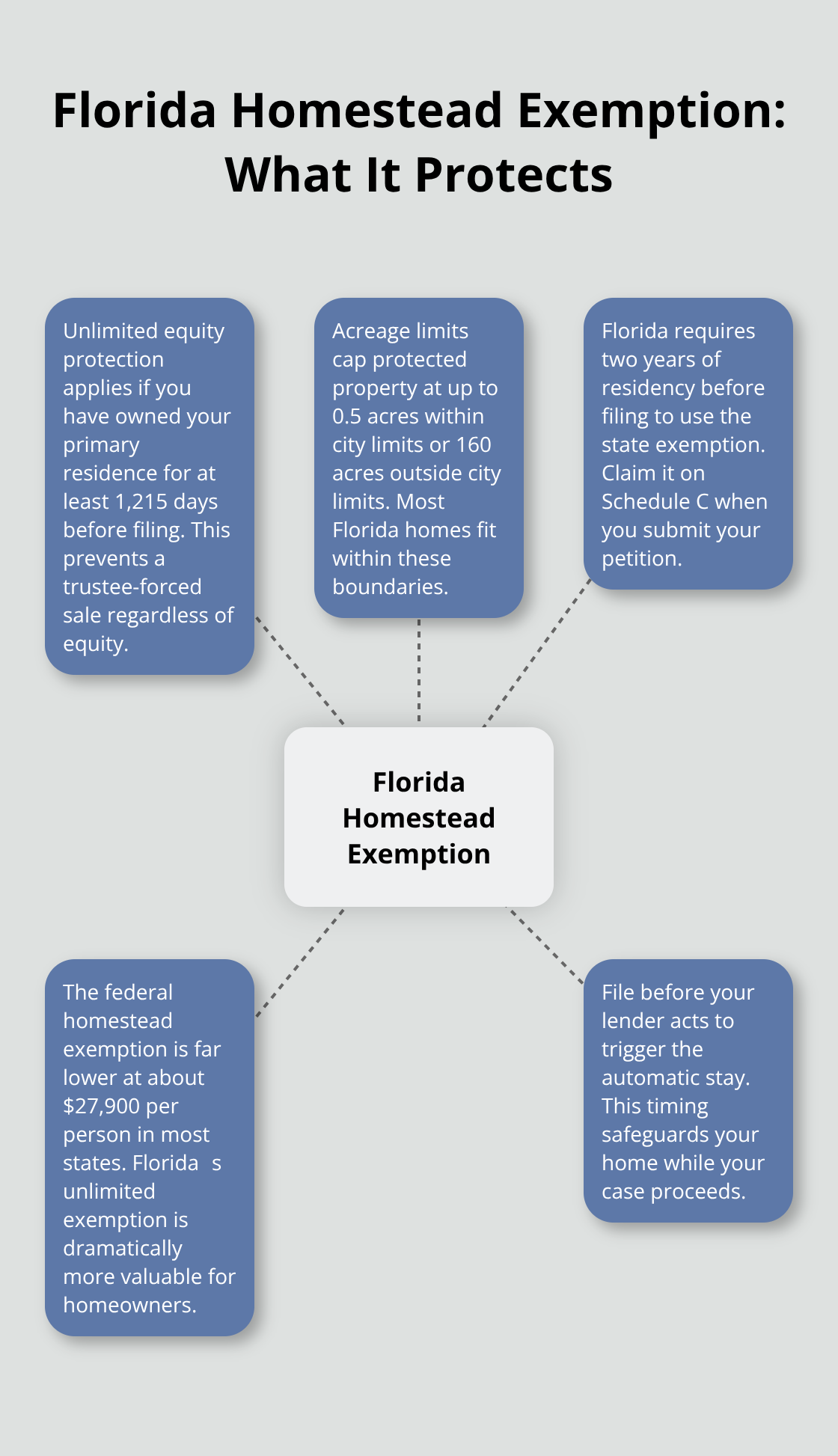
Florida’s unlimited exemption proves dramatically more valuable for homeowners filing Chapter 7.
The timing requirement of 1,215 days matters significantly because if you have not owned the home long enough, you still receive protection up to $170,350 in equity under Florida law. Even newer homeowners gain substantial protection during Chapter 7, though not the unlimited coverage of long-term owners. To claim Florida’s homestead exemption, you must have lived in Florida for the two years immediately before filing, so out-of-state residents will not qualify for this protection. The exemption applies automatically when you file your bankruptcy petition and claim it on your Schedule C, which lists the property you want to keep.
Understanding how to properly claim this exemption from day one matters for your case. Filing your bankruptcy petition at the right time-before your lender takes action-activates the automatic stay that stops foreclosure immediately.
2. File Your Bankruptcy Before Foreclosure Stops It
The automatic stay activates the moment your petition is filed with the court and immediately halts foreclosure proceedings, stops lender calls, prevents wage garnishments, and pauses nearly all collection actions. Once the stay is in place, your lender cannot move forward with a foreclosure sale without filing a motion to lift the stay and obtaining court approval, which takes additional time and resources. This breathing room gives you time to reorganize your finances and plan your next steps without the pressure of an imminent sale.
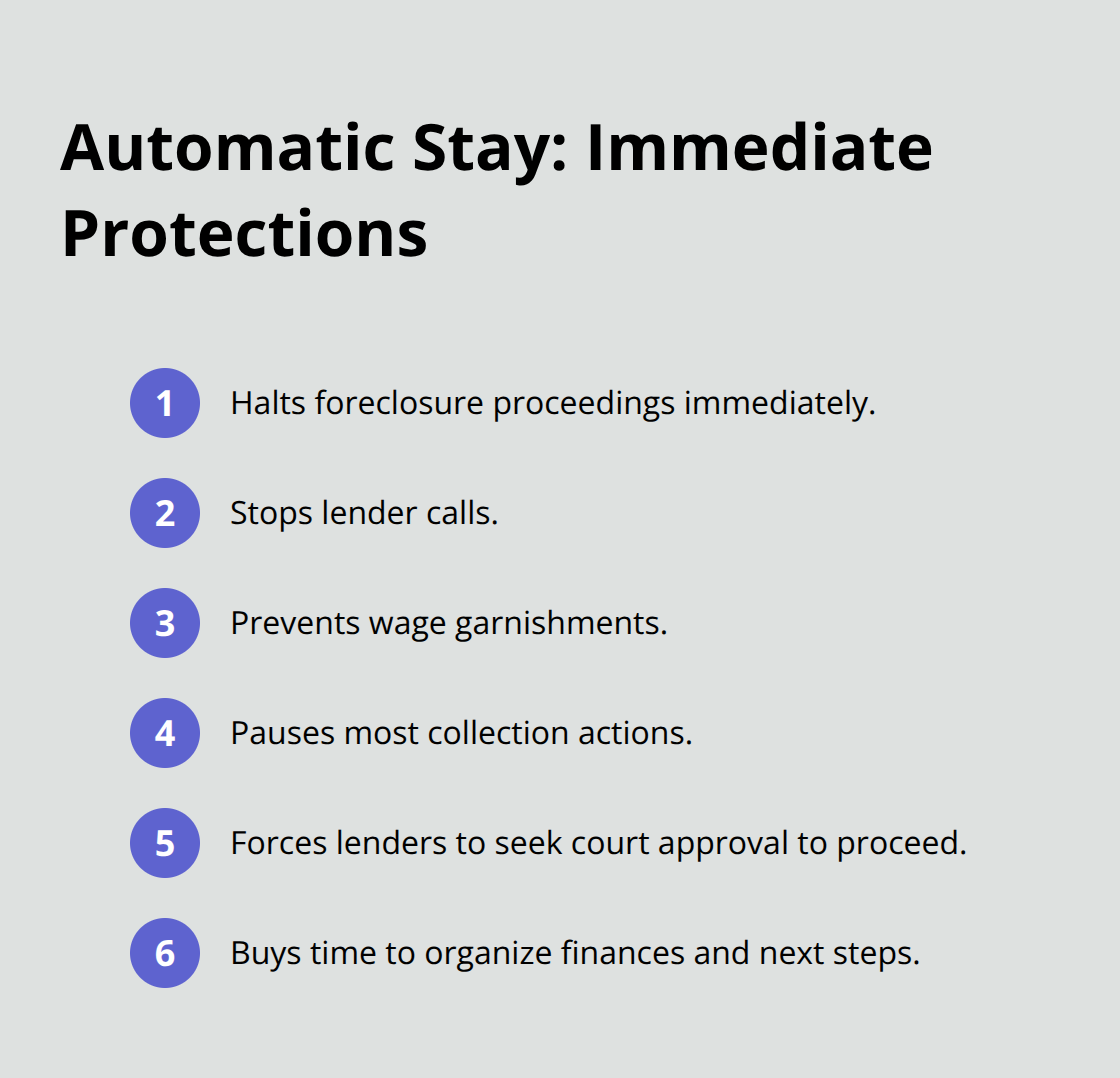
The automatic stay applies in Florida courts under 11 U.S.C. § 362, and lenders must comply with this federal protection regardless of how far along their foreclosure process has advanced.
Timing your filing matters tremendously in Florida foreclosure cases. If your lender has already scheduled a foreclosure sale date, filing before that auction occurs preserves your right to keep the home through bankruptcy. Many homeowners wait until they receive a foreclosure notice, but filing as soon as you realize you cannot catch up on payments produces better outcomes. The faster you file, the more options remain available to you, including the possibility of catching up arrears through a Chapter 13 plan if Chapter 7 does not suit your situation. Florida courts process Chapter 7 cases routinely, and the court system handles the automatic stay requirements efficiently.
Once you file and the automatic stay takes effect, your next priority shifts to protecting your income and assets during the bankruptcy process. Keeping current on your mortgage payments during Chapter 7 becomes the foundation for maintaining homeownership after discharge.
3. Keep Making Mortgage Payments During Bankruptcy
The discharge you receive in Chapter 7 does not eliminate your mortgage debt or the lender’s right to foreclose if you stop paying. Your mortgage lien survives the bankruptcy discharge, meaning the lender can still repossess your home if payments fall behind, even after all your credit cards and personal loans disappear. Continuing to pay your mortgage throughout the Chapter 7 process is the single most important action you can take to maintain ownership of your home. The automatic stay halts foreclosure temporarily, but that protection ends when your case closes if you have not kept current on payments. Many homeowners mistakenly believe that filing Chapter 7 means they can skip mortgage payments during bankruptcy, but this misunderstanding leads directly to foreclosure after discharge.
You can pay your mortgage directly to your lender throughout your Chapter 7 case without any court involvement or special procedures. Set up automatic payments through your bank if possible, as this removes the risk of missed payments during the bankruptcy process. If your mortgage is held by a servicer, contact them directly to confirm the mailing address and payment instructions, then maintain that schedule consistently from filing through discharge and beyond. The trustee in your Chapter 7 case has no authority over your mortgage payments because the lender holds a secured claim backed by your home as collateral. If you fall behind on payments during bankruptcy, your lender can file a motion to lift the automatic stay and proceed with foreclosure immediately-typically within 60 to 90 days of your case closing if arrears accumulate.
Eliminating unsecured debt through Chapter 7 discharge frees up money in your monthly budget that you can redirect toward your mortgage payments.
4. Discharge Unsecured Debt to Reclaim Your Monthly Budget
Chapter 7 bankruptcy eliminates credit cards, personal loans, medical debt, and other unsecured obligations through the discharge process, typically within 60 to 90 days after your meeting of creditors. This discharge means you no longer owe these debts after your case closes, and creditors cannot pursue collection actions against you. The average American household carrying credit card debt holds approximately $6,375 in balances, and eliminating this obligation frees up real money in your monthly budget. If you owe $500 per month across multiple credit cards and personal loans, discharging that debt instantly converts it into available funds you can direct toward your mortgage payment. This is the core mechanism that makes keeping your home financially feasible during Chapter 7.
The practical impact becomes clearer when you calculate your actual situation. Suppose you earn $4,000 monthly, your mortgage costs $1,200, and your unsecured debts total $800 in minimum payments, leaving only $2,000 for living expenses, property taxes, insurance, and utilities. After Chapter 7 discharge, that same $4,000 income now covers a $1,200 mortgage plus $3,800 for all other expenses, making homeownership sustainable. Without eliminating unsecured debt first, many Florida homeowners face an impossible choice between feeding their families and paying their mortgage. Discharge removes that false choice entirely and shifts your focus to protecting your property from other threats that can still jeopardize ownership.
5. Stop Judgment Liens Before They Drain Your Home Equity
Judgment liens pose a serious threat to Florida homeowners in Chapter 7 bankruptcy because they attach to your property and can survive the bankruptcy discharge, potentially allowing creditors to force a sale of your home after your case closes. A judgment lien differs fundamentally from a mortgage lien: your mortgage lender holds a secured claim registered before you filed bankruptcy, while a judgment creditor obtains a lien after winning a lawsuit and recording it against your property. If a creditor sues you for unpaid credit card debt or a medical bill and wins a judgment, they can file that judgment in the county where your home sits, creating a lien that attaches to your equity. This lien remains attached even after Chapter 7 discharge eliminates the underlying debt, giving the judgment creditor the right to foreclose on your home years later if you build equity. Creditors aggressively pursue judgment liens as a collection tool in Florida, and many homeowners don’t realize the lien survives bankruptcy discharge until it’s too late.
Chapter 7 bankruptcy provides a powerful tool to eliminate judgment liens through lien avoidance, but only if your home equity falls within your exemption protection. If you own your home free and clear or have minimal equity, and you qualify for Florida’s unlimited homestead exemption (because you’ve owned the property for 1,215 days), the judgment lien can be avoided entirely, removing the creditor’s ability to foreclose. If you have equity that exceeds your exemption amount, the lien cannot be avoided, and it persists after discharge. Filing Chapter 7 immediately when you receive a judgment notice prevents additional liens from being recorded against your property during the bankruptcy process, since the automatic stay stops most collection actions. Understanding whether your liens can be eliminated requires careful analysis of your specific equity position and exemption eligibility.
Reaffirming your mortgage debt offers another layer of protection for homeowners who want to guarantee their right to keep the house after discharge.
6. Reaffirm Your Mortgage to Lock In Your Right to Keep Your Home
Reaffirmation is a written agreement between you and your lender that makes you personally liable for the mortgage debt after discharge, essentially choosing to keep the loan alive rather than letting it disappear with your other debts. Most Florida homeowners who want to keep their house should consider reaffirmation because it gives your lender explicit assurance that you intend to pay and removes any ambiguity about your commitment to the property. The reaffirmation process requires you to file Official Bankruptcy Form 2400A with the court, along with a cover sheet (Form 427) and a motion for approval (Form 2400B), all of which must include original signatures from you, your lender, and your attorney if you have one representing you. The court typically approves reaffirmation agreements without a hearing if you have an attorney handling the paperwork and your budget shows sufficient income to cover the monthly payment. If you represent yourself without an attorney, the judge will schedule a hearing to confirm you understand the agreement and can actually afford to make payments, which you can attend by telephone depending on your assigned judge’s rules.
Reaffirming your mortgage creates one critical advantage: your lender has a contractual obligation to continue servicing the loan and cannot accelerate the debt or claim you abandoned the property after discharge. Without reaffirmation, your mortgage technically survives the bankruptcy as a lien, but the underlying debt obligation disappears, which creates confusion about whether you still owe the full balance. Some lenders become aggressive after discharge if no reaffirmation exists, threatening foreclosure even when you remain current on payments. The downside to reaffirmation is that you lose the fresh start protection for that specific debt, meaning if you fall behind later, the lender can pursue a deficiency judgment against you for any shortfall between the foreclosure sale price and your remaining loan balance. The clarity and lender cooperation that reaffirmation provides outweighs the theoretical deficiency risk, especially when you plan to stay in your home long-term.
With your mortgage secured through reaffirmation, you now need professional guidance to navigate the remaining steps of your bankruptcy case and protect your assets throughout the process.
7. Hire a Florida Bankruptcy Attorney Before Filing
Filing Chapter 7 without legal guidance exposes you to costly mistakes that jeopardize your home, even when Florida law provides strong protections. DIY filers frequently miss exemption opportunities, fail to properly claim homestead protection, or overlook judgment liens that should be eliminated through lien avoidance. A single error on Schedule C, which lists your homestead exemption, can result in the trustee claiming your home equity is unprotected and threatening to force a sale.
An experienced Florida bankruptcy attorney handles the technical requirements that courts enforce strictly while developing a strategy tailored to your specific home equity position, income, and creditor situation. The filing fee for Chapter 7 in Florida is $338, and attorney fees typically range from $1,500 to $3,000 depending on case complexity-far less than the cost of losing your home or spending months correcting filing errors. Local knowledge matters significantly because Florida courts follow specific administrative orders, judges maintain individual preferences about reaffirmation agreements, and local rules govern procedures that national bankruptcy software often misses.
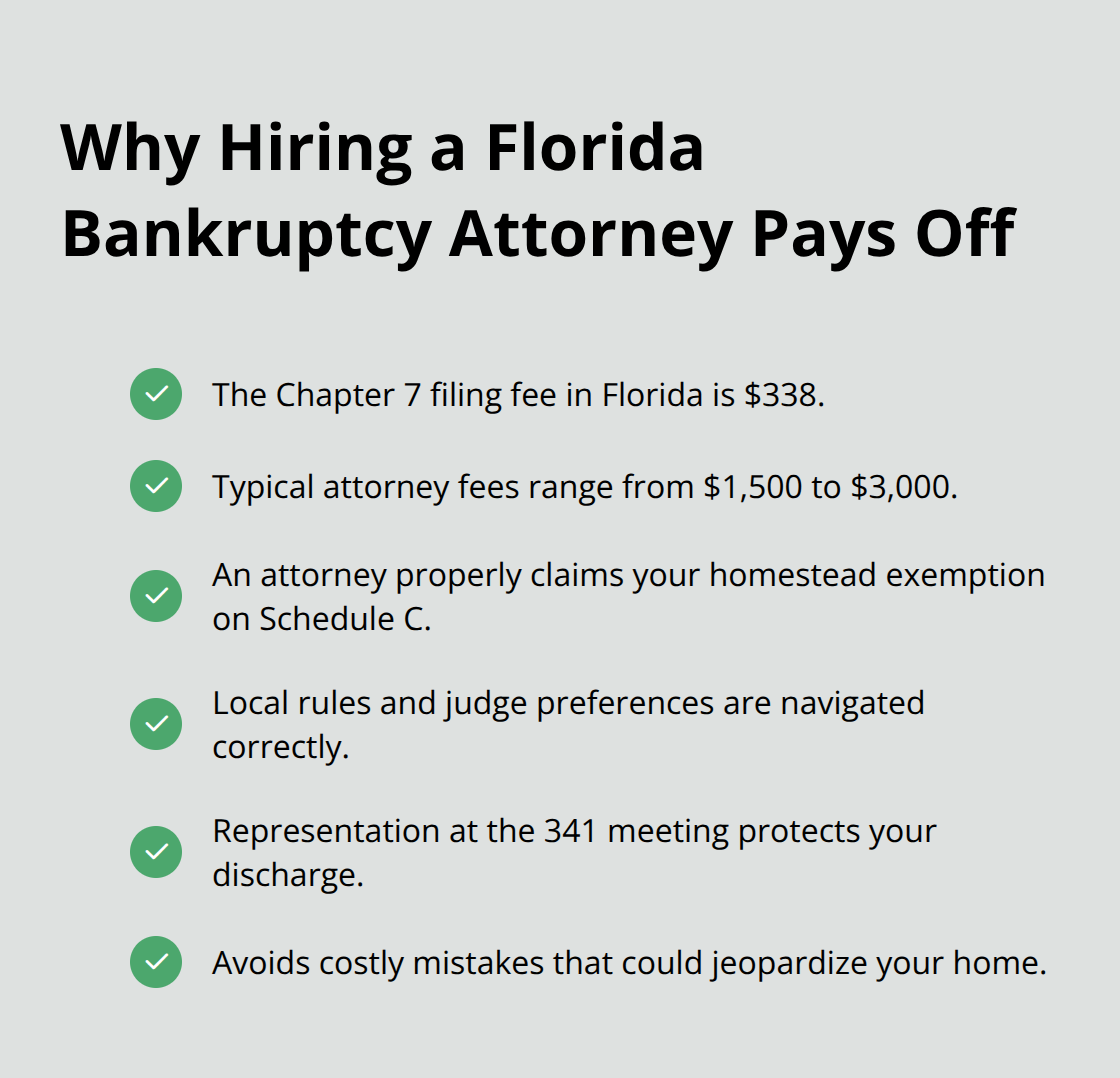
Your attorney also represents you at the 341 meeting of creditors, where the trustee questions your finances under oath. Having professional representation at this hearing dramatically improves outcomes and prevents statements that could jeopardize your discharge. With proper legal guidance in place, you can now focus on protecting your assets and rebuilding your financial future after your case closes.
Final Thoughts
Your Chapter 7 discharge marks the beginning of your financial recovery, not the end of your responsibility to your home. The moment your case closes and your debts disappear, your focus shifts entirely to maintaining the mortgage payments that keep you as the owner of your house. Missing even one payment after discharge invites your lender to file a foreclosure motion, and the automatic stay that protected you during bankruptcy no longer applies. Set up automatic payments from your bank account to eliminate the risk of accidental missed payments, and verify each month that the payment posts correctly to your account.
Rebuilding your credit after Chapter 7 takes time, but your fresh start creates genuine opportunity to establish healthier financial habits. Your credit score will recover gradually over the next three to five years as you demonstrate consistent payment history on your mortgage and any other accounts you maintain. Avoid taking on new unsecured debt immediately after discharge, and resist the temptation to max out credit cards simply because creditors begin offering them again.
Protecting yourself from future financial emergencies requires building a modest emergency fund and maintaining awareness of your monthly budget. Even small unexpected expenses like car repairs or medical bills can derail homeowners who live paycheck to paycheck. If you have questions about how to keep your house through bankruptcy chapter 7 or want to discuss your specific situation, contact us for a free consultation to explore your options.