Debt forgiveness through Chapter 7 bankruptcy is possible, but it comes with specific rules and limitations. Not all debts qualify for discharge, and your financial situation must meet strict requirements.
At Harnage Law, PLLC, we help Florida residents understand whether Chapter 7 is the right path forward. This guide walks you through what gets forgiven, how the process works, and what it takes to qualify.
What Debts Disappear in Chapter 7 and What Stays
Unsecured Debts That Chapter 7 Discharges
Chapter 7 discharge eliminates most unsecured debts, but Florida bankruptcy law draws a hard line between what vanishes and what survives. Unsecured debts like credit cards, medical bills, and personal loans typically get discharged under 11 U.S.C. § 523(a), meaning you walk away with zero obligation. Credit card balances represent the largest portion of discharged debt for most filers. Medical debt, which affected 43 million Americans according to the Consumer Financial Protection Bureau, also qualifies for discharge in Chapter 7.
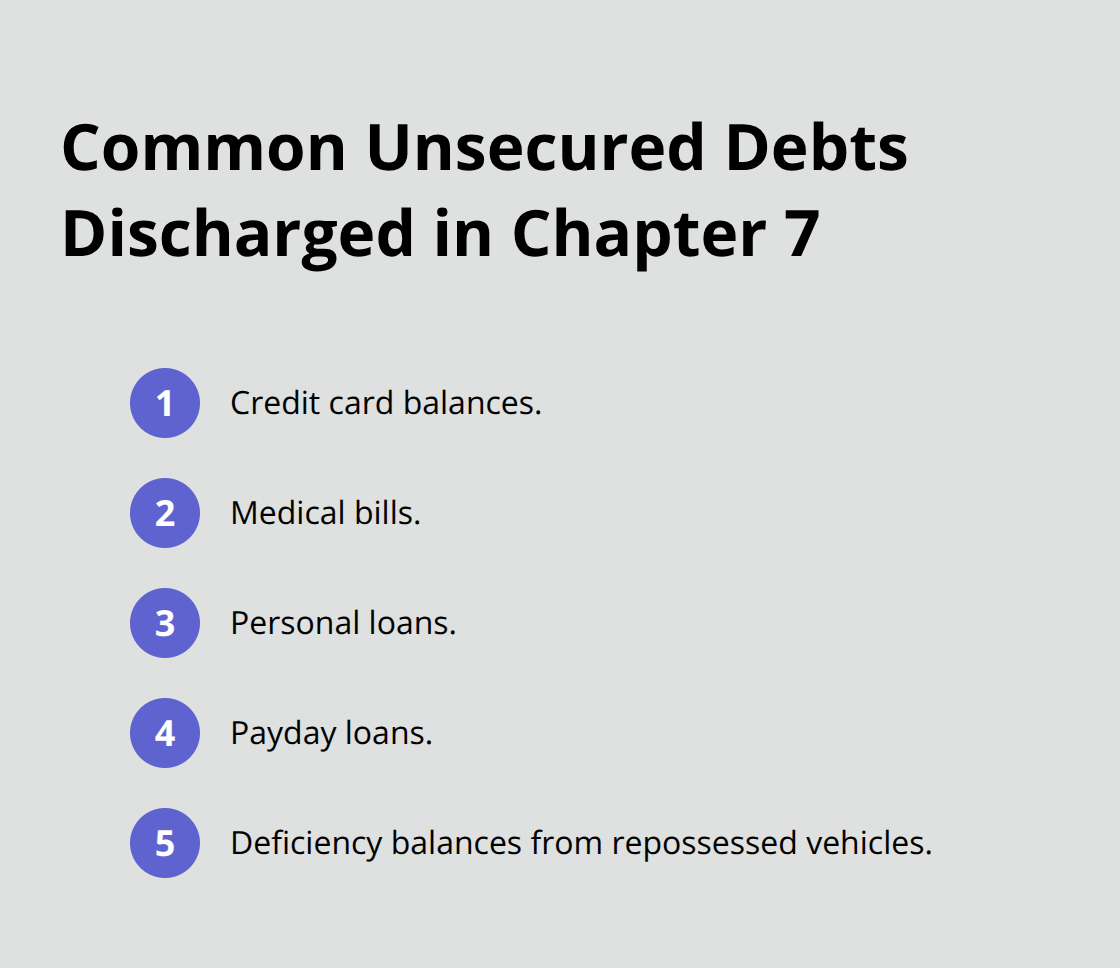
Personal loans, payday loans, and deficiency balances from repossessed vehicles all fall into the dischargeable category. The trustee liquidates your nonexempt assets to pay creditors a portion of these debts, but once the case closes, the remaining balance disappears. However, secured debts work differently-if you want to keep your home or car, you must continue paying the secured creditor or surrender the property. The discharge does not automatically remove liens, so a creditor can still foreclose or repossess if you stop paying, even after bankruptcy closes.
Nondischargeable Debts That Survive Chapter 7
Certain debts simply cannot be forgiven in Florida Chapter 7 cases, and creditors aggressively challenge discharge on these claims. Child support and alimony obligations survive bankruptcy completely under 11 U.S.C. § 523(a)(5), meaning you remain personally liable forever. Recent income tax debts within three years of filing cannot be discharged, nor can any federal or state tax debt older than three years if you did not file a return.
Student loans stay unless you prove undue hardship, a legal standard courts rarely grant. Criminal fines, restitution, and traffic citations remain nondischargeable. Debts for willful or malicious injury to a person or property, fraud, embezzlement, or larceny survive if the creditor files an objection and proves the debt qualifies. Luxury purchases of $1,150 or more made within 60 days of filing and cash advances of $1,150 or more taken within 60 days can be presumed nondischargeable. Debts you accidentally omit from your petition may also survive discharge.
How the Trustee Handles Asset Recovery and Distribution
The trustee’s role centers on asset identification and recovery, not on deciding which debts discharge. The trustee reviews your petition, schedules, and tax returns to locate nonexempt property, recovers any fraudulent transfers made within two years, and liquidates assets to distribute proceeds to creditors. In Florida no-asset Chapter 7 cases (which represent the majority of filings), the trustee finds nothing to liquidate because your exempt property and exemptions under Florida law protect most of what you own.
Understanding which debts disappear and which remain shapes your entire bankruptcy strategy. The next section explains the specific steps you take to move through the Chapter 7 process and when the court actually grants your discharge order.
From Filing to Discharge: What Happens in Your Chapter 7 Case
Preparing and Submitting Your Bankruptcy Petition
You must submit a petition and multiple official forms to the bankruptcy court when you file Chapter 7 in Florida. Official Bankruptcy Form 106A/B lists all property, Form 106C claims exemptions under Florida law, Form 106D covers secured debts, Form 106E/F addresses unsecured debts, Form 106G lists executory contracts, Form 106H identifies co-debtors, Form 106I reports income, Form 106J details expenses, and Form 106Sum provides a summary. You also file the Statement of Your Current Monthly Income and Means Test Calculation, a Creditor Matrix with every creditor’s name and address, pay stubs from the past 60 days, and your most recent tax return.
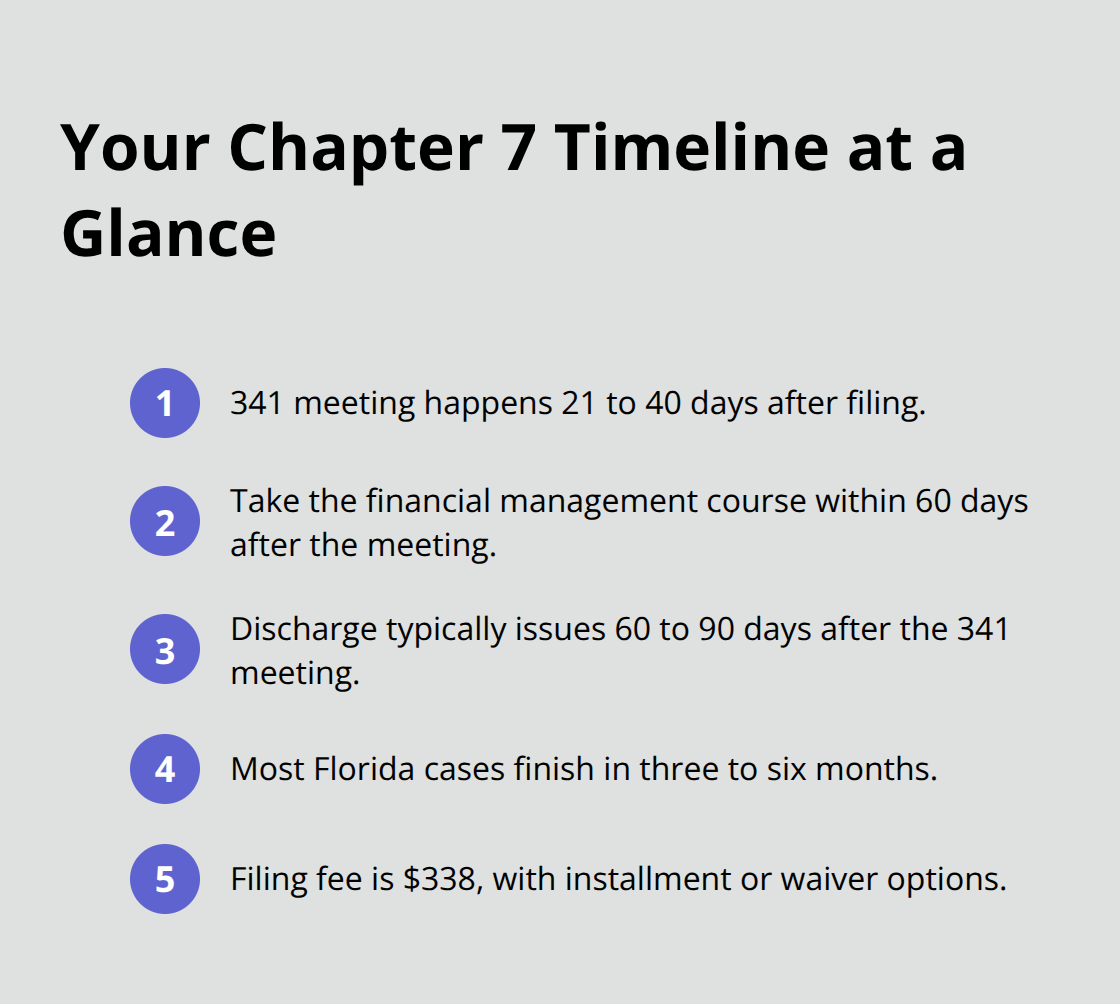
The filing fee totals $338, though you can pay in installments by submitting an Application to Pay the Filing Fee in Installments, or request a waiver using Form 103B if your household income falls below 150 percent of the federal poverty line. Wet signatures on the petition and certain schedules satisfy court rules; electronic signatures do not work in most Florida districts. Courts reject filings with missing documents, so accuracy matters significantly. Credit counseling from an approved agency must occur within 180 days before you file; the U.S. Trustee’s website lists all approved providers in Florida. The trustee receives assignment immediately after filing and reviews your documents before the 341 meeting, which takes place 21 to 40 days after your case is filed.
The 341 Meeting of Creditors
The 341 meeting of creditors is a short, oath-based session where the trustee questions you about your income, assets, debts, and the accuracy of your filed forms. Creditors rarely attend these meetings in consumer cases. You must bring a government-issued photo ID and proof of your Social Security number to this meeting. The trustee focuses on whether you have nonexempt assets, whether you disclosed all property accurately, and whether your exemptions are valid under Florida law. Truthful answers protect you; lying under oath creates serious criminal liability.
Completing Your Financial Management Course
After the 341 meeting closes, you have 60 days to complete a Personal Financial Management Course from an approved provider and file the certificate with the court. This course requirement applies to all Chapter 7 filers in Florida and cannot be waived except in rare circumstances. The trustee cannot close your case or recommend discharge until you submit proof of course completion.
When the Court Issues Your Discharge Order
Discharge typically occurs 60 to 90 days after your 341 meeting once the trustee files a no-asset report (in most Florida cases) or distributes liquidated proceeds to creditors and closes the case. The court then issues a discharge order that permanently eliminates your personal liability for all discharged debts. Secured debts and nondischargeable debts remain, but you are freed from collection efforts on discharged claims. The entire process from filing to discharge usually takes three to six months in Florida.
Once your discharge order arrives, your attention shifts to rebuilding your credit and understanding what financial obligations remain. The next section examines who qualifies for Chapter 7 in Florida and what income and asset limits determine your eligibility.
Qualifying for Chapter 7 Debt Forgiveness in Florida
The Means Test and Income Requirements
The means test determines Chapter 7 eligibility in Florida, and this calculation is nonnegotiable. If your household income exceeds the Florida state median income for your family size, you enter the second stage of the means test, which measures your disposable income against strict expense standards. The current Florida median income is approximately $72,000 annually for a single person and $93,000 for a family of four according to the U.S. Trustee’s office. If you earn below these thresholds, you pass the means test immediately and qualify for Chapter 7.
If you exceed the median, the court applies a detailed calculation using your last six months of income to determine whether you have enough disposable income to fund a Chapter 13 repayment plan instead. Courts use Official Form 106Sum-2 to run exact numbers, and abuse is presumed if your five-year net income meets thresholds of either 25 percent of your nonpriority unsecured debt or $10,275, whichever is lesser, plus $17,150. Many Florida filers believe they earn too much to file Chapter 7, but the means test calculation often reveals otherwise because it deducts actual living expenses, not arbitrary percentages. You can claim reasonable expenses for housing, utilities, food, transportation, and other necessary costs. Some filers with six-figure incomes still qualify because their expenses consume most of their income.
Asset Considerations and Exemptions
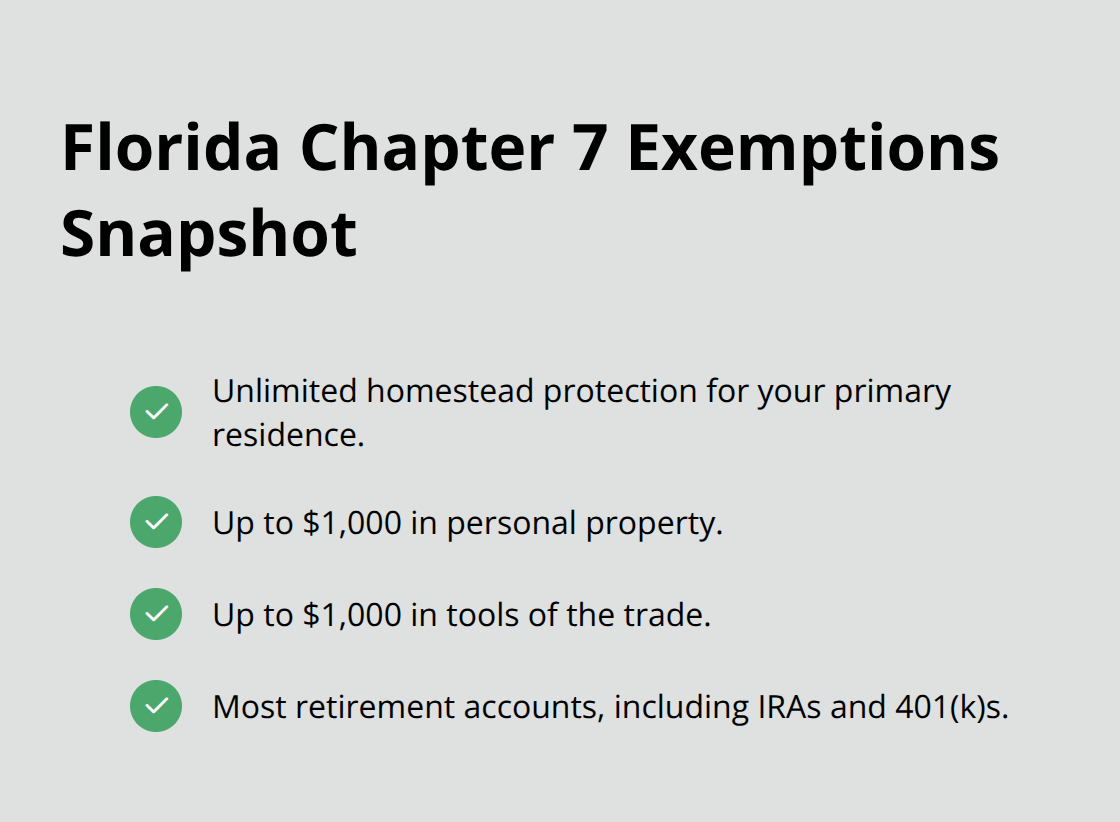
Your assets determine what you surrender in Chapter 7, and Florida exemption law is generous compared to most states. Florida allows you to exempt your primary residence without a dollar cap, which means your home equity stays fully protected regardless of value. You can also exempt up to $1,000 in personal property, $1,000 in tools or instruments of trade, and certain retirement accounts like IRAs and 401(k)s.
Most Florida Chapter 7 cases are no-asset cases, meaning the trustee finds nothing to liquidate after applying exemptions. If you own nonexempt property like a second vehicle, rental property, or significant cash, the trustee can liquidate it to pay creditors. However, you can negotiate with the trustee to keep nonexempt property by paying its value in cash or surrendering exempt property instead. This negotiation happens before the 341 meeting if you act quickly.
Secured Debts and Property Protection
Secured debts like mortgages and car loans are separate from exemptions-you must continue paying these debts if you want to keep the property, but the property itself stays protected from liquidation. Credit card debt and other unsecured obligations often qualify for complete discharge, relieving you of repayment obligations. An attorney reviewing your situation can identify which assets are exempt under Florida law and which create risk. We at Harnage Law, PLLC work with you to maximize your exemptions and structure your case to protect what matters most to you.
Final Thoughts
Debt forgiveness through Chapter 7 becomes real when you understand which debts vanish and which remain after discharge. The means test determines your eligibility, Florida exemptions protect your assets, and the trustee manages liquidation to resolve your case within three to six months. Most filers emerge with eliminated credit card balances, medical bills, and personal loans while keeping their homes and essential property intact.
Your path forward depends on your financial numbers and circumstances. If you earn below the Florida state median income, Chapter 7 likely works for you, and if you exceed it, the detailed means test calculation often reveals you still qualify because actual living expenses reduce your disposable income significantly. The filing process demands accuracy-missing documents delay your case, incomplete creditor lists leave debts undischarged, and errors on your petition create problems at the 341 meeting.
We at Harnage Law, PLLC help Florida residents stop creditor harassment, prevent wage garnishments, and halt lawsuits through Chapter 7 bankruptcy. Contact us to discuss your situation and learn whether debt forgiveness Chapter 7 is your path forward.