The means test determines whether you qualify for Chapter 7 bankruptcy in Florida. This financial assessment examines your income and expenses to decide if you have enough disposable income to repay creditors.
We at Harnage Law, PLLC help clients understand this process and navigate the numbers that matter. This guide breaks down the Florida means test guidance so you know exactly where you stand.
Understanding the Florida Means Test
What the Means Test Actually Measures
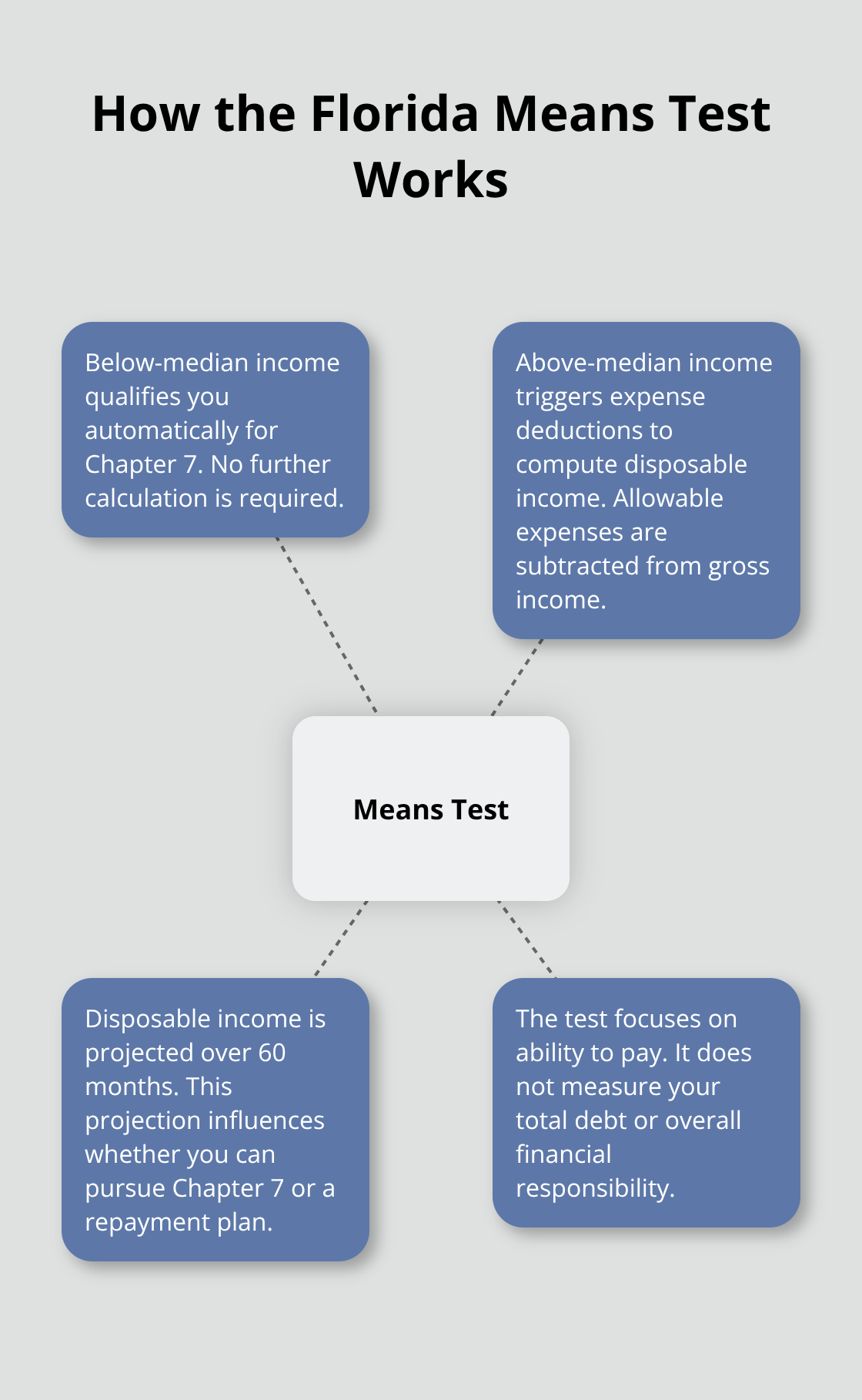
The means test is a financial formula that determines whether you have enough income left over after paying necessary expenses to repay some of your debts. It compares your average monthly income over the past six months to the Florida median income for your household size. If your income falls below the median, you typically qualify for Chapter 7 automatically. If your income exceeds the median, the test calculates your disposable income by subtracting allowable expenses from your gross income. This disposable income figure, projected over 60 months, determines whether you can afford a repayment plan or qualify for Chapter 7 debt discharge. The means test does not measure your total debt amount or your financial responsibility-it measures only your ability to pay based on current income and necessary living costs.
Income Thresholds That Determine Your Path
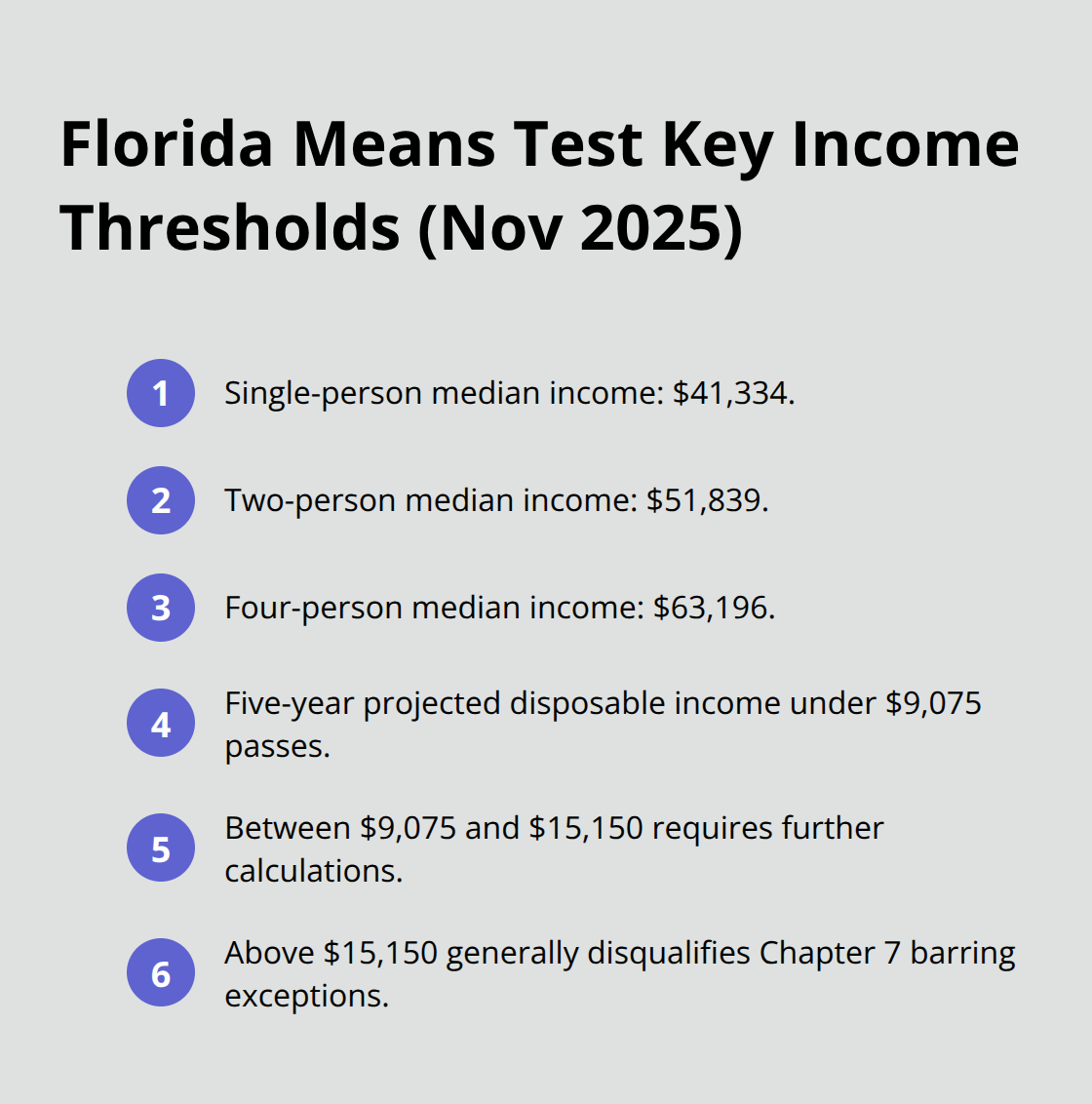
Florida median income thresholds as of November 2025 are straightforward: a single person earning below $41,334 annually passes automatically, while a family of four earning below $63,196 does the same. To calculate your position, average your gross monthly income for the six months before filing and multiply by 12. If you earn $3,000 monthly on average, your annualized income is $36,000-below the single-person threshold and triggering presumptive Chapter 7 eligibility. Earning $4,200 monthly puts you at $50,400 annually, still below the two-person threshold of $51,839. The income thresholds reset approximately every six months, so filing timing matters if your income hovers near a threshold. Above the median, the test shifts to expense deductions. You subtract mortgage payments, property taxes, healthcare costs, child support, and other allowable expenses to calculate disposable income. If your five-year projected disposable income totals less than $9,075, you pass the means test and qualify for Chapter 7 regardless of exceeding the median. Between $9,075 and $15,150, additional calculations determine eligibility. Above $15,150, Chapter 7 becomes unavailable unless exceptions apply-such as disabled veterans with 30% or higher disability ratings who incurred debts during active duty or homeland defense activities.
How Expense Deductions Shape Your Outcome
The means test outcome directly determines which bankruptcy chapter suits your situation. Passing the test opens Chapter 7, allowing you to discharge qualifying unsecured debts like credit cards and personal loans within months. Failing the test typically pushes you toward Chapter 13, a three to five-year repayment plan based on your disposable income calculation. This distinction matters enormously-Chapter 7 offers faster relief and lower attorney fees, while Chapter 13 requires sustained monthly payments but allows you to keep secured assets like homes and vehicles. Certain expense deductions significantly impact your outcome. Including actual mortgage payments, property insurance, and real property taxes reduces disposable income immediately. Healthcare costs, childcare expenses, and court-ordered payments like child support or alimony further lower your calculated disposable income. Self-employed filers can deduct legitimate business expenses from gross receipts, potentially reducing their reported income substantially. Documenting these expenses with bank statements, receipts, and payment records strengthens your position and prevents delays during the filing process. The six-month lookback period matters strategically-if you recently lost income or faced significant expenses, the averaged income reflects your true financial situation rather than a single month’s snapshot.
Strategic Timing and Special Circumstances
Filing timing can influence your means test outcome, particularly if your income hovers near a threshold or if you recently experienced a major financial change. Income reductions from job loss, medical emergencies, or reduced hours all factor into your six-month average. Certain circumstances can overcome presumptions of abuse even when your disposable income appears high. Serious medical conditions, military deployment, significant changes in expenses, and other hardships may qualify as special circumstances. Disabled veterans with service-connected disabilities rated at 30% or higher who incurred debts primarily during active duty or homeland defense activities do not have to pass the means test at all. These exceptions require documentation-medical records, termination notices, disability determinations, or other evidence that proves your situation. Understanding which deductions apply to your specific circumstances and which exceptions might protect your Chapter 7 eligibility requires careful financial analysis. The next section walks through the actual calculation process, showing you how to determine your average monthly income and identify which expenses the means test allows you to deduct.
Calculating Your Six-Month Income Average and Identifying Deductible Expenses
Gather Your Income Documentation
Start your means test calculation by collecting six months of pay stubs, bank statements, and income documentation from the period immediately before you file. The means test uses gross income, not take-home pay, so you must include all wages, bonuses, tips, self-employment income, rental income, and pension payments before taxes are removed. Average these six months together, then multiply by twelve to annualize your income for comparison against Florida’s median thresholds.
If you earned $2,800 in January, $3,100 in February, $2,950 in March, $3,200 in April, $3,050 in May, and $3,300 in June, your six-month total reaches $18,400, which averages to $3,067 monthly and annualizes to $36,804. This figure directly determines whether you clear the income threshold or must proceed to expense calculations.
Handle Self-Employment Income Correctly
Self-employed filers must deduct legitimate business expenses from gross receipts before calculating average monthly income. The IRS Standards for self-employment expenses apply, meaning you cannot claim arbitrary deductions without documentation. If your business grossed $5,000 monthly but your actual expenses for supplies, rent, and equipment averaged $1,200, your net self-employment income is $3,800 monthly.
Seasonal income fluctuations matter significantly. A contractor earning $8,000 monthly in summer and $1,000 in winter still uses the six-month average of $4,500, which reflects reality better than peak months alone. This averaging protects filers whose income varies throughout the year.
Identify Every Allowable Expense Deduction
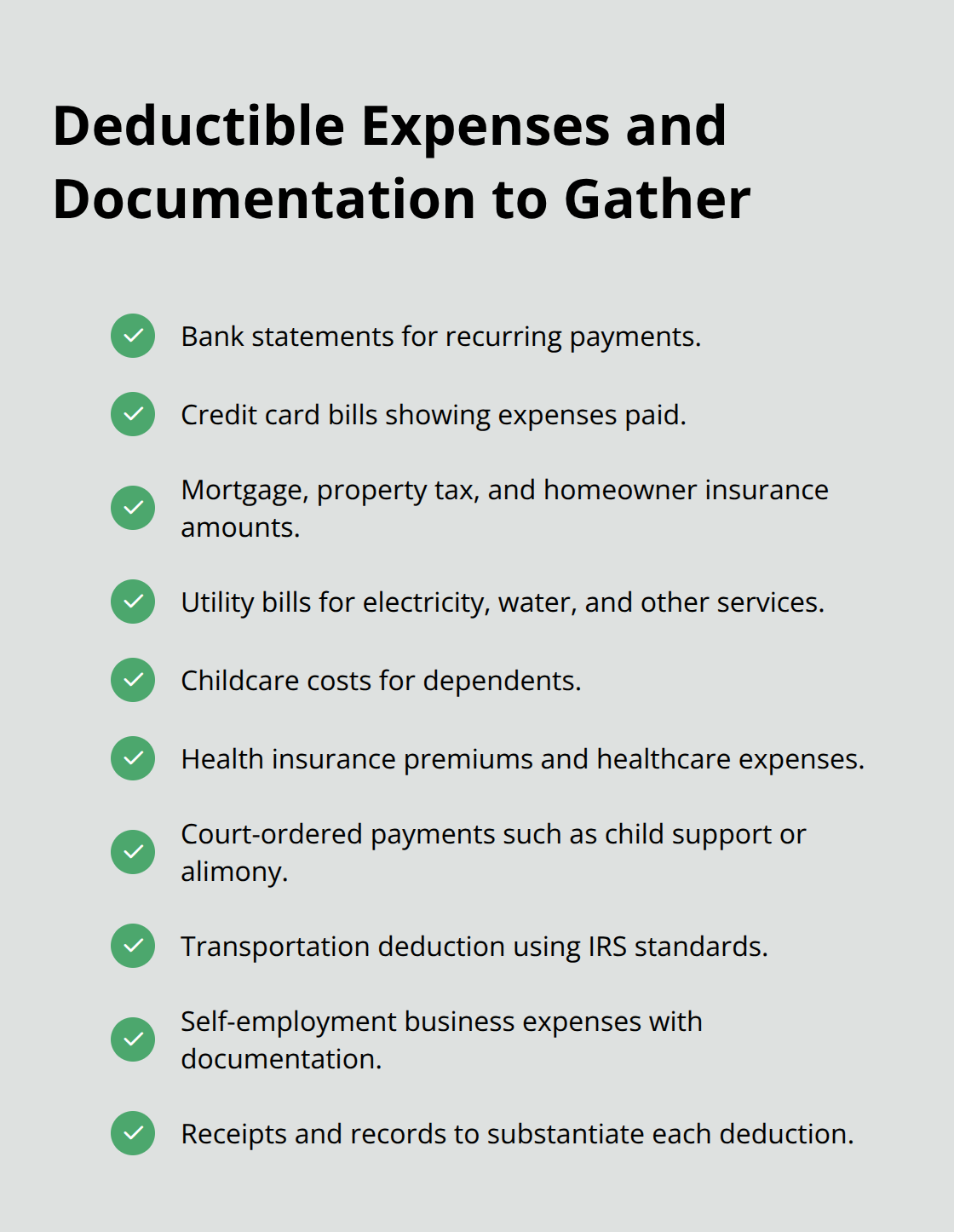
Once you establish your income, you must identify every allowable expense deduction available under Florida law and the means test standards. Mortgage payments, property taxes, homeowner insurance, and utilities reduce your disposable income immediately, as do actual childcare costs for dependents. The means test recognizes health insurance premiums, disability insurance, and term life insurance as legitimate deductions.
Court-ordered payments including child support and alimony are fully deductible, as are priority tax obligations and secured debt payments. Transportation costs use IRS standards-the current allowance for vehicle operation and maintenance typically exceeds actual costs for most filers, meaning you claim the standard amount rather than receipts. Healthcare expenses beyond insurance premiums can include out-of-pocket medical costs, prescription medications, and necessary medical equipment.
Document Your Deductions Thoroughly
You must gather bank statements, credit card bills, and payment records that document every deduction you plan to claim. If you pay $1,400 monthly mortgage, $250 property tax, $100 insurance, $180 utilities, $400 childcare, and $300 healthcare costs, your allowable expenses total $2,630 before transportation and other categories. Many filers underestimate their deductible expenses and fail to claim legitimate reductions, which inflates their calculated disposable income and harms their Chapter 7 eligibility.
Filers who fail to document expenses or overlook deductible categories often discover too late that they could have qualified for Chapter 7 with proper calculations. Thorough preparation before filing prevents this costly mistake. With your income and expenses calculated, you now move to the critical step of determining whether your disposable income places you above or below the thresholds that control your bankruptcy path.
Your Means Test Result and What Comes Next
Passing the Means Test Opens Chapter 7
Passing the means test qualifies you for Chapter 7 bankruptcy. If your six-month annualized income falls below Florida’s median for your household size, you pass immediately without further calculations. A single person earning $38,000 annually passes the income threshold of $41,334, triggering presumptive Chapter 7 eligibility. If your income exceeds the median but your five-year projected disposable income totals less than $9,075, you also pass the means test. This outcome opens the door to Chapter 7 discharge, allowing you to eliminate qualifying unsecured debts like credit cards, personal loans, and medical bills within four to six months. The filing fee in Florida is $338, and most Chapter 7 cases conclude faster and cost less than Chapter 13 alternatives. You must still complete a personal financial management course within 60 days after your initial creditor meeting, but passing the means test removes the largest barrier to debt discharge.
Failing the Means Test Typically Leads to Chapter 13
Failing the means test pushes you toward Chapter 13 bankruptcy, which requires a three to five-year repayment plan based on your calculated disposable income. If your five-year projected disposable income exceeds $15,150, the means test presumes you can afford Chapter 13. Between $9,075 and $15,150, additional calculations determine whether Chapter 13 becomes mandatory. Chapter 13 forces monthly payments to creditors according to a court-approved plan, but it allows you to keep secured assets like your home and vehicle while catching up on mortgage arrears or car loans.
Verify Your Deductions Before Accepting Chapter 13
Many filers facing Chapter 13 overlook legitimate expense deductions that could shift them below the $9,075 threshold. Childcare costs, healthcare expenses, court-ordered payments, and self-employment business expenses frequently get missed during initial calculations. Before accepting a Chapter 13 outcome, verify that you claimed every allowable deduction accurately. If your means test calculation included errors or missed deductions, recalculating could shift your result to Chapter 7 eligibility.
Strategic Timing Can Influence Your Outcome
Some filers strengthen their position before filing by reducing income through strategic job changes or timing their filing to capture recent income reductions. A job loss in the six months before filing significantly lowers your average income calculation, potentially moving you below the median threshold. Documented medical emergencies, disability determinations, or major expense increases also influence your means test outcome favorably. Disabled veterans with service-connected disabilities rated 30% or higher who incurred debts primarily during active duty or homeland defense activities bypass the means test entirely and qualify for Chapter 7 regardless of income. Filing timing matters substantially when your income hovers near a threshold or when you have experienced recent financial changes.
Final Thoughts
The Florida means test guidance you’ve learned throughout this article provides the foundation for understanding your Chapter 7 eligibility. Your income threshold determines whether you qualify automatically, while your expense deductions shape your disposable income calculation if you exceed the median. Documenting every allowable deduction prevents costly mistakes that could push you toward Chapter 13 when Chapter 7 remains available.
Your next step involves gathering the documentation outlined in this guide: six months of pay stubs, bank statements, mortgage statements, childcare receipts, healthcare costs, and any court-ordered payment records. Calculate your six-month average income, annualize it, and compare against Florida’s median for your household size. If you fall below the threshold, you likely qualify for Chapter 7 immediately; if you exceed it, identify every deductible expense and calculate your five-year projected disposable income.
We at Harnage Law, PLLC guide clients through this exact process and assist individuals and families in overcoming financial challenges by providing legal guidance and representation throughout the Chapter 7 bankruptcy process. We focus on helping you discharge qualifying debts, stop creditor harassment, prevent wage garnishments, and halt lawsuits through personalized legal services tailored to your specific financial situation. Contact us for a free consultation to review your numbers and discuss your path forward toward a fresh financial start.