Chapter 7 bankruptcy offers Florida residents a path to eliminate unsecured debts and start fresh financially. The process involves several key stages, from your initial consultation through the final discharge order.
At Harnage Law, PLLC, we guide clients through each step of the Chapter 7 process in Florida with clarity and support. Understanding what happens at every milestone helps you prepare and move forward with confidence.
Initial Consultation and Case Evaluation in Florida
Understanding Your Financial Situation
The first step in your Chapter 7 journey involves a thorough review of your financial picture. At this stage, we collect details about your debts, income, employment history, and assets to determine whether Chapter 7 is the right path forward. This conversation is straightforward and judgment-free. You need to disclose what debts you carry-credit cards, medical bills, personal loans, payday loans-and which ones qualify for discharge under Chapter 7. Not all debts disappear in bankruptcy; student loans, child support, recent taxes, and alimony typically survive discharge. Knowing this distinction upfront prevents surprises later.
Assessing Income and the Means Test
Your income against Florida’s current median household income determines much of your Chapter 7 eligibility. According to the U.S. Trustee Program, if your income falls below the state median, you likely qualify for Chapter 7 without additional scrutiny. If your income exceeds the median, the Means Test calculation determines whether you have disposable income that would require a Chapter 13 repayment plan instead. This calculation matters because it directly affects which bankruptcy chapter fits your situation. We prepare this calculation during intake using your recent pay stubs, tax returns, and expense information.
Maximizing Florida’s Asset Protections
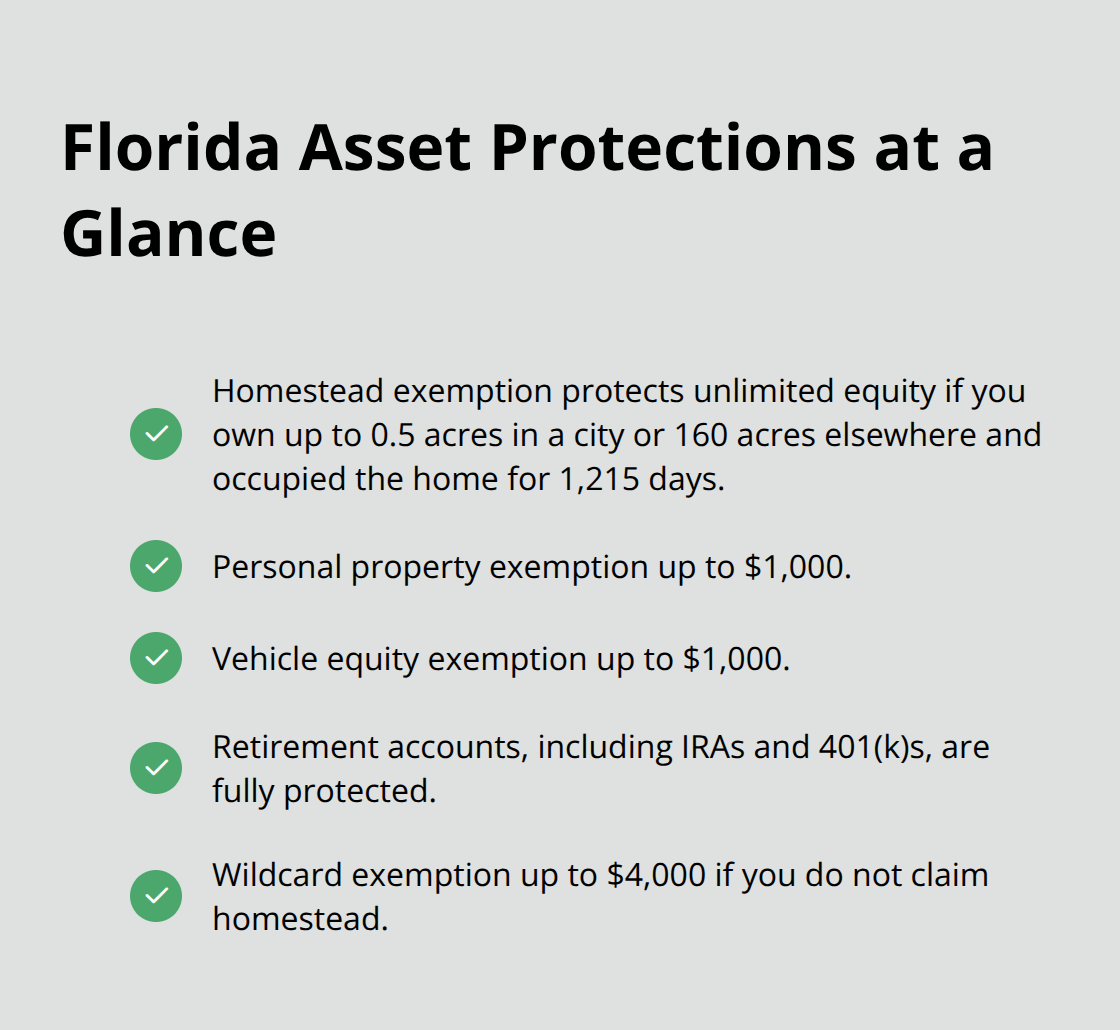
Florida offers some of the strongest asset protections in the nation, and understanding these protections shapes your entire bankruptcy strategy. The homestead exemption protects unlimited equity in your primary residence if you own up to 0.5 acres inside a city or up to 160 acres elsewhere, provided you occupied the home for at least 1,215 days before filing. This protection is powerful and often preserves the family home through Chapter 7. Beyond homestead, you can protect up to $1,000 in personal property, a $1,000 vehicle equity cushion, and full protection for retirement accounts including IRAs and 401(k)s. If you do not claim the homestead exemption, a wildcard exemption up to $4,000 offers additional flexibility for other assets.
We assess which exemptions apply to your specific situation and structure your filing to maximize these protections. Many clients are surprised to learn they lose nothing because their assets fall comfortably within Florida’s exemption limits.
Confirming Chapter 7 Eligibility
Chapter 7 eligibility hinges on passing the Means Test calculation and having primarily unsecured debts. We also confirm you have not received a discharge in a previous bankruptcy within the last eight years, which would disqualify you from Chapter 7. Timing matters here; if you filed Chapter 7 previously, we calculate the exact date when you become eligible again. We also discuss whether your spouse should file jointly or separately, as joint filing can double certain exemptions and often costs less than filing individually. This decision requires careful analysis of each spouse’s debts and assets. Once we confirm Chapter 7 eligibility, we outline the complete timeline, explain mandatory credit counseling requirements, and discuss the $338 filing fee and payment options. With your financial situation mapped and eligibility confirmed, you move into the filing stage where your petition takes shape.
Filing Your Bankruptcy Petition and Facing Creditors
Preparing and Submitting Your Complete Petition Package
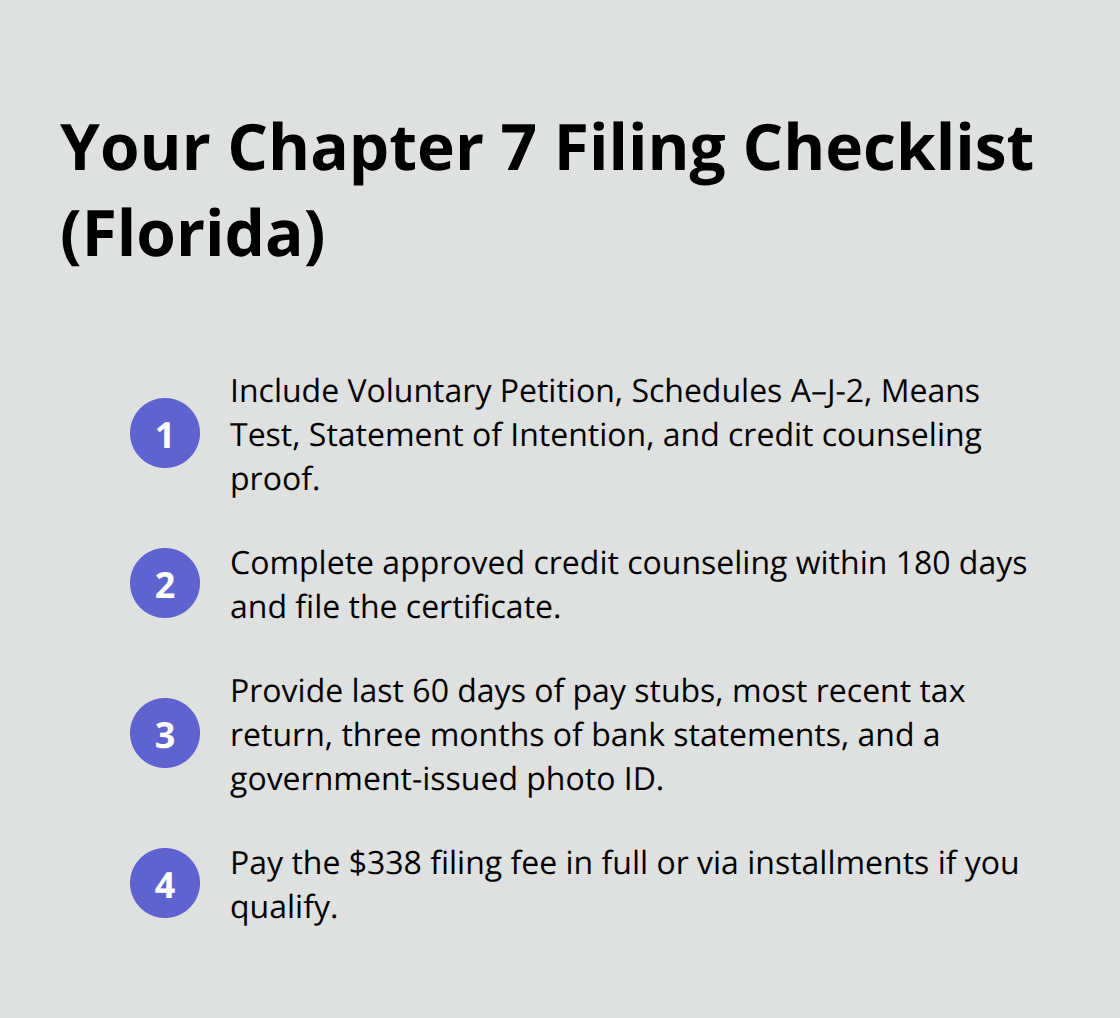
Once eligibility is confirmed, you move into the filing stage, where precision and timing become critical. Your complete petition package includes your Voluntary Petition, Schedules A through J-2, the Means Test calculation, your Statement of Intention for any secured debts, and proof of completed credit counseling. The U.S. Trustee Program requires you to complete an approved credit counseling course within 180 days before filing and submit your Certificate of Credit Counseling along with your petition. You must gather your last 60 days of pay stubs, your most recent tax return, three months of bank statements, and a government-issued photo ID. The filing fee is $338, payable in full at filing or through installment payments if your income qualifies.
Filing at the Clerk’s Office and Triggering the Automatic Stay
You file your petition at the clerk’s office, and the automatic stay takes effect immediately upon filing. This stay stops wage garnishments, foreclosures, utility shut-offs, and creditor calls in their tracks. The court assigns a case number and mails notices to every creditor listed on your schedules. Missing the 14-day deadline to file your complete schedules and payment advices leads to dismissal, so submitting everything on time is essential.
The 341 Meeting of Creditors
The 341 Meeting of Creditors, also called the Meeting of Creditors, occurs roughly 20 to 40 days after filing and is led by your appointed Chapter 7 Trustee, not a judge. This meeting typically lasts five to ten minutes, and most creditors never attend. You must bring your photo ID, original schedules, and recent tax return, and you will be under oath. The Trustee asks questions about your assets, debts, property transfers, and whether you own anything of value. Many clients fear this meeting, but it is straightforward when you are prepared.
Handling Creditor Objections
If creditors object to your discharge (which is rare), the objection must be filed within 60 days after the 341 Meeting according to federal bankruptcy rules. Common objections claim fraud or that you concealed assets, but these require concrete evidence. Most Chapter 7 cases proceed without objection because debtors who file honestly and follow court procedures have little to fear.
Completing the Financial Management Course
After the 341 Meeting, you must complete a post-petition Financial Management Course within 60 days and file your certificate of completion. This course is the final requirement before your credit score is affected by your discharge order, and it prepares you to manage finances responsibly moving forward.
Debt Discharge and Your Financial Fresh Start in Florida
Understanding Your Discharge Timeline and What It Means
Your Chapter 7 discharge typically arrives three to five months after your 341 Meeting, according to the United States Courts. The exact timing depends on whether creditors file objections and how quickly you complete your post-petition Financial Management Course and file the certificate. Once the court issues your discharge order, most unsecured debts vanish permanently. Credit cards, medical bills, personal loans, and payday loans disappear. The automatic stay that protected you from creditor calls during the filing process becomes permanent through discharge-creditors cannot legally contact you about discharged debts, and violations carry court penalties.
Protected Assets You Keep Throughout Chapter 7
Florida’s exemption laws mean you likely kept your home, vehicle, and retirement accounts intact throughout this process. The homestead exemption protected your primary residence with unlimited equity if you owned up to 0.5 acres inside a city or 160 acres elsewhere. Your retirement accounts including IRAs and 401(k)s remained fully protected because federal bankruptcy law shields these accounts regardless of their balance. Personal property up to $1,000 and vehicle equity up to $1,000 stayed with you as well. If you did not use the homestead exemption, your wildcard exemption of up to $4,000 gave you flexibility to protect other assets. The Chapter 7 Trustee only liquidates non-exempt assets, and most Florida filers own nothing the trustee can sell because their property falls within exemption limits.
Rebuilding Credit After Discharge
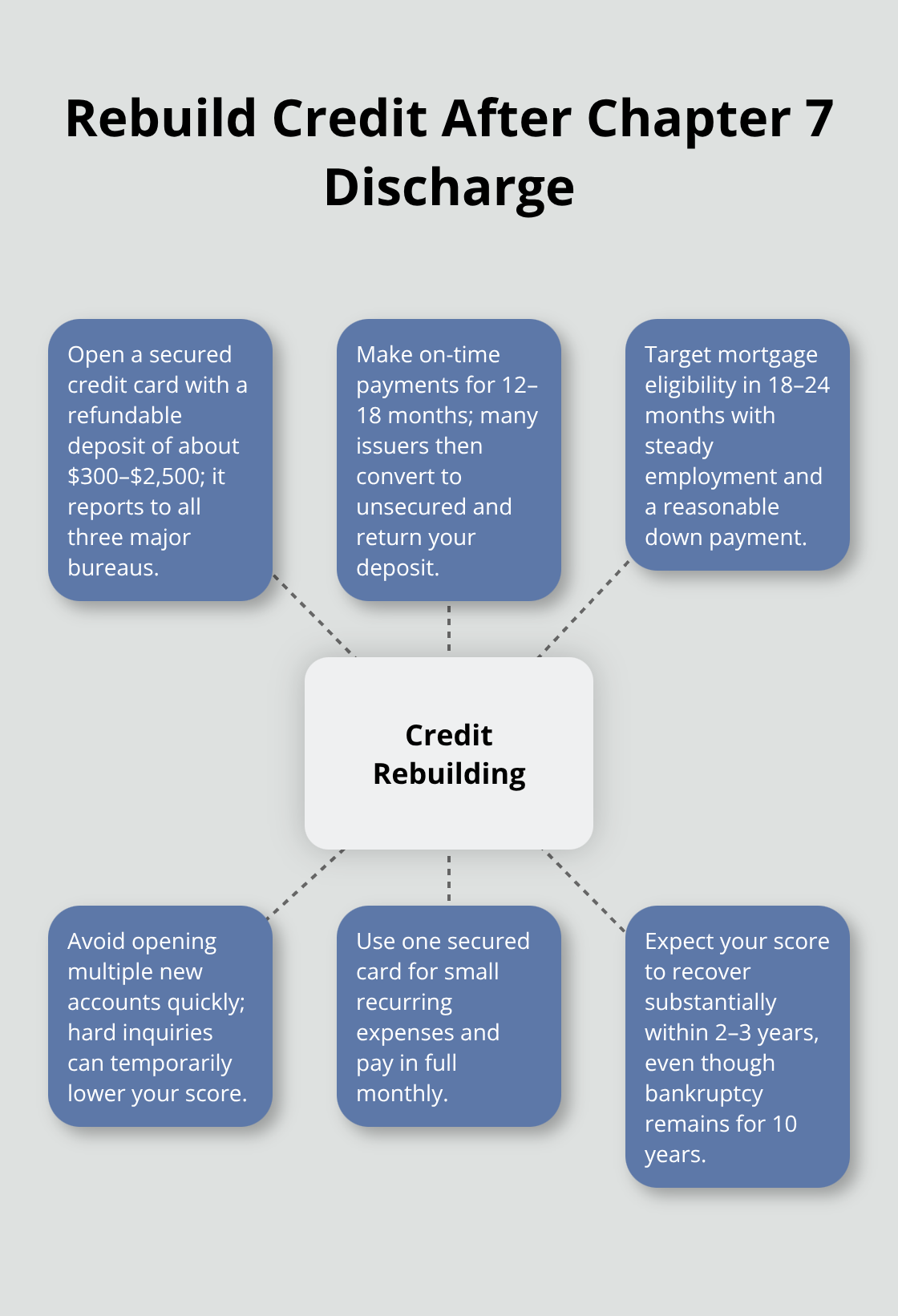
Rebuilding credit after discharge requires a deliberate strategy rather than waiting passively. Your bankruptcy appears on your credit report for ten years, but your score can recover substantially within two to three years through intentional financial behavior. Secured credit cards designed for rebuilding represent your strongest first move-these cards require a cash deposit that becomes your credit limit, typically ranging from $300 to $2,500, and they report to all three major credit bureaus. After twelve to eighteen months of on-time payments, many issuers convert secured cards to unsecured cards and return your deposit.
Strategic Steps to Restore Your Credit Score
Utility bills and phone payments do not build credit history, so secured cards matter far more than these expenses. Your first mortgage or auto loan after discharge also accelerates rebuilding because installment credit carries more weight than revolving credit in credit scoring models. Many lenders approve qualified borrowers for mortgages within eighteen to twenty-four months after discharge, particularly if you have steady employment and a reasonable down payment saved. Avoid opening multiple new accounts quickly-creditors view rapid account opening as a red flag, and each new account temporarily lowers your score through a hard inquiry. Instead, open one secured card, use it for small recurring expenses like a monthly subscription, and pay the full balance monthly. This pattern demonstrates responsible credit management far more effectively than carrying a balance.
Monitoring Your Credit Report and Enforcing Your Discharge
Check your credit report annually to verify that discharged debts are marked as such and to catch any errors. Creditors sometimes ignore discharge orders and continue reporting accounts as active or delinquent, which violates the discharge injunction and warrants a letter from your attorney (or Harnage Law, PLLC if you worked with us) demanding correction.
Final Thoughts
The Chapter 7 process in Florida moves through distinct stages, each with specific deadlines and requirements that shape your path to discharge. From your initial intake conversation where we assess your financial situation and confirm eligibility, through the filing stage where the automatic stay stops creditor harassment immediately, to your 341 Meeting and final discharge order arriving three to five months later, every milestone builds toward your fresh start. The process demands attention to detail-missing the 14-day deadline to file complete schedules leads to dismissal, and skipping your post-petition Financial Management Course delays discharge-but with proper guidance, these requirements become manageable steps rather than obstacles.
After discharge, your financial recovery accelerates through intentional credit rebuilding. A secured credit card opened immediately after discharge, paired with on-time payments and steady employment, positions you for mortgage approval within eighteen to twenty-four months. Your bankruptcy appears on your credit report for ten years, but your score recovers substantially within two to three years through responsible financial behavior, and many clients report that life normalizes quickly after discharge as creditor calls stop and wage garnishments end.
If you face financial hardship in Florida, contact Harnage Law, PLLC to discuss whether Chapter 7 bankruptcy offers the fresh start you need. We provide personalized guidance through every step of the Chapter 7 process in Florida.