Overwhelming debt can feel like it has no end. Chapter 7 bankruptcy offers a genuine path forward for Florida residents struggling with financial obligations they cannot repay.
We at Harnage Law, PLLC understand that a fresh start Florida bankruptcy provides isn’t just about eliminating debt-it’s about rebuilding your financial life. This guide walks you through how Chapter 7 works, who qualifies, and what to expect from start to finish.
What Happens to Your Debts and Assets in Chapter 7
The Automatic Stay Stops Creditor Actions Immediately
Filing Chapter 7 in Florida activates the automatic stay the moment your petition reaches the court. This federal injunction halts all creditor collection efforts-wage garnishments stop, foreclosure proceedings pause, repossession attempts cease, and collection calls end. The U.S. Bankruptcy Code Section 362 makes this automatic; creditors cannot ignore it without facing contempt charges. This breathing room typically lasts until your case closes, usually within four to six months.
Florida Exemptions Protect Most of Your Assets
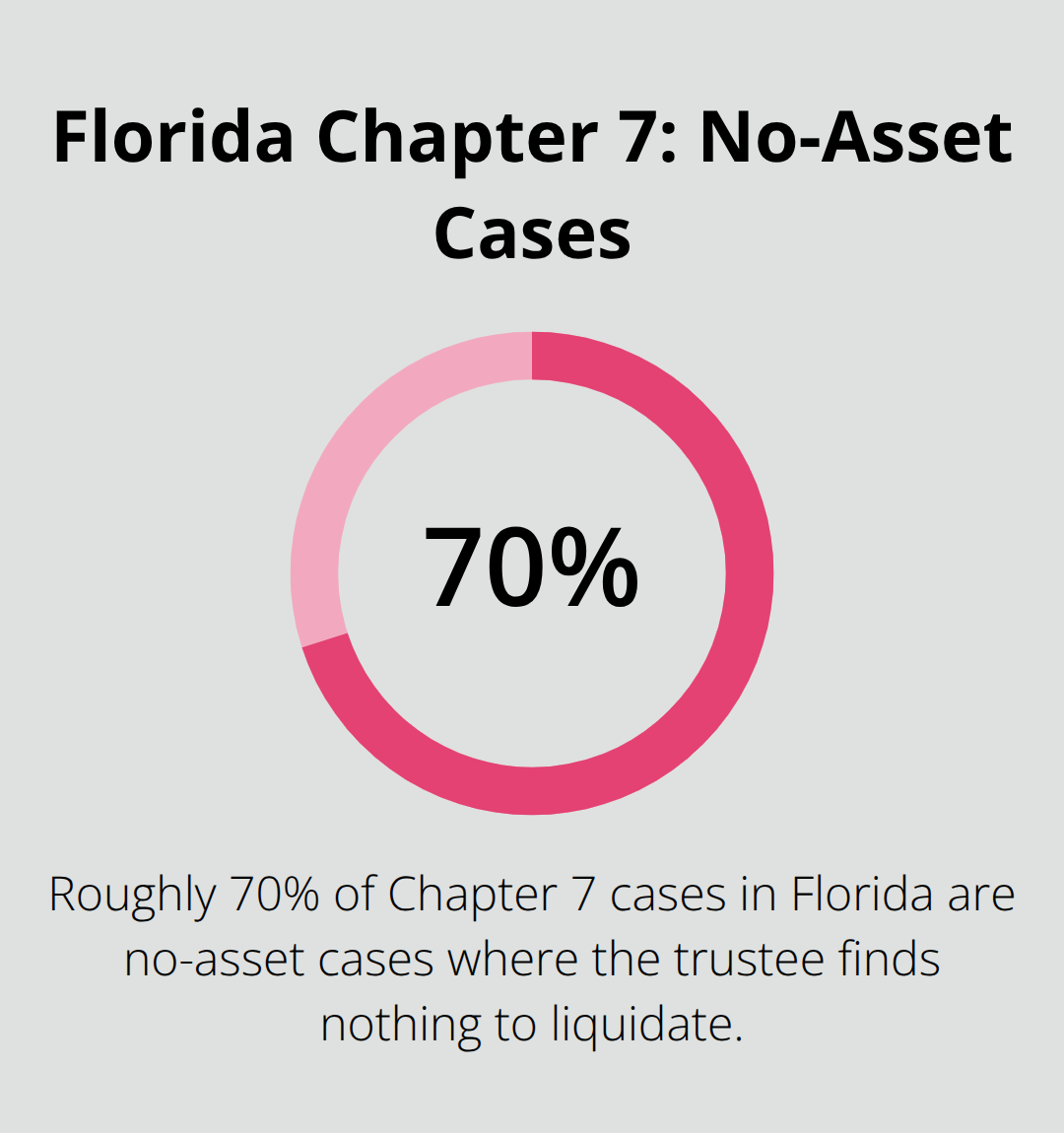
A trustee appointed by the court reviews your assets to identify what qualifies as nonexempt property. Florida law provides robust exemptions that protect most people’s essential belongings. Your primary residence receives unlimited equity protection if you’ve owned it for at least 1,215 days before filing, though a federal cap of $214,000 applies if you haven’t met that timeline. One vehicle stays protected up to $5,000 in equity, retirement accounts like 401(k)s and IRAs remain sheltered up to $1,711,975 per person for cases filed between April 1, 2025 and March 31, 2028 according to federal bankruptcy limits, and personal property such as furniture and household items receive up to $1,000 protection (or $4,000 if you don’t use the homestead exemption). Because Florida exemptions are generous, roughly 70% of Chapter 7 cases in Florida are no-asset cases where the trustee finds nothing to liquidate, meaning you keep virtually everything.
Debt Discharge Eliminates Most Obligations
Your qualifying debts receive a discharge-a permanent elimination that prevents creditors from pursuing collection. Credit card balances, medical bills, personal loans, and similar unsecured debts vanish after discharge. However, certain obligations survive bankruptcy and remain your responsibility: child support and alimony, most student loans, recent tax debts, criminal fines, and debts incurred through fraud. Co-signers on discharged debts may still face collection attempts since discharge only protects you, not those who guaranteed your obligations.
What Happens After Discharge
The discharge typically arrives three to six months after you file, and once it’s granted, creditors cannot contact you about discharged debts or pursue collection through lawsuits, wage garnishment, or bank levies. This means any income you earn after discharge stays yours, and your financial obligations shrink dramatically. The practical benefit is substantial: if you owe $50,000 in credit card debt and $15,000 in medical bills but own a modest home and one vehicle, Chapter 7 eliminates those unsecured debts while you retain your home and car through Florida’s exemptions.
Understanding what assets you’ll keep and which debts will disappear is essential before you move forward. The next section explains who actually qualifies for Chapter 7 and what income thresholds determine your eligibility.
Who Qualifies for Chapter 7 in Florida
Income Requirements and the Means Test
Your income determines whether Chapter 7 is available to you, and Florida uses a specific means test to make this decision. If your monthly income falls below Florida’s median income for your household size, you likely qualify immediately. For 2026, the median income for a single filer in Florida is approximately $65,000 annually, while a family of four sits around $135,000 annually according to data from the U.S. Trustee. If you earn above these thresholds, you must complete Official Forms 122A-1 and 122A-2, which calculate your disposable income by deducting allowed expenses from your gross income.
This calculation matters because if the trustee determines you have excess income, Chapter 7 becomes unavailable and Chapter 13 becomes your only option. The means test scrutinizes transportation costs, housing expenses, utilities, food, and childcare to establish what you actually need to live, then compares that to what you earn. Many filers assume they disqualify automatically based on income alone, but the detailed expense analysis often reveals they pass the means test anyway.
Debts That Disappear Through Chapter 7
Dischargeable debts vanish permanently through Chapter 7, while nondischargeable debts survive the bankruptcy and remain your obligation. Credit card balances, medical bills, personal loans, payday loans, and deficiency judgments from repossessed vehicles all disappear. The discharge order prevents creditors from pursuing collection through lawsuits, wage garnishment, or bank levies once the court grants your discharge.
Debts That Survive Bankruptcy
Child support and alimony obligations cannot be discharged regardless of your financial situation, making these debts a permanent priority. Most student loans remain nondischargeable unless you prove undue hardship, a legal standard that requires showing you cannot maintain a minimal standard of living while repaying the loans.
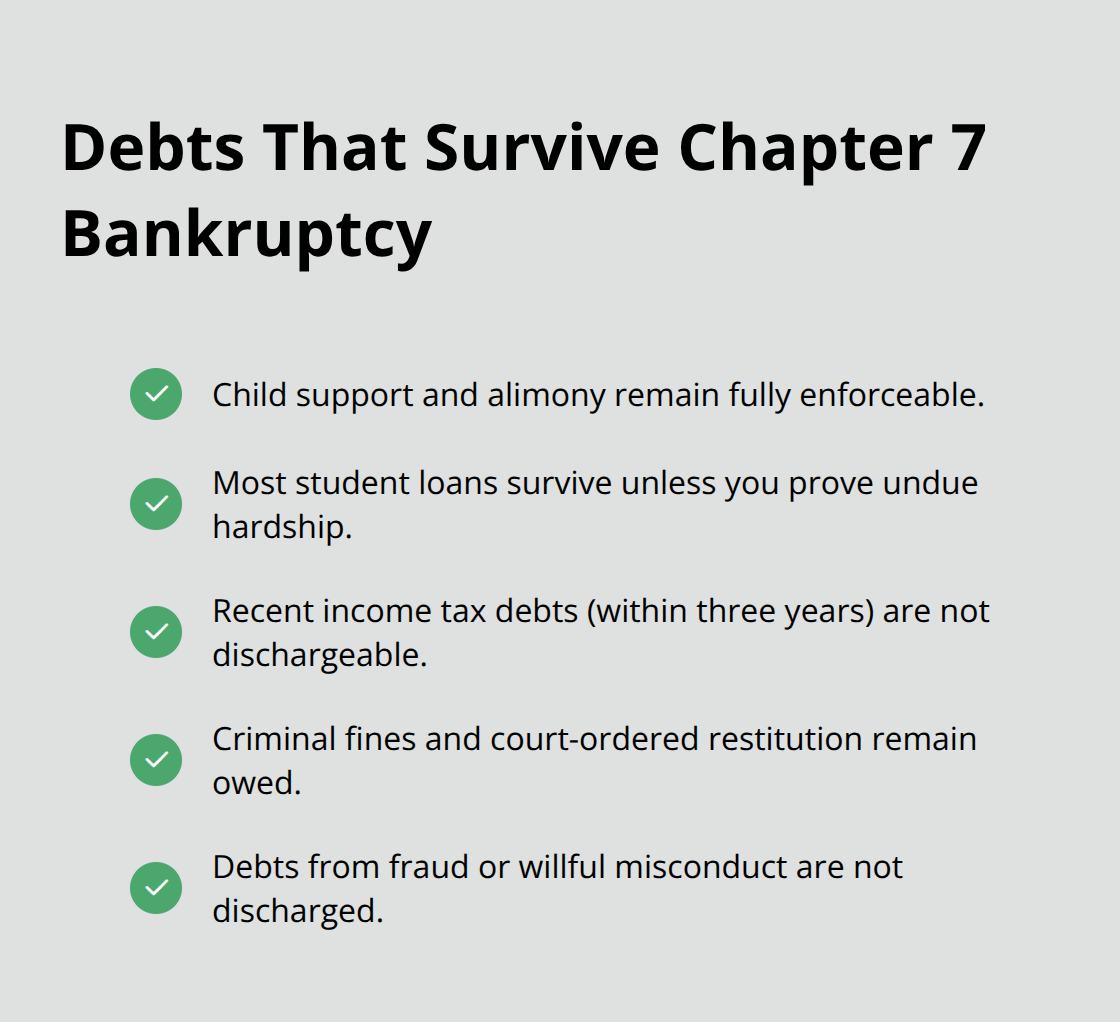
Recent income tax debts within three years of the filing date cannot be discharged, though older tax debt may qualify depending on when you filed your return. Criminal fines, restitution ordered by courts, and debts incurred through fraud or willful misconduct also survive.
The Co-Signer Problem
Co-signers present another critical issue: when you discharge a debt, the co-signer remains fully liable, so any person who guaranteed your obligation will face collection attempts after your discharge. This means a spouse, parent, or friend who signed with you on a loan receives no protection from your bankruptcy filing. Understanding which debts vanish and which remain is essential to realistic financial planning after bankruptcy, as you cannot assume all obligations disappear. The next section walks you through the actual Chapter 7 process timeline, showing you exactly what happens from the moment you file through the day you receive your discharge.
The Chapter 7 Process Timeline in Florida
The Chapter 7 process moves faster than most people expect, typically completing within four to six months from the moment you file your petition to the day you receive your discharge. Understanding the exact timeline and what happens at each stage removes uncertainty and helps you prepare mentally and financially for what’s ahead.
Filing Your Petition and Required Documentation
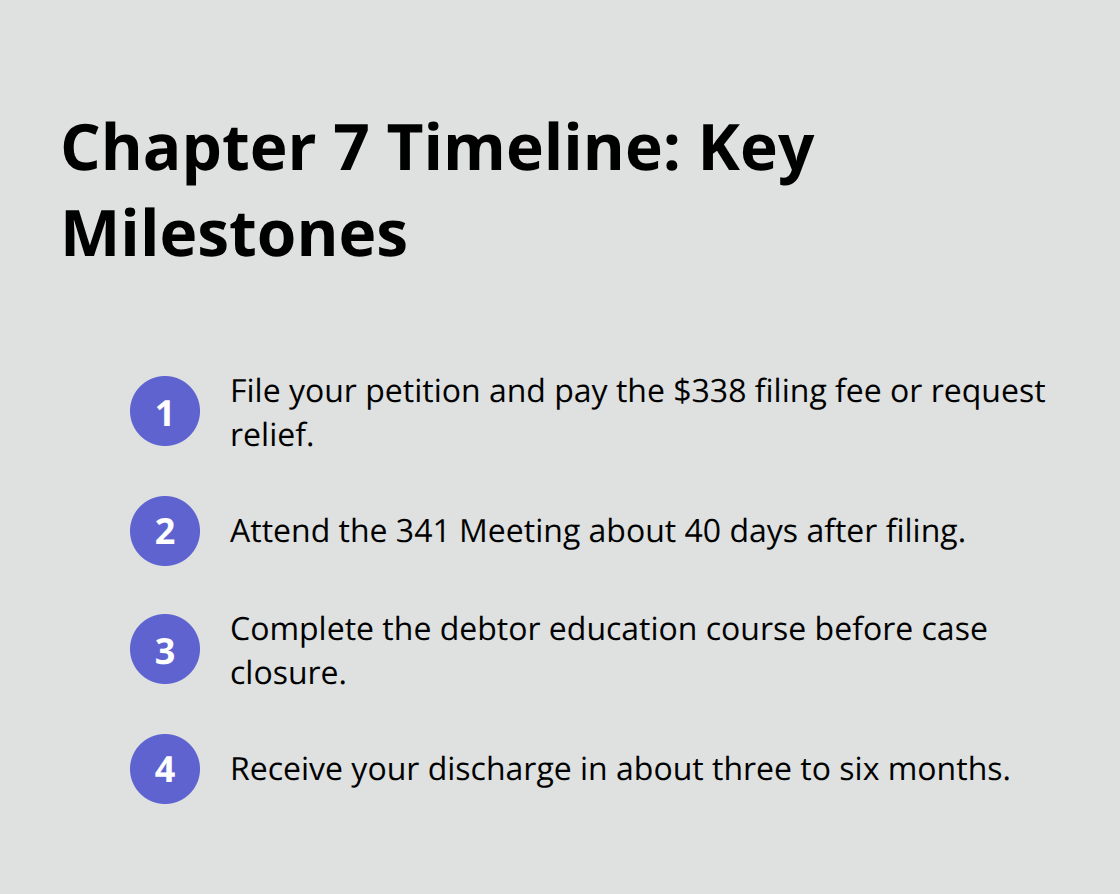
When you file your Chapter 7 petition in Florida, you must submit numerous documents simultaneously, and the Clerk of Court requires original signed petitions with wet signatures, not digital signatures. The filing fee stands at $338, though you can request installment payments or fee waivers if you meet income thresholds using Official Form 103B according to poverty guidelines.
Your petition must include the Voluntary Petition, Statement About Your Social Security Numbers (showing only the last four digits on most documents for privacy), Certificate of Credit Counseling completed within six months before filing from an agency approved by the U.S. Trustee, Creditor Matrix with names and addresses, and government-issued photo ID photocopy. You must also file schedules listing every asset, liability, income source, and expense, along with the Statement of Financial Affairs and Current Monthly Income calculation. If your income exceeds Florida’s median, you must complete the Means Test forms.
The Clerk of Court requires legible documents using current official forms, not outdated versions, and will reject filings containing old forms or illegible copies. Within 60 days of filing, you must provide copies of your last two months of pay advices or indicate if this requirement doesn’t apply.
The 341 Meeting of Creditors
Approximately 40 days after you file, the court schedules your 341 Meeting of Creditors, which despite its name is primarily a meeting between you and the trustee appointed to your case. This meeting occurs via Zoom at designated locations throughout Florida, and the trustee conducts an under-oath examination of your finances, asking questions about your assets, debts, income, and whether you concealed property or incurred suspicious debts before filing.
Creditors may attend but rarely do in routine Chapter 7 cases, making the meeting typically brief and far less intimidating than filers anticipate. The trustee searches for nonexempt property that can be liquidated to pay creditors, reviews whether you properly claimed all available Florida exemptions, and confirms you completed credit counseling before filing. If the trustee uncovers nonexempt assets, you can sometimes negotiate to keep them (by paying the trustee cash equal to their value or surrendering other exemptions).
Receiving Your Discharge Order
After the meeting concludes, the trustee has 60 days to file a final report, and if no objections emerge regarding your exemptions or discharge eligibility, the court issues your discharge order within three to six months after filing. Once discharge arrives, creditors cannot pursue any discharged debts through lawsuits, wage garnishment, or collection calls. You must complete a final debtor education course before the case officially closes. The entire timeline from petition to discharge typically spans four to six months for straightforward cases, though complex situations involving significant assets or disputed exemptions may extend longer.
Final Thoughts
Chapter 7 bankruptcy in Florida provides a legitimate path to eliminate overwhelming debt and rebuild your financial life. The automatic stay stops creditor harassment immediately, Florida’s generous exemptions protect your home, vehicle, and retirement accounts, and the discharge eliminates most unsecured debts within four to six months. The means test determines your eligibility, but many filers who assume they disqualify actually pass when their allowed expenses are calculated.
Understanding which debts disappear and which survive prevents unrealistic expectations about your fresh start Florida bankruptcy. Child support, student loans, and recent taxes remain your responsibility, while credit card balances, medical bills, and personal loans vanish permanently. The timeline moves faster than most people anticipate-you file your petition with required documentation, attend a brief 341 meeting with the trustee around 40 days later, and receive your discharge order within three to six months.
Contact Harnage Law, PLLC today to discuss whether Chapter 7 fits your circumstances and review your assets, debts, and eligibility. We can answer questions about Florida exemptions, explain how the means test applies to your income, and outline what to expect from filing through discharge. Your financial recovery starts with understanding your options and taking action.