
Filing Chapter 7 bankruptcy in Florida doesn’t mean losing everything you own. Federal and state laws protect many of your most valuable assets, from your home to your retirement savings.
At Harnage Law, PLLC, we help clients understand which assets stay protected and which ones are at risk. Knowing the rules around Chapter 7 assets protection can make the difference between rebuilding your finances and facing unnecessary losses.
What Assets Stay Protected in Florida Chapter 7
Your home receives the strongest protection under Florida law. The homestead exemption shields unlimited equity in your primary residence if you own it within half an acre in a municipality or up to 160 acres elsewhere, provided you’ve owned the property for at least 1,215 days before filing. This protection stands as one of the most powerful available-Florida Statutes Chapter 222 makes this exemption nearly unbeatable compared to other states. If you haven’t met the 1,215-day ownership requirement, a federal cap of $214,000 applies instead, which still protects most primary residences in Florida.
Retirement Accounts and Long-Term Savings
Your retirement accounts receive full protection regardless of balance size. ERISA-qualified plans like 401(k)s, 403(b)s, and pensions remain completely shielded from liquidation. Traditional and Roth IRAs stay protected up to approximately $1.7 million per person for cases filed between April 1, 2025 and March 31, 2028, according to federal bankruptcy law. This protection matters significantly because it prevents the trustee from touching decades of retirement savings that you’ve built for your future.
Motor Vehicles and Personal Belongings
You can protect up to $5,000 in equity in a motor vehicle under Florida law. If your car is worth $25,000 and you owe $22,000, that $3,000 equity stays protected. If you don’t claim the homestead exemption, you can use the wildcard exemption to protect an additional $4,000 in any property you choose-perhaps another vehicle, electronics, or valuable items.
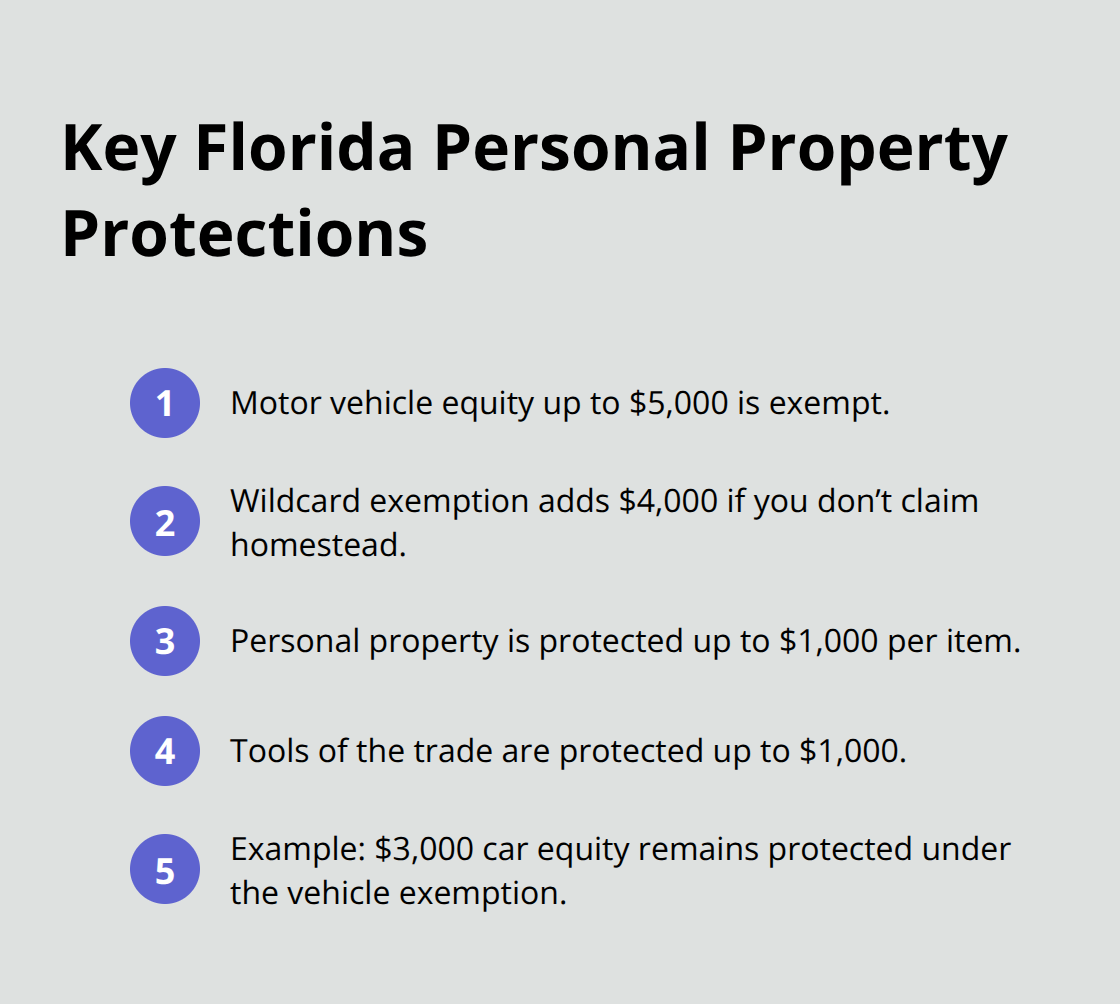
Personal property like clothing, furniture, books, and household goods are protected up to $1,000 per item with no total cap. Family heirlooms and basic household furnishings remain with you. Tools of your trade receive up to $1,000 protection, which matters if you’re self-employed or rely on specific equipment for your job.
Income and Government Benefits
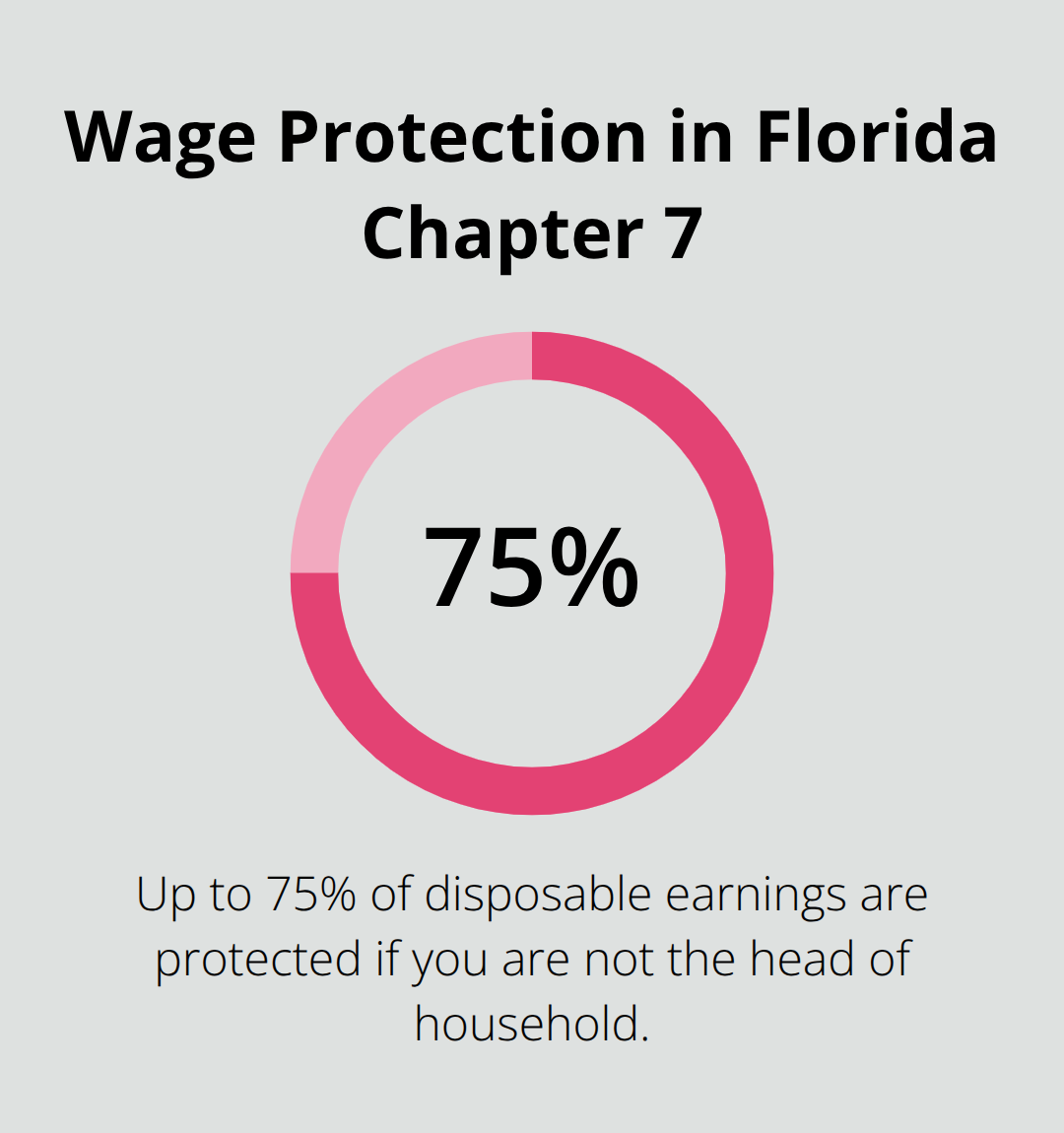
Your wages receive substantial protection. If you’re the head of household, your entire wages may be exempt. Otherwise, up to 75 percent of your disposable earnings or 30 times the federal minimum wage (whichever is greater) stays protected from creditors. Social Security benefits, disability payments, veterans benefits, and workers’ compensation are fully exempt.
Child support and alimony you receive are protected to the extent reasonably necessary for your support.
Understanding which assets stay protected forms only half the battle. The way you claim these exemptions on your bankruptcy petition determines whether the trustee respects them or challenges them in court.
How Exemptions Work to Safeguard Your Assets in Florida Chapter 7
Florida’s State Exemption System Gives You Maximum Protection
Claiming exemptions on your bankruptcy petition transforms asset protection from theory into reality. Florida law requires you to use state exemptions exclusively, and this requirement actually works in your favor. Florida has opted out of the federal bankruptcy exemption system, which means you cannot mix and match between state and federal rules. If you meet Florida’s residency requirement of 730 days before filing, you must use Florida exemptions. This restriction protects you because Florida’s homestead exemption is substantially stronger than the federal alternative. The federal homestead cap sits at $214,000, while Florida’s homestead protection has no dollar limit if you meet the ownership and acreage requirements. For someone with $400,000 in home equity and proper ownership history, the difference between federal and state exemptions means keeping your entire home instead of losing $186,000 to the bankruptcy trustee.
Strategic Use of Wildcard and Motor Vehicle Exemptions
The wildcard exemption adds another layer of protection that most filers underutilize. If you claim the homestead exemption, you get $1,000 in wildcard protection for additional property. If you skip the homestead exemption entirely, that wildcard exemption jumps to $4,000. This creates a real decision point: someone with a paid-off modest home but significant vehicle equity might actually benefit from abandoning homestead protection to shield $4,000 in an additional car or valuable electronics. Your motor vehicle exemption covers $5,000 in equity separately, so combining these protections strategically matters. A Florida resident with a $30,000 truck, $8,000 in tools for their contracting business, and $3,000 in jewelry protects all of it by claiming the $5,000 vehicle exemption, the $1,000 tools-of-trade exemption, and the $4,000 wildcard exemption. The bankruptcy trustee cannot touch any of those assets.
Proper Filing of Exemption Claims Prevents Permanent Loss
Failing to claim exemptions correctly means losing these protections permanently. When you file your petition, you list exemptions on Schedule C of your bankruptcy documents. The trustee reviews your claims within 14 days, and creditors get 30 days to object. If you fail to claim an exemption that applies to your property, you forfeit that protection. This is why listing every asset with accurate fair market values matters. A $2,000 laptop sitting in your home office needs to be listed and claimed as personal property, or the trustee can sell it to pay creditors.
Residency Rules Determine Your Exemption Eligibility
The residency rules add complexity that catches many filers off guard. You need 730 days of Florida residency before filing to use Florida exemptions. If you moved to Florida 18 months ago, you cannot use Florida exemptions yet. Instead, you must use the exemptions from whichever state you lived in the longest during the 180 days before the two-year look-back period. This timing issue means someone relocating for a job might face significantly weaker asset protection if they file too quickly. Planning your filing date around this 730-day threshold can preserve thousands in home equity or retirement account protection. The specific assets you own and your residency timeline interact to determine which exemptions apply to your situation.
Common Mistakes That Put Your Assets at Risk in Florida Chapter 7
Incomplete Exemption Claims Cost You Protected Property
The gap between understanding exemptions and actually protecting your assets comes down to execution. Most people lose property they could have kept because they make preventable mistakes before filing or during the process. The first critical error is incomplete or inaccurate exemption claims on Schedule C.
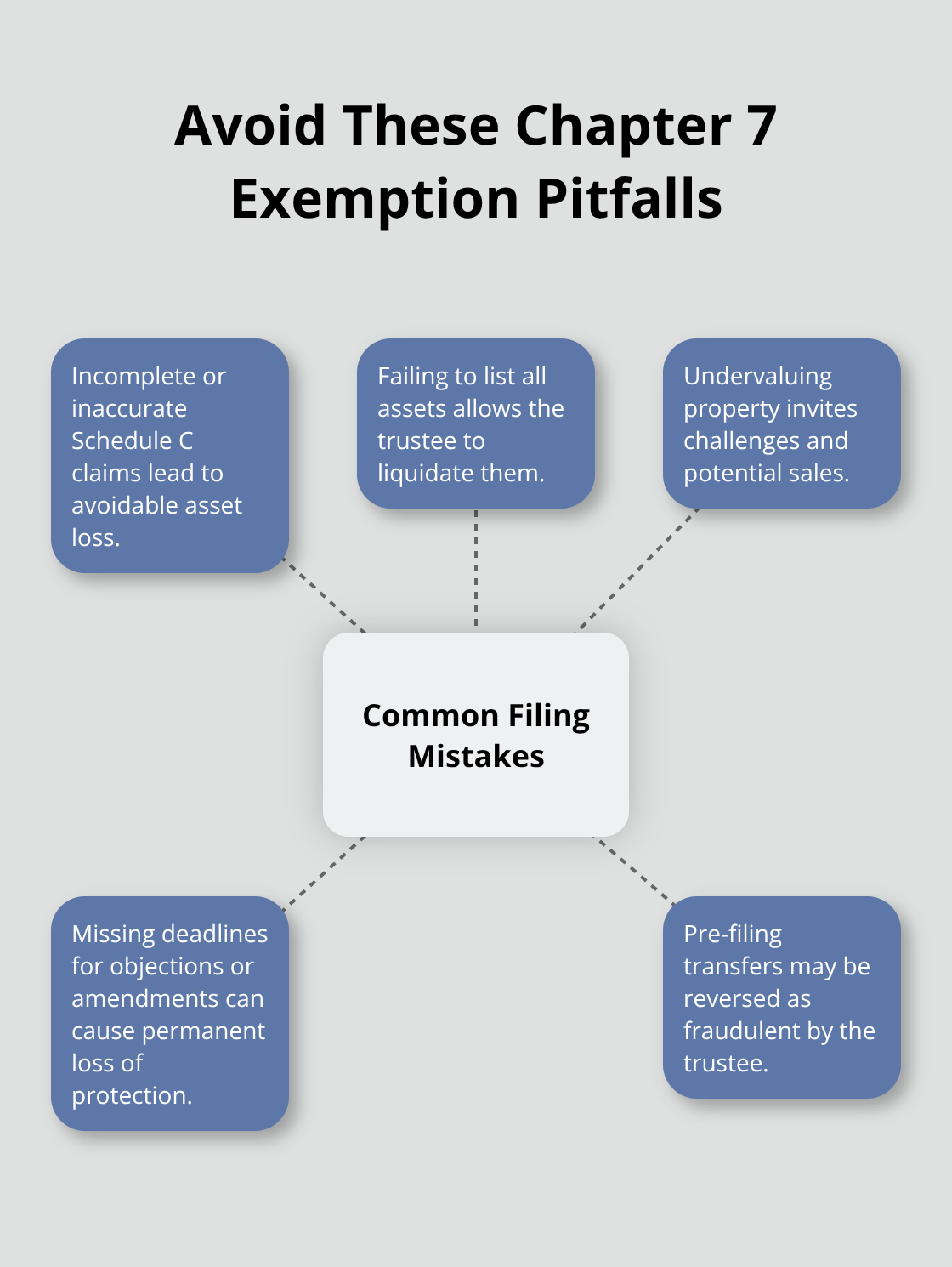
You must list every asset you own with its fair market value, then claim the specific exemption that applies. If you own a $3,000 laptop but fail to list it on your petition, the trustee can liquidate it even though personal property exemptions would have protected it. The same applies to vehicles, jewelry, tools, and household items.
One Florida filer lost a $4,200 motorcycle because they listed it as having zero value rather than claiming the motor vehicle exemption. The trustee sold it, and by the time the filer realized the mistake, the exemption window had closed. Courts are strict about exemption timing-you typically get one chance to claim them at filing or within the amendment window allowed by your local bankruptcy rules. Missing this deadline means permanent loss of protection.
Asset Transfers Before Filing Trigger Trustee Recovery Actions
The second major mistake involves asset transfers in the months before filing. Federal bankruptcy law treats transfers made within two years before filing with extreme suspicion, and fraudulent transfer law can reach back even further. If you transfer your home to a family member to protect it from creditors, the trustee can reverse that transfer and sell the property to pay creditors. The same applies to moving money into a family member’s account, gifting vehicles, or paying down debts selectively. Courts view these actions as attempts to hide assets from creditors.
One Florida debtor transferred $15,000 to their spouse’s business account three months before filing, intending to protect it. The trustee recovered the full amount as a fraudulent transfer. Even innocent transfers can trigger trustee action-paying off a personal loan to a family member weeks before filing can be reversed. The safest approach is to avoid any asset movement in the year before you anticipate filing. If you need to restructure your finances, consult a bankruptcy attorney first.
Residency Rules and Exemption Selection Require Strategic Planning
The third critical mistake is failing to account for residency rules when claiming Florida exemptions. If you have lived in Florida for only 400 days and file for bankruptcy, you cannot use Florida’s powerful homestead exemption. Instead, you must use the exemptions from your previous state, which often provide significantly weaker protection. A filer who moved from California to Florida and filed after 18 months faced a $214,000 federal homestead cap instead of Florida’s unlimited protection because they did not meet the 730-day residency requirement.
Planning your filing date around this threshold can preserve substantial equity. Additionally, some filers overlook that the wildcard exemption changes based on whether you claim the homestead exemption-choosing to forgo homestead protection can increase your wildcard from $1,000 to $4,000 if your situation warrants it. Understanding your specific residency timeline and asset composition before filing prevents leaving money on the table. A consultation with a bankruptcy attorney can review your assets and timeline before you file, ensuring you claim every available protection and avoid costly mistakes.
Final Thoughts
Chapter 7 assets protection in Florida rests on three foundational principles: understanding which assets the law shields, claiming those exemptions correctly on your bankruptcy petition, and avoiding the mistakes that cost filers thousands in unnecessary losses. Your home receives unlimited protection if you meet Florida’s ownership and acreage requirements. Your retirement accounts stay completely safe regardless of balance. Your wages, government benefits, and essential personal property remain protected through Florida Statutes Chapter 222.
The gap between knowing these rules and actually protecting your assets comes down to execution and timing. Incomplete exemption claims, improper asset transfers before filing, and overlooking residency requirements destroy protection you could have kept. Filing your petition with accurate asset values and complete exemption claims prevents the trustee from liquidating property that should remain yours.
Working with a bankruptcy attorney transforms Chapter 7 assets protection from a theoretical exercise into a concrete strategy tailored to your specific situation. An attorney reviews your assets, income, and timeline to identify every available exemption and flag potential mistakes before they cost you money. Contact us to discuss your Chapter 7 assets protection strategy and take the first step toward a fresh financial start.
