
Early retirement withdrawals feel like a solution when you need cash fast. But the IRS penalties and tax bills that follow often create the opposite problem-a financial crisis that spirals into debt you can’t escape.
We at Harnage Law, PLLC see this pattern repeatedly with Florida residents who face overwhelming tax debt after tapping retirement accounts early. Chapter 7 bankruptcy offers genuine debt relief for those caught in this trap, eliminating tax obligations and stopping creditor collection efforts.
What Happens When You Withdraw From Your Retirement Account Early
Withdrawing from a 401(k) or IRA before age 59½ triggers a 10% federal penalty plus ordinary income tax on the full amount withdrawn, according to the IRS. If you withdraw $50,000 from your 401(k) to pay down debt, you face $5,000 in penalties alone, plus income tax that could range from 22% to 37% depending on your tax bracket. That $50,000 withdrawal might net only $28,000 to $33,000 in actual cash. The remaining $17,000 to $22,000 evaporates through taxes and penalties, leaving you with less money to solve the original problem while creating a new tax liability.
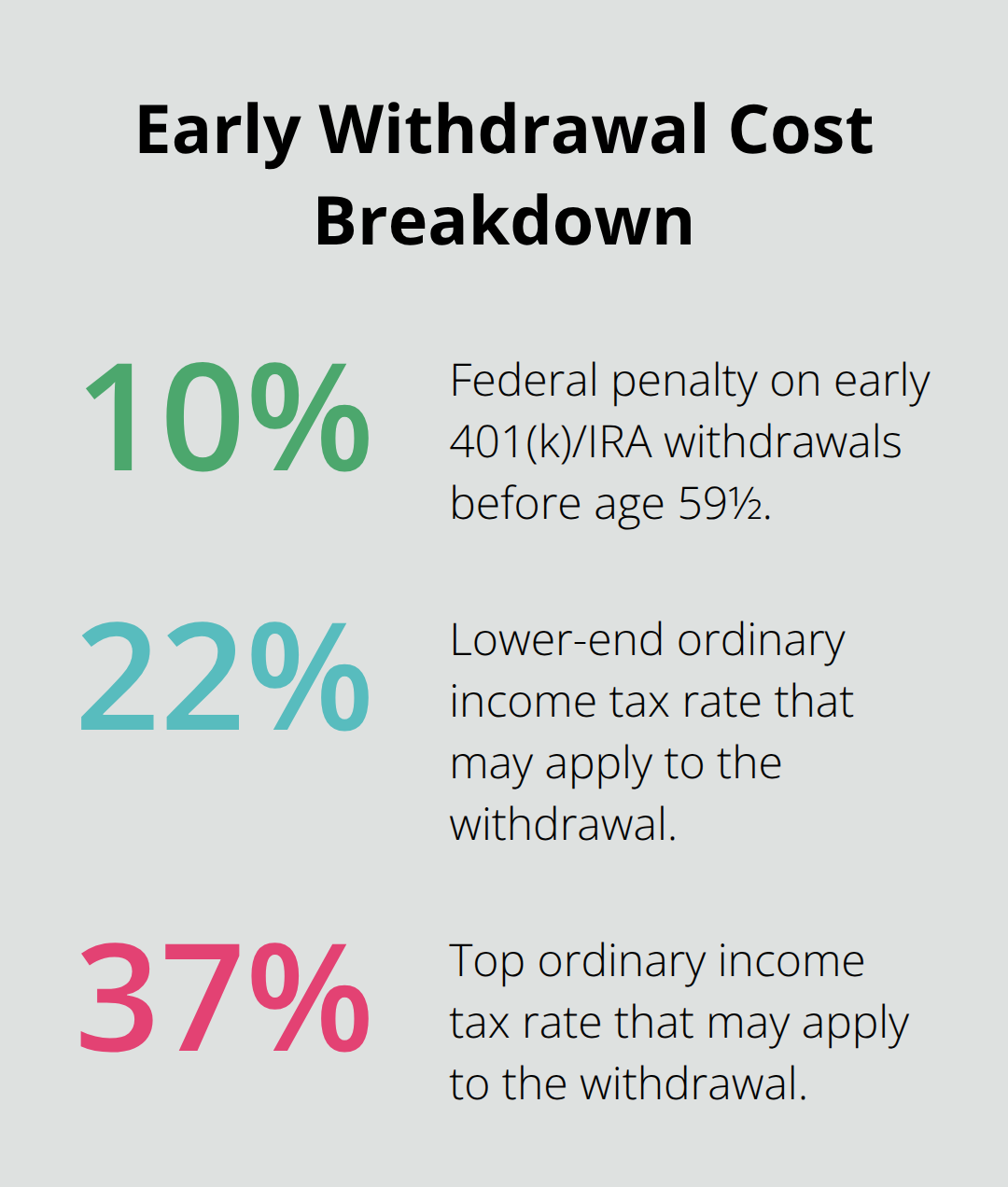
The CFPB notes that the combination of taxes and penalties from early withdrawals significantly reduces available cash and worsens existing debt loads, increasing bankruptcy risk. Tapping retirement funds to cover current bills destroys your finances-the tax consequences often exceed the relief you gain.
The Tax Bill Arrives Months Later
The tax hit does not arrive immediately. When you withdraw in 2026, the tax withholding may be insufficient, leaving you with an unexpected tax bill due on April 15, 2027. Many people withdraw funds thinking they have solved their cash flow problem, only to face a larger bill months later. If you withdrew $50,000 and the withholding covered only $10,000 in taxes and penalties, you owe another $7,000 to $12,000 when you file your return. That unpaid tax debt becomes a high-priority claim that creditors and the IRS pursue aggressively. IRS collections include wage garnishment, bank levies, and liens on property, all of which compound financial pressure. The Federal Reserve reports that emergency funds of 3 to 6 months of expenses prevent the need to raid retirement savings during cash crunches, yet most households lack this cushion. Without preparation, early withdrawal becomes a trap that trades long-term security for short-term relief that never materializes.
Penalties Stack on Top of Debt
The IRS allows limited exceptions to the 10% penalty for disability, medical expenses, first-time home purchase, and higher education costs, but most people withdrawing to pay bills do not qualify. Even if you withdraw for a qualifying expense, you still owe ordinary income tax on the full amount. A second withdrawal compounds the problem-two early withdrawals mean two separate penalty assessments and two separate tax bills. Rolling over a 401(k) to an IRA preserves tax-deferred status and maintains retirement asset protection under federal exemptions, but only if the funds remain in the IRA and are not withdrawn. Once the money leaves the retirement account, it loses protection entirely. In bankruptcy, an account balance of $50,000 remaining in a 401(k) stays fully protected under federal law, but that same $50,000 already withdrawn and spent is gone forever-no bankruptcy discharge can recover it.
Why Withdrawing to Pay Debt Backfires
Withdrawing retirement funds to pay unsecured debts is usually a mistake. Chapter 7 bankruptcy can discharge credit card debt, medical bills, and personal loans while keeping your retirement accounts fully intact, but only if you have not already emptied them. The harsh reality is that the IRS penalties and tax consequences transform what feels like a solution into a financial catastrophe. Your retirement account loses its protection the moment you withdraw the funds, and the tax bill that follows creates new debt obligations that compound your original problem. Understanding this trap before you act separates those who recover financially from those who spiral deeper into debt.
How the Spiral From Withdrawal to Bankruptcy Happens
The Tax Bill Arrives and Collection Begins
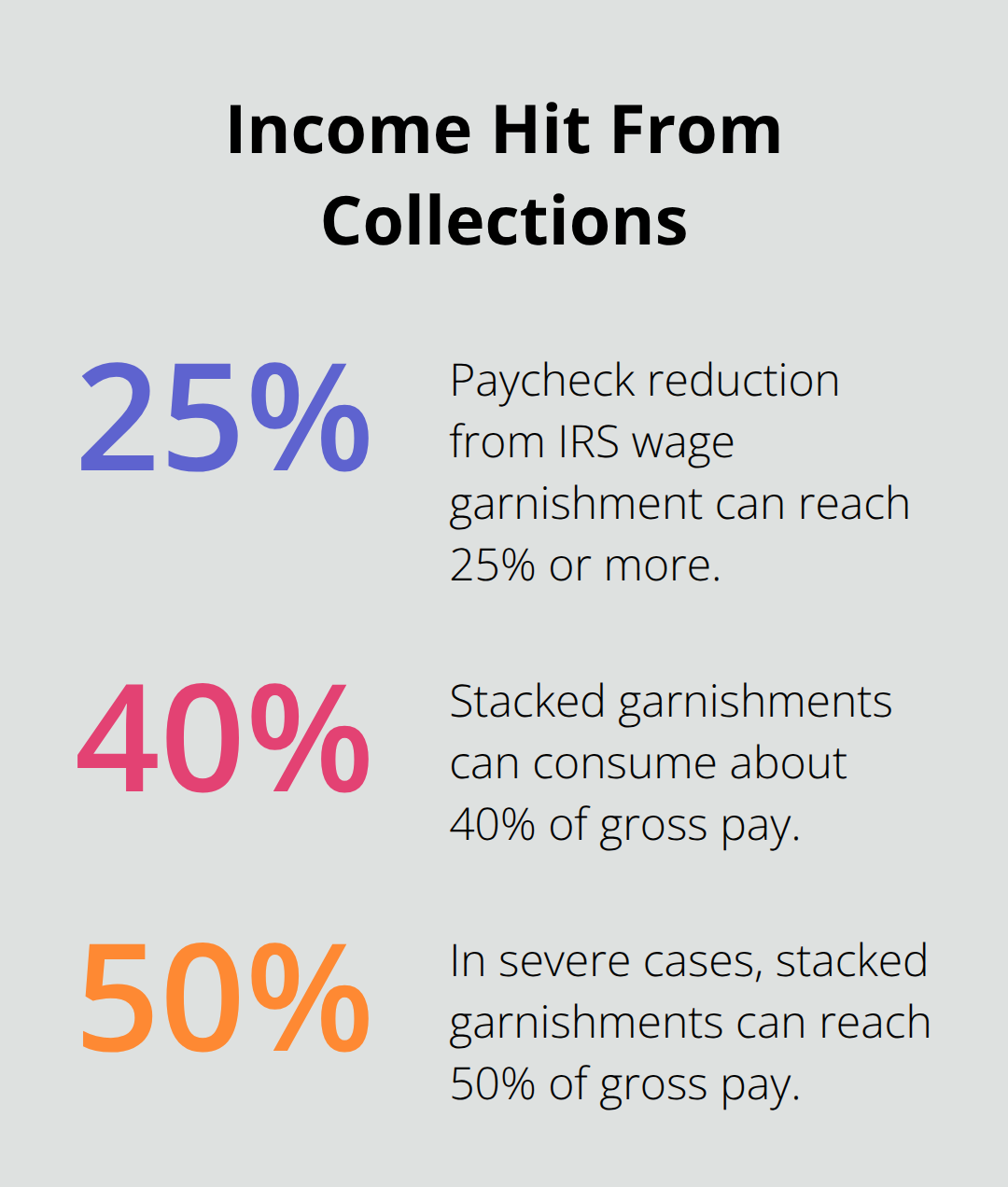
The months following an early retirement withdrawal reveal the true cost of that decision. The initial cash feels like relief, but the tax bill arrives in April, and suddenly you face a liability that grows faster than you can manage. If you withdrew $50,000 in 2026 and the employer withholding covered only $8,000 of your tax obligation, you now owe the IRS an additional $9,000 to $15,000 when you file in 2027. This bill does not sit quietly. The IRS pursues collection aggressively through wage garnishment, bank levies, and property liens. According to the CFPB, the combination of taxes and penalties from early withdrawals significantly reduces available cash and worsens existing debt loads. Your paycheck shrinks by 25% or more due to garnishment, your bank account gets frozen, and your credit score collapses.
Creditors Multiply Your Problems
Meanwhile, the credit card companies and medical providers you originally tried to pay with that $50,000 withdrawal are now calling daily because you still owe them. The withdrawal solved nothing-it only created a second, more aggressive creditor hunting you down. If you missed payments on credit cards before the withdrawal, missed payments accelerate after it. Most credit issuers report 30-day delinquencies to credit bureaus within 60 days, and lawsuits follow by 120 days of missed payments. Florida creditors file roughly 100,000 debt collection lawsuits annually, and wage garnishment orders are standard in judgments. When the IRS garnishes your wages and a credit card company does the same, stacked deductions consume 40% to 50% of your gross pay. The Federal Reserve data shows that households without 3 to 6 months of emergency savings are most vulnerable to this exact scenario. One unexpected expense-a car repair, a medical bill, a job loss-forces the early withdrawal decision, and that single choice triggers a cascade of collection actions that makes your situation exponentially worse.
Debt Accumulation Accelerates Rapidly
The accumulation of debt accelerates because each new collection action creates additional costs and legal fees. Court filing fees, attorney fees for debt collection lawsuits, and interest charges compound monthly. A $10,000 credit card debt can grow to $14,000 or $16,000 within two years when interest rates run 18% to 25% annually and collection costs are added. The IRS interest rate sits at 8% annually as of 2026, but penalties add another 0.5% per month, meaning your $12,000 tax bill from the withdrawal becomes $13,500 within a year if unpaid. Creditors file liens against your property, freezing any equity you might have. Banks initiate foreclosure proceedings if you fall behind on a mortgage. You cannot refinance, cannot access credit, and cannot negotiate because every collector has a legal judgment.
Chapter 7 Stops the Cascade
At this point, Chapter 7 bankruptcy becomes not a failure but the only rational path forward. Chapter 7 eliminates the unsecured debts-credit cards, medical bills, personal loans, and tax debt-stopping wage garnishment and creditor lawsuits immediately through the automatic stay. Your retirement accounts remain fully protected under federal exemptions because you never withdrew them; they stay in your 401(k) or IRA untouched and shielded from creditors. The harsh truth is that the early withdrawal you made to avoid bankruptcy actually accelerated the process. Had you left that retirement money alone and consulted with a bankruptcy attorney about your options, you could have discharged the original debts while keeping your retirement savings intact. Understanding this reality before you act determines whether you protect your financial future or destroy it.
How Chapter 7 Stops the Financial Collapse
Chapter 7 bankruptcy operates differently than most people assume. When you file in Florida, the automatic stay takes effect immediately, halting wage garnishment, bank levies, foreclosure proceedings, and creditor lawsuits in a single stroke. The IRS cannot garnish your wages. Credit card companies cannot call. Collection agencies cannot file new lawsuits. This immediate relief matters because it provides breathing room to stabilize your finances while the bankruptcy process unfolds.
The Automatic Stay Halts Collection Actions
The discharge that follows eliminates unsecured debts entirely, including credit card balances, medical bills, personal loans, and tax debt from early retirement withdrawals. According to the U.S. Courts, the automatic stay stands as one of the most powerful tools available to debtors facing multiple collection actions. In Florida, where roughly 100,000 debt collection lawsuits are filed annually, this protection prevents the cascading wage garnishments and frozen bank accounts that destroy household finances. The tax bill from your $50,000 early withdrawal-potentially $12,000 to $15,000-disappears through discharge. The credit card debt you originally tried to pay with that withdrawal also vanishes. You emerge with a clean slate and, most importantly, your retirement accounts fully intact because you never withdrew them.
Retirement Assets Remain Fully Protected
The retirement asset protection available in Florida Chapter 7 cases makes this outcome possible. ERISA-qualified plans like 401(k)s, 403(b)s, and profit-sharing plans receive unlimited bankruptcy protection under federal law. Traditional IRAs and Roth IRAs are protected up to the federal exemption cap of $1,711,975 per person as of April 2025 through March 2028, a threshold most Florida residents never approach. This means your $400,000 in retirement savings stays completely protected while your $60,000 in unsecured debt vanishes. The long-term financial security that early withdrawal would have destroyed instead remains intact.
The Fresh Start Timeline in Florida
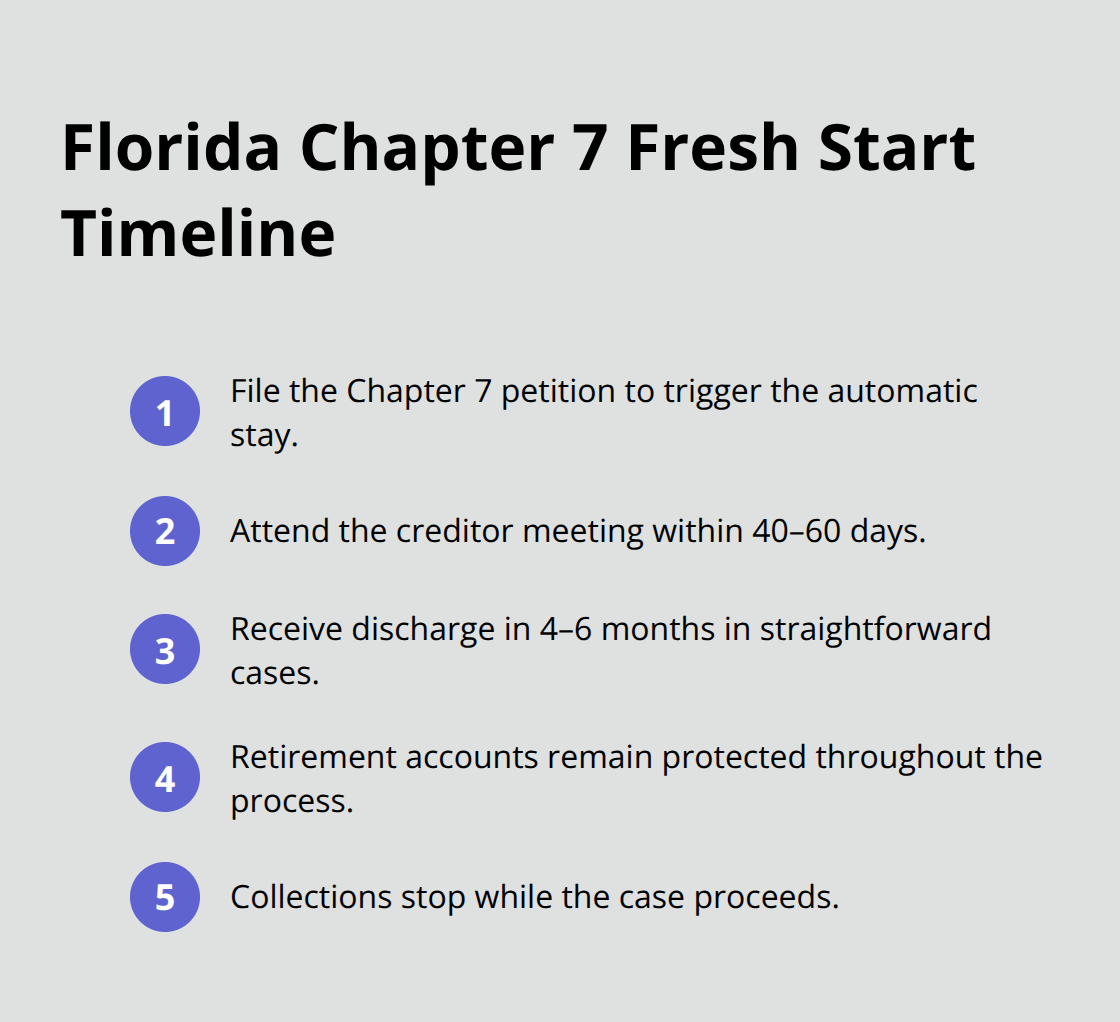
The fresh start process in Florida involves filing the petition, attending the creditor meeting within 40 to 60 days, and receiving discharge within 4 to 6 months in straightforward cases. Your retirement accounts remain protected throughout this timeline, and creditors have no claim against them. If you have already withdrawn retirement funds, Chapter 7 still eliminates the resulting tax debt and other liabilities, stopping the collection cascade before additional damage occurs.
The protection framework ensures that your path forward does not require sacrificing the retirement security you worked decades to build.
Final Thoughts
The decision to withdraw from your retirement account early feels urgent when bills pile up and creditors call. That decision trades decades of financial security for temporary relief that never arrives, and the tax penalties that follow create a worse situation than the one you started with. Stop the withdrawal impulse before it happens by exploring alternatives first-debt management plans reduce interest rates without touching retirement funds, credit counseling through nonprofit agencies clarifies your actual options, and 401(k) loans let you borrow against your balance without triggering penalties or taxes.
If you have already withdrawn retirement funds or face overwhelming debt despite your efforts, Chapter 7 bankruptcy provides genuine debt relief. The automatic stay stops wage garnishment and creditor lawsuits immediately, while the discharge eliminates tax debt, credit card balances, and medical bills that feel impossible to manage. Your remaining retirement accounts stay fully protected under federal exemptions, preserving the security you built over your working years.
We at Harnage Law, PLLC help Florida residents understand their actual options before financial crisis deepens. A conversation with our team clarifies whether Chapter 7 makes sense for your situation, how your retirement assets remain protected, and what the fresh start process looks like in practice. Contact us to discuss your circumstances and explore the path that protects your financial future.