Facing overwhelming debt in Florida forces you to choose between bankruptcy action and settlement. Both paths offer relief, but they work in fundamentally different ways.
We at Harnage Law, PLLC help clients understand which option actually fits their financial situation. This guide breaks down when Chapter 7 makes sense and when settlement is the smarter move.
How Chapter 7 and Settlement Actually Work in Florida
Chapter 7 Liquidates Assets and Discharges Debt
Chapter 7 bankruptcy liquidates your nonexempt assets to pay creditors, then discharges remaining unsecured debts like credit cards and medical bills. In Florida, you keep exempt property-your home up to the homestead limit, retirement accounts, and a motor vehicle up to $1,000 in value. The filing fee runs $338, and the entire process takes four to six months from filing to discharge.
Settlement Negotiates Directly with Creditors
Debt settlement negotiates directly with creditors to accept less than you owe, typically 30 to 70 percent of the original balance. Settlement requires no court filing, no liquidation, and no formal discharge, but creditors must agree to the deal. You either make a lump-sum payment or structured payments over months. Settlement costs range from 15 to 25 percent in professional fees if you hire a company, or nothing if you negotiate yourself. The timeline stretches from six months to three years depending on how willing creditors are to settle.
Immediate Protection vs. Ongoing Vulnerability
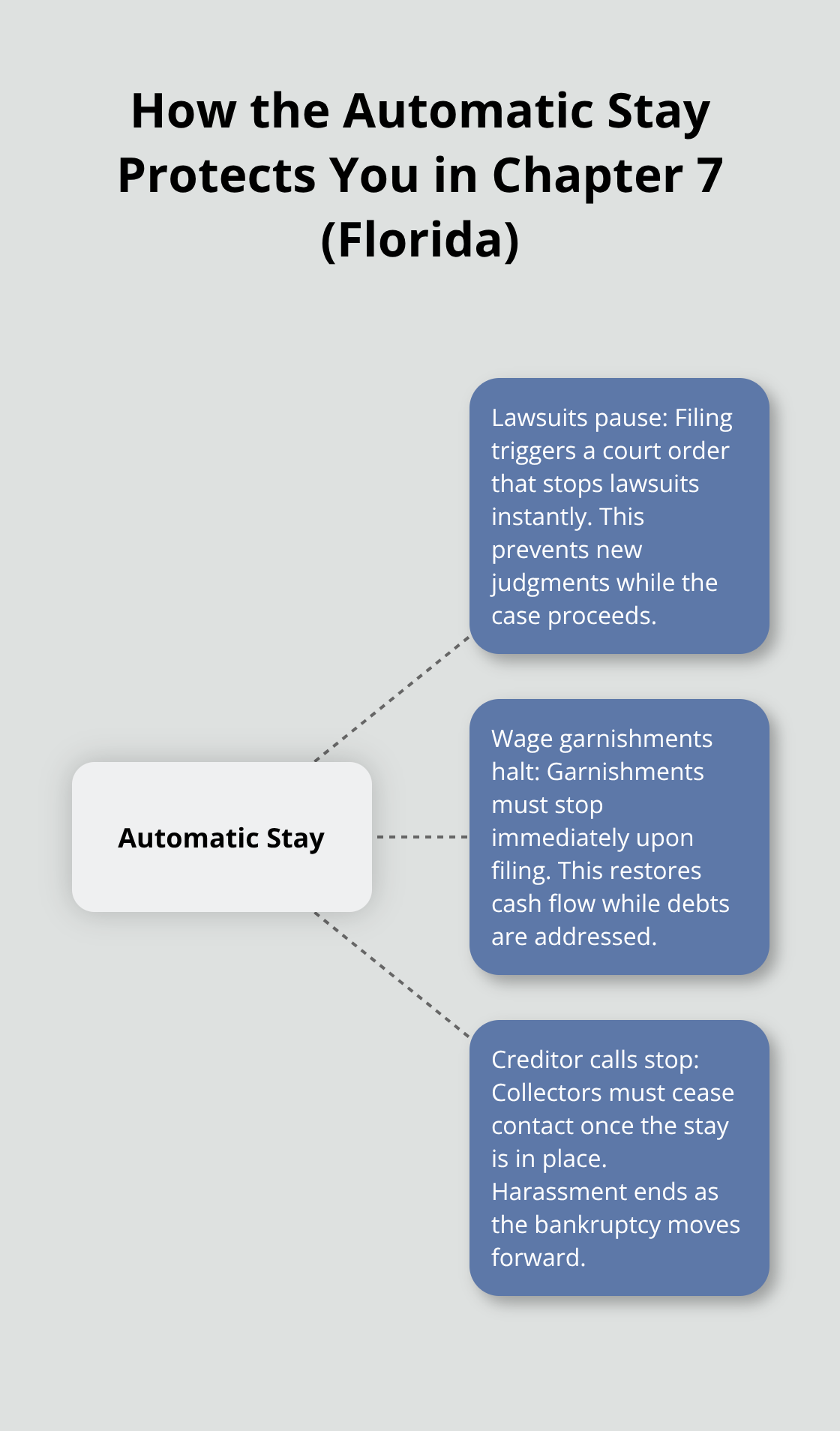
Chapter 7 stops all collection actions immediately through an automatic stay-lawsuits pause, wage garnishments halt, and creditor calls stop the moment you file. You discharge most unsecured debts permanently within months. Settlement leaves you vulnerable during negotiations; creditors can still sue or garnish while you’re trying to settle.
According to data from Debt.org, Chapter 7 appears on your credit report for ten years, while a settled debt marked as paid-for-less stays for seven. Both hurt your credit, but Chapter 7 offers faster relief and broader debt elimination.
Privacy and Certainty Trade-Offs
Settlement preserves privacy since no court filing occurs, but it doesn’t guarantee creditors will accept your offer. In Florida, if you owe primarily unsecured debt and creditors are actively pursuing you, Chapter 7 delivers certainty and speed that settlement cannot match. The choice between these two paths hinges on whether you need immediate legal protection and broad debt elimination or prefer to keep your financial situation private while negotiating with individual creditors.
When Chapter 7 Actually Works in Florida
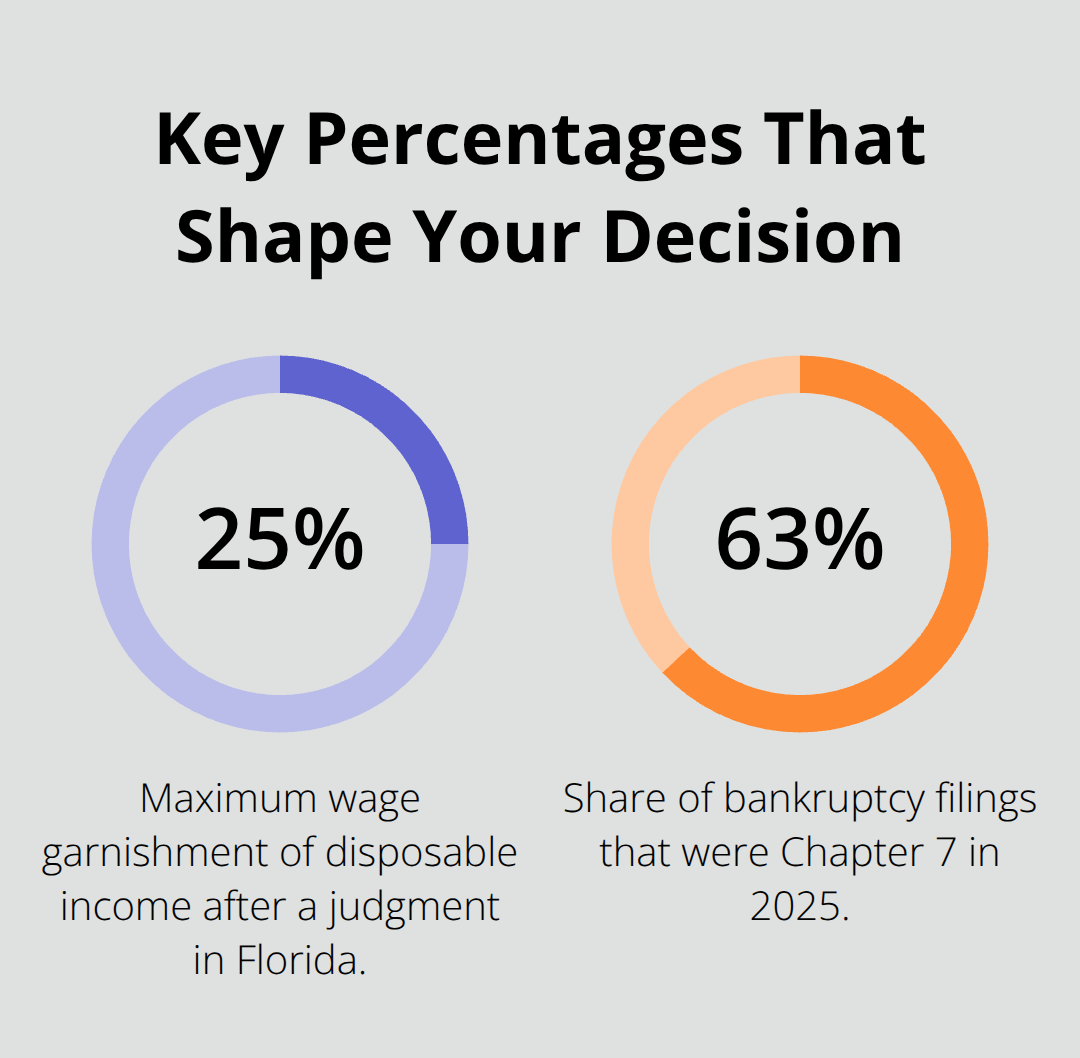
Chapter 7 becomes the right choice when your unsecured debt has grown beyond what your income can realistically handle. If you earn $3,500 monthly and owe $45,000 across credit cards, medical bills, and personal loans, settlement negotiations will stretch across years while creditors continue collecting. Chapter 7 eliminates this debt permanently within four to six months. The means test determines your eligibility; if your income falls below Florida’s median for your household size, you qualify automatically. Even if you’re above the median, allowable living expenses and disposable income calculations often still allow Chapter 7 relief. In 2025, about 63 percent of all bankruptcy filings were Chapter 7 cases, according to U.S. Courts data cited by Debt.org, reflecting how frequently this path addresses genuine financial collapse rather than temporary hardship.
Creditors Stop Negotiating and Start Suing
Wage garnishment changes everything. Once a creditor obtains a judgment against you in Florida, they can garnish up to 25 percent of your disposable income directly from your paycheck. If you face active lawsuits or already experience garnishments, settlement becomes ineffective because creditors have already won in court. Chapter 7’s automatic stay halts these collection actions immediately upon filing, stopping wage garnishments, freezing lawsuits, and ending creditor calls the moment the court receives your petition. This legal protection cannot be negotiated; it activates automatically. Settlement offers no such shield. You’ll continue losing money to garnishment while trying to convince creditors to accept partial payment, a position that weakens your negotiating power rather than strengthens it.
Your Income Cannot Support Any Repayment Structure
Settlement typically requires either a lump-sum payment or monthly installments you can afford over time. If your monthly income barely covers rent, utilities, food, and transportation, settlement demands money you don’t have. Chapter 7 asks nothing of you going forward; it discharges your debts regardless of future income. This matters enormously for people earning under $25,000 annually or those facing job instability. Chapter 13, the alternative repayment plan, requires three to five years of court-supervised payments, which also won’t work if your income cannot support any payment structure. Chapter 7 provides a genuine fresh start for people without the financial capacity to pay anything back, whereas settlement and Chapter 13 both presume you’ll contribute money you simply don’t have available.
The Automatic Stay Stops Collection Immediately
The automatic stay represents Chapter 7’s most powerful advantage over settlement. The moment you file, the court issues a legal order that stops lawsuits, wage garnishments, foreclosure proceedings, and creditor harassment instantly. Settlement provides no such protection; creditors can continue pursuing you through the courts while you negotiate. If multiple creditors have sued you (a common situation in Florida), the automatic stay consolidates all those separate collection efforts into one bankruptcy case. Settlement would require you to negotiate with each creditor individually while they maintain their legal leverage against you. This immediate, comprehensive protection makes Chapter 7 the logical choice when creditors have already escalated beyond phone calls to court action.
When Settlement Actually Works for Your Debt
Income Stability Determines Settlement Viability
Settlement makes practical sense only when your financial situation differs fundamentally from the Chapter 7 scenario. You need stable monthly income that exceeds your essential expenses by enough to fund settlement payments over time. If you earn $4,500 monthly, spend $2,800 on living costs, and have $25,000 in unsecured debt, you could theoretically negotiate settlements and pay $300 to $400 monthly for 24 to 36 months. Chapter 7 would eliminate this debt faster, but settlement preserves privacy and avoids the ten-year credit report mark that bankruptcy carries.
The critical calculation is whether creditors will actually accept your settlement offer. According to the Association of Consumer Debt Relief, settled debt typically resolves for 30 to 70 percent of the original balance, but this assumes creditors participate willingly. If your creditors have already obtained judgments and begun wage garnishment, they’ve demonstrated unwillingness to negotiate; settlement becomes a fantasy rather than a viable path.
Tax Consequences Create Hidden Costs
Settlement triggers tax consequences you must anticipate before committing to this path. The IRS treats forgiven debt above $600 as taxable income reported on a 1099-C form, meaning a $15,000 settlement could create a $15,000 tax liability in the following year. You’ll need cash reserves to handle this unexpected tax bill or face another debt problem.
Professional settlement companies charge 15 to 25 percent of enrolled debt according to the Association of Consumer Debt Relief data, so a $25,000 debt load costs $3,750 to $6,250 in fees alone, plus the actual settlement payments themselves. These costs stack on top of the tax liability you’ll owe.
Limited Creditors and Recent Income Recovery
The timing and creditor willingness determine whether settlement works at all in Florida. If you face one or two creditors rather than five or ten, settlement negotiations become manageable because you’re dealing with a limited number of decision-makers. Creditors who haven’t sued you yet show more flexibility than those holding judgments; they’ll negotiate to recover something rather than risk future collection difficulties.
Settlement also makes sense if you experienced a temporary income disruption that has now resolved, such as job loss followed by reemployment at similar or better pay. Your income stability matters enormously because settlement companies need confidence you’ll make monthly payments for months or years. Unstable income, seasonal work, or contract-based employment creates creditor skepticism about your ability to follow through.
Budget Margins and Privacy Trade-Offs
If settlement requires you to stretch your budget dangerously thin with no safety margin for emergencies, you’ll default on settlement payments and face worse consequences than your original debt situation. The privacy advantage of settlement appeals to business owners, professionals, and individuals concerned about public bankruptcy records, but this benefit vanishes if you cannot actually complete the settlement process and end up filing Chapter 7 anyway after months of failed negotiations and additional creditor actions.
Final Thoughts
Chapter 7 eliminates debt through court-supervised liquidation and discharge, while settlement negotiates directly with creditors to accept partial payment. The fundamental difference determines which path makes sense for your situation in Florida. Chapter 7 delivers immediate protection through an automatic stay that stops lawsuits, wage garnishments, and creditor calls the moment you file. Settlement offers no such legal shield and leaves you vulnerable to ongoing collection actions while you negotiate. The bankruptcy action process takes four to six months and costs $338 in filing fees plus attorney representation, whereas settlement stretches across months or years with professional fees running 15 to 25 percent of enrolled debt plus unexpected tax liabilities on forgiven amounts.
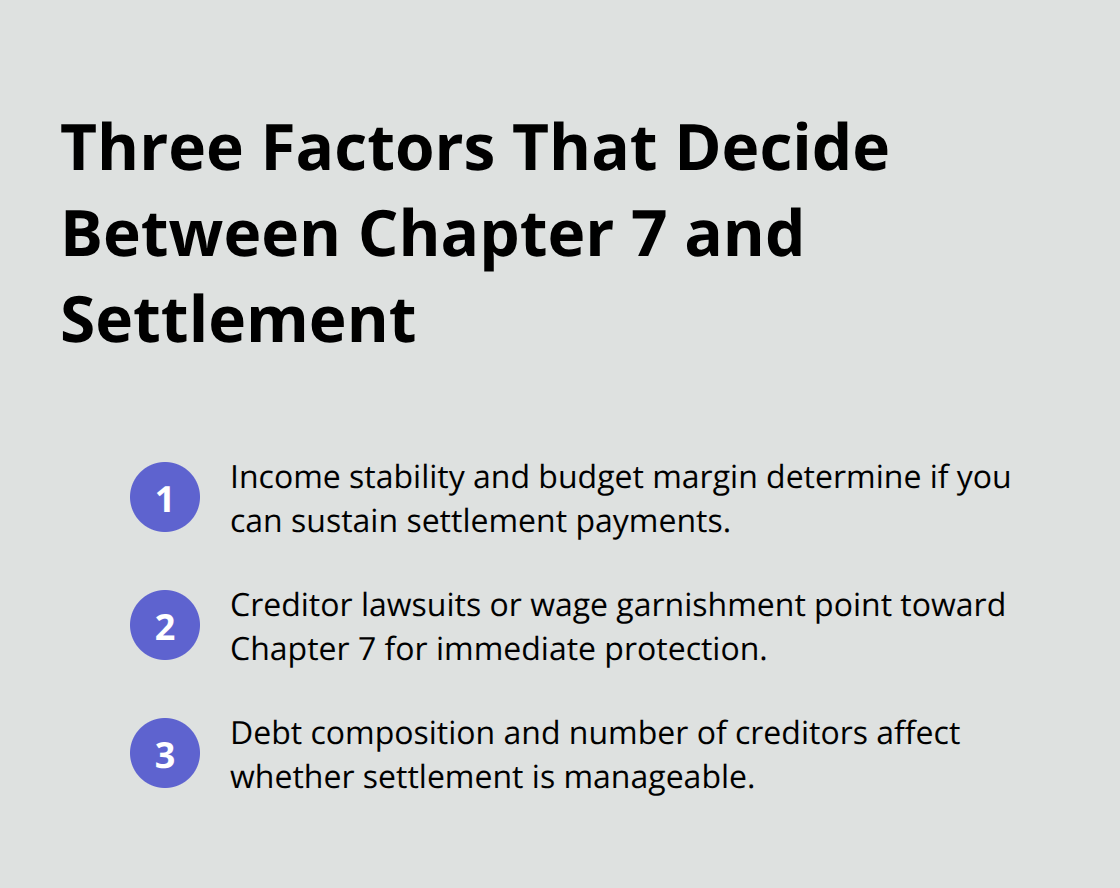
Your decision hinges on three concrete factors. First, assess your income stability and whether you can realistically afford settlement payments over time-if your monthly income barely covers essential expenses, settlement becomes impossible because you lack the financial capacity to pay anything back. Chapter 7 discharges your debts regardless of future income, making it the only viable option for people earning under $25,000 annually or facing job instability. Second, evaluate whether creditors have already sued you or begun wage garnishment, since once creditors obtain judgments, they’ve demonstrated unwillingness to negotiate and Chapter 7’s automatic stay halts their collection efforts immediately.
Third, consider your debt composition and creditor count, as limited unsecured debt with one or two creditors who haven’t sued yet makes settlement feasible, while substantial debt across multiple creditors who’ve already escalated to court action demands Chapter 7 relief. We at Harnage Law, PLLC help Florida residents navigate this decision by analyzing your specific financial circumstances and explaining how each path affects your assets, income, and future.
Contact us to discuss your situation and determine whether Chapter 7 provides the fresh start you need.