Filing for Chapter 7 bankruptcy in Florida involves seven distinct steps, each with specific requirements and deadlines. We at Harnage Law, PLLC understand that the petition bankruptcy Chapter Seven process can feel overwhelming without clear guidance.
This guide walks you through each stage, from eligibility checks to your final discharge, so you know exactly what to expect and when.
Step 1: Check if Chapter 7 Works for Your Florida Situation
Your first task is determining whether Chapter 7 bankruptcy actually fits your financial circumstances. Florida uses its own income thresholds rather than federal exemptions, which means your eligibility depends on specific numbers tied to your household size. According to U.S. Courts data, if your average monthly income falls below the Florida median for your household size, you likely qualify outright. For a single person in Florida, the median income is $62,973 annually; for a family of four, it’s $104,069. To calculate your average monthly income, add up your gross income from the last six months, divide by six, then multiply by twelve to annualize it.
If your income exceeds the median, the means test determines whether you can still file Chapter 7. The means test subtracts allowed expenses from your income to calculate five-year disposable income. According to U.S. Courts, if your five-year disposable income falls below $9,075, Chapter 7 generally remains available to you.
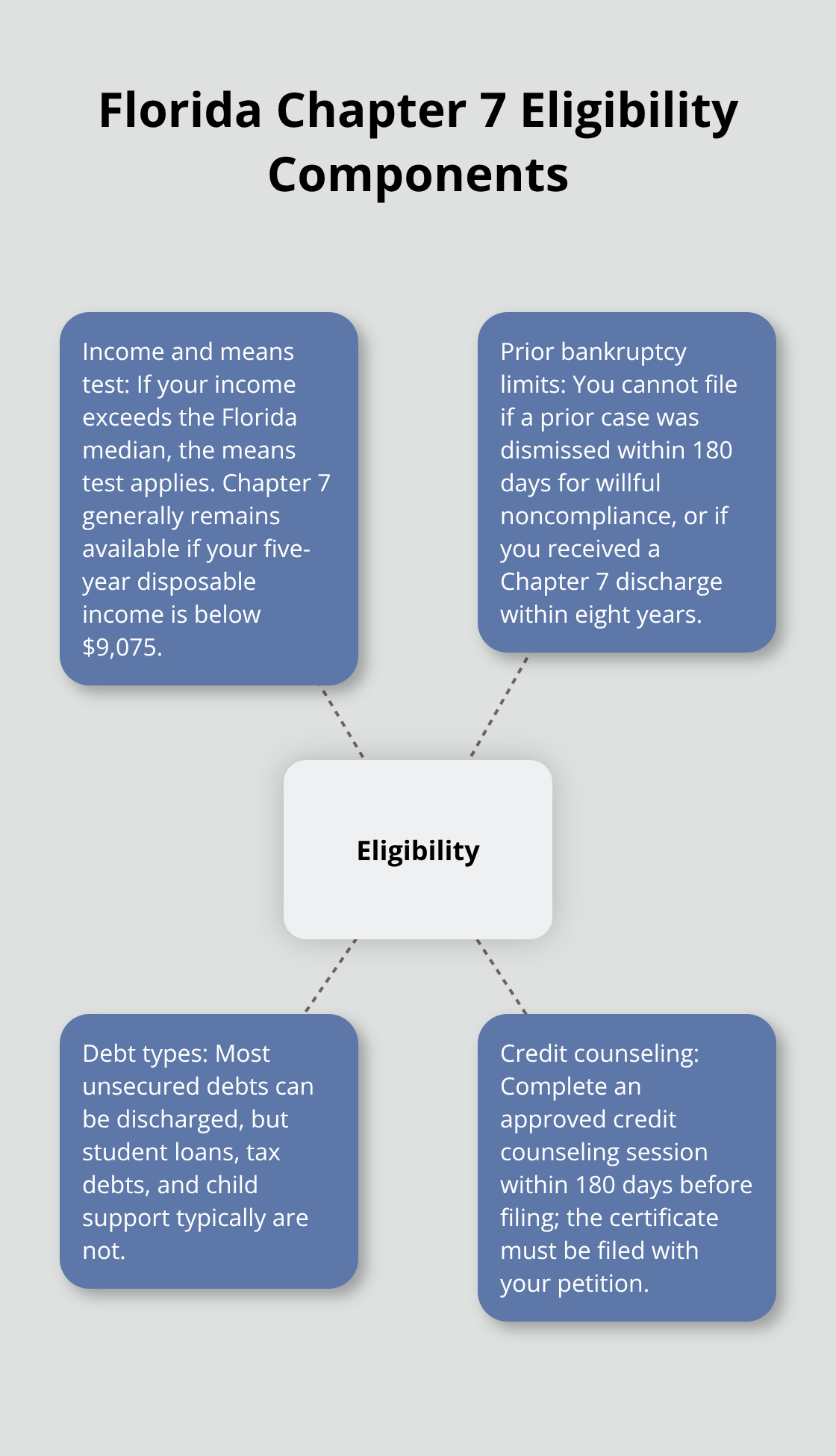
Common deductible expenses include mortgage or car payments, childcare costs, court-ordered support, health insurance premiums, and caregiver expenses for disabled household members (these reduce your disposable income significantly). You cannot file Chapter 7 if you’ve had a previous bankruptcy case dismissed within the past 180 days due to willful noncompliance, or if you’ve received a discharge in a Chapter 7 case within eight years.
Your debt types also matter significantly. Chapter 7 discharges most unsecured debts like credit cards and medical bills, but student loans, tax debts, and child support typically remain non-dischargeable. Once you confirm your eligibility through these three components, you’re ready to move forward with the next critical requirement: completing credit counseling from an approved Florida agency.
Step 2: Complete Credit Counseling Before Filing
Credit counseling is not optional-it’s a federal requirement that must happen within 180 days before you file your petition. The U.S. Courts mandate this step for all Chapter 7 filers in Florida, and skipping it means your case gets dismissed. You need to find an agency approved by the U.S. Trustee Program, which maintains an official list of providers. Most courses cost under $15 and take one to two hours, offered online or by phone for maximum flexibility. The counselor will review your budget, discuss alternatives to bankruptcy, and explain your rights and responsibilities in the process.
Once you complete the session, you’ll receive a certificate of completion that becomes part of your court filing. This certificate must accompany your petition when you submit it to the Florida bankruptcy court-the court won’t accept your case without it. Keep the original certificate in a safe place and make a copy for your records. Schedule your course early so you have time to gather financial documents and prepare your forms without feeling pressured. With your certificate in hand, you’re ready to move into the next critical phase: collecting and organizing all the financial documents the court requires.
Step 3: Gather Your Financial Documents
The court will reject your petition without complete financial documentation, so this step determines whether your case moves forward or stalls. Start with your most recent pay stubs covering the last 60 days-the court requires these to verify your current income and employment status. Collect your last two years of federal tax returns, which the U.S. Courts require you to file alongside your petition. Gather six months of bank statements from all checking and savings accounts to show your actual spending patterns and liquid assets. You’ll also need recent statements for any investment accounts, retirement accounts, or other financial assets you hold.
Next, compile a complete list of every creditor you owe money to, including credit card companies, medical providers, personal lenders, and utility companies. The court requires names, addresses, and account numbers for each creditor on your creditor matrix-missing even one creditor can delay your case. Document your monthly living expenses by collecting utility bills, insurance statements, rent or mortgage payment records, childcare invoices, and healthcare costs. Make a detailed inventory of everything you own: your home (with current market value), vehicles (year, make, model, and estimated value), jewelry, electronics, furniture, and personal belongings. Florida law protects certain assets through exemptions, so accurate valuations matter tremendously when determining what you keep after bankruptcy.
Once you organize these documents in separate folders, you’ll have everything needed to fill out the official bankruptcy forms that the Florida court requires.
Step 4: Complete the Official Bankruptcy Forms
The Official Bankruptcy Forms from uscourts.gov/bkforms/index.html are mandatory-the Florida bankruptcy court will reject anything else. Start with the voluntary petition and immediately move to Schedules A through J, where you list every asset, liability, income source, and monthly expense with exact dollar amounts. The court expects precision here; approximations get flagged and cause delays. Schedule A covers real property (your home), Schedule B covers personal property (vehicles, jewelry, electronics), Schedule C is where you claim exemptions under Florida law, Schedule D lists secured debts like mortgages and car loans, Schedule E/F covers unsecured debts such as credit cards and medical bills, and Schedules I and J detail your current monthly income and expenses.
The Statement of Financial Affairs requires you to disclose all transactions, property transfers, and financial activity from the past four years-this catches any fraudulent transfers that might affect your case. The means test calculation is where you prove your five-year disposable income falls below the threshold that would make Chapter 7 abuse presumptive. Most filers underestimate how detailed these forms demand to be. The court requires the last four digits of your Social Security number only, not your full number, to protect your identity. Your pay stubs from the last 60 days must accompany the petition, and your last two years of tax returns are mandatory.
If you file jointly, both spouses’ income and expenses go on the forms, even if only one spouse has significant debt. The means test calculations can be confusing because allowed expenses differ from what you actually spend-you use IRS standards for certain categories like food and utilities, not your real grocery bills. If you claim you cannot afford your car payment or mortgage in the means test, the trustee may question whether you are truly unable to pay or simply choosing not to. Filling these forms accurately prevents objections from the trustee and keeps your case moving toward the next critical phase: submitting your petition to the Florida bankruptcy court.
Step 5: File Your Petition with the Florida Bankruptcy Court
You must file your petition with the specific Florida district court where you live. The Southern District of Florida charges a $338 filing fee, which you can pay upfront or request installment payments using the local form for installment applications-your minimum initial payment must be half the fee, with the remainder due within 180 days. If your income falls below 150 percent of federal poverty guidelines, you can apply for a complete fee waiver using Official Bankruptcy Form 103B, though approval is not automatic and the court reviews your financial situation carefully.
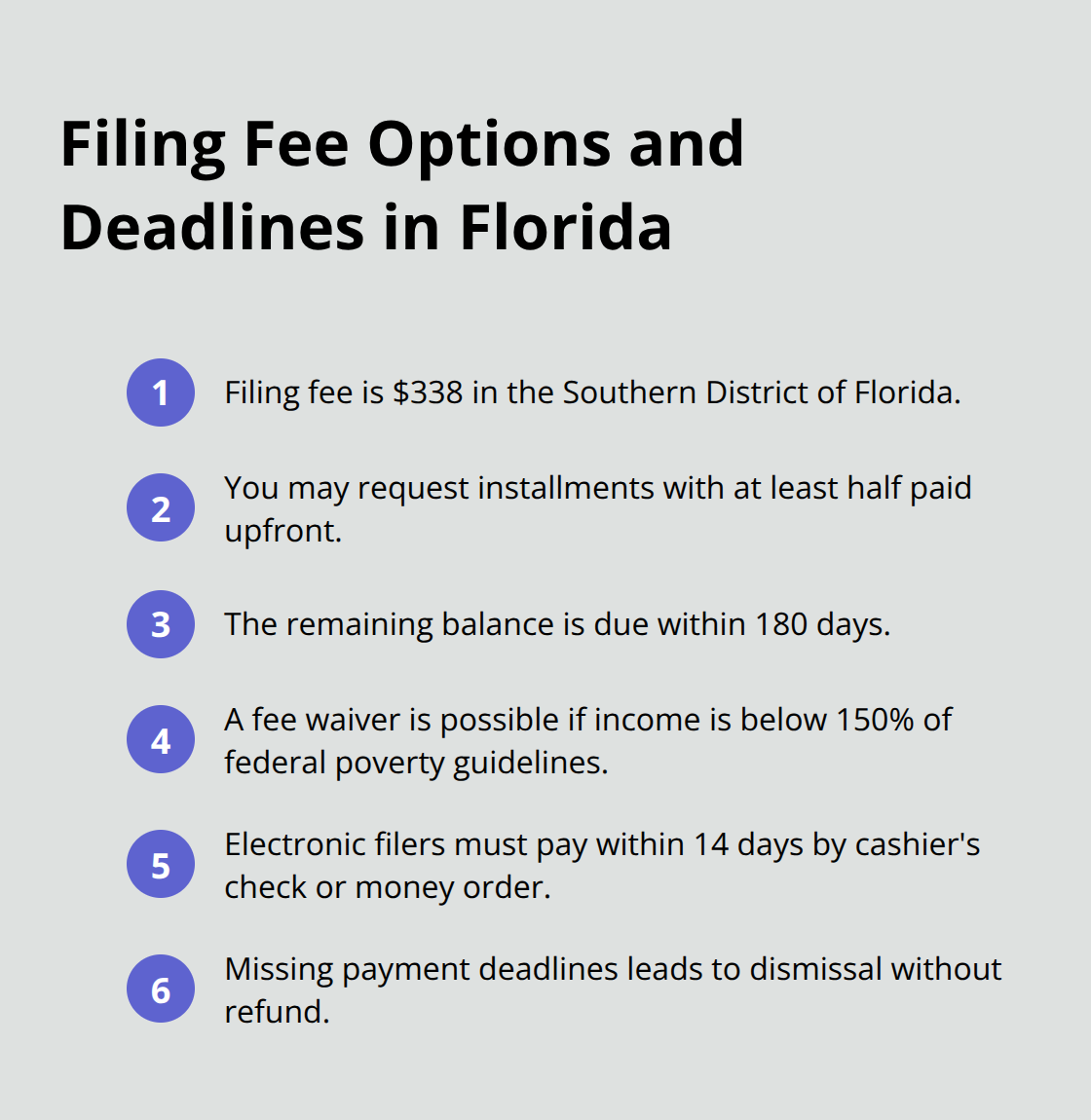
When you file electronically, you must pay within 14 days using a cashier’s check or money order made payable to the Clerk of the U.S. Court, and include your case number on the payment. Missing this deadline means the court dismisses your case without refunding any fees you’ve already paid.
Submit your completed petition alongside all required documents: the voluntary petition, your certificate of credit counseling, the creditor matrix with names and addresses only, a legible government-issued photo ID, the Statement of Financial Affairs, your pay stubs from the last 60 days, and your last two years of tax returns. Once the clerk accepts your petition, the automatic stay takes effect immediately under federal bankruptcy law, prohibiting creditors from continuing collection calls, lawsuits, wage garnishments, and foreclosure proceedings against you or your property. This automatic stay provides breathing room while your case progresses. The court assigns a bankruptcy trustee to your case and schedules your 341 meeting of creditors, typically 21 to 40 days after filing, and notifies you of this date by mail.
Step 6: Meet Your Bankruptcy Trustee at the 341 Meeting
The 341 meeting of creditors occurs 21 to 40 days after you file, and it presents far less intimidation than the name suggests. According to U.S. Courts data, the trustee assigned to your case will ask straightforward questions about your finances, assets, and the information you provided on your bankruptcy forms. You must bring your government-issued photo ID, your original Social Security card or tax return showing your full Social Security number, and recent pay stubs to verify your current income. The trustee will also ask whether you own a vehicle, have equity in your home, or possess valuable personal property that could be liquidated to pay creditors. If you filed jointly with your spouse, both of you must attend this meeting in person-the court will not excuse one spouse’s absence.
Most Chapter 7 meetings last only 5 to 10 minutes because creditors rarely show up. When creditors do attend, they typically ask whether you can afford to pay any portion of your debt or whether you own assets worth pursuing. The trustee’s primary job involves investigating whether you hid assets or committed fraud, not attacking you personally. You should answer every question honestly and directly without volunteering extra information. If the trustee asks about a transaction from several years ago that you listed on your Statement of Financial Affairs, you need a clear explanation ready-inconsistencies between what you told the trustee and what appears on your forms can trigger deeper investigation or even case dismissal.
Once you complete the 341 meeting successfully, you move into the final requirement before discharge: completing your debtor education course and filing the certificate with the court.
Step 7: Complete Your Financial Management Course
The debtor education course stands as your final mandatory step before the court grants your discharge, and you must complete it within 60 days after your first 341 meeting date. Unlike credit counseling, which focuses on budget review and alternatives to bankruptcy, this course teaches practical financial management skills covering budgeting, credit rebuilding, and money management strategies you’ll need after discharge. The U.S. Trustee Program maintains an approved provider list, and courses typically cost $15 to $50 depending on the agency you select. Most providers offer online or phone-based options, allowing you to complete the two-hour course on your schedule without traveling to an office. Missing the 60-day deadline results in automatic case dismissal without discharge, meaning your debts remain legally enforceable despite completing all other bankruptcy steps.
After you finish your course, the provider issues a certificate of completion that you must file with the court before your discharge becomes final. The certificate includes your case number, the course completion date, and the provider’s credentials. File this certificate promptly rather than waiting until the deadline approaches, because the court’s processing time can extend beyond your expectations. Once the clerk receives and processes your certificate, the judge typically enters your discharge order within days, formally releasing you from personal liability for dischargeable debts. This discharge marks the moment your fresh start becomes official-creditors can no longer pursue collection efforts on those debts, and you transition into rebuilding your financial foundation without the weight of past obligations.
Moving Forward After Your Chapter 7 Discharge in Florida
Your discharge order marks the official end of your petition bankruptcy Chapter Seven case, but it represents the beginning of your financial recovery. Once the court enters your discharge, the trustee closes your case and stops all liquidation activities. Most Chapter 7 filers receive no payout because their assets fall within Florida’s generous exemptions, meaning the trustee files a no-asset report and unsecured creditors receive nothing.
Student loans, recent tax debts, child support, and alimony survive your discharge and continue as legal obligations you must pay. If you reaffirmed a debt like a car loan before discharge, that obligation also remains because you voluntarily agreed to keep it. Liens on property may persist even after discharge, so if a creditor holds a mortgage on your home or a security interest in your vehicle, they retain the right to foreclose or repossess if you stop paying (despite the discharge eliminating your personal liability).
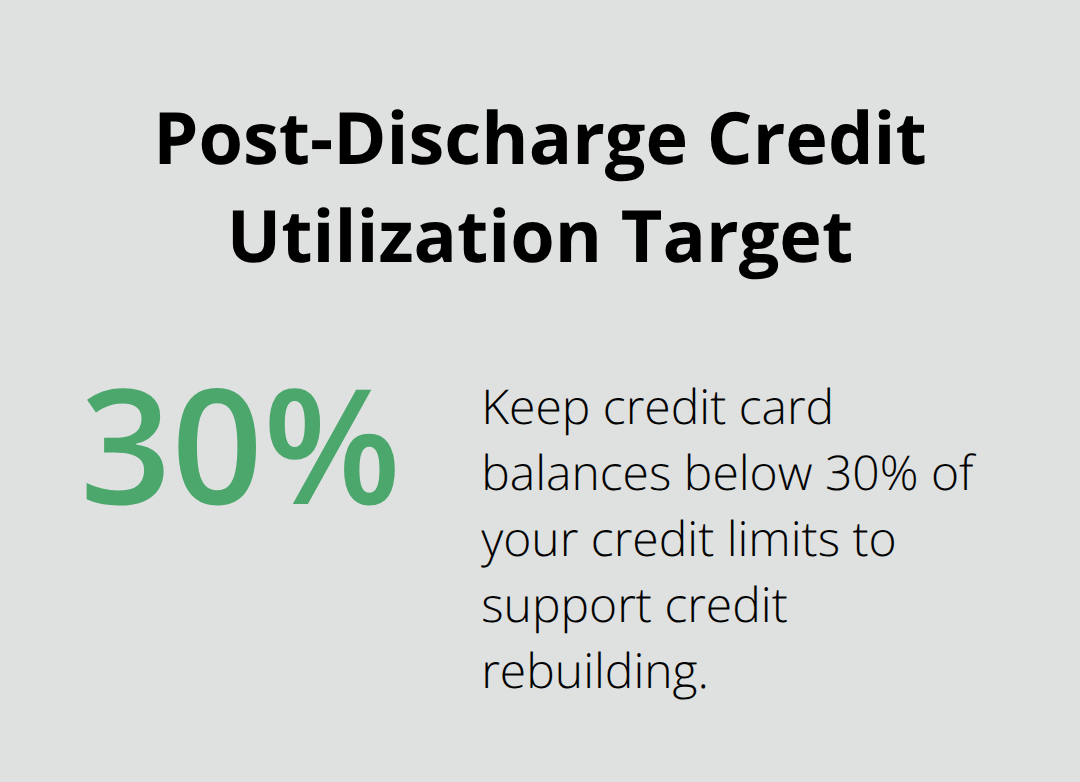
Rebuilding your credit begins immediately after discharge, and your score can improve significantly within months by paying all bills on time and keeping credit card balances below thirty percent of your limits. Secured credit cards designed for rebuilding require a cash deposit but report to credit bureaus and help demonstrate creditworthiness to future lenders. Many lenders offer mortgages to Chapter 7 filers within two years of discharge, though interest rates may be higher initially.
Contact our Florida office to discuss your situation and learn how we can help you achieve the fresh financial start you deserve.