Chapter 7 bankruptcy offers a fresh start for Florida residents drowning in debt, but the process involves specific rules and requirements you need to understand before filing.
We at Harnage Law, PLLC have guided hundreds of Floridians through Chapter 7 fundamentals, and we know the confusion that surrounds this option. This guide breaks down what happens when you file, which debts disappear, and what assets you keep.
What is Chapter 7 Bankruptcy in Florida
Definition and Purpose of Chapter 7
Chapter 7 bankruptcy is a legal process that allows individuals to eliminate most unsecured debts completely. When you file Chapter 7 in Florida, a court-appointed trustee takes control of your nonexempt assets, sells them, and distributes the proceeds to your creditors. In return, qualifying debts like credit cards, medical bills, and personal loans are discharged, meaning you no longer owe them. The process typically takes three to six months from filing to discharge. This isn’t a repayment plan-it’s a liquidation strategy designed for people with limited income who cannot realistically pay back what they owe.
The Scale of Chapter 7 Filings
Over 400,000 Americans filed for bankruptcy in 2023, with Chapter 7 accounting for the majority of those filings. Florida residents face particular financial pressures due to rising housing costs and healthcare expenses, making Chapter 7 an increasingly relevant option for those struggling with debt.
Income Requirements for Chapter 7 Eligibility
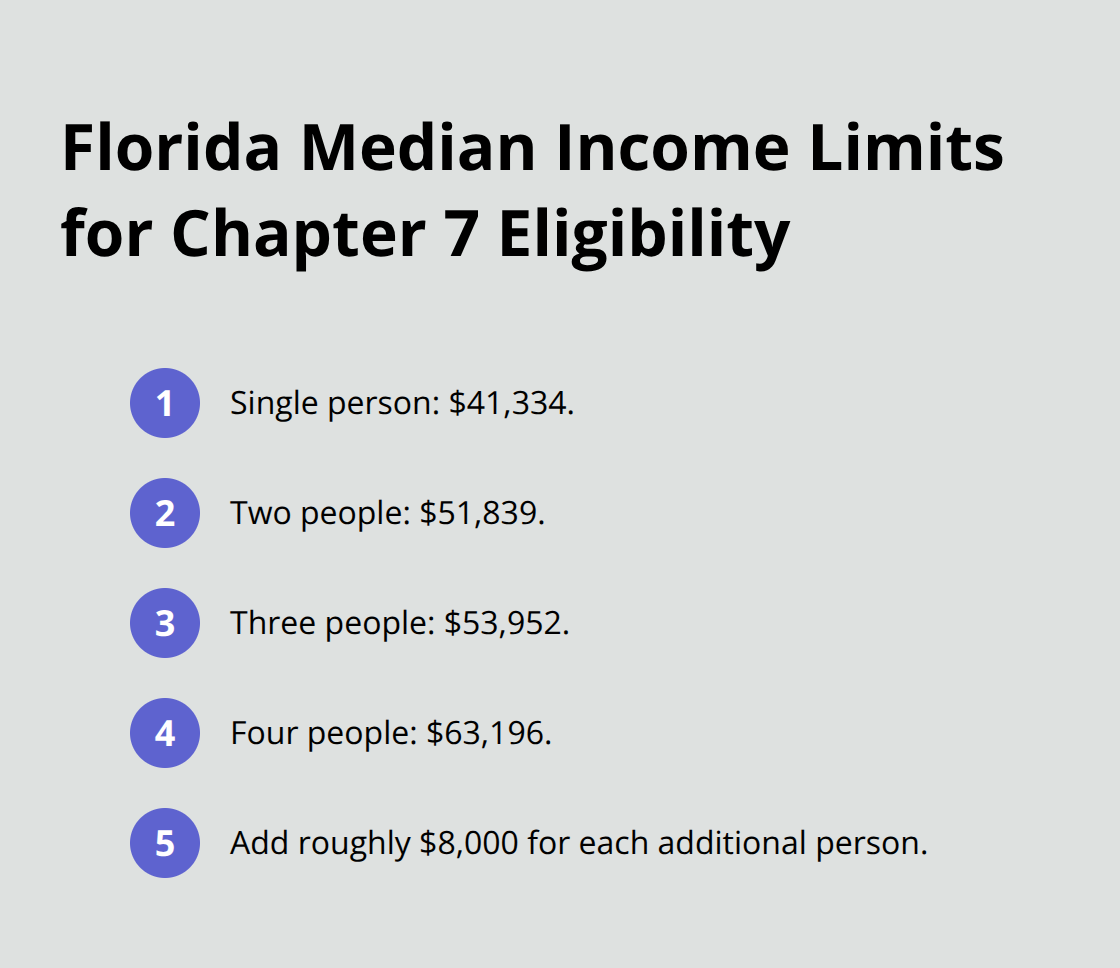
Not everyone can file Chapter 7. Florida uses a means test to determine eligibility, and this test represents the single biggest hurdle most filers face. If your household income falls below the Florida median income for your family size, you automatically qualify. Current data shows the Florida median income is $41,334 for a single person, $51,839 for two people, $53,952 for three people, and $63,196 for four people. For larger households, add roughly $8,000 per additional person.
Calculating Your Income and Passing the Means Test
To calculate your income, average your monthly earnings over the last six months and multiply by twelve. This includes wages, self-employment income, rental income, and certain benefits. If you’re above the median, you must complete the full means test, which subtracts allowable expenses like mortgage payments, insurance, childcare, and court-ordered support from your adjusted income. If your remaining disposable income over 60 months is less than $9,075, you pass and can file Chapter 7. Income above this threshold typically disqualifies you unless you have business debts or are a disabled veteran.
Strategic Timing for Your Filing
If your income recently dropped due to job loss or reduced hours, waiting one or two months might lower your six-month average enough to qualify for Chapter 7 instead of the more restrictive Chapter 13 repayment plan. Understanding these income thresholds and how the means test works sets the foundation for determining whether Chapter 7 fits your situation, which then leads directly into the specific filing requirements and documentation you’ll need to gather.
Filing Requirements and Creditor Protection in Florida Chapter 7
Submitting Your Initial Bankruptcy Documents
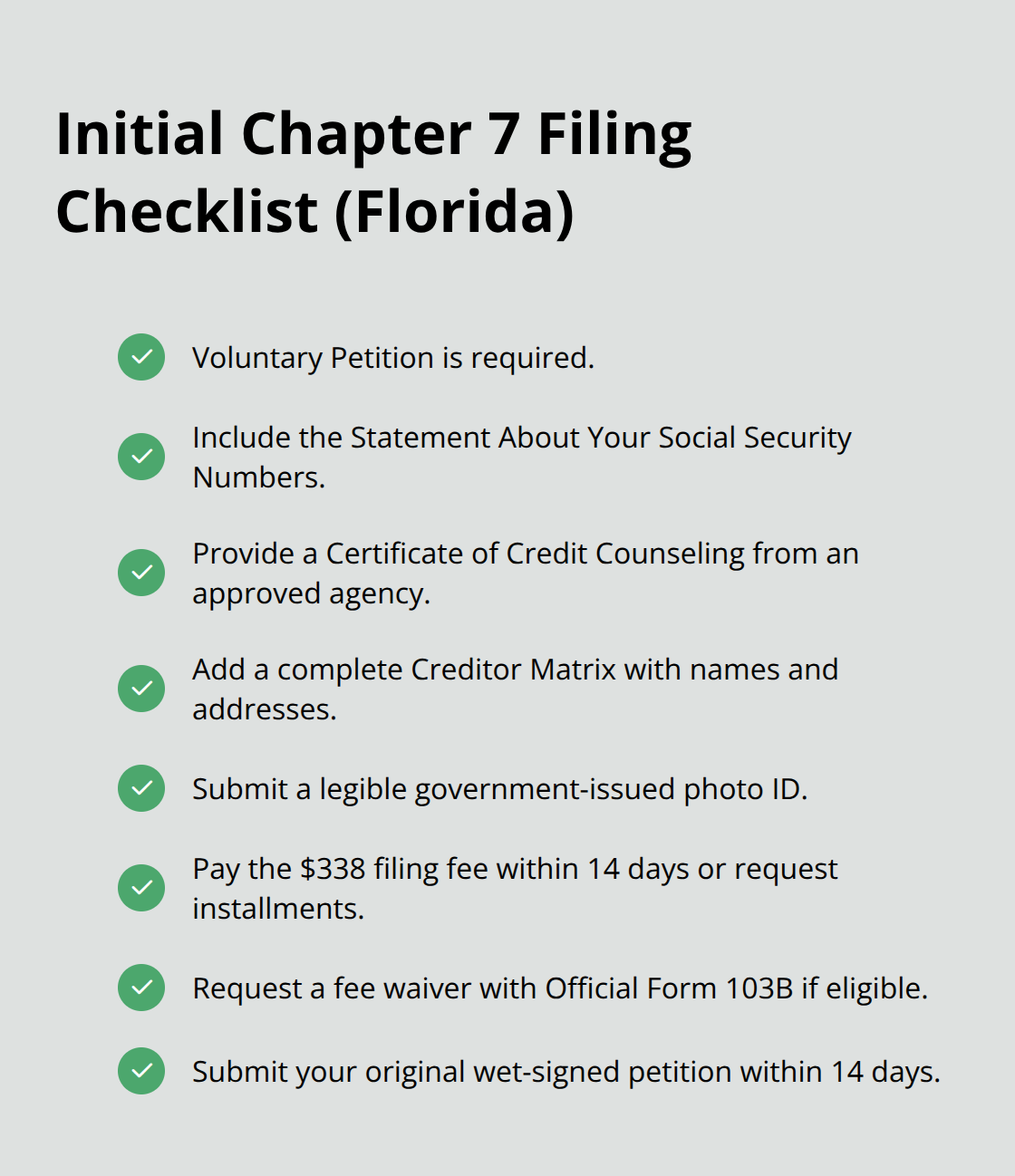
Filing Chapter 7 in Florida requires you to submit specific documents to the bankruptcy court, and getting this right the first time prevents costly delays. The filing fee is $338, payable within 14 days of submission through certified check or money order to the Clerk of Court. You can request to pay in installments if you qualify, with at least half due at filing. If your income falls below the poverty guidelines, you can request a fee waiver using Official Bankruptcy Form 103B.
At the moment you file, you must provide your Voluntary Petition, a Statement About Your Social Security Numbers, your Certificate of Credit Counseling (completed through an approved agency listed on the U.S. Trustee’s website), a Creditor Matrix listing every creditor’s name and address, and a legible photocopy of government-issued photo identification. Within 14 days, you submit payment along with your original wet-signed petition.
Completing Your Schedules and Financial Statements
The court requires your complete schedules and statements within the same filing window: your Summary of Assets and Liabilities, Schedules A through J (covering property, debts, income, and expenses), your Declaration About Your Schedules, your Statement of Financial Affairs, and your Means Test forms if your income exceeds the Florida median. Missing even one document triggers court rejections and delays your discharge timeline.
How the Automatic Stay Protects You
The automatic stay takes effect the moment your petition is filed, immediately halting wage garnishments, foreclosures, repossessions, and collection calls. This legal protection stops creditors from pursuing lawsuits, freezing bank accounts, or contacting you directly. The stay typically remains in effect throughout your case, though creditors can petition the court to lift it under specific circumstances (such as if you have multiple recent filings). Many Florida debtors find this immediate relief from collection pressure transforms their financial situation overnight.
The 341 Meeting and Financial Management Course
After you file, the trustee schedules your 341 meeting of creditors within 21 to 40 days, where you meet with the trustee and answer questions about your assets and debts. This meeting is straightforward for most filers; the trustee rarely finds nonexempt assets worth pursuing in Chapter 7 cases. You must also complete a personal financial management course within 60 days after this meeting to remain eligible for discharge. Failure to complete either requirement can result in case dismissal, so treating these deadlines seriously is essential.
Once you understand these filing mechanics and protections, the next critical step involves learning which debts actually disappear through discharge and which assets you retain throughout the process.
What Debts Disappear and What Assets You Keep
Dischargeable and Non-Dischargeable Debts
Chapter 7 eliminates most unsecured debts, but not all of them, and this distinction determines your actual financial relief. Credit card balances, medical bills, personal loans, and payday loans vanish completely through discharge. However, child support, alimony, most tax debts, student loans (absent undue hardship), and debts from DUI-related injuries remain intact regardless of filing. The discharge order from the court makes it illegal for creditors to pursue you on eliminated debts, and violating this prohibition carries serious penalties.
Protected Assets Under Florida Law
Florida law protects certain assets throughout the process, meaning you keep them even as the trustee liquidates nonexempt property. Your primary residence receives unlimited protection under Florida’s homestead exemption if you owned it for at least 1,215 days before filing and the property stays within half an acre inside a municipality or 160 acres elsewhere. A single motor vehicle can retain up to $5,000 in equity, protecting most people’s transportation.
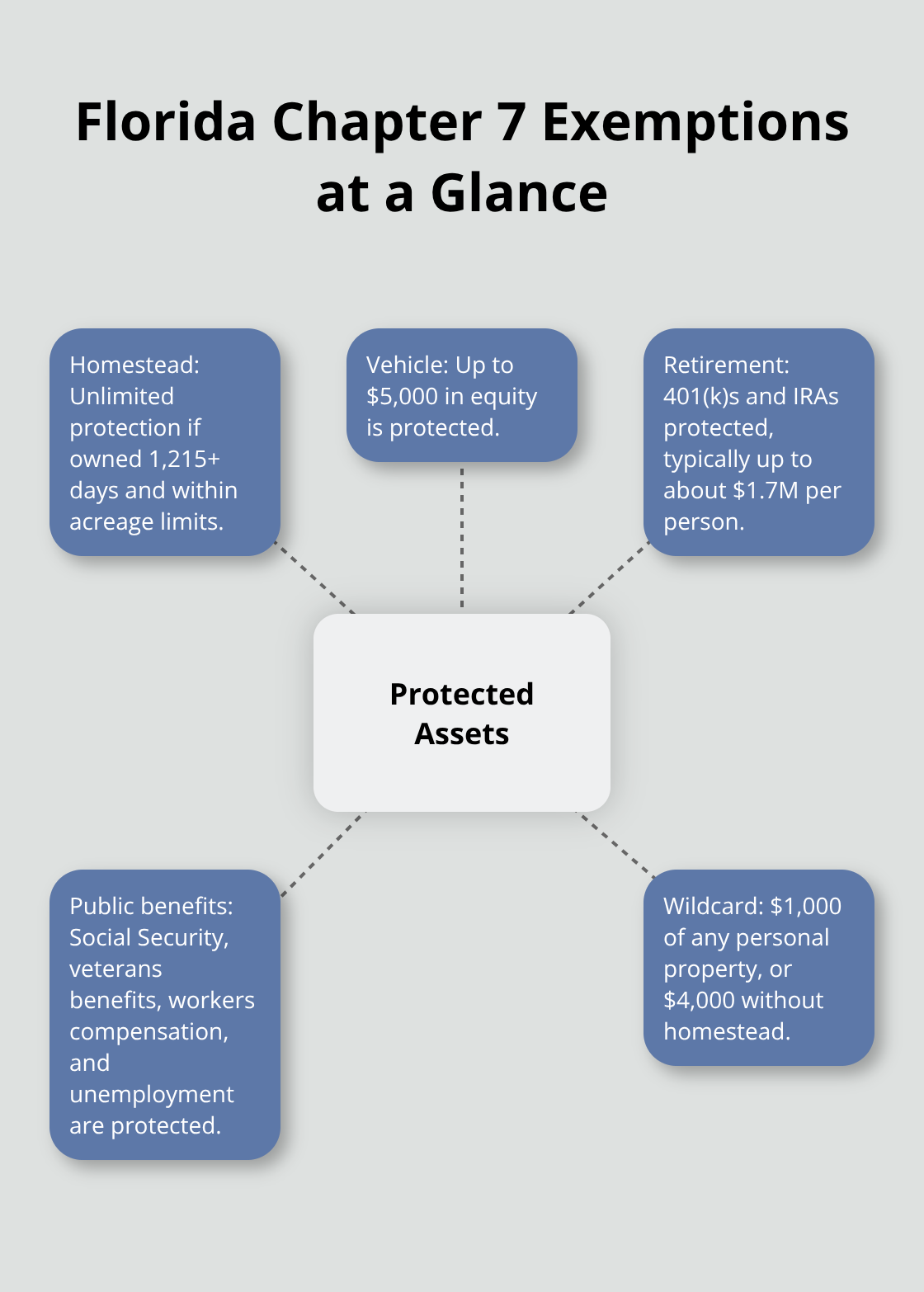
Retirement accounts like 401(k)s and IRAs receive broad federal protection capped around $1.7 million per person for most filing windows. Social Security benefits, veterans benefits, workers compensation, and unemployment payments cannot be touched by the trustee or creditors. Florida also provides a wildcard exemption worth $1,000 of any personal property, or $4,000 if you don’t claim the homestead exemption, allowing you to shield items like jewelry, electronics, or household goods.
Timeline From Filing to Discharge
The timeline from filing to discharge typically spans three to six months, though this varies based on your specific circumstances and court schedules. The trustee has 60 days after your 341 meeting to decide whether your nonexempt assets warrant liquidation; in most Chapter 7 cases, the trustee finds nothing worth selling because your property falls within exemption limits. Once the trustee closes the estate, the court issues your discharge order, legally eliminating your qualifying debts. You must complete the required personal financial management course within 60 days after the 341 meeting to finalize your discharge eligibility. Skipping this step results in case dismissal and leaves you liable for all debts.
Income Fluctuations and Filing Timing
Florida median incomes according to the U.S. Trustee’s office determine whether you qualify, and income fluctuations directly impact your timeline. If you face creditor harassment or wage garnishment before filing, the automatic stay provides immediate relief, but this protection applies only after your petition reaches the court, making timely filing critical.
Final Thoughts
Chapter 7 fundamentals in Florida center on one reality: this bankruptcy option eliminates qualifying debts and provides immediate protection from creditors through the automatic stay. If your household income falls below the Florida median for your family size, you likely qualify without completing the full means test. Even if your income exceeds the median, the means test calculation accounts for legitimate expenses, and many filers still pass.
Your protected assets under Florida law remain yours throughout the process. Your home receives unlimited protection if you meet the 1,215-day ownership requirement, your vehicle keeps up to $5,000 in equity, and retirement accounts stay completely shielded. Social Security, veterans benefits, and workers compensation cannot be touched, while the trustee liquidates only nonexempt property (which represents a small portion of most filers’ belongings).
The path forward after Chapter 7 discharge involves rebuilding your credit and establishing healthy financial habits. Your credit score will recover within two to three years for many people, and you become eligible to purchase a home again after two years. Contact us at Harnage Law, PLLC to discuss whether Chapter 7 fits your circumstances and what your fresh start looks like.