
Filing Chapter 7 bankruptcy doesn’t mean losing your home. Florida law provides strong protections for homeowners, and we at Harnage Law, PLLC want you to understand exactly how to keep your house after Chapter 7.
The key is knowing the rules before you file. Your home’s fate depends on homestead exemptions, equity calculations, and staying current on mortgage payments throughout the process.
1. How Florida’s Homestead Exemption Shields Your Home
Florida’s homestead exemption stands as one of the most generous in the nation and serves as your primary defense against losing your home in Chapter 7. If you owned your home for at least 1,215 days before filing, the exemption protects unlimited equity in your primary residence, regardless of the property’s value-a $500,000 home with $200,000 in equity receives full protection if you meet the ownership requirement. The exemption applies only to homesteads within half an acre inside a municipality or 160 acres outside city limits, so your property must qualify as a primary residence, not a rental or investment property. For homeowners who have not yet owned the property for 1,215 days, Florida still protects up to $170,350 of equity, which covers most residential situations. This protection forms the foundation of your home defense strategy in bankruptcy.
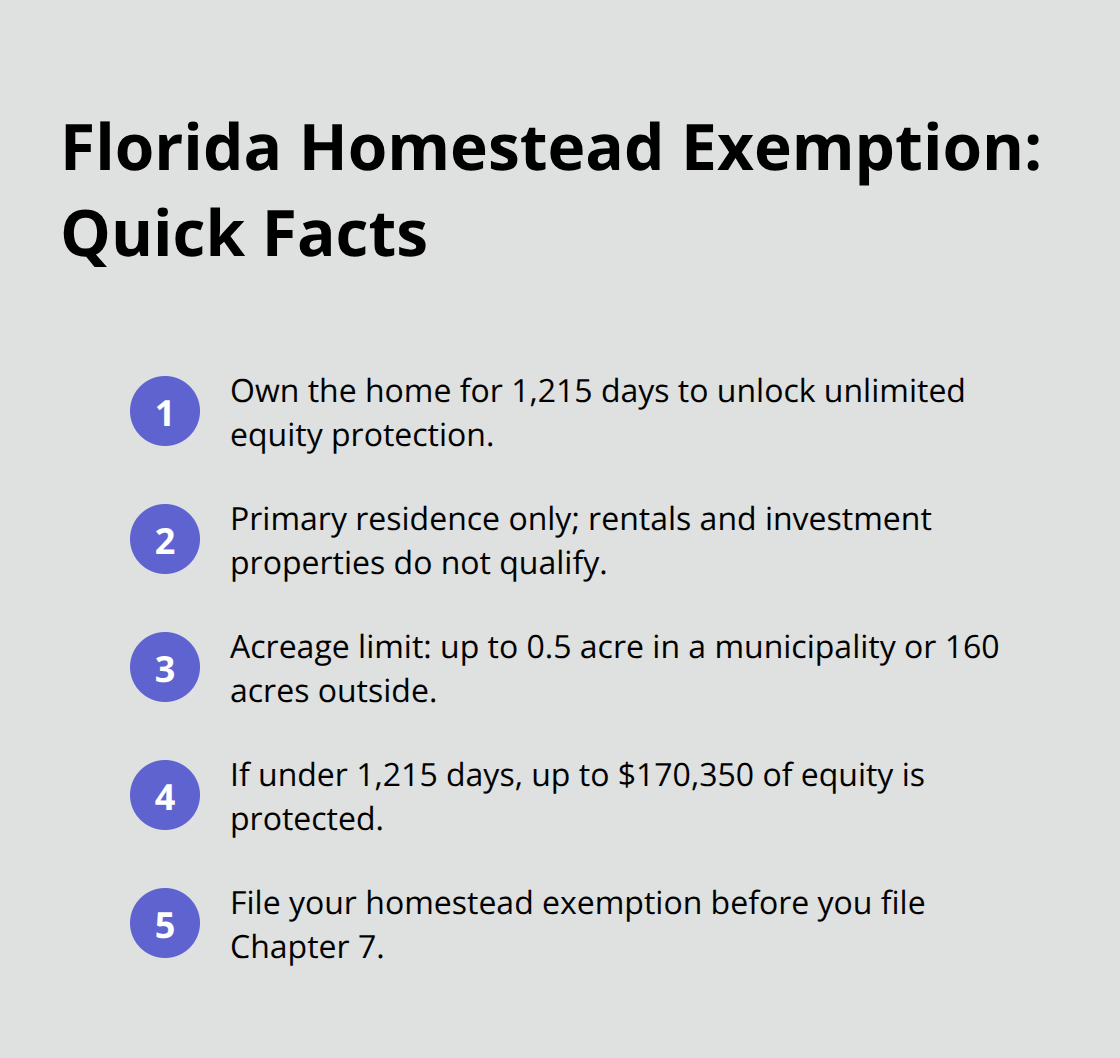
To claim this protection, you must file a homestead exemption with your county property appraiser before filing bankruptcy. Complete the Declaration of Homestead form, submit it to the appraiser’s office, and pay the filing fee (typically under $50). Florida law requires you to have lived in the home as your primary residence for the required period, and you cannot claim homestead status on multiple properties simultaneously. The trustee assigned to your case will review your homestead filing during the bankruptcy process, so accuracy matters tremendously. Missing the 1,215-day threshold by even one day drops your protection to $170,350, which is why timing your filing date carefully can mean the difference between keeping unlimited equity or facing potential liquidation if your equity exceeds that cap-understanding your exact ownership timeline becomes your next critical step.
File Your Homestead Exemption Before Bankruptcy
Submit your Declaration of Homestead form to your county property appraiser’s office before you file Chapter 7, not after. Florida counties process these filings quickly, typically within days, but waiting until after bankruptcy filing creates unnecessary risk since the trustee will scrutinize your homestead claim during case administration. Visit your county appraiser’s website, download the Declaration of Homestead form, and submit it in person or by mail with the modest filing fee-usually under $50. Accuracy on this form matters enormously; any errors in property description, ownership dates, or marital status can trigger trustee challenges that delay or deny your exemption protection. Calculate your exact ownership start date now and verify it against your deed or mortgage documents, since the 1,215-day ownership requirement is absolute.
Many homeowners make critical mistakes that jeopardize their homestead protection. Never claim homestead status on multiple properties simultaneously, as Florida law permits only one homestead exemption per person at any given time. Do not transfer the home to a spouse or family member shortly before filing in hopes of gaining additional protection; the trustee reviews all property transfers made within two years of filing and will challenge fraudulent conveyances. If you have lived in the home for fewer than 1,215 days, accept that your protection caps at $170,350 of equity rather than attempting to manipulate documentation-courts and trustees verify ownership records through public deed filings. Contact your appraiser’s office directly to verify your homestead filing was actually recorded, since some filers assume completion without confirmation, only to discover months later that the form never reached the county system. Once your homestead exemption is filed and confirmed, your next step involves calculating exactly how much equity you hold in the property.
2. Calculate Your Home Equity to Protect It
Your home’s equity is the single most important number in determining whether you keep your house after Chapter 7. Equity equals your home’s current market value minus what you owe on the mortgage and any home equity lines of credit or second mortgages. If your home is worth $300,000 and you owe $190,000 on the mortgage, you have $110,000 in equity-a figure that directly influences whether the trustee can liquidate your property. Check recent comparable sales in your neighborhood to get an accurate market valuation, not inflated estimates from real estate agents. Pull your mortgage statement and calculate this number before meeting with a bankruptcy attorney, since many homeowners underestimate their equity and file Chapter 7 unprepared for trustee scrutiny.
The trustee’s decision to liquidate your home hinges entirely on whether your equity exceeds Florida’s exemption limits. If your equity stays under $170,350 (or unlimited if you meet the 1,215-day ownership requirement), the trustee cannot touch your home-the exemption shields it completely. However, if nonexempt equity exists, the trustee will likely sell the property to pay creditors, after covering the mortgage payoff and deducting 6–10% in selling costs. Refinancing or major home improvements made within two years of filing trigger trustee scrutiny, as courts view these transactions as potential attempts to hide assets. Second mortgages or HELOCs actually work in your favor by reducing nonexempt equity; if you owe $150,000 on a first mortgage and $40,000 on a second mortgage against a $300,000 home, your nonexempt equity drops significantly, making trustee liquidation less likely and moving you closer to keeping your property through the bankruptcy discharge process.
3. Why Your Mortgage Stays Active Through Chapter 7
Chapter 7 bankruptcy discharges unsecured debts like credit cards and medical bills, but your mortgage obligation survives the process intact. The lender’s lien on your home remains in place, and you must continue making monthly payments after discharge or face foreclosure. Missing even one payment after your case closes puts your home at immediate risk, since the automatic stay that protected you during bankruptcy no longer applies. Many homeowners mistakenly believe Chapter 7 erases the mortgage debt, then face shock when the lender begins collection efforts post-discharge. This reality makes staying current on payments your highest priority throughout the bankruptcy timeline and beyond.
Calculate your exact monthly mortgage obligation and build it into your household budget before filing. If financial hardship makes regular payments difficult, contact your lender immediately to discuss loan modification options such as extending the loan term or reducing the interest rate. Some lenders offer payment deferrals that temporarily lower your monthly obligation during the bankruptcy period, giving you breathing room while other debts discharge. Document all communication with your lender in writing and keep copies of payment receipts, since disputes about payment status can arise months later. Missing 60 to 90 days of payments triggers foreclosure risk and signals to the trustee that you cannot sustain homeownership, potentially affecting their willingness to allow you to keep the property.
Staying current demonstrates financial commitment and protects your home far more effectively than any exemption filing ever could. Your next step involves addressing any second mortgages or home equity lines of credit that may complicate your situation.
4. Second Mortgages and Home Equity Lines of Credit
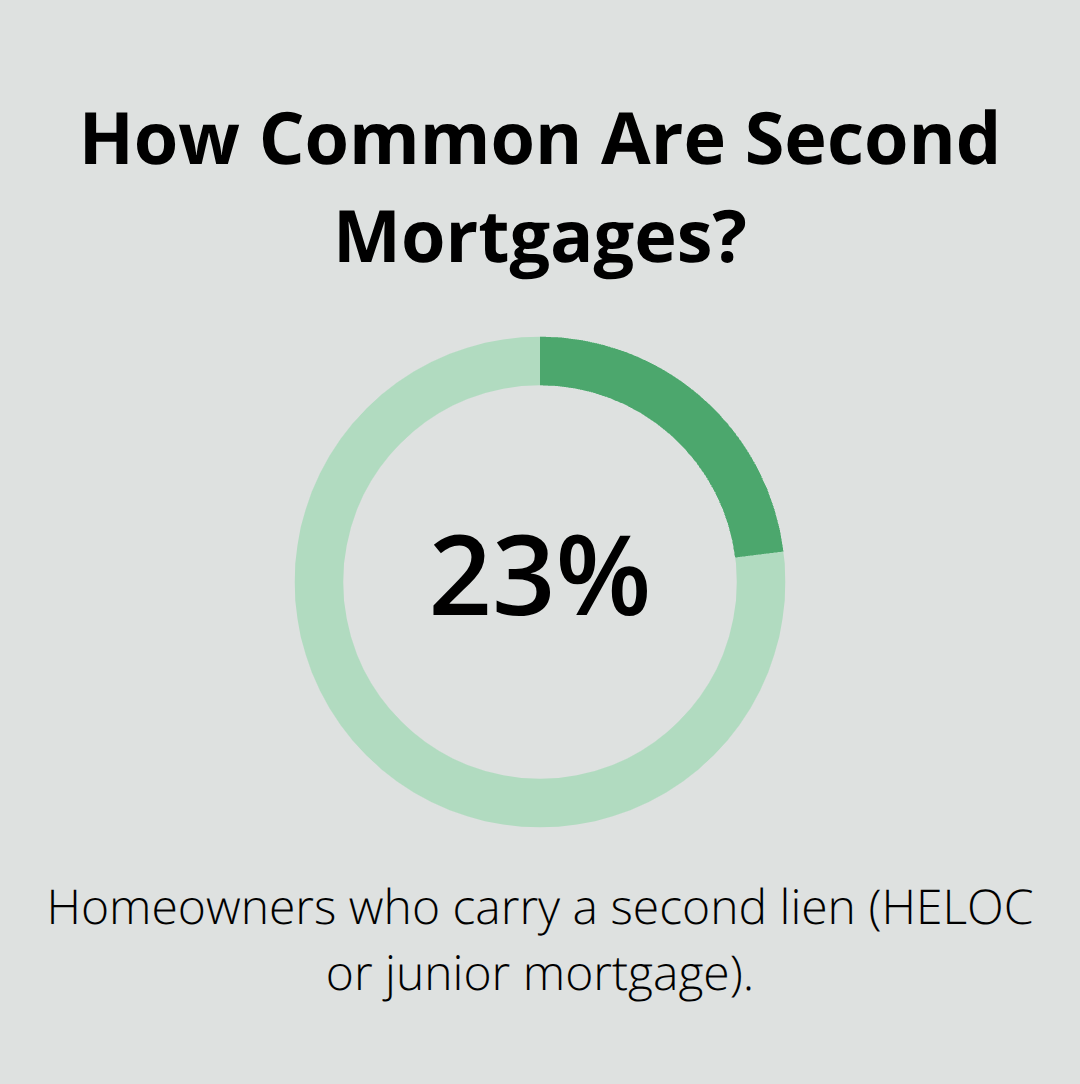
Second mortgages and home equity lines of credit function as junior liens, sitting behind your primary mortgage in the repayment hierarchy. If your home sells during Chapter 7, the first mortgage receives full payment before any second lien holder gets a dollar, which dramatically reduces the amount available to satisfy junior debt. The Federal Reserve Bank of St. Louis reports that approximately 23% of homeowners carry second liens, and this secondary debt actually works in your favor during bankruptcy. When a home’s value drops below what you owe on the first mortgage, the second lien becomes completely unsecured, meaning the trustee will not liquidate your property to satisfy it since no equity exists to distribute.
This scenario protects you far more effectively than any exemption filing, since the trustee has zero financial incentive to sell a home where the primary lender would consume all proceeds.
Negotiate directly with second lien holders after your Chapter 7 discharge to eliminate this debt entirely. Many holders of junior mortgages will accept a substantial discount-sometimes 30 to 50% of the balance-rather than wait through years of post-bankruptcy collection efforts that yield nothing. Request a payoff quote in writing and propose a lump-sum settlement that you can finance through a personal loan or family assistance. If the second lien holder refuses negotiation, the debt technically survives discharge, but practical collection becomes nearly impossible since you have already eliminated your unsecured debts and demonstrated financial recovery through your fresh start. Document all settlement communications and obtain a written release once payment clears, protecting yourself against future claims on your home.
With second liens addressed, the next critical step involves understanding how the trustee evaluates your property and what happens during their assessment process.
5. Stop Pre-Bankruptcy Property Transfers Now
The trustee assigned to your case will scrutinize every property transaction you made within two years before filing Chapter 7, and transferring your home to a family member or spouse during this lookback period strips away homestead protection entirely. Florida bankruptcy law treats property transfers as fraudulent conveyances if they occurred within 24 months of your filing date and you received less than reasonably equivalent value in return. Transferring your home to your spouse, adult child, or parent to shield it from creditors is exactly what trustees investigate first, since these transfers signal an attempt to hide assets rather than legitimate financial planning. Courts will reverse the transfer and order the property returned to your bankruptcy estate, which then becomes available for liquidation to pay creditors. The trustee possesses powerful tools to unwind these transactions, and the consequences extend far beyond losing your home protection-you face potential fraud charges and damage to your credibility with the court.
Refinancing your home or making substantial improvements within two years of filing also triggers trustee attention, though these actions carry less risk than outright transfers since they represent legitimate financial activity. A $50,000 kitchen renovation or roof replacement made six months before filing will be reviewed for timing and purpose, but courts generally allow necessary home maintenance. Avoid any deed transfers, quitclaim arrangements, or title changes in the months leading up to your bankruptcy filing. If you have already transferred property within the past 24 months, disclose this to your bankruptcy attorney immediately so they can assess the damage and develop a strategy to protect you during the bankruptcy process. Understanding what the trustee actually does during property assessment helps you prepare for the next phase of your case.
6. Understanding the Trustee’s Property Assessment
The trustee assigned to your case will order a property valuation early in your bankruptcy timeline, typically within 60 days of your filing date. This assessment determines whether your home contains nonexempt equity that the trustee can liquidate to pay creditors. The trustee does not automatically visit your home; instead, they rely on county tax records, comparable sales data, and your own financial disclosures to establish market value. However, if your equity position appears close to the exemption threshold, the trustee may request a professional appraisal or conduct an in-person inspection to verify the property’s actual condition and value.
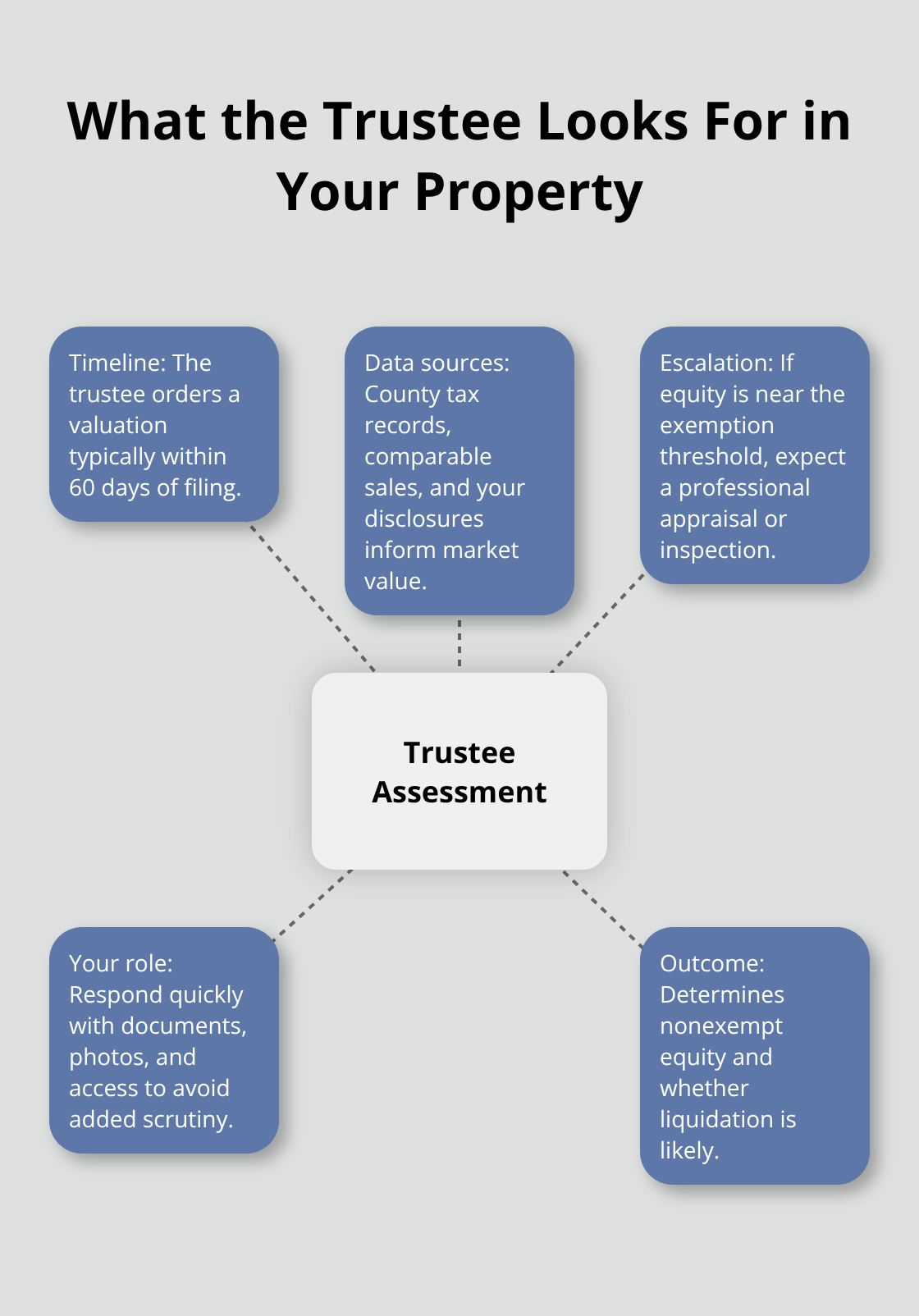
Respond promptly to any trustee requests for documentation, property photos, or access to your home, since delays signal evasiveness and increase scrutiny of your entire case.
Obtain your own independent appraisal before the trustee orders one, particularly if you believe the county assessment overvalues your property or if your neighborhood experienced recent price declines. A professional appraisal costs between $400 and $600 but protects you by establishing a lower value that reduces nonexempt equity and strengthens your position. Submit this appraisal to the trustee voluntarily along with comparable sales data from your area showing recent market trends, which demonstrates good faith and prevents the trustee from obtaining a higher valuation. If the trustee’s valuation appears inflated, challenge it directly by presenting multiple comparable properties sold within the past six months in your immediate neighborhood, along with documentation of any necessary repairs or deferred maintenance that reduce your home’s actual value. Many trustees accept well-documented challenges without ordering a second appraisal, saving time and money while protecting your equity position.
With your property valuation established and any trustee concerns addressed, you now face the practical reality of maintaining your home after discharge-a process that requires sustained financial discipline and strategic planning around your mortgage obligations and post-bankruptcy financial recovery.
Your Fresh Start After Chapter 7
Your house after Chapter 7 discharge remains yours if you stay current on mortgage payments and maintain your homestead exemption. The first 12 months following discharge are critical-missing even one payment triggers foreclosure risk since the automatic stay no longer protects you. Set up automatic payments through your bank to eliminate the risk of accidental late payments, and treat the mortgage as your highest priority debt.
Rebuilding credit after Chapter 7 accelerates faster than most people expect, with your credit score typically improving within 6 to 12 months as discharged debts age and your payment history becomes clean. Secured credit cards with modest limits help demonstrate responsible borrowing, and keeping credit utilization below 30% shows lenders you manage debt wisely. Within 18 to 24 months, many filers qualify for conventional refinancing at competitive rates, which can lower monthly payments and accelerate equity rebuilding.
Equity rebuilds naturally through mortgage principal payments and home appreciation (Memphis-area homes appreciate at roughly 3 to 4% annually, meaning a $250,000 home gains $7,500 to $10,000 in value each year). This appreciation, combined with your regular mortgage payments, steadily increases your protected equity position. Contact us at https://chapter7florida.com to discuss your specific circumstances and confirm you chose the right bankruptcy path for your home protection goals.