
Your home is likely your most valuable asset, and homestead exemptions in Florida offer powerful legal protection when financial hardship strikes. At Harnage Law, PLLC, we’ve seen how filing for bankruptcy without understanding these exemptions can cost homeowners thousands in equity they could have protected.
This guide walks you through exactly how homestead exemptions work, what mistakes to avoid, and the specific steps needed to safeguard your primary residence.
How Florida’s Homestead Exemption Actually Works
A homestead exemption in Florida is a legal shield that protects your primary residence from creditor claims and forced sale during bankruptcy. Unlike most states that cap home equity protection at a specific dollar amount, Florida offers unlimited homestead exemption for qualifying properties. This means if you own your home outright or have significant equity, that equity remains yours even after filing for bankruptcy. The exemption applies to the structure itself, the land it sits on, and any permanent fixtures attached to the property. For homeowners in financial distress, this protection often makes the difference between keeping their home and losing it to creditors.
The Two Requirements That Actually Matter
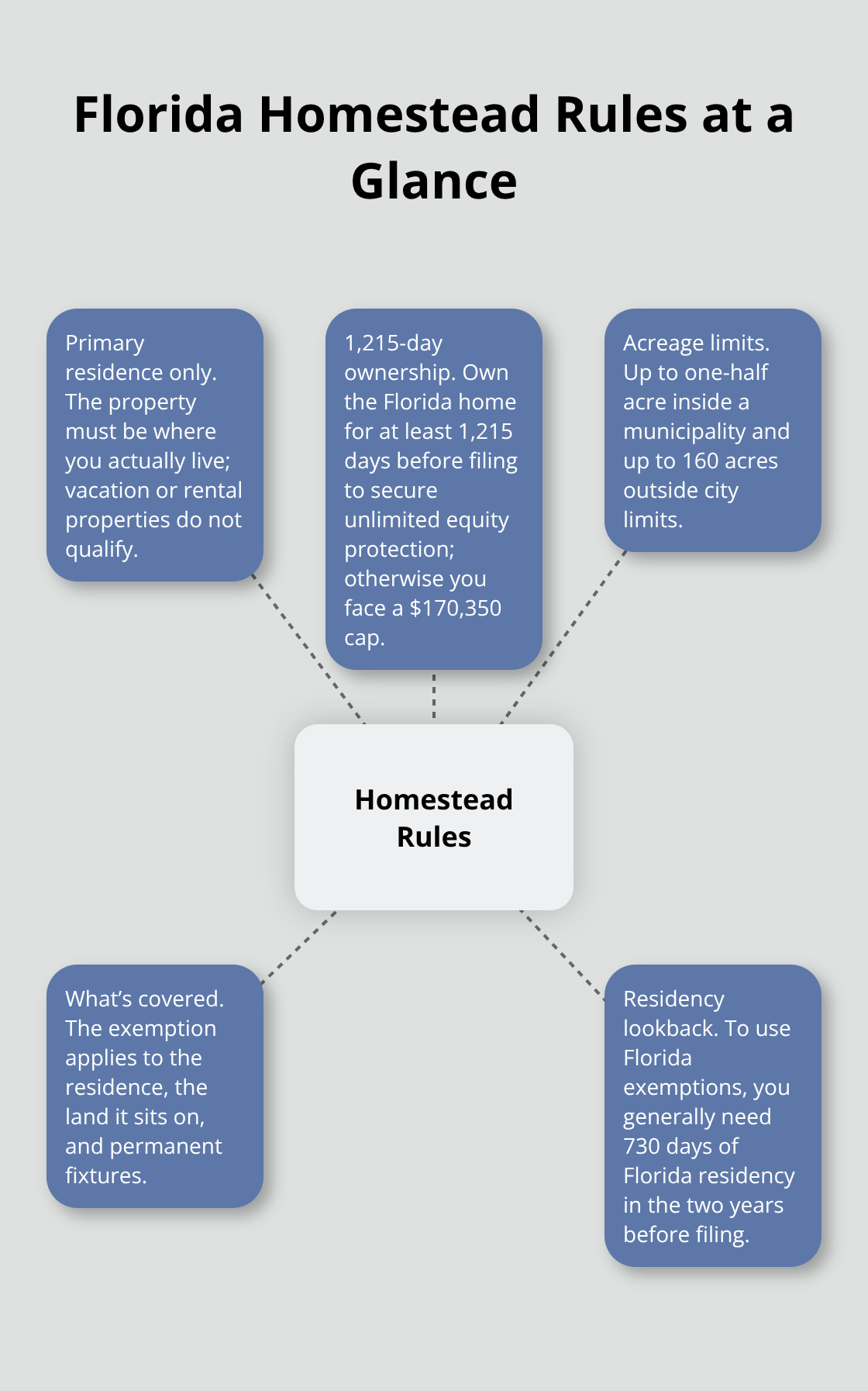
Florida’s homestead exemption hinges on two concrete requirements that you must satisfy before filing bankruptcy. First, the property must be your primary residence where you actually live, not a vacation home, investment property, or rental unit. Second, you must have owned a Florida home for at least 1,215 days before filing for bankruptcy-roughly three years and four months of ownership.
The size of your protected property depends on location. If you own a home inside a city or municipality, the exemption covers up to one-half acre. If your property sits outside city limits, the exemption protects up to 160 acres. These aren’t theoretical limits.
The sheriff’s office can order a survey to determine your exact homestead boundary if a creditor challenges your claim.
If you haven’t reached the 1,215-day mark, you still have protection, but it drops to $170,350 in equity rather than unlimited protection. This matters significantly because homeowners who recently moved to Florida or purchased within the past few years often face unexpected limitations on what they can shield from creditors.
Why Residency Timing Changes Everything
Your residency history directly determines which exemptions you can claim. To use Florida’s homestead exemption, you must have lived in Florida for at least 730 days in the two years before filing bankruptcy. If you haven’t met this requirement, you must use the exemptions from whichever state you lived in longest during the 180 days before your two-year lookback period.
This creates a trap for people who relocated to Florida expecting automatic protection. Someone who moved to Florida 18 months ago to escape financial problems in another state cannot claim Florida’s unlimited homestead exemption yet. They’re locked into whatever exemptions their previous state offers, which could mean significantly less home equity protection. The timing requirements exist in federal bankruptcy law, and they apply uniformly regardless of your intentions or circumstances.
Calculating Your Ownership Timeline Correctly
Many homeowners miscalculate their ownership dates and lose protection they could have claimed. The 1,215-day requirement starts from the date you actually took title to the property, not from when you signed the purchase agreement or closed the loan. If you purchased your home on March 15, 2021, you reach the 1,215-day threshold on July 28, 2024. Filing bankruptcy even one day before that date costs you unlimited protection.
Keep precise records of your ownership dates and residency dates. These documents become critical evidence if a trustee or creditor challenges your exemption claim. Miscalculating either timeline can result in losing tens of thousands in equity that could have been protected. Understanding these specific dates before you file ensures you maximize the protection Florida law provides.
How Your Home Stays Protected in Chapter 7 Bankruptcy
Filing Chapter 7 bankruptcy in Florida creates a specific legal environment where your homestead exemption becomes your primary defense against losing your home. In Chapter 7, the bankruptcy trustee liquidates your nonexempt assets and distributes the proceeds to creditors. However, because Florida offers unlimited homestead protection for qualifying properties, most homeowners keep their homes intact. The trustee cannot touch equity protected by your homestead exemption, which means if you own your home outright or have significant equity and meet the ownership and residency requirements, that equity remains yours after bankruptcy discharge. This protection applies only if you stay current on your mortgage payments. Filing bankruptcy pauses foreclosure temporarily through the automatic stay, but it does not erase missed payments. If you fall behind on your mortgage, Chapter 7 will not cure that delinquency, and your lender can resume foreclosure proceedings after the stay lifts. This is why homeowners facing foreclosure often benefit more from Chapter 13 bankruptcy, where a repayment plan allows you to catch up on missed payments over three to five years.
What the Trustee Can and Cannot Touch
The critical distinction in Chapter 7 lies between exempt and nonexempt property. Your homestead exemption shields your home’s equity, but other assets may not receive the same protection. A vehicle with $8,000 in equity qualifies for only a $1,000 exemption under Florida law, leaving $7,000 exposed to the trustee’s liquidation authority.
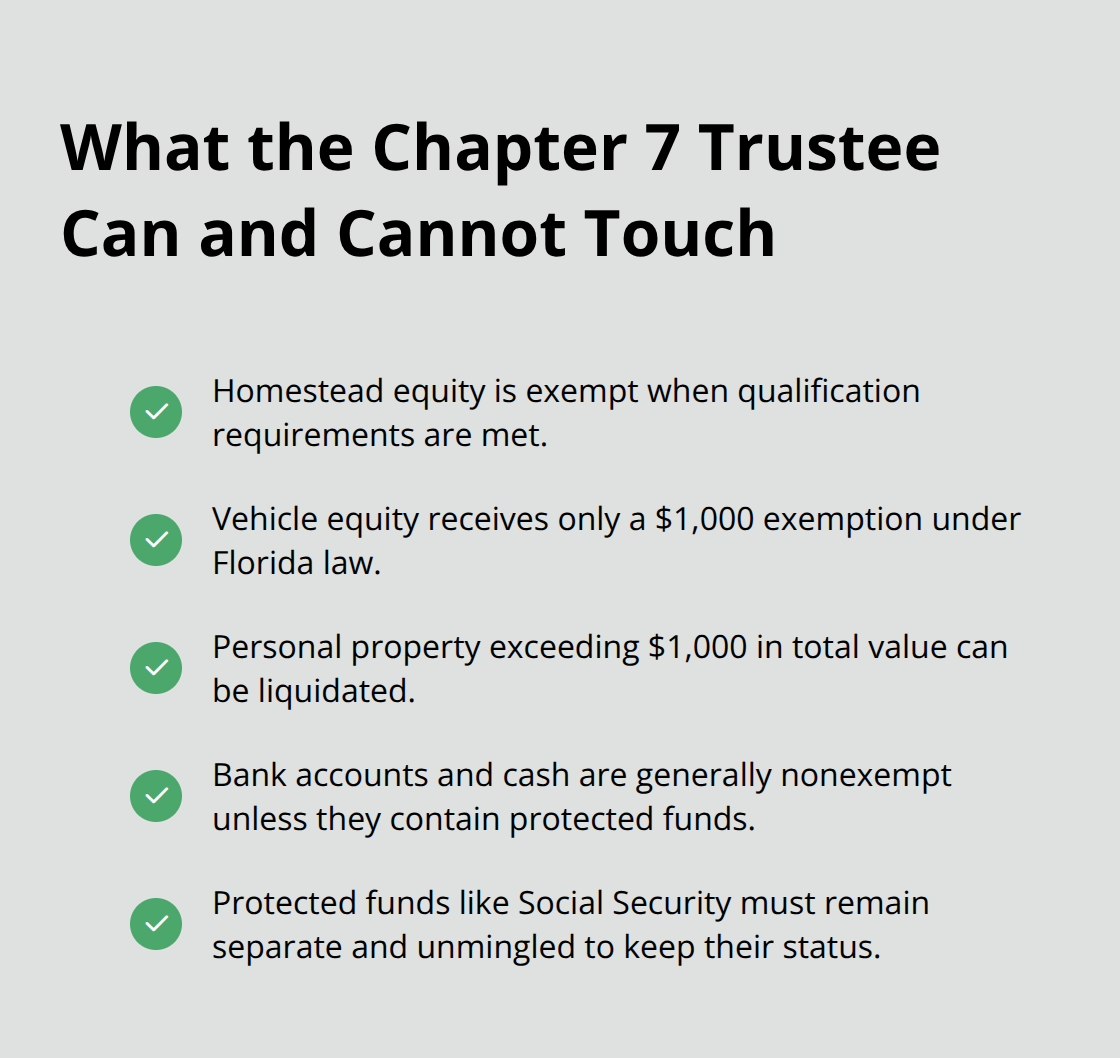
Personal property like electronics, jewelry, or collectibles exceeding $1,000 in total value can be sold to pay creditors. Bank accounts and cash holdings are nonexempt unless they contain protected funds like Social Security benefits or retirement account distributions, which must remain separate and unmingled with other money.
Calculating Your Exposure Before Filing
The practical reality is that Chapter 7 works best for homeowners with minimal nonexempt assets. If most of your wealth sits in your home and you have met the 1,215-day ownership requirement, you face minimal risk of losing property during bankruptcy. Conversely, if you own multiple vehicles, have substantial savings, or hold significant personal property, the trustee may recover thousands for creditors. This is why calculating your actual exempt versus nonexempt assets before filing matters enormously. Many homeowners discover too late that they could have protected more by timing their filing differently or restructuring their assets.
The Mortgage Payment Requirement
The mortgage payment requirement cannot be overstated. Chapter 7 discharge eliminates most unsecured debts like credit cards and medical bills, but it does not eliminate your mortgage obligation. Lenders retain their secured claim against your home regardless of bankruptcy. If you stop paying the mortgage after discharge, the lender can foreclose just as if you had never filed bankruptcy. The automatic stay typically lasts three to four months, providing a window to stabilize your finances and resume payments.
Rebuilding Credit Through Reaffirmation
Many homeowners use the automatic stay period to eliminate credit card debt and medical bills, which frees up monthly cash flow to maintain mortgage payments going forward. Reaffirming your mortgage loan during bankruptcy can actually help rebuild your credit after discharge, as on-time mortgage payments demonstrate financial responsibility to future lenders. The homestead exemption protects your equity, but only if you actively maintain your mortgage obligations. Losing your home to foreclosure after bankruptcy defeats the entire purpose of filing and wastes the protection Florida law provides.
Your mortgage situation directly affects whether Chapter 7 or Chapter 13 makes sense for your circumstances, which is why understanding your specific payment status matters before you file.
Mistakes That Cost Homeowners Thousands in Protection
The gap between understanding homestead exemptions in theory and claiming them correctly in bankruptcy paperwork destroys more cases than any single factor. Homeowners routinely lose protection they legally qualified for because they miscalculate ownership dates, fail to establish homestead status before filing, or submit incomplete documentation to the court. These aren’t minor technicalities. A trustee who spots errors in your exemption claims will challenge them aggressively, and once a challenge succeeds, you cannot recover that lost equity after your case closes.
Ownership and Residency Dates Demand Precision
The most common error homeowners make is filing bankruptcy without first confirming their exact ownership date and residency timeline. Someone who purchased their home on March 20, 2021 might file bankruptcy on March 10, 2024, believing they have met the 1,215-day requirement when they actually fall five days short. That five-day gap costs them unlimited protection and locks them into the $170,350 cap instead. Federal bankruptcy law treats these dates with absolute precision.
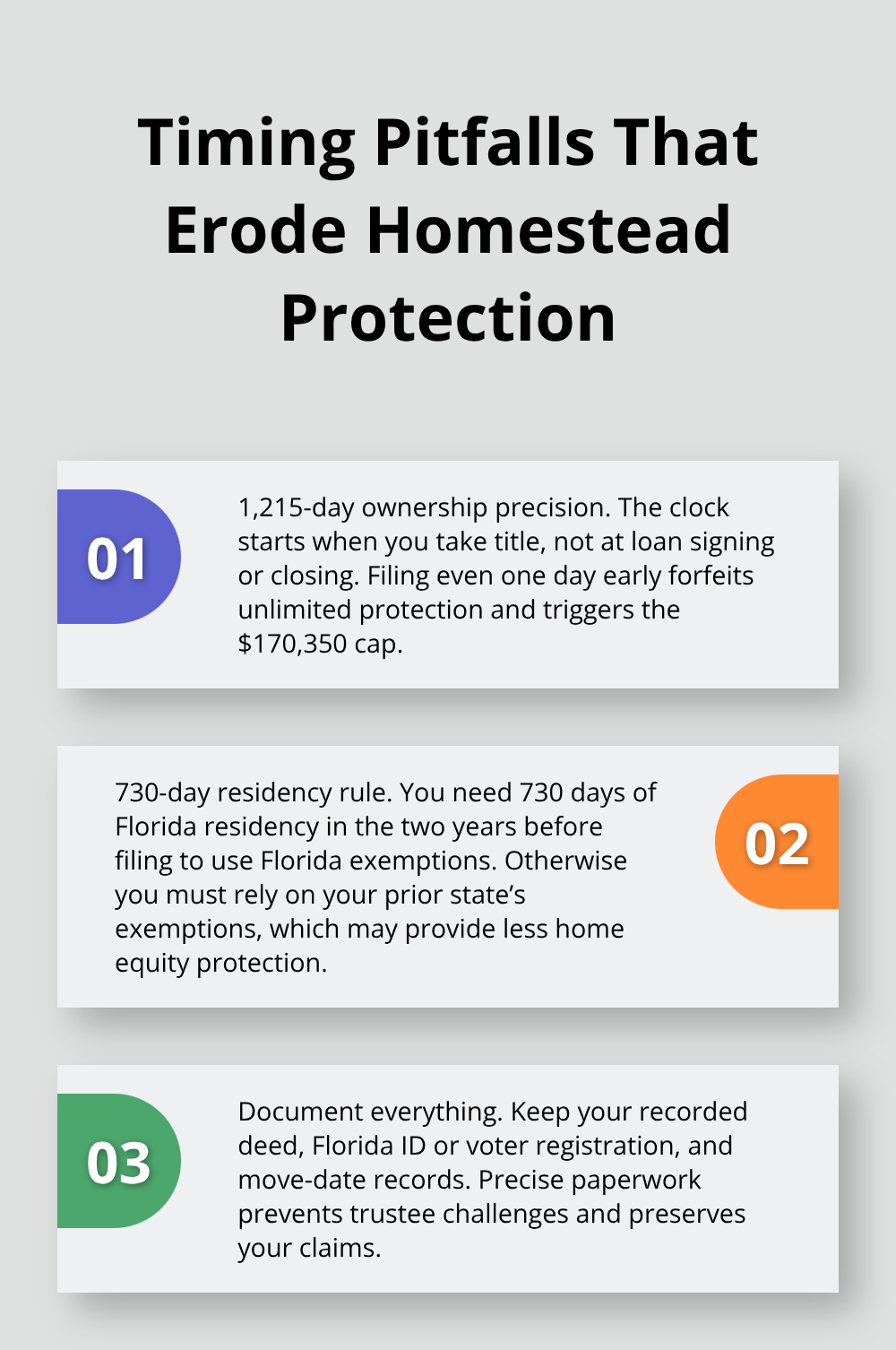
Your ownership period begins when you received title to the property, which appears on your deed recorded with the county clerk. Many homeowners confuse this date with their mortgage closing date, loan approval date, or when they first occupied the property. Pull your recorded deed immediately and count forward 1,215 days using a calendar. Do not estimate. Do not assume.
The residency requirement creates equal problems. You need 730 days of Florida residency in the two years before filing to claim Florida exemptions. Someone who moved to Florida on June 1, 2022 cannot file bankruptcy before June 1, 2024 without losing access to Florida’s unlimited homestead protection. If they file on May 15, 2024, they must use their previous state’s exemptions, which could provide minimal home equity protection depending on where they lived before.
These timing calculations demand written documentation. Gather your deed showing the date you received title, your Florida driver’s license or voter registration showing when you established residency, utility bills from your previous state showing your move date, and any lease agreements or purchase documents that establish your timeline.
Property Coverage Limits Create Unexpected Exposure
The second critical mistake involves misunderstanding what the homestead exemption actually covers and what it leaves exposed. The homestead exemption protects your home’s equity but nothing else. If you own a vehicle worth $12,000 with a $6,000 loan balance, you have $6,000 in equity. Florida’s vehicle exemption protects only $1,000 of that equity, leaving $5,000 exposed to the trustee. Many homeowners assume the homestead exemption extends to other property, then face shock when the trustee liquidates their vehicle, boat, or personal property.
The wildcard exemption adds $4,000 in additional personal property protection if you do not claim the homestead exemption, but this applies only in Chapter 7 cases and covers almost any property except land. You must choose strategically. If your home equity qualifies for unlimited protection, claiming the homestead exemption makes sense, and the wildcard exemption becomes unavailable.
Documentation and Valuation Errors Invite Trustee Challenges
The third mistake involves filing exemption schedules with incomplete or inaccurate information. Federal bankruptcy forms require you to list every exemption you claim with specific property descriptions and valuations. Listing your home as exempt without providing the street address, legal description, or property appraiser parcel number invites trustee objections. Courts have dismissed exemption claims for vague descriptions like simply writing down “home” or “residential property.” The property must be identifiable with precision.
Include your complete street address, the legal description from your deed, and the current fair market value based on recent appraisals or tax assessments. For personal property exemptions, list items with replacement values rather than sentimental values. A computer worth $400 new but ten years old has a replacement value of perhaps $100, not the original purchase price. Undervaluing assets looks deceptive and undermines your credibility with the trustee. Overvaluing them exposes more nonexempt equity than actually exists. Accurate valuation from the start prevents disputes and preserves your claims.
Recording Your Homestead Declaration Strengthens Your Position
Filing your homestead exemption through the county clerk before bankruptcy provides additional protection in some situations. Although not required for bankruptcy exemptions, recording a homestead declaration with the circuit court creates a public record of your claim. This step costs roughly $50 to $100 but can prevent judgment liens from attaching to your property and demonstrates your serious intent to protect your home. If a creditor has already filed a judgment lien against your property, you have 45 days after service to file a notice of homestead asserting your exemption. Missing this deadline can cost you thousands in equity.
Final Thoughts
Florida’s homestead exemptions stand as one of the strongest asset protection tools available to homeowners facing bankruptcy. The unlimited equity protection you receive after meeting the 1,215-day ownership requirement and 730-day residency requirement can preserve hundreds of thousands of dollars that would otherwise go to creditors. However, this protection only works if you claim it correctly and understand the specific requirements that apply to your situation.
A single miscalculation can cost you tens of thousands in equity you could have legally protected. Homeowners who file without confirming their exact ownership date, who misunderstand what the homestead exemption covers, or who submit incomplete documentation to the court often discover too late that they lost protection they qualified for. Once your bankruptcy case closes, you cannot recover that lost equity or correct errors in your exemption claims.
We at Harnage Law, PLLC understand that protecting your home requires precise documentation, accurate calculations, and strategic planning tailored to your specific circumstances. Contact us for a consultation to confirm your eligibility for homestead exemptions in Florida, verify your ownership timeline, and develop a strategy that protects your most valuable asset. Visit our website to learn how we can help you navigate bankruptcy with confidence and preserve the home you’ve worked to build.