
Filing Chapter 7 bankruptcy in Florida means understanding which assets you can protect. State law gives you powerful tools to shield your home, vehicles, retirement accounts, and other property from creditors.
We at Harnage Law, PLLC help clients navigate Florida’s Chapter 7 exemptions list to keep what matters most. This guide walks you through the protections available and how to position your assets strategically before filing.
How Florida Exemptions Work in Chapter 7
An exemption is a legal protection that lets you keep specific assets when you file Chapter 7 bankruptcy. Instead of losing everything to creditors, exemptions carve out property the trustee cannot touch. Florida law is unusually generous here-the state protects unlimited home equity if you meet ownership requirements, full retirement account balances, and essential personal property. This matters because Chapter 7 is liquidation bankruptcy, meaning the trustee sells nonexempt assets to pay creditors. Without exemptions, you’d lose your house, car, and savings accounts. With them, you walk away with your life intact.
Florida Statute Section 222 lays out these protections, and they apply automatically when you file-but only if you claim them correctly on your paperwork. The catch is that Florida opted out of the federal exemption system entirely, so you cannot use federal exemptions in Florida bankruptcy. This is actually favorable because Florida’s list is more debtor-friendly than federal options in most categories.
What You Actually Keep Under Florida Law
Your home receives unlimited protection if you’ve owned it as your primary residence for at least 1,215 days before filing and the property stays within half an acre in a city or 160 acres elsewhere. If you haven’t hit the 1,215-day mark yet, Florida still protects approximately $170,350 in home equity.
Retirement accounts-401(k)s, 403(b)s, IRAs, and pensions-remain fully exempt with no dollar cap, protected under both state law and federal rules that survive bankruptcy. Motor vehicles receive protection up to $1,000 in equity per person, or $2,000 for couples filing jointly.
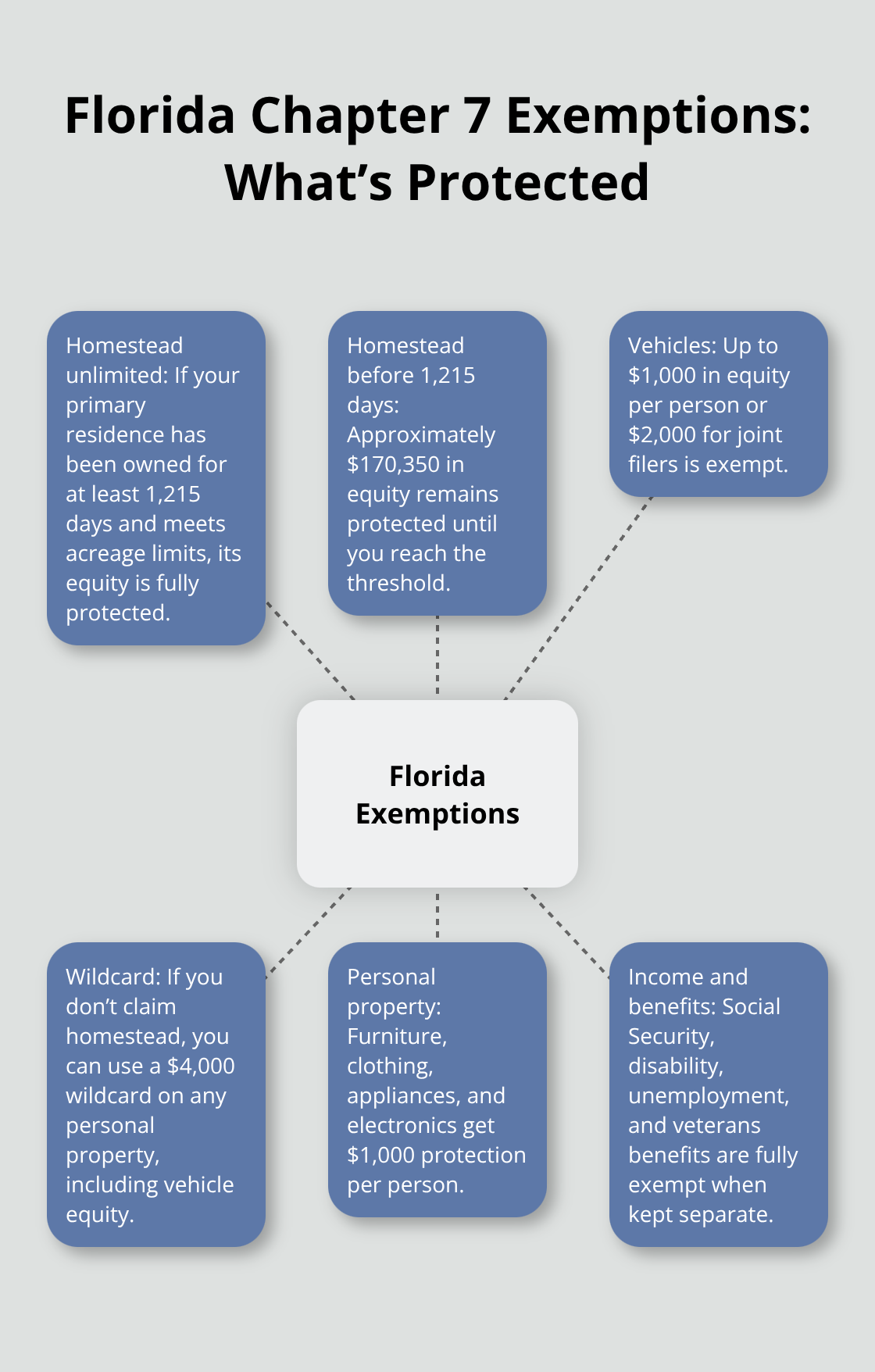
Personal property like furniture, clothing, appliances, and electronics gets up to $1,000 protection per person. If you don’t claim the homestead exemption on real estate, a wildcard exemption gives you $4,000 to use on any personal property, including excess vehicle equity.
Social Security, disability benefits, unemployment compensation, and veterans benefits remain fully protected and don’t count as bankruptcy estate assets when kept separate from other funds. Life insurance proceeds payable to a beneficiary and the cash surrender value of whole life policies are exempt. Wages for the head of household receive 100 percent protection up to $750 per week.
Why the Residency Requirement Matters
You must have lived in Florida continuously for at least 730 days before filing to use Florida exemptions. If you moved to Florida fewer than two years ago, you cannot use Florida’s generous homestead protection. Instead, you’d apply exemptions from the state where you lived the longest during the 180 days before your two-year lookback period.
This is a serious planning issue. Someone who relocated to Florida from California 18 months ago cannot protect unlimited home equity-they’d use California exemptions instead, which cap home protection at $600,000 for a single filer. Timing matters enormously. If you’re close to the 730-day mark, waiting a few months could mean the difference between protecting your entire home and losing it.
The residency clock starts when you establish Florida domicile, not when you buy property, so renting counts toward the requirement. Understanding where you stand on this timeline shapes your entire exemption strategy and filing decision.
What Assets Does Florida Actually Protect in Chapter 7
Your Home Receives Unlimited Protection
Your home is the crown jewel of Florida’s Chapter 7 protections, and the numbers reflect why this matters. If you own your primary residence for at least 1,215 days before filing, Florida protects unlimited equity regardless of your home’s sale price. A $500,000 home, a $1 million home, or a $2 million home all receive the same full protection as long as the property stays within half an acre inside city limits or 160 acres in rural areas. This is extraordinarily rare among U.S. states-most states cap homestead protection between $25,000 and $600,000, making Florida’s unlimited approach a significant advantage. If you haven’t yet reached the 1,215-day ownership threshold, Florida still shields approximately $170,350 in home equity, which covers most primary residences in the state. Do not sell or transfer your home before filing Chapter 7 if you’re close to the 1,215-day mark. Waiting another few months transforms your protection from capped to unlimited.
Vehicles and Personal Property Coverage
Vehicles and personal property receive more modest but still meaningful protection. A single vehicle gets up to $1,000 in equity protection, or $2,000 for couples filing jointly. This protects equity only, not the vehicle’s full value, so a car worth $12,000 with a $10,000 loan has only $2,000 in equity and would be fully protected. If you don’t claim homestead protection, Florida’s wildcard exemption gives you $4,000 in additional personal property coverage, which you can apply to excess vehicle equity, jewelry, electronics, or furniture. Calculate your actual equity before filing by subtracting the loan balance from the vehicle’s fair market value using tools like Kelley Blue Book, then determine whether you need to apply your wildcard exemption to protect excess equity.
Retirement Accounts and Income Benefits
Retirement accounts receive complete protection with no dollar limits: your 401(k), 403(b), IRA, and pension balances remain untouchable in Chapter 7, safeguarded under both Florida statute and federal law that applies across all states. Social Security benefits, disability payments, veterans benefits, and unemployment compensation stay fully exempt when kept in separate accounts. Life insurance proceeds payable to beneficiaries and whole life policy cash surrender values are protected. Wages for heads of household receive 100 percent protection up to $750 per week.
Protecting Your Funds Through Careful Separation
The practical strategy here involves separating funds carefully: keep Social Security and disability payments in dedicated accounts, never commingling them with other income, because mixing exempt and nonexempt money creates disputes with the trustee about what portion remains protected. This separation becomes critical when the trustee reviews your bank statements and account history. Funds that appear mixed together may lose their exempt status, even if you originally deposited them as protected income. The trustee will scrutinize deposits and withdrawals to determine what portion of your account balance qualifies for protection.
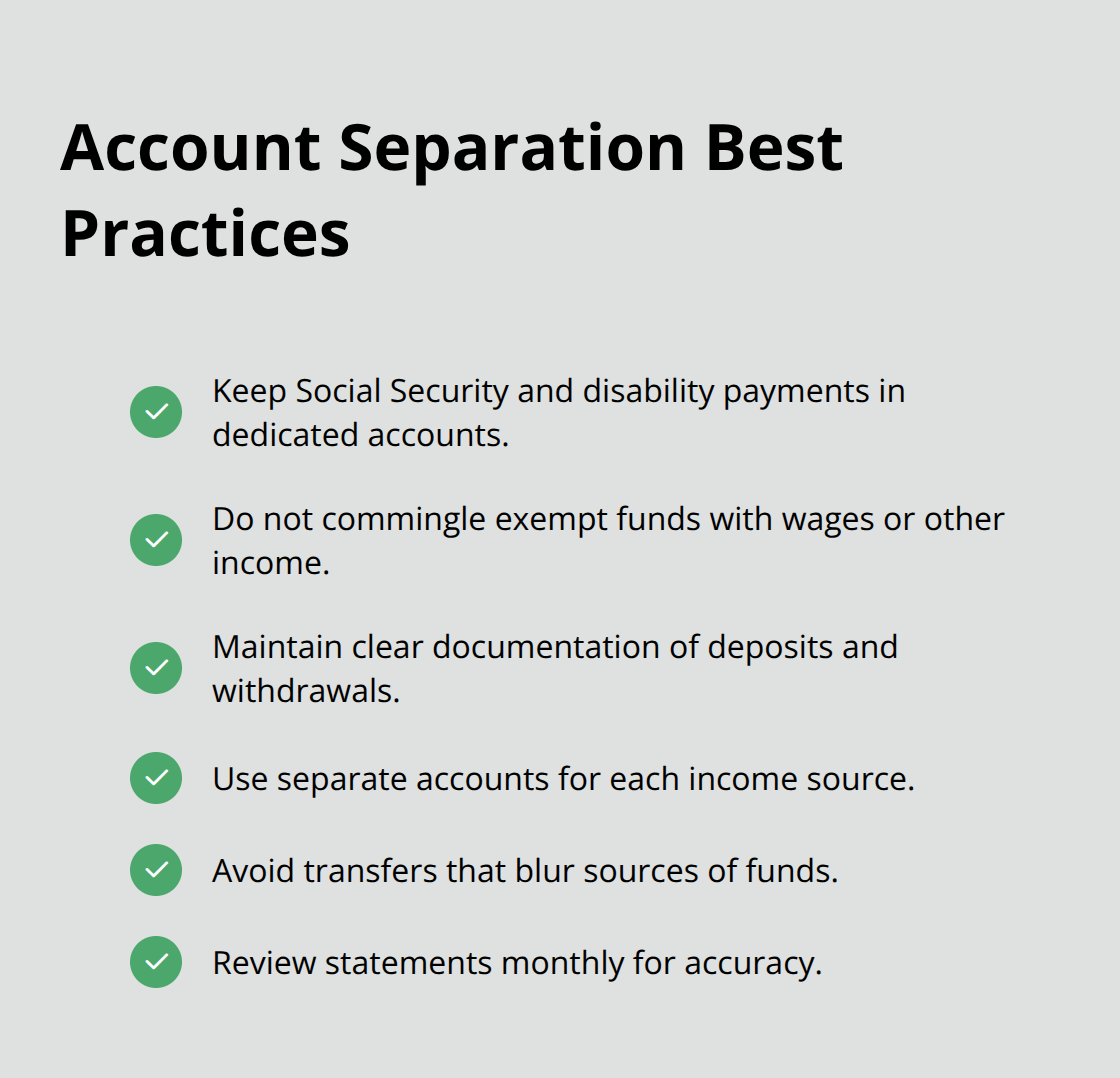
Maintaining distinct accounts for each income source eliminates this ambiguity and strengthens your exemption claims during the bankruptcy process.
Strategic Planning to Maximize Your Florida Chapter 7 Exemptions
Timing Your Filing Around Residency Deadlines
The 730-day residency requirement for Florida exemptions creates a hard deadline that shapes everything else in your Chapter 7 strategy. If you moved to Florida 18 months ago, filing now means losing unlimited homestead protection and reverting to your previous state’s exemptions, which almost always cap home equity far lower than Florida’s unlimited shield. Waiting six months transforms your entire financial picture. Someone with a $400,000 home in California before relocating gains nothing by filing early; California caps homestead at $600,000 for single filers, but that’s still capped.
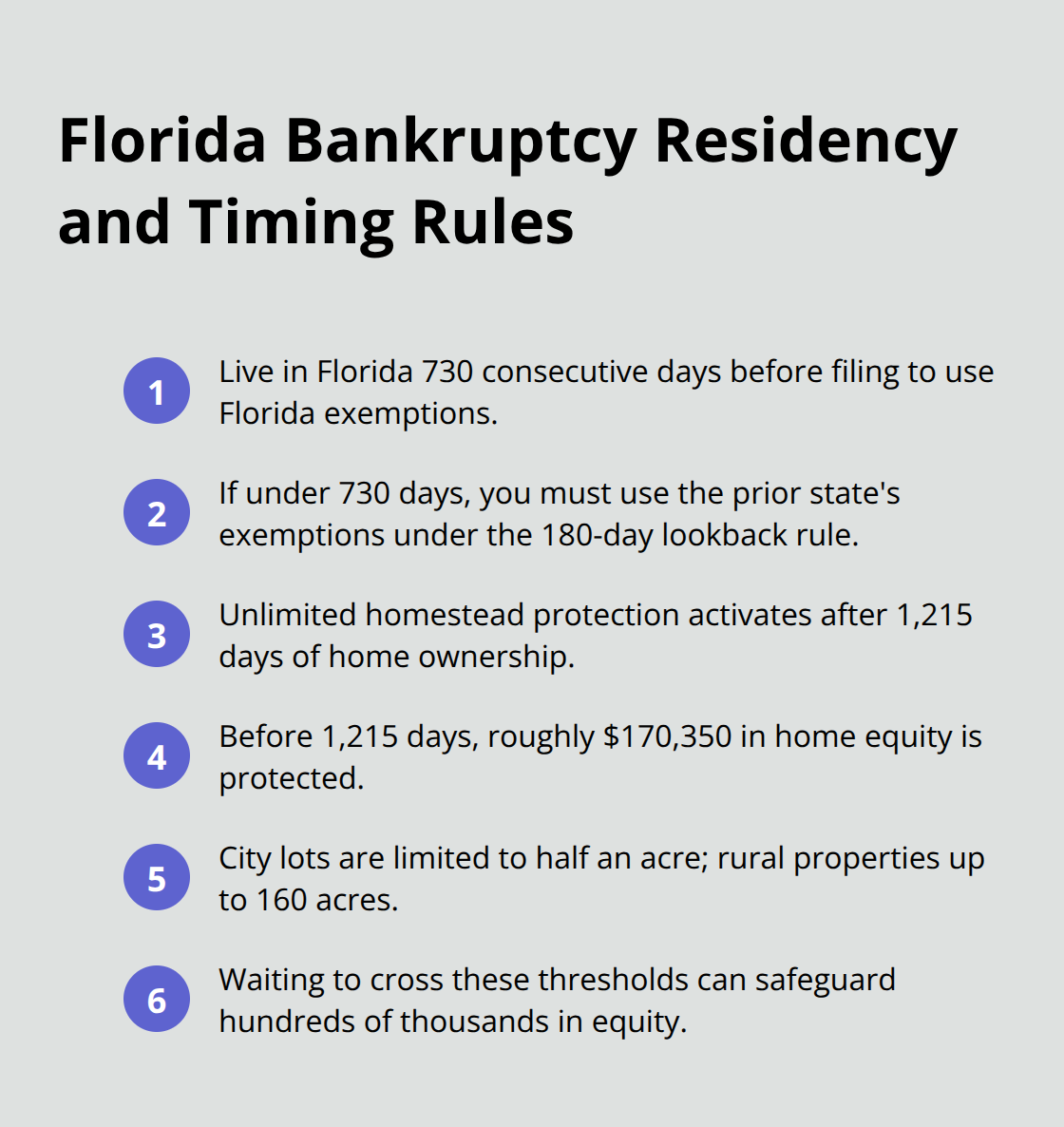
File in Florida after hitting 730 days of residency and you protect the full $400,000 regardless of appreciation.
The 1,215-day homestead ownership threshold works similarly. You don’t need to own a home for nearly four years to get basic protection-Florida shields approximately $170,350 even if you’ve owned the property for just 90 days. But unlimited protection activates at 1,215 days. If you’ve owned your primary residence for 1,200 days, waiting 15 more days before filing transforms capped protection into unlimited protection with zero additional cost. Someone with a $600,000 home who files 14 days too early loses $430,000 in potential protection. The trustee gets paid from nonexempt assets, and that difference means the trustee can seize and sell your home.
Calculate your exact residency date and ownership date before contacting a bankruptcy attorney, then compare that timeline against your debt situation. If you’re within six months of either deadline and your creditors aren’t actively suing you, waiting typically makes financial sense.
Positioning Assets Before You File
Asset positioning before filing requires ruthless honesty about what you actually own and what equity you hold. The biggest mistake people make involves underestimating vehicle equity. A car worth $15,000 with a $12,000 loan has $3,000 in equity, but only $1,000 receives protection under Florida exemptions. The trustee can seize and sell that vehicle, paying off the loan and keeping the remaining $2,000 for creditors. You cannot avoid this by selling the car and purchasing a cheaper one two weeks before filing-the trustee will investigate recent transactions and can reverse sales that look designed to hide assets.
Instead, if you have excess vehicle equity and don’t claim homestead exemption, apply your $4,000 wildcard exemption to cover the overage. Keep detailed records showing the vehicle’s fair market value using Kelley Blue Book or NADA Guides, then subtract the loan balance to prove your actual equity. Personal property creates similar complications. That jewelry collection, electronics, or furniture gets $1,000 protection per person. Most households exceed this with ease. List everything with replacement values, not yard sale prices. A television you bought for $1,200 five years ago gets valued at its replacement cost today, typically $400 to $600.
Many people undervalue items, thinking lower values mean less trustee interest, but inaccurate valuations constitute fraud in bankruptcy. The trustee reviews your schedules against bank statements, credit card statements, and purchase history. Inconsistencies trigger investigations. Separate accounts for Social Security and disability income before filing strengthens your protection claims. If your disability check deposits into the same account as your spouse’s wages and you withdraw funds for groceries and bills, the trustee will argue portions of that mixed account lose exempt status. Three separate accounts-one for disability, one for wages, one for household expenses-eliminates ambiguity.
Protecting Income Through Account Separation
The trustee still reviews account activity, but clear source documentation makes your exemption claims bulletproof. Social Security benefits, disability payments, veterans benefits, and unemployment compensation stay fully exempt when kept in separate accounts. Commingling these funds with other income creates disputes about what portion remains protected. When the trustee reviews your bank statements and account history, funds that appear mixed together may lose their exempt status, even if you originally deposited them as protected income.
The trustee will scrutinize deposits and withdrawals to determine what portion of your account balance qualifies for protection. Maintaining distinct accounts for each income source eliminates this ambiguity and strengthens your exemption claims during the bankruptcy process. This separation becomes critical when the trustee examines your financial records. A dedicated account for disability income with clear monthly deposits and withdrawals for essential expenses presents a far stronger case than a mixed account where disability funds blend with wages and other income sources.
Working With Legal Representation to Identify All Protections
Working with a bankruptcy attorney isn’t optional if you want to maximize exemptions; it’s essential for identifying protections you don’t know exist. Most people focus on home and vehicle equity and miss entirely that health savings accounts receive full protection, or that certain annuities protect additional retirement savings, or that tenancy by the entirety rules can shelter jointly-owned property when only one spouse files. An attorney examines your complete financial picture to identify every available protection. This isn’t a generic checklist; it’s tactical planning.
Someone earning $75,000 annually with $400,000 in home equity and $50,000 in vehicle equity needs different strategy than someone earning $120,000 with identical assets, because income affects Chapter 13 eligibility and repayment obligations. An attorney runs the means test calculation before filing to determine whether Chapter 7 actually remains available or whether Chapter 13 becomes necessary. Chapter 13 changes your entire exemption approach because you can pay nonexempt assets through a repayment plan over five years, potentially keeping assets you’d lose in Chapter 7.
The decision between Chapter 7 and Chapter 13 hinges partly on exemptions, partly on income, partly on whether you want to catch up mortgage arrears or prevent vehicle repossession. An attorney explains how each chapter interacts with your specific exemptions. Never file without this analysis.
Final Thoughts
Florida’s Chapter 7 exemptions list provides real protection for your home, vehicles, retirement accounts, and income when you file bankruptcy. The state’s unlimited homestead exemption, full retirement account protection, and generous personal property coverage create a framework that lets you rebuild financially without losing everything to creditors. These protections exist specifically to give you a fresh start, not to punish you for financial hardship.
Timing and accuracy matter enormously in your exemption strategy. Missing your 730-day residency deadline or 1,215-day homestead ownership threshold by weeks can cost you hundreds of thousands in lost protection. Undervaluing assets or commingling exempt income with other funds creates disputes with the trustee that weaken your exemption claims. Your home remains yours, your retirement savings stay intact, and your Social Security and disability income cannot be touched when you position your assets correctly.
Calculate your exact residency timeline and asset equity, then contact a bankruptcy attorney to review your complete financial picture. We at Harnage Law, PLLC help clients navigate Chapter 7 bankruptcy by identifying every available protection and positioning assets strategically before filing. Contact us to discuss how Florida exemptions apply to your situation and whether Chapter 7 offers the fresh start you need.