Filing for Chapter 7 bankruptcy in Florida doesn’t mean losing everything you own. State law protects many of your most valuable assets from creditors, and understanding your Florida bankruptcy exemptions list is the first step toward keeping what matters most.
We at Harnage Law, PLLC help clients navigate these protections every day. This guide walks you through exactly which assets you can safely keep and how to claim them properly.
How Exemptions Shield Your Assets in Chapter 7
Exemptions are the legal tools that protect specific assets when you file Chapter 7 bankruptcy in Florida. Without them, a trustee appointed by the court could liquidate nearly everything you own to pay creditors. Instead, exemptions create a protected list of property that stays with you even after filing. Florida law recognizes that you need a home, a vehicle, retirement savings, and basic household items to rebuild your life. The exemptions exist because lawmakers understand that stripping someone of all possessions doesn’t help them become financially stable again. When you file Chapter 7 in Florida, you claim exemptions on your bankruptcy forms to tell the court which assets are off-limits. The trustee reviews your list and can only sell nonexempt property to pay unsecured creditors like credit card companies and medical bill collectors.
Florida Chose Its Own Path on Exemptions
Florida is an opt-out state, meaning you cannot use federal bankruptcy exemptions. Instead, you must use Florida’s exemption system, which the Florida Constitution and state statutes establish. This matters significantly because Florida’s protections are substantially stronger than federal exemptions in several categories.
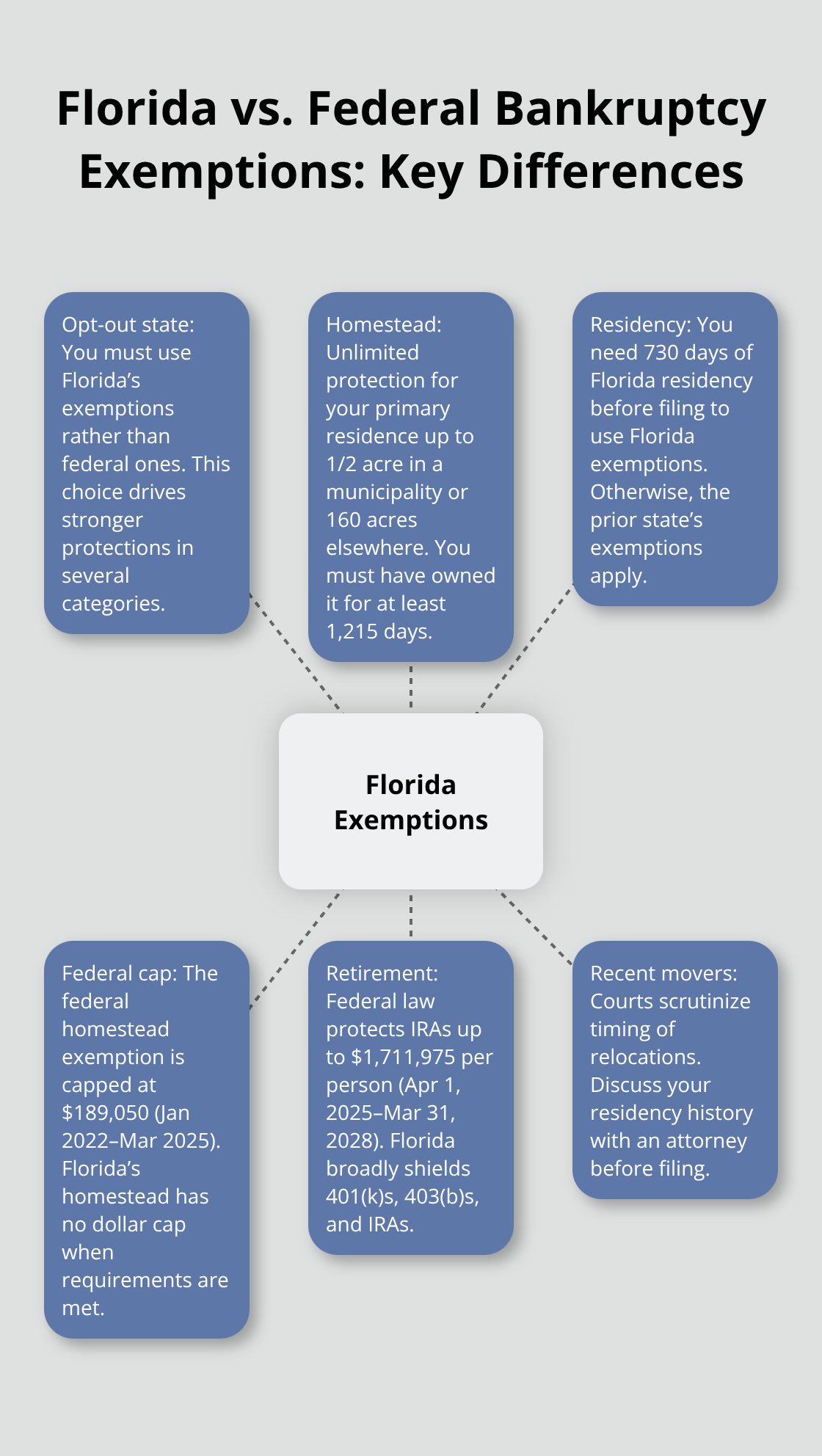
The federal homestead exemption caps out at $189,050 for cases filed between January 2022 and March 2025, according to the U.S. Bankruptcy Code. Florida’s homestead exemption, by contrast, offers unlimited protection for your primary residence up to half an acre in a municipality or 160 acres elsewhere, provided you owned it for at least 1,215 days before filing. For retirement accounts, federal law protects IRAs up to $1,711,975 per person for cases filed between April 1, 2025 and March 31, 2028. Florida law protects tax-exempt retirement accounts broadly, including 401(k)s, 403(b)s, SEP IRAs, SIMPLE IRAs, traditional IRAs, and Roth IRAs with similar protections. This distinction matters if you moved to Florida recently or are considering relocation. You must have lived in Florida for at least 730 days before filing to use Florida exemptions; otherwise, courts apply the exemptions from the state where you lived longest during the two years before filing.
Why Florida Stands Out for Debtors
Florida’s exemption framework ranks among the strongest in the nation, and homeowners benefit most dramatically. A person with significant home equity in Florida can keep that entire equity protected in Chapter 7, whereas the same homeowner in most other states would lose the excess above federal caps. Workers’ compensation benefits are fully exempt under Florida law, as are Social Security, VA benefits, and public employee pensions (including firefighter, police, and teacher retirement plans). Life insurance proceeds payable to a named beneficiary are entirely protected, and the cash surrender value of life insurance policies cannot be touched by creditors. Personal property exemptions in Florida allow you to protect up to $1,000 in household items like furniture, electronics, and art per person, or $4,000 if you don’t use the homestead exemption. Motor vehicle equity protection covers up to $5,000 per vehicle under Florida law, meaning most financed vehicles with minimal equity are fully protected. Health savings accounts, disability income benefits, and annuity contracts also receive protection. This layered approach to exemptions reflects Florida’s constitutional commitment to protecting homeowners and working families from financial ruin.
Residency Requirements Determine Your Exemption Rights
Your ability to use Florida’s generous exemptions depends on how long you’ve lived in the state. The 730-day residency requirement (approximately two years) is the threshold that unlocks Florida’s full exemption protections. If you haven’t met this requirement, courts look back to the state where you lived longest during the two years before filing and apply that state’s exemptions instead. This timing matters enormously because moving to Florida specifically to file bankruptcy won’t automatically grant you access to Florida’s unlimited homestead exemption. Courts scrutinize the timing of moves to Florida, so you should discuss your residency history with a bankruptcy attorney before filing. The 1,215-day ownership requirement for the homestead exemption (approximately 40 months) is separate from the residency requirement, and both must be satisfied to claim unlimited home equity protection.
What Happens Next in Your Chapter 7 Filing
Understanding these exemptions is only the first step. You must properly claim them on your bankruptcy forms and work with the trustee to ensure the court recognizes your protected assets. The next chapter walks you through exactly how to file your exemption schedule with the court and avoid the mistakes that can jeopardize your asset protection.
What Assets Stay Protected in Your Chapter 7 Filing
Your Home Receives Unlimited Protection
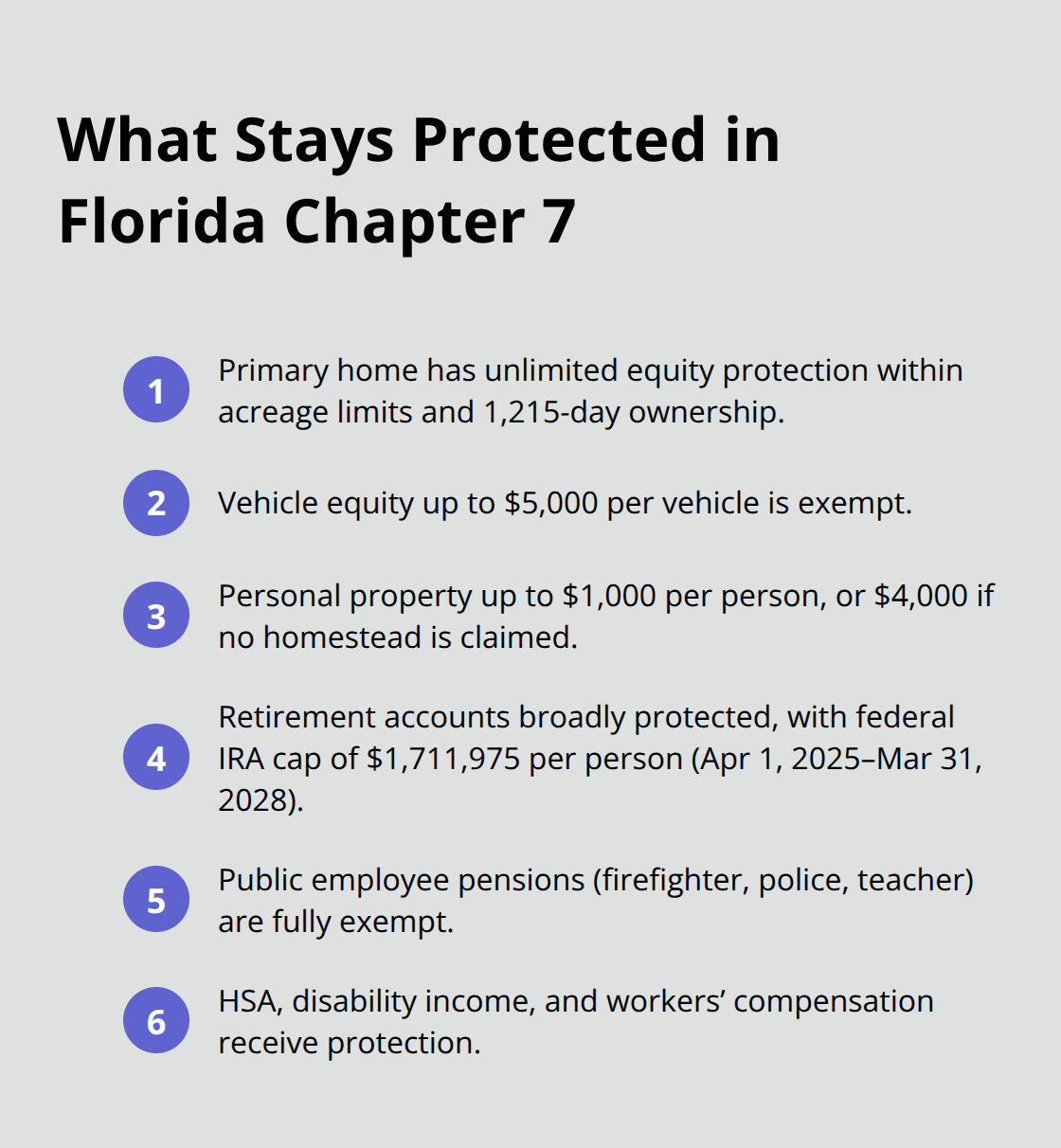
Florida’s exemption system protects far more than most debtors realize, and the numbers prove it. Your primary residence receives unlimited protection if you own a home on half an acre or less within city limits, or up to 160 acres outside municipalities. This protection applies regardless of your home’s value-a $500,000 house receives the same legal shield as a $200,000 one, provided you owned it for at least 1,215 days and meet Florida’s residency requirements.
The federal cap of $189,050 doesn’t apply here because Florida opted out of federal exemptions entirely.
Vehicles and Personal Property Stay With You
Vehicle equity up to $5,000 stays with you under Florida law, which covers most financed vehicles since depreciation typically leaves little equity once you account for loan balances. For a car worth $12,000 with a $9,000 remaining loan, you keep the full vehicle because the $3,000 equity falls within the $5,000 exemption. Personal property exemptions protect up to $1,000 per person for household items like furniture, electronics, and artwork, or $4,000 if you don’t claim the homestead exemption. This means a television, refrigerator, bedroom set, and family heirlooms remain yours.
Retirement Accounts Offer Your Strongest Protection After Your Home
Retirement accounts represent exceptional protection under Florida law. The state shields 401(k)s, 403(b)s, traditional IRAs, Roth IRAs, SEP IRAs, and SIMPLE IRAs with broad protection. For cases filed between April 1, 2025 and March 31, 2028, federal law protects up to $1,711,975 per person in IRA accounts. Public employee pensions, including firefighter, police, and teacher retirement benefits, are fully exempt under Florida statute. Health savings accounts receive full protection under Florida law, as do disability income benefits and workers’ compensation awards.
Income and Benefits Remain Protected
Social Security benefits, VA benefits, and unemployment compensation remain untouched by creditors when properly segregated in your bank account. Life insurance proceeds paid to named beneficiaries are entirely exempt, and the cash surrender value of whole life policies cannot be seized. If you’re a head of household, wage exemptions protect 100% of your wages up to $750 per week under Florida law, though this applies to ongoing income rather than assets already in bankruptcy.
Documentation and Account Management Determine Your Success
The key to maximizing these protections lies in accurate documentation. You must list each asset with its replacement value, not what you paid for it years ago. A five-year-old laptop worth $200 today gets listed at $200, not the original $1,200 purchase price. Commingling exempt funds with non-exempt money jeopardizes protection, so keep Social Security deposits separate from other income and maintain clear records showing the source of each account. Proper asset valuation and account separation prevent disputes with the trustee and protect what matters most to your financial recovery. The next chapter shows you exactly how to file your exemption schedule with the court and work with the trustee to claim these protections.
Claiming Your Exemptions in Chapter 7
Complete Schedule C With Precision and Honesty
Filing your exemption schedule transforms protection from theory into legal reality. You must complete Schedule C of your bankruptcy petition, listing every asset you want to protect and citing the specific Florida statute that shields it. This form goes directly to the court and the trustee, so accuracy matters enormously. List your primary residence with its current market value, not what you owe on the mortgage. For a home worth $350,000 with a $200,000 mortgage, you list the full $350,000 value and claim the unlimited homestead exemption under Florida Constitution Article X, Section 4. The trustee sees immediately that the property is fully exempt and moves on to nonexempt assets.
Vehicle equity requires honest math: take the fair market value from resources like NADA Guides or Kelley Blue Book, subtract what you still owe, and list the remaining equity with the $5,000 exemption citation from Florida Statute 222.25(1). A vehicle worth $8,000 with a $6,500 loan shows $1,500 equity, which falls entirely within your exemption. Retirement accounts get listed with their account balance as of your filing date, claiming the broad protection under Florida Statute 222.21(2), which shields 401(k)s, IRAs, and pension plans.
Personal property requires itemized entries: furniture at replacement value, electronics, artwork, and household goods all get separate line items totaling no more than $1,000 per person under Florida Statute 222.25. Many filers undervalue items and miss protection opportunities, while others overvalue property and trigger trustee objections. Try honest replacement value-what you could sell the item for today in its current condition, not original purchase price or wishful thinking.
Support Your Claims With Documentation
Your trustee will review these exemption claims, and this interaction determines whether you keep what you listed. Most trustees accept properly cited exemptions without challenge, but some scrutinize valuations or question whether items truly exist. Bring documentation to support your claims: recent photos of household items, bank statements showing retirement account balances, vehicle registration and maintenance records, and proof of homestead status like a property tax bill.
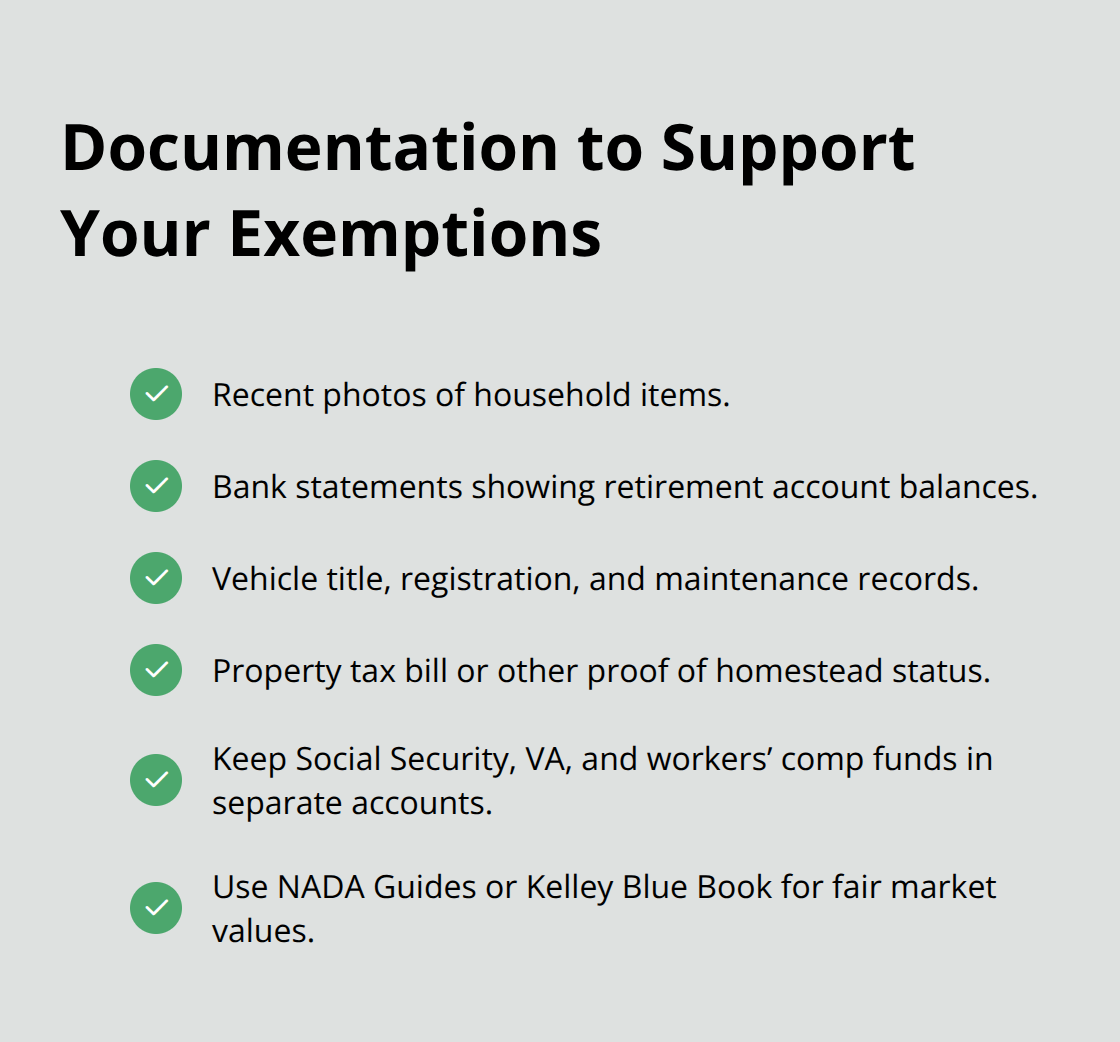
The biggest mistake filers make involves listing assets without claiming exemptions, leaving property unprotected and vulnerable to liquidation. Another critical error involves commingling funds: if you deposit your Social Security check into an account holding other money, you risk losing protection if the trustee claims the account balance exceeds your exemption. Keep Social Security, VA benefits, and workers’ compensation in separate accounts with clear documentation of the source.
Avoid Valuation Errors That Invite Scrutiny
Filers frequently mischaracterize property values-listing a ten-year-old television at its original $2,000 price instead of its actual $150 replacement value creates red flags and invites closer scrutiny of your entire exemption schedule. Accurate valuations protect your credibility with the trustee and strengthen your position across all claimed exemptions.
Prepare for the 341 Meeting
The trustee attends your 341 meeting, a brief hearing where you answer questions under oath about your assets and exemptions. Prepare for questions about high-value items, recent purchases, and accounts with significant balances. If the trustee objects to an exemption, you can file a response explaining why the asset qualifies, but prevention through accurate initial claims serves you far better than fighting objections later.
Work With a Bankruptcy Attorney to Maximize Protection
Completing Schedule C accurately requires attention to detail and knowledge of Florida’s exemption statutes. A bankruptcy attorney helps you complete the form correctly, anticipate trustee concerns, and prepare for the 341 meeting so your protected assets remain yours after discharge.
Final Thoughts
Florida’s bankruptcy exemptions list provides substantial protection for your home, vehicle, retirement savings, and essential personal property when you file Chapter 7. The unlimited homestead exemption stands out as one of the strongest asset protections in the nation, shielding your primary residence regardless of its value if you meet the ownership and residency requirements. Vehicle equity up to $5,000, retirement accounts with broad protection, and personal property exemptions up to $1,000 create a comprehensive safety net that allows you to rebuild after discharge.
The real challenge lies not in understanding what Florida protects, but in claiming those exemptions correctly on your bankruptcy forms. Valuation errors, commingling of funds, and incomplete documentation can jeopardize assets that should remain yours. The 341 meeting with your trustee determines whether your claimed exemptions stick, making accuracy and preparation essential from the moment you file.
We at Harnage Law, PLLC help clients navigate this process by ensuring your exemption schedule receives accurate completion, your asset valuations withstand trustee scrutiny, and your protected assets remain yours after discharge. Contact Harnage Law, PLLC to discuss how we can help you maximize your asset protection and achieve a fresh financial start through Chapter 7 bankruptcy.