
Chapter 7 bankruptcy offers a fresh start for many Floridians drowning in debt, but not everyone qualifies. Understanding Chapter 7 eligibility criteria is the first step toward determining if this path makes sense for your situation.
At Harnage Law, PLLC, we help clients navigate these requirements every day. This guide breaks down the income thresholds, debt rules, and timing restrictions that determine your eligibility.
Do You Earn Too Much for Chapter 7?
Your income determines whether Chapter 7 bankruptcy is even an option. Florida uses two income tests to screen eligibility, and the numbers matter far more than general financial difficulty.
The Median Income Test: Your First Hurdle
The first test is straightforward: if your household income falls below Florida’s median income for your family size, you likely qualify for Chapter 7 without further scrutiny. As of April 2024, Florida’s median income thresholds are $62,973 for a single person, $77,639 for two people, $89,908 for three, and $104,069 for four. Each additional household member adds $9,900 to the threshold.
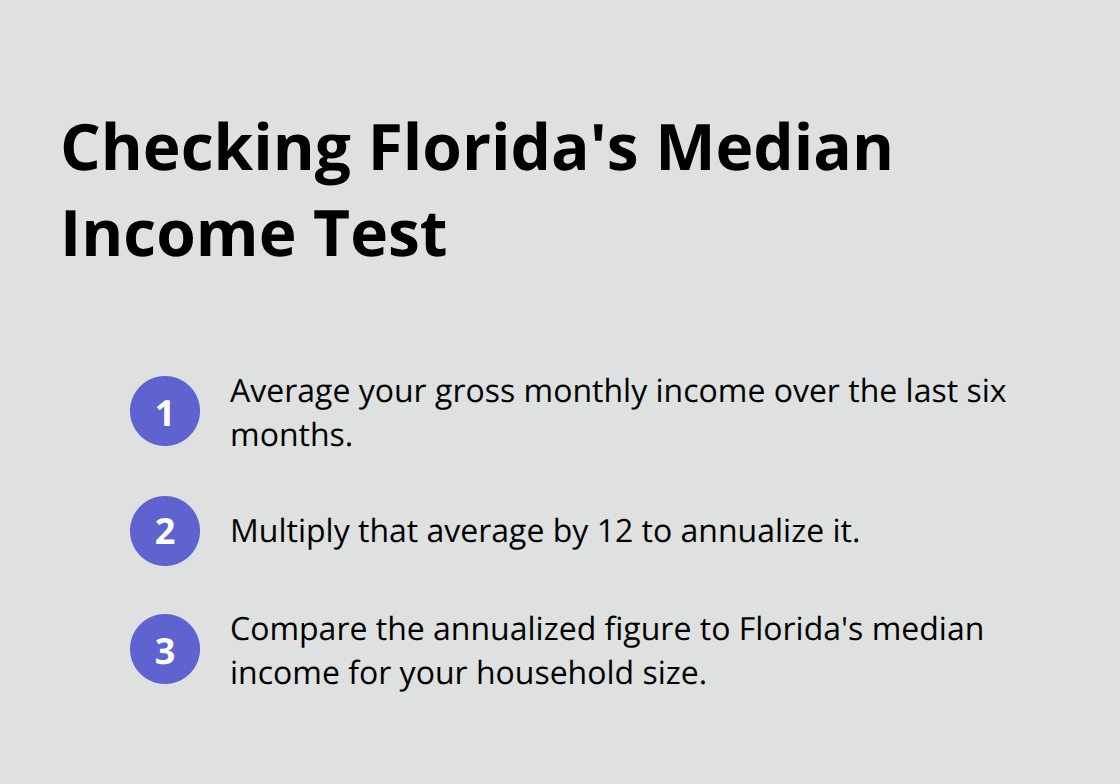
To calculate your household income, average your gross monthly income over the last six months and multiply by twelve. This six-month lookback period captures seasonal variations in earnings. If your annualized income sits below the applicable threshold, you pass the first test and move forward with Chapter 7.
What Happens When Your Income Exceeds the Median
Income above the median does not disqualify you automatically. Instead, you proceed to the means test, which is far more complex and determines whether filing Chapter 7 would constitute an abuse of the bankruptcy system. This second layer of analysis often surprises filers who assume high income automatically bars them from Chapter 7 relief.
The Means Test: Converting Income Into Disposable Income
The means test calculates disposable income by subtracting allowable expenses from your adjusted monthly income, then projecting that figure over five years. This calculation reveals whether you have money left over after covering essential living costs and debt obligations.
If your five-year disposable income falls below $9,075, you qualify for Chapter 7 discharge. If it exceeds $15,150, you generally cannot file Chapter 7 and must consider Chapter 13 instead, where you repay creditors through a structured plan. Income between $9,075 and $15,150 triggers additional calculations that factor in your unsecured nonpriority debt.
The means test uses government expense benchmarks from the Census Bureau and IRS data, so you cannot simply claim any expense you want; only IRS-approved expense categories apply.
Which Expenses Actually Count
Mortgage or car payments for property you intend to keep are deductible, as are property taxes, insurance, and court-ordered payments like child support or alimony. Childcare expenses, caregiver costs for elderly or disabled household members, and employer-required contributions to retirement plans or union dues all reduce your disposable income. Education expenses qualify if your job requires them or if a child has a disability.
The expenses you deduct often determine your outcome more than your raw income does. Two households earning identical incomes can reach opposite conclusions because one carries a mortgage while the other rents, or one pays child support while the other does not. This is why many Floridians above the median income still qualify for Chapter 7-their legitimate expenses shrink their disposable income below the threshold.
The means test does not accept discretionary spending like entertainment, dining out, or vacation costs. What matters are the fixed, necessary obligations the bankruptcy code recognizes. Miscalculating or omitting deductible expenses can artificially inflate your disposable income and cost you eligibility for Chapter 7 discharge.
Understanding your disposable income position sets the stage for the next critical factor: what debts you can actually eliminate through Chapter 7.
What Debts Disappear in Chapter 7 and What Stays
Dischargeable Debts: What Chapter 7 Eliminates
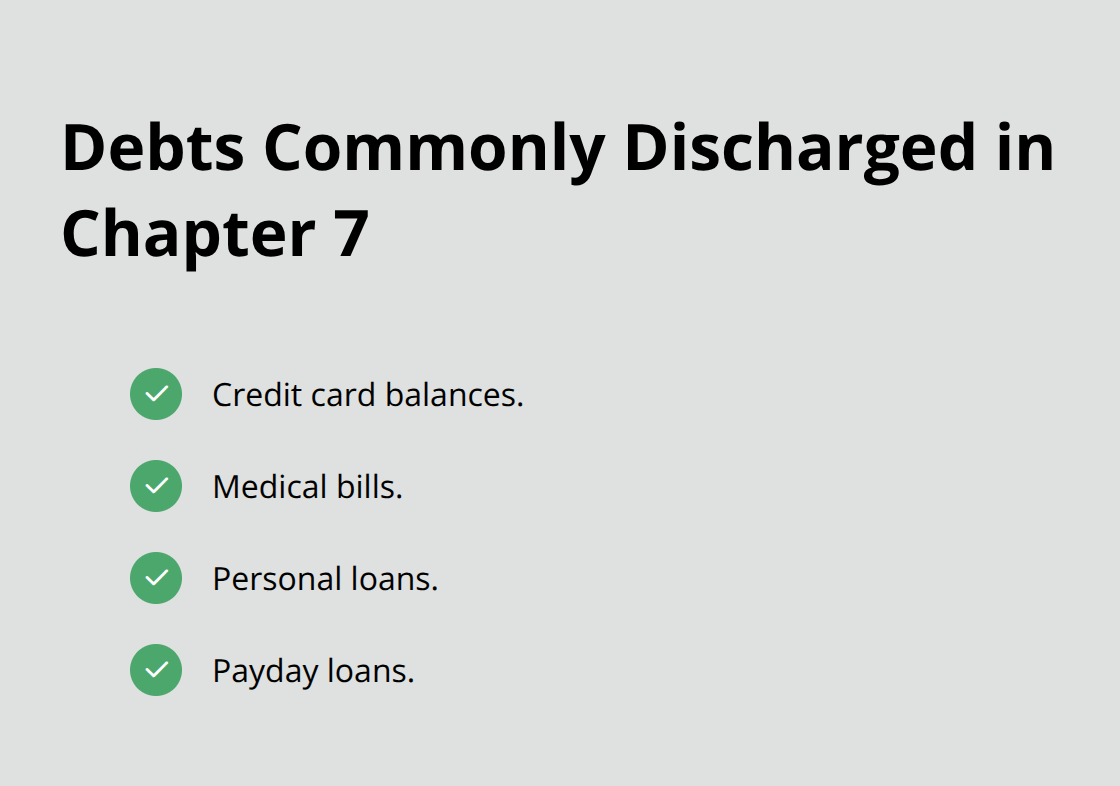
Chapter 7 wipes out most unsecured debts when the court enters your discharge order, typically 60 to 90 days after your creditors’ meeting. Credit card balances, medical bills, personal loans, and payday loans all vanish through this process. These debts represent the bulk of what most Floridians file Chapter 7 to eliminate, making discharge the primary appeal of this bankruptcy chapter.
Nondischargeable Debts: What Survives Bankruptcy
Certain obligations remain your responsibility after discharge no matter how dire your financial situation. Child support and alimony never disappear under any circumstance; the bankruptcy code prioritizes family obligations above all other debts. Student loans present a harder case: they are generally nondischargeable unless you prove undue hardship, a legal standard courts apply sparingly.
Recent tax debts create significant problems. Income taxes owed for the three most recent tax years typically cannot be discharged, though older tax debt may qualify if you filed the return more than two years before filing bankruptcy and more than three years passed since the return’s due date. Property tax debt on your home poses special risks because it can trigger foreclosure outside the bankruptcy process if you do not address it through a Chapter 13 plan instead.
Criminal fines, restitution ordered by courts, and debts arising from fraud or willful injury to person or property all survive Chapter 7 discharge. Debts incurred to pay nondischargeable taxes or debts from criminal activity also stick around.
The Strategic Implication: Chapter 7 May Not Be Your Best Path
Passing the means test and filing Chapter 7 does not guarantee you walk away debt-free. A Chapter 13 plan lasts three to five years and allows you to catch up on mortgage arrears, pay down tax debt gradually, and still discharge remaining unsecured debts at the end of the plan. If you owe significant recent tax debt or child support arrears, Chapter 13 often makes more sense than Chapter 7, even if you technically qualify for Chapter 7 discharge.
Tax debt from the prior three years, for example, might represent 40 to 60 percent of your total obligations, making Chapter 7 a hollow victory if that debt remains. Understanding which debts discharge and which do not reshapes your entire bankruptcy strategy and determines whether Chapter 7 truly offers the fresh start you need. This analysis becomes even more critical when you factor in timing restrictions that can delay or prevent your eligibility altogether.
Previous Bankruptcy Filings and Timing Rules
The Eight-Year Bar After Chapter 7 Discharge
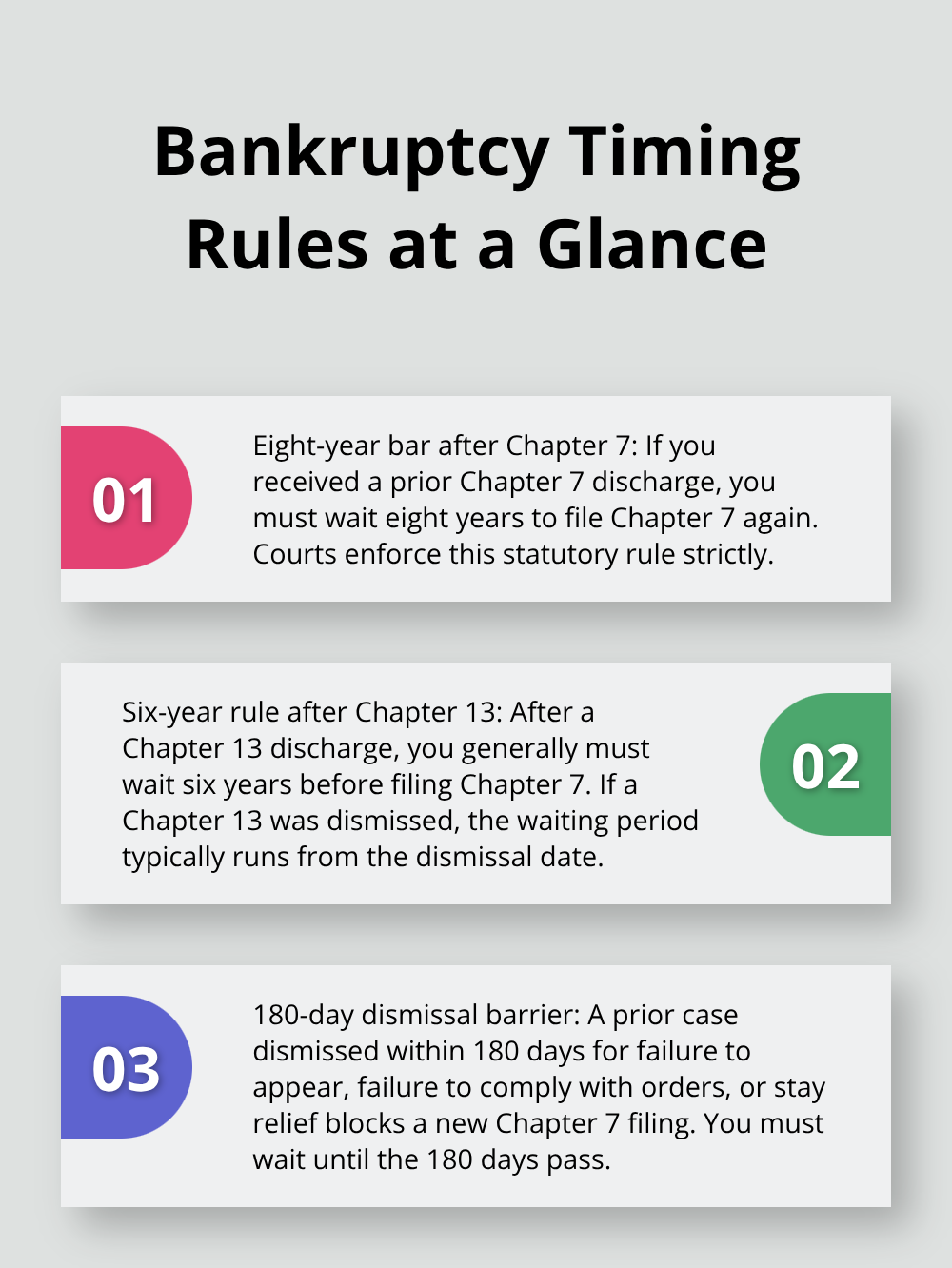
A prior Chapter 7 discharge creates a hard eight-year waiting period before you can file Chapter 7 again, according to U.S. Courts guidance. This is not a guideline or suggestion-it is a statutory bar that courts enforce strictly. If you received a Chapter 7 discharge in 2018, you cannot file Chapter 7 again until 2026, regardless of how much new debt you accumulate.
The Six-Year Rule After Chapter 13 Discharge
The waiting period operates differently depending on which chapter you filed previously. If you received a Chapter 13 discharge, you must wait six years before filing Chapter 7, not eight. The distinction matters enormously because Chapter 13 debtors can access Chapter 7 relief sooner, though six years still represents a significant delay.
If you dismissed a Chapter 13 case before completing the plan, the six-year clock typically starts from the dismissal date, not from the original filing date. The timeline resets based on when your case actually ended, not when you started it. This creates a practical advantage for some debtors: if you filed Chapter 13, realized it was not working, and dismissed the case after one year, you could theoretically file Chapter 7 just five years later rather than waiting the full six years from the original filing.
The 180-Day Dismissal Barrier
Prior dismissals within 180 days create immediate filing barriers that block Chapter 7 entirely in certain situations. According to U.S. Courts, if your previous bankruptcy case was dismissed within the past 180 days because you failed to appear in court, failed to comply with court orders, or because creditors obtained relief from the automatic stay, you cannot file Chapter 7 now. This 180-day rule is absolute and applies regardless of your current financial condition.
If your case was dismissed 179 days ago for willful failure to comply, filing Chapter 7 today would be improper and the court would reject your petition. Many Floridians discover this barrier only when they attempt to file, discovering that a recent dismissal has locked them out of bankruptcy relief temporarily.
Moving Forward After Dismissal
The practical solution is straightforward: wait until the 180-day window closes, then file. However, the reason for dismissal matters significantly for your long-term strategy. If a previous case was dismissed because you could not afford Chapter 13 plan payments, Chapter 7 might be your only viable path forward once the 180-day bar expires. If it was dismissed for failure to appear or comply, addressing whatever caused that failure becomes essential before filing again, or you risk repeating the same outcome.
Final Thoughts
Chapter 7 eligibility criteria in Florida rest on three interconnected factors: your income relative to state medians, the expenses you can legitimately deduct through the means test, and your history with prior bankruptcy filings. The means test determines whether you have disposable income available to repay creditors, and nondischargeable debts like child support, recent taxes, and student loans shape whether Chapter 7 actually delivers the fresh start you need. Timing restrictions from previous filings add another layer of complexity that can delay relief or block it entirely for 180 days or longer.
If you have calculated your income against Florida’s median thresholds, identified which debts would survive discharge, and confirmed you are not barred by a recent dismissal, you possess the foundation to move forward. The next step involves gathering documentation such as your last six months of pay stubs, tax returns, a list of all debts with creditor names and balances, and details about your assets and monthly expenses. You will also need to complete credit counseling from an approved agency before filing, a requirement that typically costs between fifty and one hundred dollars and takes a few hours.
We at Harnage Law, PLLC help clients navigate Chapter 7 eligibility criteria and determine whether Chapter 7 or Chapter 13 better protects your assets and financial future. We stop creditor harassment, prevent wage garnishments, and halt lawsuits while you rebuild. Contact us to discuss your situation and learn how we can help you move forward.