
Filing for Chapter 7 bankruptcy in Florida is overwhelming, and making the wrong decision early on can cost you thousands. When you hire a bankruptcy attorney in Florida, you gain someone who understands the process and protects your rights from start to finish.
At Harnage Law, PLLC, we’ve guided countless Floridians through Chapter 7 cases. This guide shows you exactly what to look for and when to take action.
When to Hire a Bankruptcy Attorney in Florida
Signs You Need Legal Representation Immediately
Creditors calling daily, wage garnishment notices appearing on your paycheck, and collection lawsuits landing in your mailbox signal that you need legal representation immediately. These situations do not resolve on their own, and waiting typically costs you more money. If you face any combination of debt collection calls, lawsuits, or garnishments, an attorney should become your next call, not your last resort. The automatic stay in Chapter 7 bankruptcy stops all collection efforts the moment your petition is filed, but only if the paperwork is done correctly. Filing incorrectly or missing deadlines results in dismissed cases, leaving you vulnerable to continued collection action.
The Cost of Waiting Too Long
Many people delay hiring an attorney because they think they will save money by handling things themselves, but this false economy often backfires. Court filing fees alone total $673 in Florida federal bankruptcy court, and if you miss required documents or deadlines, you may need to refile and pay those fees again. The financial damage compounds quickly when you attempt to navigate the system without proper guidance.
How Early Intervention Prevents Costly Mistakes
Early intervention with an attorney prevents expensive mistakes that can haunt your case. Transferring assets within 90 days of filing triggers trustee objections, and failing to properly list all creditors means those debts will not be discharged. An attorney verifies that your income qualifies for Chapter 7 rather than forcing you into a Chapter 13 repayment plan, which locks you into monthly payments for three to five years.
Required Steps Only an Attorney Can Navigate
An attorney ensures you complete the required credit counseling through an approved agency before filing and the mandatory financial management course within 60 days of your 341 Meeting of Creditors. They handle all document preparation, creditor communication, and court representation so you do not have to navigate the system alone. The difference between proper representation and attempting to file pro se often determines whether you keep your assets, receive a full debt discharge, and actually achieve the fresh financial start that Chapter 7 offers.
What Comes Next in Your Search
Understanding when to hire an attorney is only the first step. The next critical decision involves knowing exactly what qualities and qualifications to evaluate in a bankruptcy attorney before you commit to representation.
What to Look for in a Florida Bankruptcy Attorney
Verify Real Chapter 7 Experience
The attorney you hire will shape the entire outcome of your Chapter 7 case, so this decision warrants careful evaluation. Start by checking whether the attorney has actually filed Chapter 7 cases in Florida federal bankruptcy court. You can verify this through PACER, the Public Access to Court Electronic Records system, which displays every bankruptcy petition filed under an attorney’s name. An attorney who claims extensive experience but shows minimal public filings is not the right choice. Look for someone with at least 50 to 100 Chapter 7 cases filed in Florida courts, as this demonstrates genuine, ongoing practice rather than occasional bankruptcy work. During your initial consultation, ask directly how many Chapter 7 cases they filed last year and how many total cases they have handled. If they hesitate or provide vague answers, move to another candidate.
Assess Communication and Responsiveness
Communication matters enormously because you will need to understand what happens at the 341 Meeting of Creditors, why certain documents are required, and what the automatic stay actually does for you. Call the office with a specific question and measure how quickly they respond. If it takes three days to hear back about a simple query, expect slow communication when you need urgent help. The attorney should personally meet with you during the initial consultation, not hand you off to a paralegal or staff member. Direct attorney access allows you to understand your case strategy from the start.
Understand Fee Structures and Payment Options
Fees vary significantly across Florida, with Chapter 7 attorney costs ranging from $1,500 to $2,500 depending on case complexity. Simpler cases with fewer assets cost less than cases involving multiple properties or vehicles. Request a written fee agreement that itemizes what is included, such as document preparation, court filing fees of $338, and representation at your 341 Meeting. Some firms offer garnishment-focused pricing if you earn at least $3,500 monthly and face active wage garnishment, allowing you to pay $150 upfront plus the $335 filing fee and spread remaining costs over four months. Avoid attorneys who quote extremely low fees, as this often signals they handle cases through paralegals rather than providing attorney review.
Red Flags to Reject
Similarly, reject any firm that pressures you to decide immediately or uses high-pressure sales tactics. The right attorney will give you time to make an informed choice and will encourage you to compare options before committing. You should feel confident in your selection, not rushed into a decision you may regret later.
Now that you understand what qualities to evaluate in a Florida bankruptcy attorney, the next step involves learning how that attorney will guide you through the actual Chapter 7 process from start to finish.
How Your Attorney Guides You Through Chapter 7 Filing
Initial Consultation and Financial Assessment
Your attorney’s role starts long before you enter a courtroom. During your initial consultation, your attorney assesses whether Chapter 7 fits your situation or whether Chapter 13 makes more sense for your income level and assets. This evaluation involves reviewing your current monthly income against the median income for your household size in Florida. If your income exceeds the state median, you may face a forced Chapter 13 repayment plan instead of Chapter 7 liquidation, and identifying this early prevents months of wasted time.
Your attorney identifies which assets you can protect under Florida’s exemption laws, including your homestead exemption for your primary residence and protections for certain retirement accounts. You receive concrete numbers about what the trustee might liquidate and what you will keep, rather than vague promises. You provide a complete financial picture: all debts, income sources, asset values, and recent financial transactions. Any transfers of money or property within 90 days of filing face trustee scrutiny, so disclosing these upfront prevents later objections that could derail your case.
Document Preparation and Filing Requirements
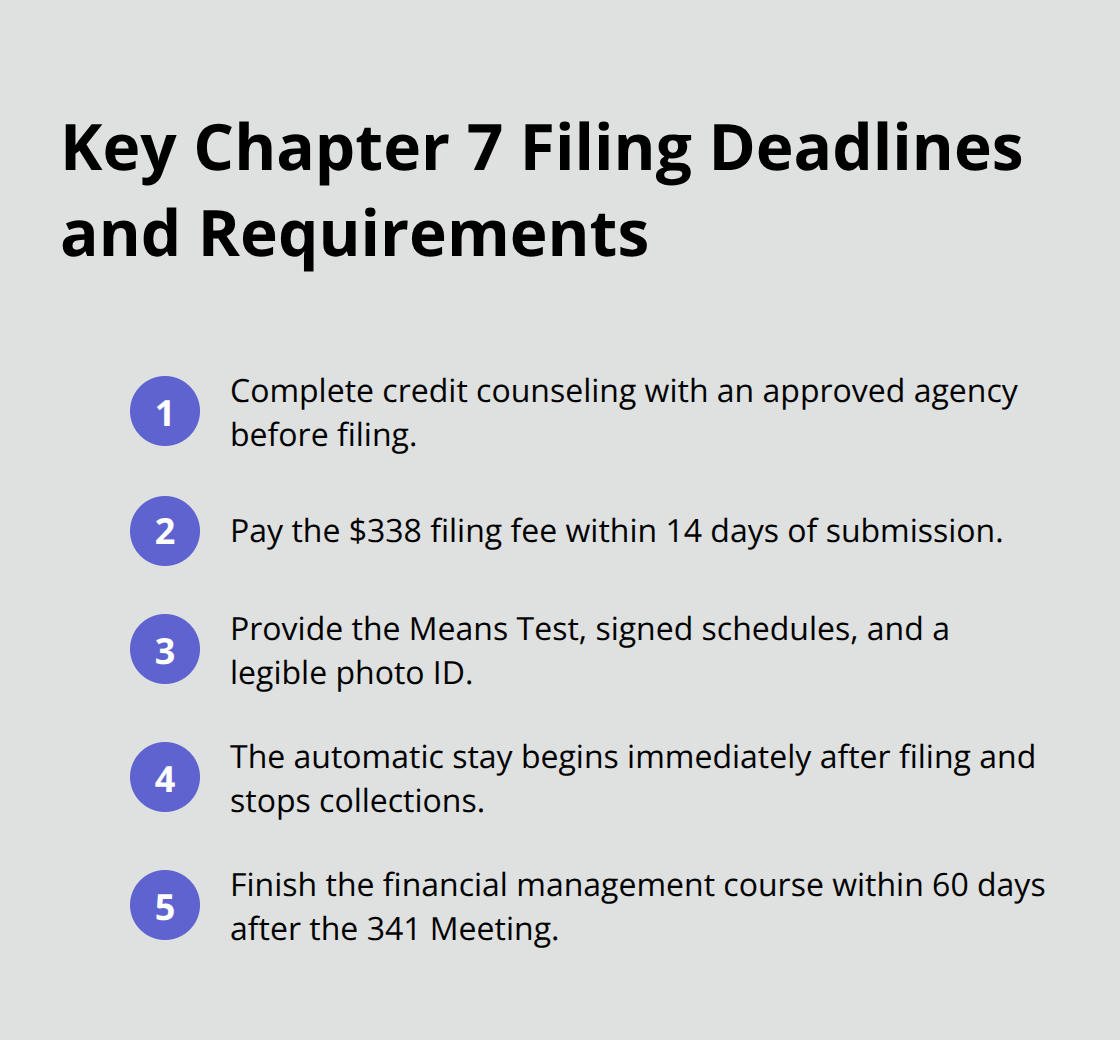
Your attorney handles the document preparation that trips up most pro se filers. You must complete credit counseling through an approved agency before filing, and your attorney confirms you have the certificate from an agency listed on the U.S. Trustee website. The filing itself requires multiple schedules including your complete asset list, income calculations, expense breakdown, and detailed creditor information formatted precisely as the court demands.
The filing fee of $338 must be paid within 14 days of submission according to Clerk’s Office rules. Your attorney prepares the Means Test calculation that determines whether you qualify for Chapter 7, submits all required documents with original wet signatures as mandated by Administrative Order 2020-07, and includes your legible photo ID copy. After filing, the automatic stay takes effect immediately, halting wage garnishments, collection calls, and lawsuits.
Meeting of Creditors and Course Completion
Your attorney prepares you for the 341 Meeting of Creditors, explaining exactly what happens at this meeting, what questions the trustee will ask, and how to answer them. Within 60 days after your 341 Meeting, you must complete a personal financial management course through another approved agency and file the certificate with the court. Your attorney tracks all these deadlines and prevents anything from falling through the cracks.
Once the trustee completes their review and no objections arise, the court issues your discharge order, eliminating qualifying debts permanently and giving you the fresh financial start that Chapter 7 provides.
Final Thoughts
Hiring a bankruptcy attorney in Florida transforms your Chapter 7 case from a confusing process into a manageable path with clear outcomes. The right attorney matches your financial situation, communicates openly about what to expect, and charges transparent fees without hidden surprises. You now understand the warning signs that demand immediate legal action, the qualifications that separate capable attorneys from those who cut corners, and exactly how an attorney guides you from initial consultation through debt discharge.
Your financial situation is unique, and the attorney you select should treat it that way. Someone who listens to your specific circumstances, explains how Florida’s exemption laws protect your assets, and prepares you thoroughly for the 341 Meeting will give you confidence moving forward. The cost of hiring a bankruptcy attorney in Florida is far lower than the cost of filing incorrectly, missing deadlines, or losing assets you could have protected.
We at Harnage Law, PLLC help individuals and families overcome financial challenges through Chapter 7 bankruptcy representation. Contact us to discuss your options and begin your path toward financial recovery.