Filing Chapter 7 bankruptcy in Florida requires proving your income through specific documentation. The bankruptcy trustee needs to verify your financial situation to determine if you qualify for this form of debt relief.
We at Harnage Law, PLLC help clients gather the right Chapter 7 income proof documents to meet court requirements. This guide walks you through exactly what paperwork you’ll need and how to present it effectively.
What Documents Prove Your Income for Chapter 7
Income Documentation the Trustee Requires
The bankruptcy trustee assigned to your case will scrutinize your income documentation to calculate whether you pass the means test for Chapter 7 eligibility. The trustee needs to verify your current monthly income over the six months before you file, which means you must gather the right paperwork. Pay stubs from your employer should cover the most recent six months and clearly show your gross income, deductions, and net pay. If you receive irregular paychecks, collect all stubs from that period to establish an accurate average.
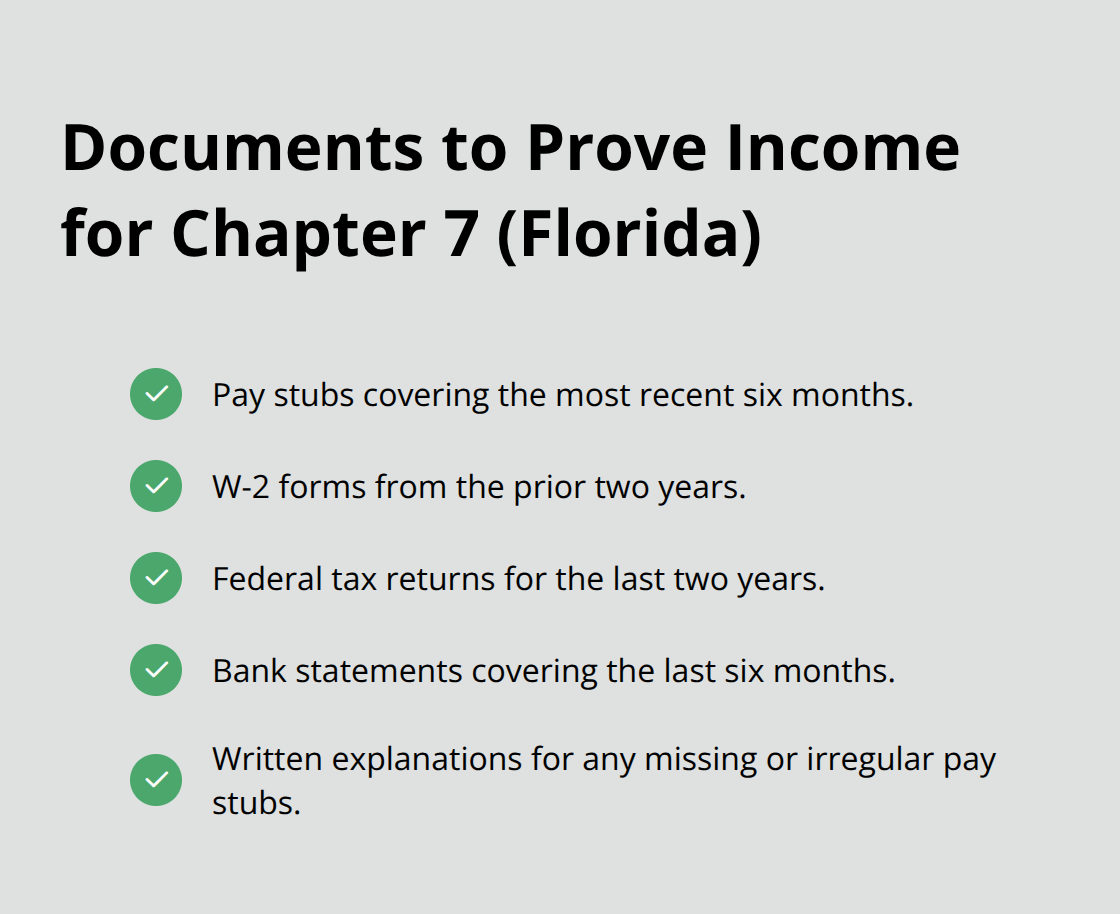
W-2 forms from the prior two years provide the trustee with historical context and help confirm your income stability. Tax returns, specifically your federal returns for the past two years, serve as the trustee’s primary tool to cross-check reported income against what you claim on the bankruptcy forms. Bank statements covering the last six months demonstrate actual deposits and cash flow, which the trustee uses to validate income figures. The trustee will compare deposits in your statements to your reported income on the bankruptcy schedules; any significant discrepancies invite deeper investigation and potential case dismissal.
Self-Employed Income Documentation in Florida
For self-employed filers in Florida, the documentation requirements expand considerably. You must provide three years of personal and business bank statements to show cash flow patterns and income trends. Profit and loss statements for at least two years are essential; many trustees request monthly P&L statements rather than annual summaries alone. If you receive cash payments, signed statements from clients or customers document those transactions and become critical evidence to avoid underreporting accusations.
Invoices, contracts, and receipts spanning three years substantiate your revenue claims and prove income sources are legitimate. Federal tax returns for Chapter 7 require two years of filings; if you convert to Chapter 13 or file Chapter 13 initially, the court demands four years of returns. Organize these documents chronologically and highlight the specific figures that appear on your bankruptcy forms so the trustee can verify consistency immediately.
Avoiding Red Flags in Your Documentation
Inconsistencies between your bank statements, tax returns, and the income you report on Schedule I create red flags that lead to trustee questions at the 341 meeting and potentially case complications. The trustee compares up-to-date tax filings to back taxes claimed; extra tax documents may be required in Chapter 13 for repayment purposes. SOFA figures help detect fraud, such as disguised income or assets; you must maintain consistency to avoid asset investigations. Organized records now reduce the risk of case dismissal and help identify issues before filing.
How you present this documentation matters as much as what you submit. The next section explains the specific steps to organize and present your income documentation in a way that satisfies Florida court requirements.
How to Organize Your Income Documentation for the Trustee
Collect Six Months of Complete Pay Records
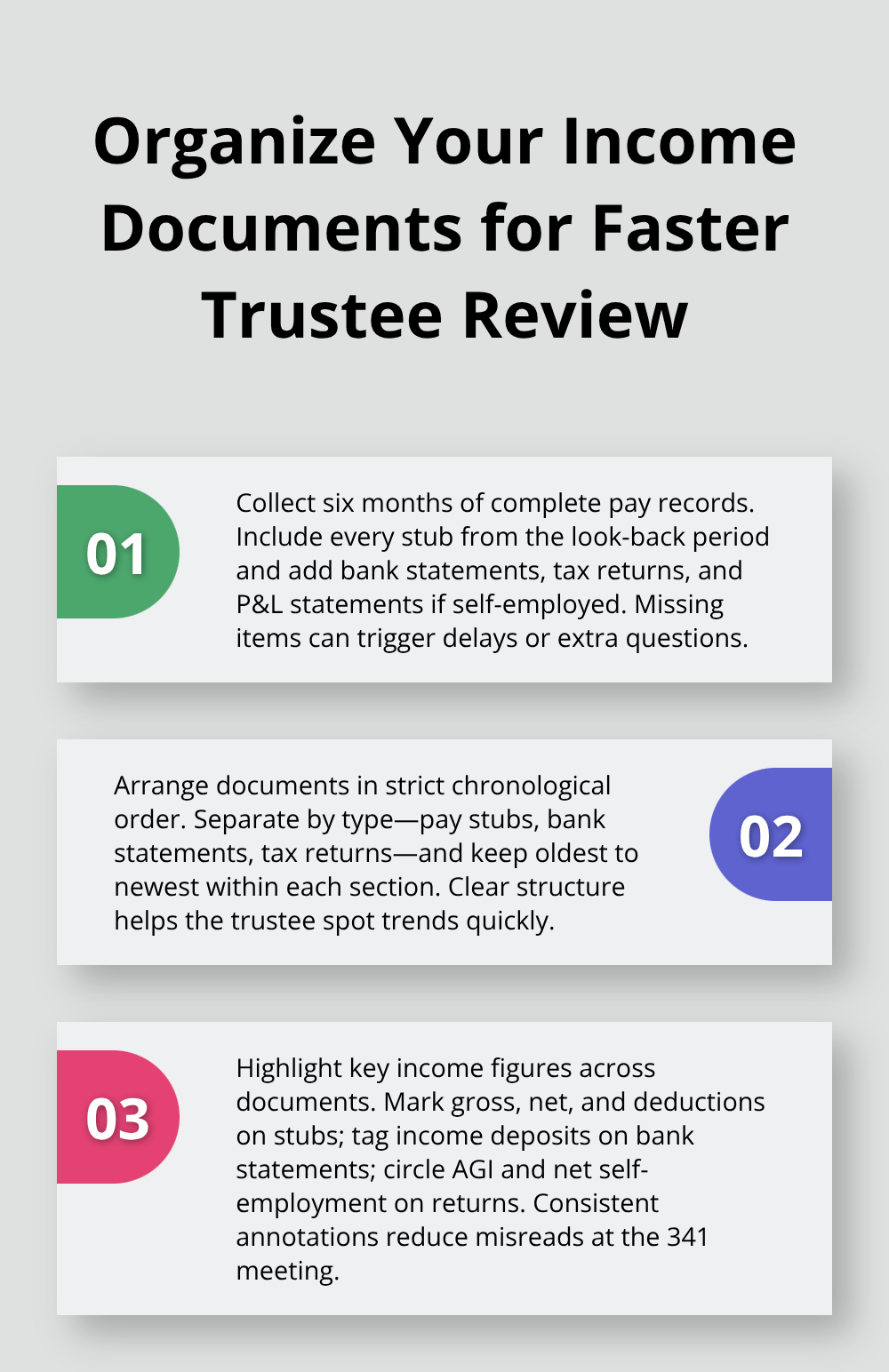
The trustee uses income from the six months before your filing date to calculate your current monthly income for the means test, so you must pull every pay stub from that period without exception. If you receive paychecks twice monthly, you need roughly twelve stubs; if weekly, approximately twenty-six. Missing stubs force delays or require written explanations that raise suspicion. For self-employed filers, bank statements for the full six-month window plus tax returns and profit and loss statements going back two years become essential. Disorganized submission leads to trustee follow-up questions at your 341 meeting, which extends your case timeline unnecessarily.
Arrange Documents in Strict Chronological Order
The trustee reviews documents sequentially to track income trends and spot gaps or inconsistencies, so chronological order matters significantly. Start with the oldest document and end with the most recent. Create separate folders or sections for different document types: pay stubs in one section, bank statements in another, tax returns in a third. Within each section, maintain chronological order. Label each document with the date range it covers-write “January 2025 Pay Stubs” at the top of that section, for example.
Highlight Key Figures to Speed Up Review
Highlight the gross income, net pay, and deduction amounts on each pay stub using a highlighter or annotation tool. This forces the trustee’s eye directly to the figures that matter and demonstrates you understand what the court needs. On your bank statements, mark deposits that correspond to your reported income with a note like “Income Deposit” or “Paycheck.” On tax returns, circle the adjusted gross income and net self-employment income figures. This active highlighting reduces the chance the trustee misreads your numbers or questions whether amounts match across documents.
Present Documentation That Passes Trustee Scrutiny
The trustee reviews hundreds of bankruptcy cases annually, and clear presentation accelerates the review process while minimizing requests for clarification. Inconsistencies between your bank statements, tax returns, and the income you report on Schedule I create red flags that lead to trustee questions and potentially case complications. The trustee compares up-to-date tax filings to back taxes claimed; extra tax documents may be required in Chapter 13 for repayment purposes. Organized records reduce the risk of case dismissal and help identify issues before filing. When you submit documents to the court, consistency across all your financial paperwork becomes your strongest defense against further investigation.
The next section covers the specific income thresholds and documentation standards that Florida courts apply when reviewing your Chapter 7 eligibility.
Florida-Specific Requirements for Income Verification in Chapter 7
State Median Income Thresholds
Florida’s Chapter 7 eligibility hinges on two income tests that the bankruptcy court applies consistently across all filings in the state. The median income test comes first: as of April 2024, Florida’s median income for a one-person household stands at $62,973 annually, rising to $153,569 for a nine-person household, with $9,900 added for each additional person beyond nine according to Census Bureau data. To apply this test, average your monthly income over the last six months and multiply by twelve to annualize the figure. If your annualized income falls below Florida’s median for your household size, you likely qualify for Chapter 7 without further scrutiny.
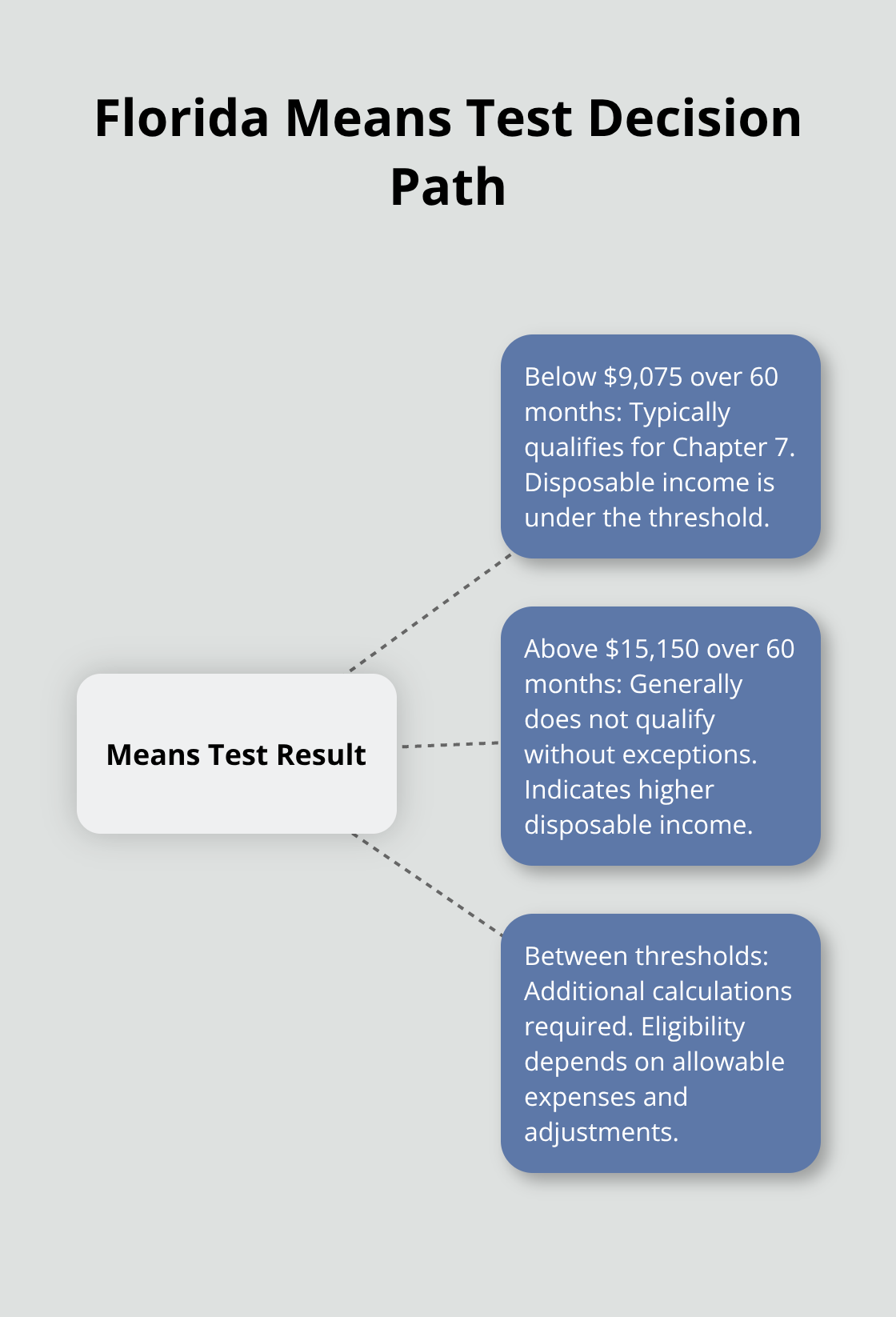
If your income exceeds the median, the means test calculation on Form B122A-2 determines whether you still qualify by measuring disposable income after allowable expenses. The means test projects your disposable income over sixty months: if that five-year figure falls below $9,075, you typically qualify for Chapter 7; if it exceeds $15,150, you generally do not qualify unless exceptions apply; if it falls between those thresholds, additional calculations determine eligibility.
How Florida Courts Review Income Documentation
Florida courts demand consistency across all income documentation because the trustee compares your reported figures against tax returns, bank statements, and the bankruptcy schedules you file. The trustee looks for deposits matching your claimed income on your bank statements and cross-references those deposits against your tax returns and W-2 forms to verify no amounts are inflated or hidden. Self-employed filers face heightened scrutiny: Florida trustees require three years of bank statements, two years of profit and loss statements, invoices, and contracts to substantiate revenue claims, and they examine whether cash payments are properly documented with signed statements from clients.
If your bank deposits significantly exceed what you report as income on the bankruptcy forms, the trustee investigates whether you are underreporting earnings or hiding assets, which can result in case dismissal or conversion to Chapter 13. The trustee will also verify that claimed business expenses on your means test calculation match the deductions you took on your federal tax returns; mismatches invite detailed questions at your 341 meeting.
Additional Documentation Florida Courts Request
Florida courts request written explanations for any income gaps or unusual deposits that appear in your financial records. Documentation of court-ordered payments like child support or alimony reduces your disposable income and improves your Chapter 7 eligibility, so the trustee needs proof of these obligations. Proof of mortgage or car loan payments (which are deductible under the means test) and evidence of healthcare, childcare, or caregiver expenses for elderly or disabled household members all lower your disposable income and strengthen your case.
Organize all income-related documents chronologically and keep copies of everything you submit to the court, because the trustee may request clarification or additional proof months after your case begins. Consistency across your financial paperwork becomes your strongest defense against further investigation and potential complications during the bankruptcy process.
Final Thoughts
Proving your income for Chapter 7 requires you to gather the right documents and present them clearly to the bankruptcy trustee. Your pay stubs, tax returns, bank statements, and profit and loss statements form the foundation of your Chapter 7 income proof, and the trustee uses these documents to verify your current monthly income, calculate your disposable income, and determine whether you qualify under Florida’s median income thresholds and means test requirements. Consistency across all your financial paperwork prevents red flags and reduces the likelihood of case complications or dismissal.
Before filing, you should organize your documentation chronologically, highlight key income figures, and verify that every number matches across your bank statements, tax returns, and bankruptcy schedules. Self-employed filers must prepare three years of bank statements and two years of profit and loss statements to satisfy trustee requirements, and missing or inconsistent documents delay your case and invite trustee questions at your 341 meeting. You also need to complete a credit counseling course before filing and a debtor education course after filing to obtain your discharge.
We at Harnage Law, PLLC help clients through every stage of the Chapter 7 filing process, from gathering income documentation to representing you at your 341 meeting and beyond. Contact Harnage Law, PLLC today to discuss your Chapter 7 eligibility and begin your path toward financial relief.