Filing Chapter 7 bankruptcy without an attorney is possible in Florida, but it requires careful attention to state laws and federal court procedures. The process involves gathering financial documents, completing detailed petition forms, and navigating court requirements that can feel overwhelming.
At Harnage Law, PLLC, we’ve seen many Floridians successfully handle their own filings, though the path isn’t simple. This guide walks you through each step so you understand what’s ahead.
1. Meet Florida’s Chapter 7 Income and Asset Rules
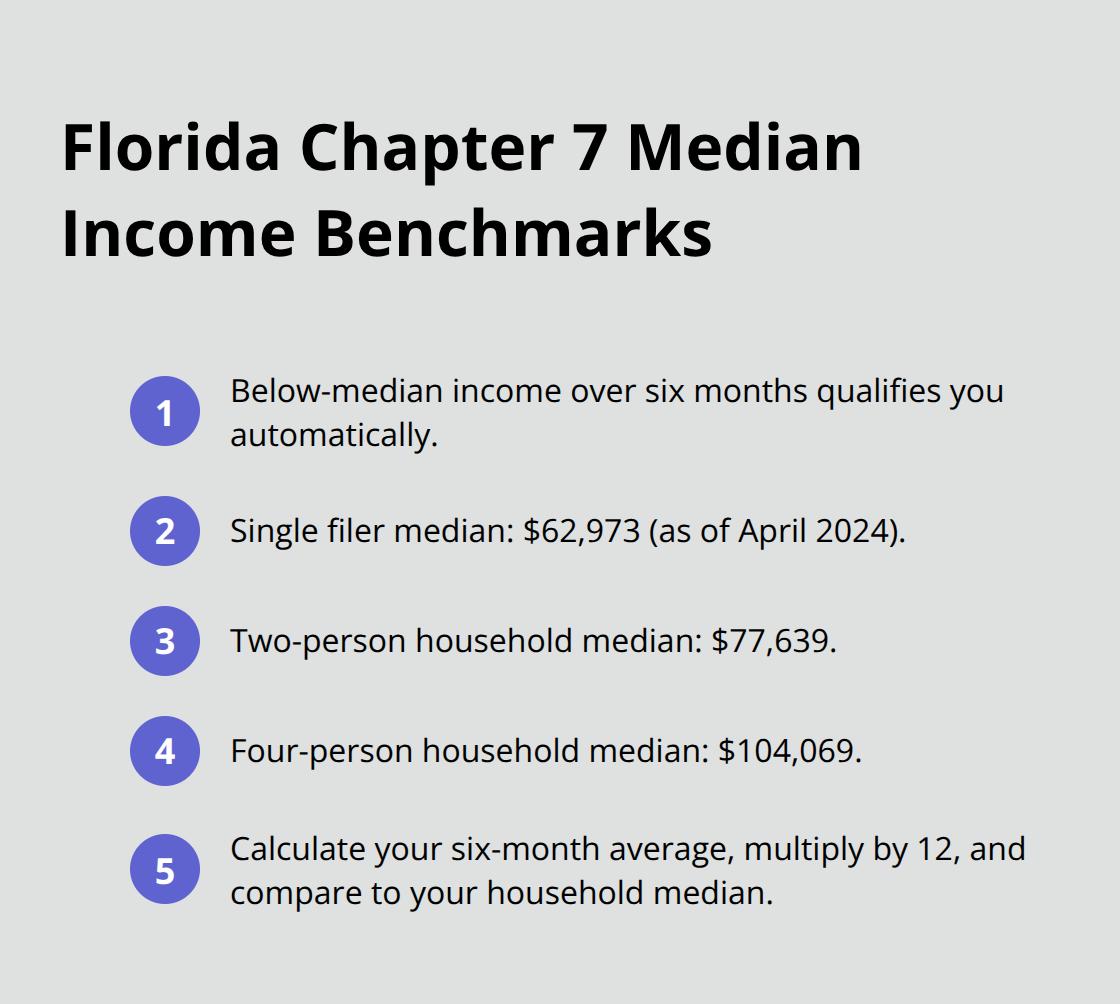
Florida’s means test determines whether you qualify for Chapter 7, and the numbers matter more than your circumstances. If your household income averages below the state median over the last six months, you pass automatically and can file Chapter 7 without further calculation. For a single filer in Florida, that median is $62,973 annually as of April 2024, according to the US Trustee Program. A two-person household has a median of $77,639, while a four-person household sits at $104,069. Calculate your average monthly income from the last six months, multiply by 12, and compare it directly to your household size median-this single step eliminates the means test entirely if you fall below the threshold.
If your income exceeds the Florida median, you enter the means test calculation where deductible expenses determine your fate. The calculation multiplies your adjusted monthly income by 60 months, and if that total falls below $9,075, you still qualify for Chapter 7 according to the US Trustee Program standards. Deductible expenses include secured debt payments like mortgages, taxes, childcare, court-ordered support payments, and certain insurance premiums. Florida’s automatic stay protects you immediately upon filing, stopping wage garnishment, foreclosure, repossession, and creditor calls within seconds of submission to the court. Asset protection through Florida exemptions proves generous-your home receives unlimited equity protection if you meet residency requirements, one vehicle protection reaches up to $5,000 in equity, and a wildcard exemption adds up to $4,000 of additional protection for any property.
With your income and asset situation clarified, the next step requires you to pull together the financial documents that support your filing.
2. Gather Your Financial Documents
The IRS requires you to document your last two years of tax returns and your most recent 60 days of pay stubs when filing Chapter 7 in Florida. Start to gather documents at least 30 days before you file to avoid rushed preparation that leads to errors or omissions. Income statements matter because the court verifies your average monthly income against Florida’s median thresholds, which determine whether you qualify for Chapter 7. If you’re self-employed, gather your business tax returns, profit-and-loss statements, and bank statements showing business deposits for the past two years. The Southern District of Florida specifically requires you to submit 60 days of pay stubs with your petition, so collect these before filing to avoid rejection of your paperwork.
Create a comprehensive list of every creditor, including credit card companies, medical providers, payday lenders, and collection agencies, along with current balances and account numbers from your most recent statements. Property valuations require honest assessments of your home’s current market value, vehicle worth using NADA Guides or Kelley Blue Book, and personal property like electronics and furniture that hold meaningful value. Document everything with bank statements from the last three months, mortgage statements, car loan papers, and any appraisals you’ve obtained. The court uses these valuations to determine what property you’ll protect under Florida exemptions, so accuracy prevents surprises during your case.
Once you organize these documents in one folder, you’re ready to move into the next phase: completing the actual bankruptcy petition forms that the court requires.
3. Complete Your Bankruptcy Petition Forms
The Official Bankruptcy Forms required by the US Trustee Program form the backbone of your filing, and accuracy determines whether the court accepts or rejects your petition. Form B122A-1 captures your current monthly income and applies Florida’s median income test to establish your baseline eligibility. If your income exceeds the median, Form B122A-2 walks through the means test calculation by listing deductible expenses like mortgage payments, taxes, childcare, and insurance premiums that reduce your disposable income. Schedule A/B documents all property you own, including your home’s current market value, vehicles valued through NADA Guides or Kelley Blue Book, bank accounts, and personal property exceeding $500 in value. The court uses Schedule A/B to identify what assets Florida exemptions protect and what property might be liquidated to pay creditors, making honest valuations essential.
Schedule D lists all secured debts tied to property, such as your mortgage balance, car loans, and home equity lines of credit, with exact account numbers and creditor contact information from your most recent statements. Schedule E/F captures unsecured debts including credit cards, medical bills, personal loans, and collection accounts, along with current balances that determine your total debt load. Pro se filers often make mistakes on these schedules by undervaluing property, omitting creditors, or miscalculating income, which can trigger trustee objections or even case dismissal. Download the free official forms from USCourts.gov, complete them carefully using your gathered documents, and cross-check figures against your tax returns and pay stubs before submission. The Southern District of Florida and other Florida districts accept these completed forms by mail or in-person filing, but errors cost time and money through amended filings or court appearances.
Once you finalize your forms and verify every detail, you’ll prepare to submit them to the appropriate Florida bankruptcy court that handles your county’s filings.
4. File Your Petition with the Florida Bankruptcy Court
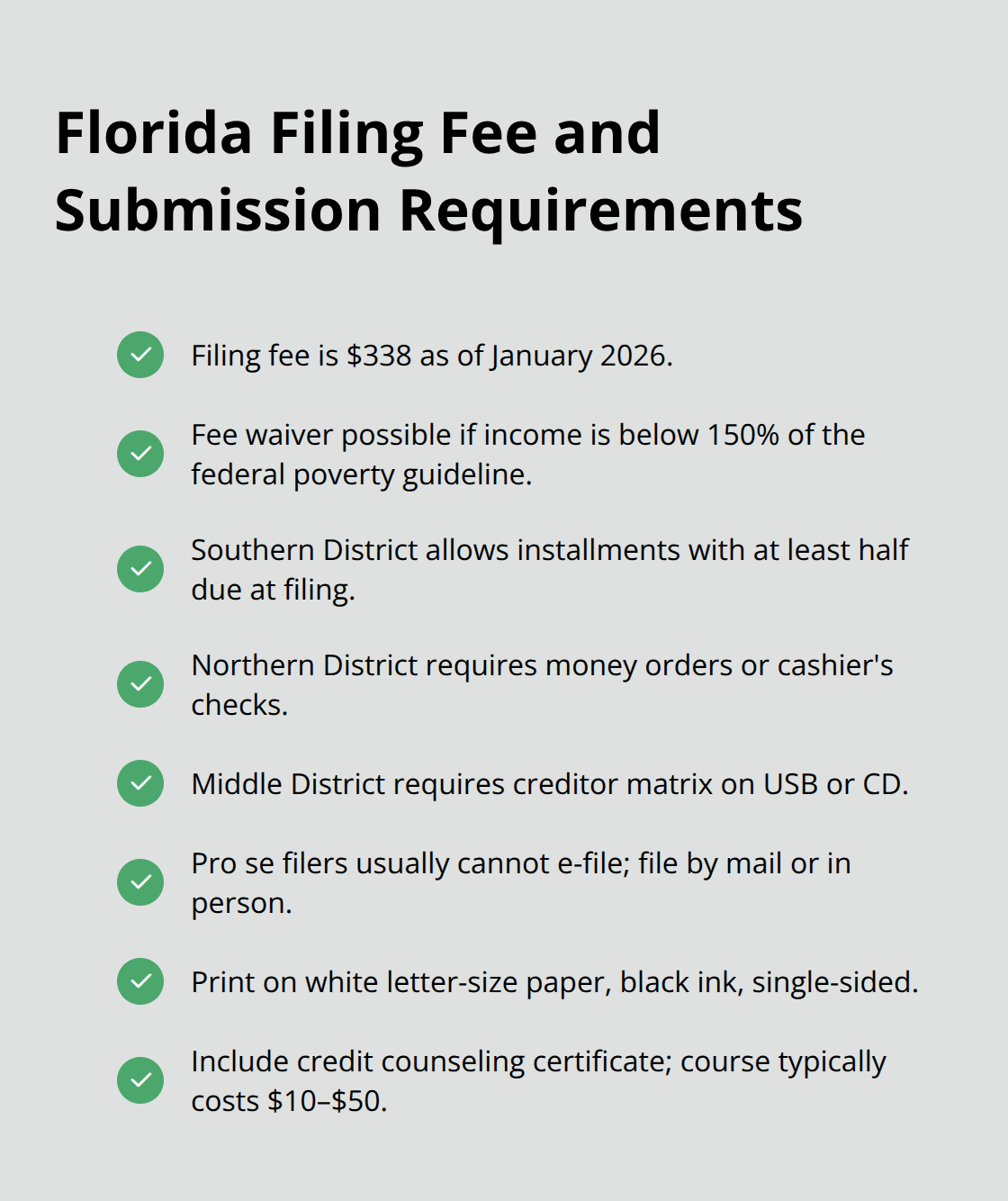
Florida’s three bankruptcy districts-Northern, Middle, and Southern-each handle filings from specific counties, and you must select the correct court for your location. Determine your district by locating your county on the court’s website, then verify local filing requirements since each district imposes different rules. The filing fee stands at $338 as of January 2026, and you can request a waiver if your household income falls below 150% of the federal poverty guideline. The Southern District allows installment payments with at least half due at filing, while the Northern District requires money orders or cashier’s checks. The Middle District requires electronic submission of your creditor matrix on USB or CD.
Pro se filers in Florida cannot submit petitions electronically through most courts, so you mail your completed forms or file in person at the courthouse. Print all forms on white letter-size paper using black ink, single-sided only, following federal printing guidelines that courts strictly enforce. Include your credit counseling completion certificate with your petition since you must complete this course within 180 days before filing, typically costing $10 to $50 with fee waivers available.
The Middle District’s Jacksonville Division requires a pre-341 trustee conference before your creditors meeting, adding an extra step that other districts skip. Missing signatures, incomplete schedules, or arithmetic errors trigger rejections that delay your case and postpone the automatic stay protecting you from creditors, so you must verify every detail before submission.
Once you file your petition successfully, the court schedules your meeting of creditors, which marks the next critical phase in your bankruptcy journey.
5. Attend Your 341 Meeting of Creditors
The 341 meeting occurs one to two months after you file your petition and lasts under ten minutes for most pro se filers. You’ll meet with the bankruptcy trustee assigned to your case, who reviews your petition for accuracy and asks straightforward questions about your income, debts, and property. The trustee verifies that you’ve listed all assets correctly and that your exemptions comply with Florida law rather than scrutinizing your personal circumstances. Creditors rarely attend these meetings-the US Courts reports that actual creditor participation happens in fewer than five percent of Chapter 7 cases.
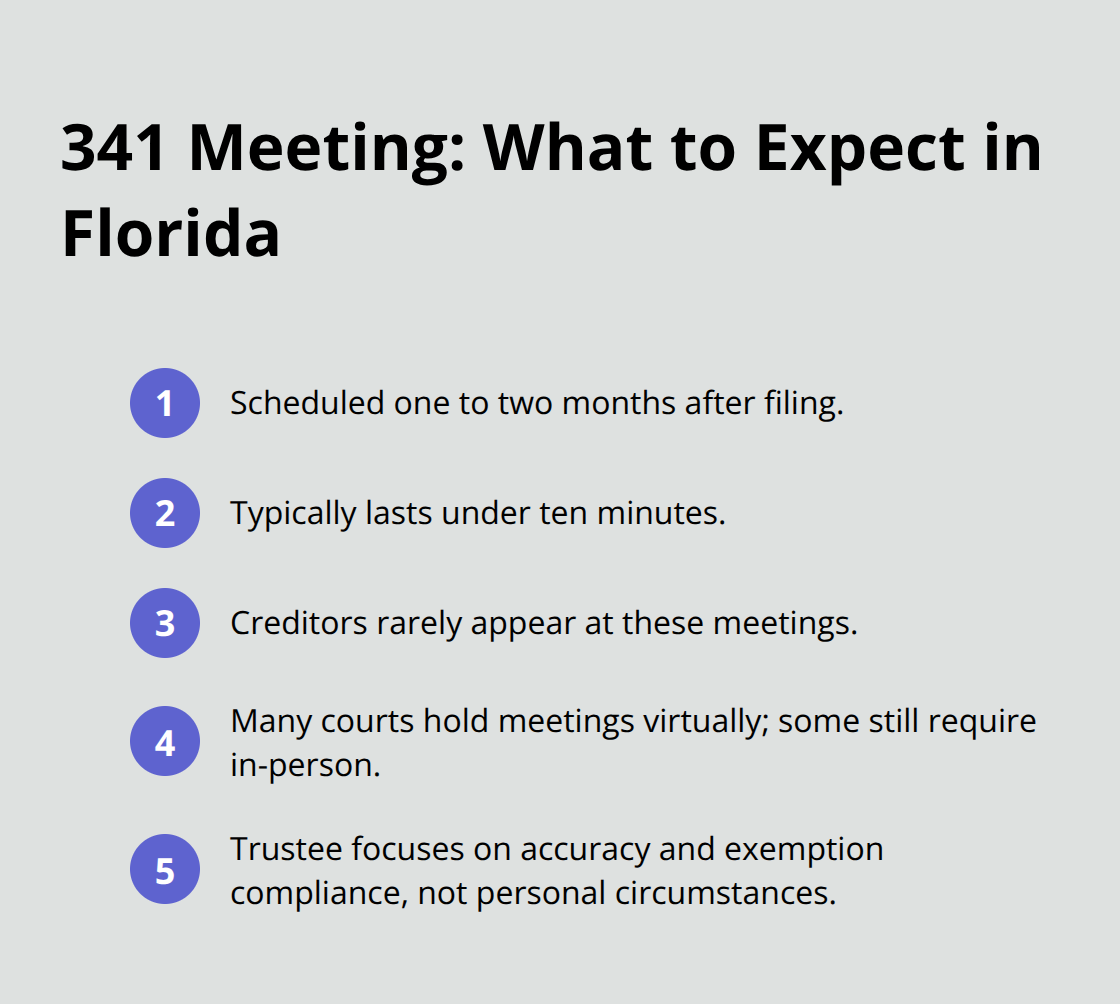
Many Florida courts now conduct these meetings virtually, eliminating travel to the courthouse, though some districts still require in-person appearances.
Bring original copies of your two years of tax returns, your last 60 days of pay stubs, recent bank statements, and your photo identification to verify your identity. The trustee will ask basic questions like whether you own your home, what vehicles you drive, and whether you’ve accurately valued your property on Schedule A/B. Answer directly and honestly without offering extra information or making excuses about your debts-the trustee needs facts, not explanations. If you’ve made errors on your petition, disclose them immediately rather than hoping the trustee overlooks them, since corrections filed before the meeting prevent later complications. Complete your debtor education course within 60 days after this meeting and file the certificate with the court, because failure to complete this course makes you ineligible for discharge and leaves you unprotected from creditors indefinitely.
Once you pass the 341 meeting and complete your debtor education course, you’ll move into the final phase where objections surface and your discharge approaches.
6. Navigate Objections and Reach Discharge
Most pro se filers never face objections because the trustee finds no issues with their petition, but objections do occur when the trustee questions your income calculations, property valuations, or claimed exemptions. The trustee files a formal objection within 60 days of your 341 meeting, and you’ll receive notice detailing the specific concern-whether that’s undervalued assets, inflated expense deductions, or exemptions that exceed Florida limits. Respond in writing within 14 days by filing an objection response with the court, explaining your position with supporting documents like appraisals, bank statements, or expense receipts that justify your original figures. If the trustee objects to your exemptions claiming they violate Florida law, you can defend your home’s unlimited equity protection if you meet residency requirements or justify your vehicle exemption of up to $5,000 in equity with proof of the car’s current market value. Creditor objections happen far less frequently than trustee objections, but if a creditor files an objection, the same 14-day response deadline applies, and you should address their specific claim with documentation rather than assumptions about their motives.
Reaffirmation agreements allow you to keep secured property like your vehicle by agreeing to continue paying the loan after discharge, but this decision carries serious consequences that demand careful thought before signing. If you reaffirm a car loan, you remain personally liable for the full balance even if the vehicle’s value drops below what you owe, and missing payments after discharge triggers repossession without the bankruptcy protections you previously had. Your discharge typically arrives 60 to 90 days after your 341 meeting once all objections are resolved and your debtor education certificate is filed, marking the moment when qualifying debts vanish and creditors lose all collection rights. The discharge order from the bankruptcy court is your legal proof that debts are eliminated, so keep multiple copies for your records and provide them to creditors who continue contacting you after discharge, as violations of the discharge injunction carry penalties against creditors. After discharge, your fresh start begins immediately-creditors cannot pursue wage garnishment, lawsuits, or collection calls on discharged debts, though you’ll need to rebuild credit through secured credit cards and on-time payments over the next three to five years, which leads directly into understanding when legal guidance becomes invaluable for protecting your assets and maximizing your financial recovery.
7. When You Should Hire an Attorney
Pro se filing works until it doesn’t, and the moment your situation becomes complex, the cost of mistakes outweighs the attorney fees you’re trying to avoid. If you own a business, hold rental property, have significant assets above Florida exemption limits, or face objections from the trustee, hiring an attorney transforms your case from risky to manageable. Self-employed filers with variable income often miscalculate their means test because business deductions require documentation the court scrutinizes heavily-accountants and attorneys catch these errors before filing, not after dismissal. If creditors have already sued you, obtained judgments, or started wage garnishment, the timeline compresses and errors become costlier because you’re fighting multiple fronts simultaneously. Disabled veterans claiming exemptions from the means test need proper documentation and legal arguments that pro se filers frequently botch, resulting in denied eligibility when attorney guidance would have secured approval.
Asset protection strategies demand legal analysis specific to your situation-keeping your home through reaffirmation, protecting retirement accounts that creditors cannot touch anyway, or structuring property transfers legally requires understanding that extends beyond form completion. The Legal Services Corporation provides free legal assistance if your household income falls below 125% of the federal poverty line, and you can search for providers through their website. The American Bar Association’s Legal Help referral service connects you with affordable attorneys in your area, many offering payment plans or reduced fees for low-income filers. Finding the right attorney matters because complex situations require someone who understands Florida bankruptcy law and can protect your assets effectively. Your next step involves identifying which resources and support systems will guide you toward the strongest possible outcome for your financial recovery.
Final Thoughts
Filing Chapter 7 bankruptcy without an attorney in Florida works when your financial situation stays straightforward, but complexity demands professional guidance that protects your assets and maximizes your discharge. Your discharge order arrives within months of filing, eliminating qualifying debts and stopping creditor collection efforts permanently, while the automatic stay protection begins immediately upon filing and halts wage garnishment, foreclosure, and collection calls before creditors cause further damage. After discharge, rebuilding your credit requires deliberate action over three to five years through secured credit cards with deposits of $500 to $2,500 that allow you to establish new payment history without traditional approval.
Monitor your credit reports monthly through AnnualCreditReport.com to verify that discharged debts no longer appear as active accounts and to catch errors that damage your score. Build a three-month emergency fund to prevent future debt accumulation when unexpected expenses arise, and track your spending to identify patterns that led to your original financial crisis. Many nonprofit credit counseling agencies offer free or low-cost financial coaching to help you develop sustainable spending habits and avoid repeating past mistakes.
If your situation involves complex assets, business income, or significant property holdings, we at Harnage Law, PLLC can guide you through how to file Chapter 7 bankruptcy without an attorney while protecting your assets and maximizing your discharge. Visit our website to learn how we help Floridians stop creditor harassment, prevent wage garnishments, and rebuild their financial futures with confidence.