Chapter 7 bankruptcy offers Florida residents a fresh financial start by eliminating most unsecured debts. Understanding how to qualify for a Chapter 7 bankruptcy requires meeting specific income thresholds and asset requirements.
We at Harnage Law, PLLC see many clients who benefit from this debt relief option when they meet the necessary criteria. The qualification process involves passing the means test and protecting allowable property exemptions.
What Income Limits Apply for Chapter 7 Bankruptcy in Florida
Your household income determines whether you qualify for Chapter 7 bankruptcy in Florida through a two-step process that starts with median income thresholds. As of April 2024, a single-person household must earn less than $62,973 annually to automatically qualify, while a four-person household faces a $104,069 threshold. For households with more than nine people, add $9,900 for each additional person to calculate your median income limit. The court calculates your average monthly income from the past six months before filing, so recent income changes won’t immediately affect your eligibility.
The Means Test Calculation Process
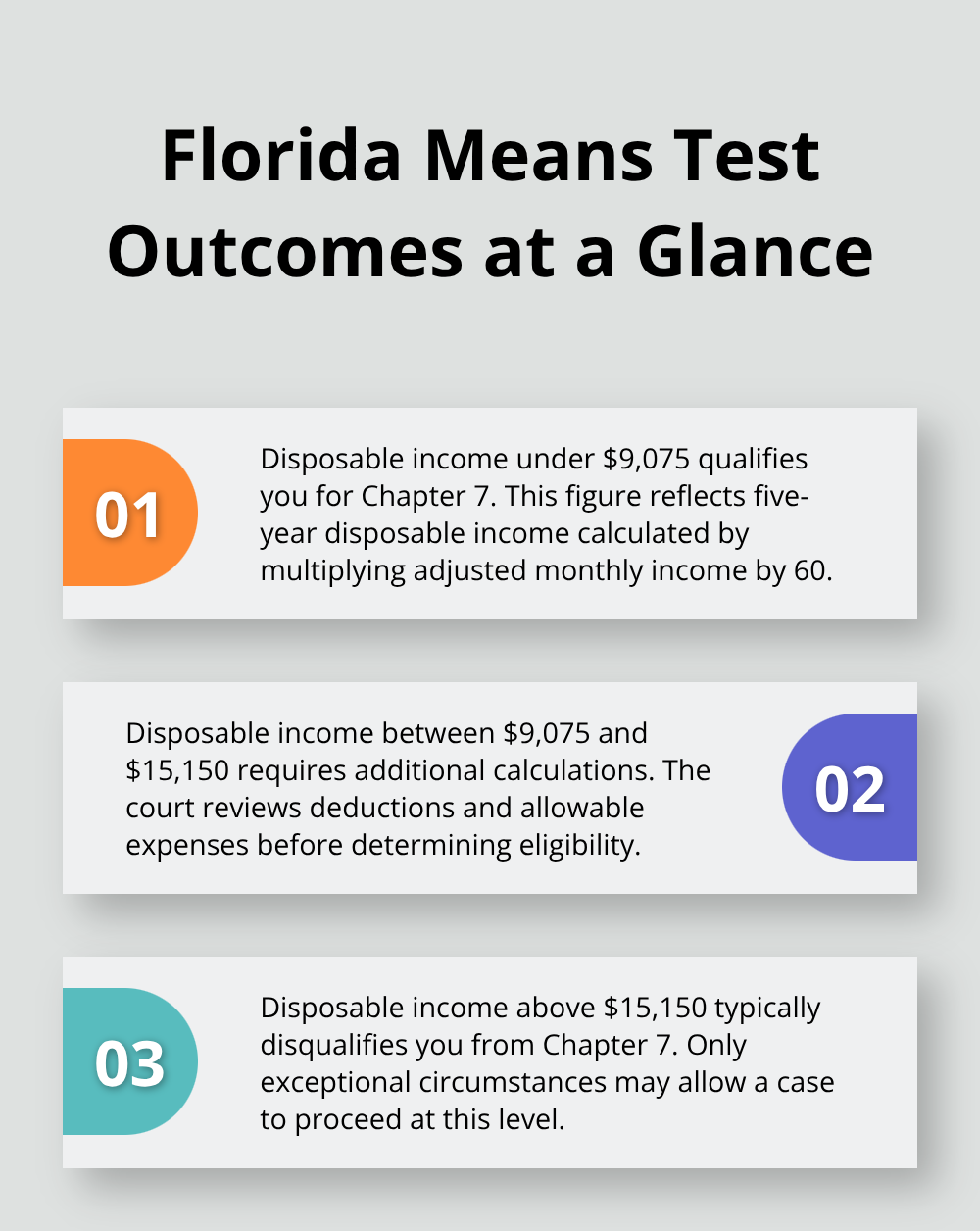
If your income exceeds Florida’s median, you must pass a means test to qualify for Chapter 7 bankruptcy. This calculation allows specific monthly expense deductions that include secured debt payments on homes and cars, overdue taxes, employer-required retirement contributions, health insurance premiums, childcare expenses, and court-ordered payments like child support. The means test multiplies your adjusted monthly income by 60 to assess your five-year disposable income. A disposable income under $9,075 qualifies you for Chapter 7, while amounts between $9,075 and $15,150 require additional calculations. Income above $15,150 typically disqualifies you unless exceptional circumstances apply.
Business Debt and Military Exceptions
Certain situations bypass the means test entirely and provide direct qualification paths for Chapter 7 bankruptcy. Individuals with primarily business debt rather than consumer debt avoid means test requirements completely. Disabled veterans with a 30% or higher disability rating who incurred debts during active duty also qualify without income restrictions (11 U.S.C. § 522). These exceptions recognize unique financial circumstances that standard income calculations don’t address adequately.
Income Documentation Requirements
The court requires specific documentation to verify your income calculations and qualification status. You must provide pay statements from the past 60 days through a “Declaration Regarding Payment Advices” form. Tax returns from recent years help establish income patterns, while bank statements show actual cash flow. Self-employed individuals need profit and loss statements plus business tax returns to document their earnings accurately.
Once you establish income qualification, the next step involves understanding which assets Florida law protects during the bankruptcy process.
Which Assets Can You Keep in Florida Chapter 7 Bankruptcy
Florida’s bankruptcy exemption system protects significantly more property than most states and gives debtors substantial advantages when they file Chapter 7. The state opted out of federal exemptions and requires all Florida residents to use state-specific protections that often prove more generous. Florida’s unlimited homestead exemption stands as the most powerful asset protection available and allows you to keep your primary residence regardless of equity value if it meets size restrictions (half an acre in municipalities or 160 acres in rural areas). This protection requires 1,215 days of ownership before you file, or your equity protection caps at $214,000 under federal limits.
Vehicle and Personal Property Protections
Florida law protects $5,000 in vehicle equity for a single car, which covers most standard vehicles without luxury features. The state’s wildcard exemption allows $1,000 in any personal property and expands to $4,000 if you don’t claim homestead protection. Retirement accounts receive robust protection with 401(k)s and IRAs protected up to $1,711,975 according to federal law. Social Security benefits, veterans benefits, workers compensation, and court-ordered support payments remain completely exempt from creditors.
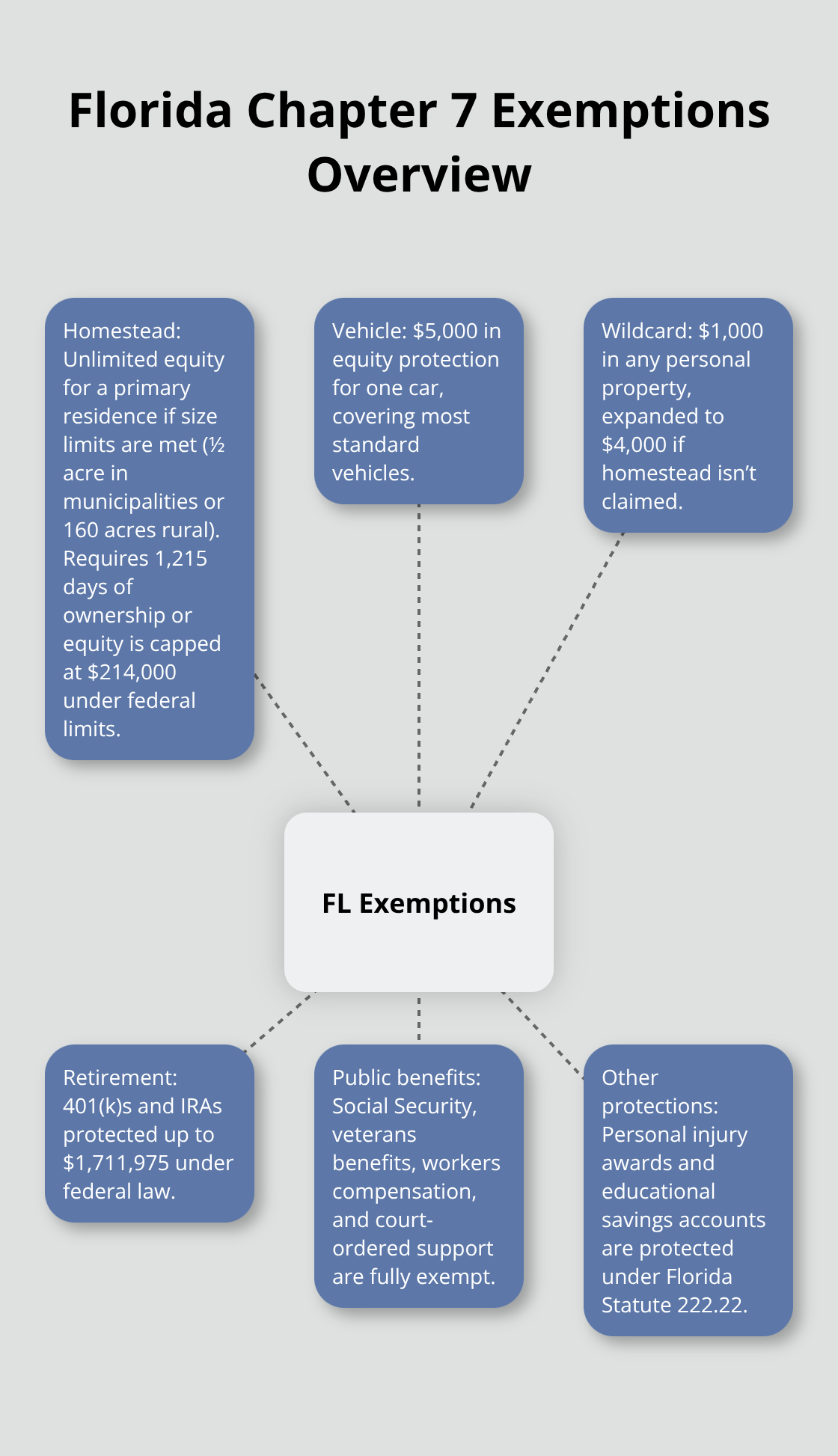
Personal injury awards and educational savings accounts also receive full protection under Florida Statute 222.22.
Strategic Asset Protection Before You File
Smart debtors maximize exemptions through legal pre-filing actions that move non-exempt assets into protected categories. You can convert cash into homestead improvements or pay down mortgage principal to increase protected equity. You can fund retirement accounts to legal limits to shield money from liquidation while you provide future security. However, fraudulent transfers made to hide assets from creditors can result in serious legal consequences and bankruptcy fraud charges. The key lies in legitimate financial preparation that occurs well before you file, not last-minute asset moves that courts scrutinize heavily.
Common Asset Mistakes to Avoid
Many debtors lose valuable property because they misunderstand Florida’s exemption rules or fail to claim protections properly. You must live in Florida for at least 730 days to utilize state exemption laws fully (rather than federal alternatives). Courts challenge property exemptions when debtors mischaracterize assets or attempt to claim protections they don’t qualify for. Trustees resolve most exemption disputes informally, but they can escalate to court proceedings if necessary.
The documentation you submit with your bankruptcy petition must accurately reflect all assets and properly claim available exemptions to avoid complications during the process. Certain assets may be exempt under Florida law, including your primary residence and other personal belongings.
What Documents Must You File for Chapter 7 Bankruptcy in Florida
Chapter 7 bankruptcy in Florida demands precise documentation within strict deadlines that determine your case success. The court requires Official Bankruptcy Form 122A-1 to report current monthly income, Form 122A-2 for means test calculations, and comprehensive schedules that detail all assets, liabilities, income, and expenses through Schedules A through J. You must provide a complete creditor matrix that lists every creditor’s name and address, plus a Statement of Financial Affairs that documents recent financial transactions. The court sets the total fee at $338, which you can pay in installments with half due at the time you file (if the court approves). Court staff cannot provide legal advice, so accuracy becomes your responsibility when you complete these forms.
Credit Counseling and Financial Management Requirements
You must complete credit counseling from an approved agency within 180 days before you file and submit the certificate with your petition. This requirement applies to every individual debtor without exception, and failure to complete counseling results in case dismissal. After you file, you have 60 days to complete a financial management course and submit certification to receive debt discharge.
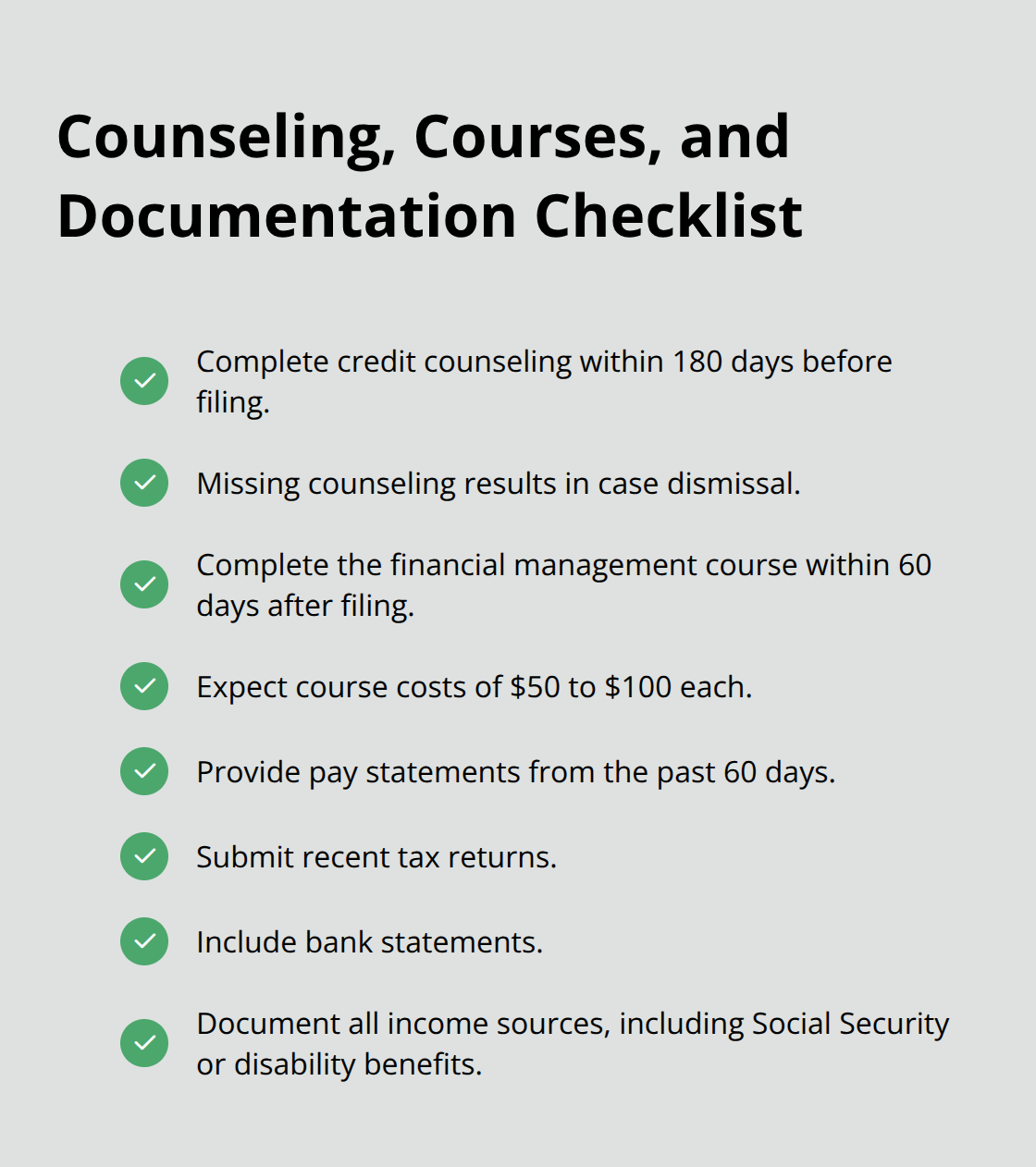
The U.S. Trustee Program maintains approved agency lists, and courses typically cost $50 to $100 each. You must also provide pay statements from the past 60 days through a Declaration Regarding Payment Advices, recent tax returns, bank statements, and documentation for all income sources that include Social Security or disability benefits.
Documentation Timeline and Organization Strategy
Start to gather documents at least 30 days before you file to avoid rushed preparation that leads to errors or omissions. Create separate folders for income documentation, asset records, debt statements, and required certificates to streamline the process. Courts reject petitions with unofficial forms or missing signatures, so download current versions directly from your local bankruptcy court website. Joint filers must both sign all required documents, and missing documentation can delay or dismiss your case entirely. Transparency remains paramount because you face serious criminal penalties for bankruptcy fraud when you hide assets.
Final Thoughts
Chapter 7 bankruptcy qualification in Florida depends on three key factors: income limits, asset protection, and proper documentation. Your household income must fall below Florida’s median or pass the means test that considers allowable deductions. Florida’s exemption system protects your homestead, vehicle equity up to $5,000, and retirement accounts while requiring 730 days of residency to access these benefits.
The court demands precise documentation that includes income statements, asset schedules, creditor lists, and mandatory credit counseling certificates. Missing forms or incorrect information can delay or dismiss your case entirely. Most individual debtors receive discharge within three to six months when they follow proper procedures.
We at Harnage Law, PLLC help Florida residents understand how to qualify for Chapter 7 bankruptcy and guide them through every step of the process. Our firm focuses on debt discharge, creditor harassment prevention, and asset protection during bankruptcy proceedings (11 U.S.C. § 522). Professional legal assistance becomes valuable when your financial situation involves complex assets, high income that requires means test calculations, or potential exemption challenges that could affect your case outcome.