Filing for Chapter 7 bankruptcy in Florida involves several distinct phases, each with specific deadlines and requirements. Understanding the Florida Chapter 7 timeline helps you prepare for what’s ahead and reduces uncertainty throughout the process.
At Harnage Law, PLLC, we guide clients through each milestone, from initial paperwork to final discharge. This post breaks down the key stages so you know exactly what to expect.
Getting Your Paperwork Right Before Filing
Complete Your Credit Counseling First
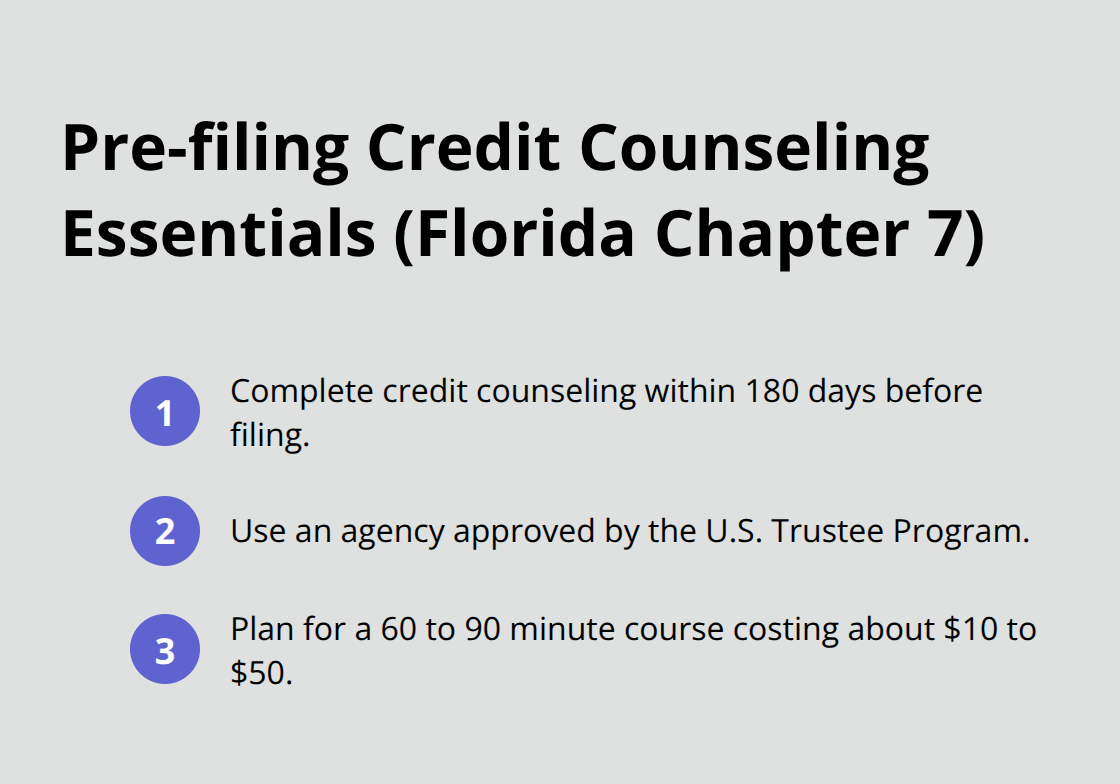
The paperwork phase determines whether your case moves forward smoothly or gets delayed. Before filing, you must complete a credit counseling course from an approved agency within 180 days prior to filing, per guidance from the U.S. Trustee Program. This is non-negotiable. You can find approved agencies on the U.S. Trustee website, and most courses take 60 to 90 minutes and cost between $10 and $50.
The course assesses whether Chapter 7 is actually the right path or if Chapter 13 makes more sense for your situation. Many people skip this step thinking it’s just a formality, but it protects you from filing in a way that could hurt your case later.
Gather and Organize Required Documents
When you file your petition, the court expects a complete package. You need the Voluntary Petition, Statement About Your Social Security Numbers, Certificate of Credit Counseling, Creditor Matrix with names and addresses, and a legible copy of government-issued photo ID. Beyond these basics, you must submit Schedules A through J detailing every asset, liability, income source, and monthly expense. The Means Test forms determine whether your income qualifies you for Chapter 7 discharge. Courts scrutinize asset valuations and income calculations closely, so inaccuracy creates problems during your 341 meeting.
Handle Fees and Payment Options
The filing fee is $338, due within 14 days of submission. If you cannot pay upfront, you can request installment payments or a fee waiver if your household income falls below 150 percent of the poverty level. The fee waiver application is Official Bankruptcy Form 103B, and the installment option uses Official Bankruptcy Form 106C. Both require both spouses’ signatures if filing jointly.
Submit Pay Stubs and Prepare for Trustee Review
You must provide pay stubs from the last 60 days to the trustee at least 7 days before your 341 meeting. Florida courts warn that mistakes in these documents lead to dismissal or loss of discharge, so accuracy matters far more than speed. Once you submit your complete petition package, the court issues an automatic stay that stops most creditor collection actions immediately, giving you breathing room while the trustee begins reviewing your financial details.
The 341 Meeting and Trustee Review
What Happens at Your 341 Meeting
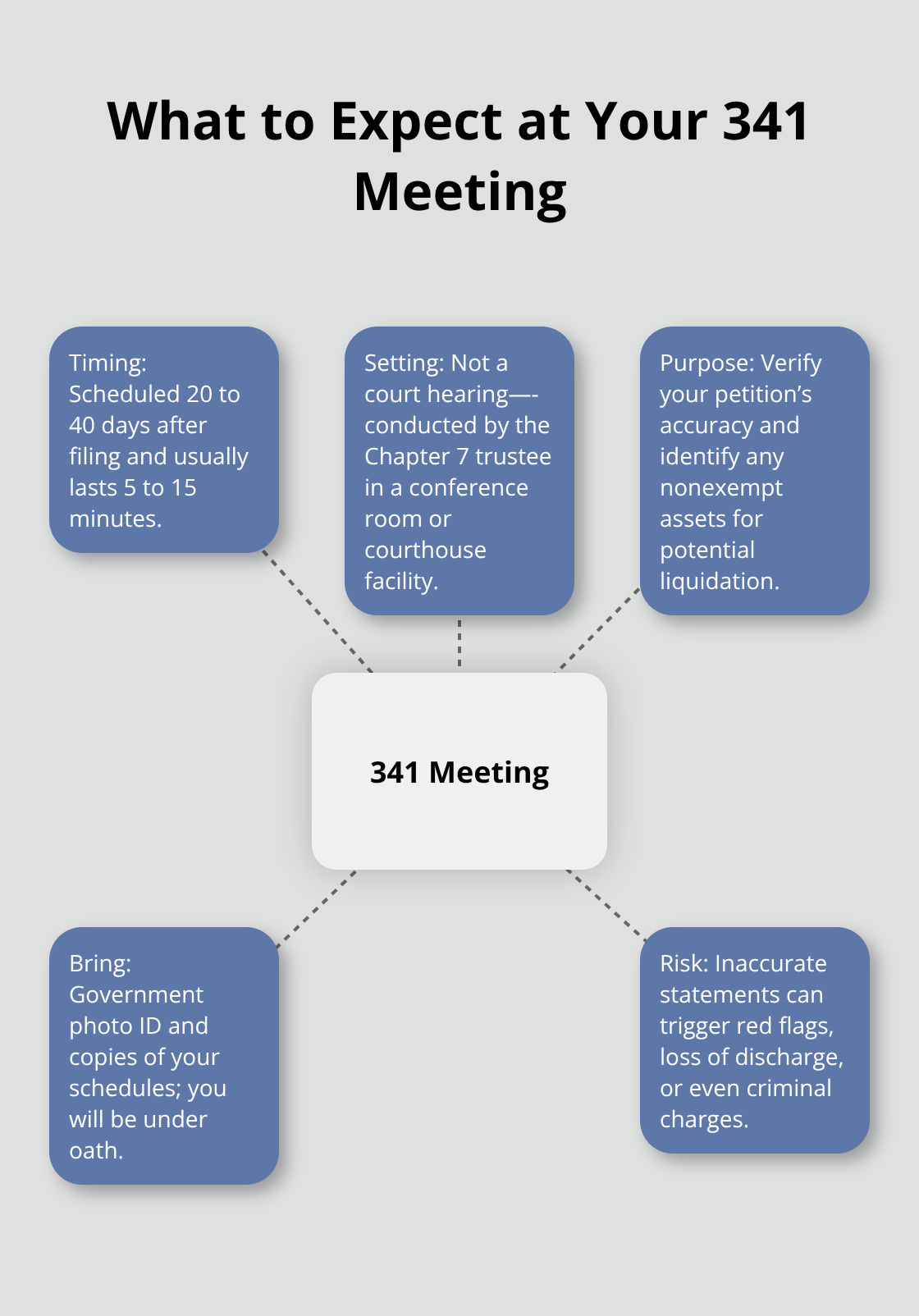
Your 341 meeting of creditors occurs 20 to 40 days after you file, and the name comes from the bankruptcy code section that requires it. This meeting is not a court hearing-the judge will not be present, and you will not stand before a bench. Instead, the Chapter 7 trustee appointed by the U.S. Trustee Program will conduct the meeting in a conference room or courthouse facility. The trustee’s job is straightforward: verify that the information in your petition matches reality and identify any nonexempt assets that could be liquidated to pay creditors. The meeting typically lasts 5 to 15 minutes, though complex cases can run longer. You must bring your photo ID and copies of your schedules. You will be under oath, so dishonesty creates serious consequences including loss of discharge or criminal charges.
The trustee will ask about your income, debts, property, and any transfers you made in the year before filing.
Creditor Participation and Questions
Creditors rarely attend these meetings-most simply send the trustee documentation and skip the in-person session. When creditors do show up, they ask questions about secured debts like mortgages or car loans, or about whether you have assets worth pursuing. Bring your most recent federal tax return at least 7 days before the meeting, as the trustee will want to review it against the income figures in your petition. Do not bring cell phones or recording devices into the meeting space. Many people worry the trustee will attack them or that creditors will ambush them with hostile questions. That rarely happens. The trustee wants debtors to succeed and complete the process; aggressive questioning only slows things down. What actually matters is accuracy. If your petition says you own a car worth $5,000 but you tell the trustee it’s worth $15,000, that discrepancy raises red flags. If your income calculations do not match your pay stubs, the trustee will catch it.
Actions Required After the 341 Meeting
After the 341 meeting concludes, you have 30 days to perform any actions you stated in your Statement of Intention-typically this means deciding whether to reaffirm a car loan, redeem the vehicle by paying its current value, or surrender it. You must also complete a financial management course (also called a debtor education course) and file Form B423 within 60 days after the date your 341 meeting was first scheduled. This is separate from the pre-filing credit counseling and is mandatory for discharge. The course covers budgeting, credit management, and rebuilding your financial life, and most providers charge $15 to $50.
The Trustee’s Role in Asset Liquidation
The trustee’s role extends beyond the meeting itself. If you have nonexempt assets-property not protected by Florida exemptions-the trustee may decide to liquidate them and distribute the proceeds to creditors. If your case is a no-asset case, meaning everything you own is either exempt or already encumbered by liens, the trustee typically moves toward discharge without selling anything. You can negotiate with the trustee to keep nonexempt property by surrendering exempt property instead or paying the trustee cash equal to the nonexempt asset’s value. These negotiations happen after the 341 meeting and before the trustee takes action. The automatic stay that went into effect when you filed remains in place throughout this period, blocking creditor collection calls, lawsuits, and wage garnishments. This protection gives you and the trustee time to work through the details without external pressure. Once the trustee completes the asset review and you satisfy all post-meeting requirements, your case moves into the final phase where the court prepares your discharge order.
Debt Discharge and Case Closure in Florida Chapter 7
Timeline for Your Discharge Order
Your discharge typically arrives 3 to 6 months after filing, though the exact timing depends on how quickly you complete post-filing requirements and whether the trustee encounters complications. The court will not issue your discharge order until you submit proof that you completed the financial management course within 60 days after your 341 meeting was first scheduled. This deadline is absolute. If you miss it, your discharge gets delayed indefinitely. Most debtors think the 341 meeting marks the finish line, but it actually marks the midpoint. You still have critical steps ahead.
Once the trustee confirms that all required documents are filed, that you answered all questions truthfully, and that any asset liquidation is complete, the court enters your discharge order. This order eliminates your personal liability for most unsecured debts like credit cards, medical bills, and personal loans. The discharge papers arrive by mail from the court clerk, typically within a few days of the order being entered. Some courts now use the Debtor Electronic Bankruptcy Noticing system, a free voluntary service that lets you receive notices by email instead of waiting for postal mail, which accelerates your awareness of key dates.
Debts That Survive Discharge
Not every debt disappears when your discharge order arrives. Student loans almost never get discharged unless you can prove undue hardship, which requires showing that repaying them would prevent you from maintaining a minimal standard of living. The U.S. Department of Education reports that less than 1 percent of student loan discharge requests succeed, making this path nearly impossible for most debtors.
Child support and alimony obligations continue after discharge because bankruptcy law treats family support as a fundamental obligation that cannot be erased. Tax debts generally survive unless they are more than three years old, were filed more than two years before your bankruptcy petition, and meet other specific conditions. Recent tax liens also remain enforceable against property even after discharge. Criminal fines and restitution orders imposed by courts do not get discharged.
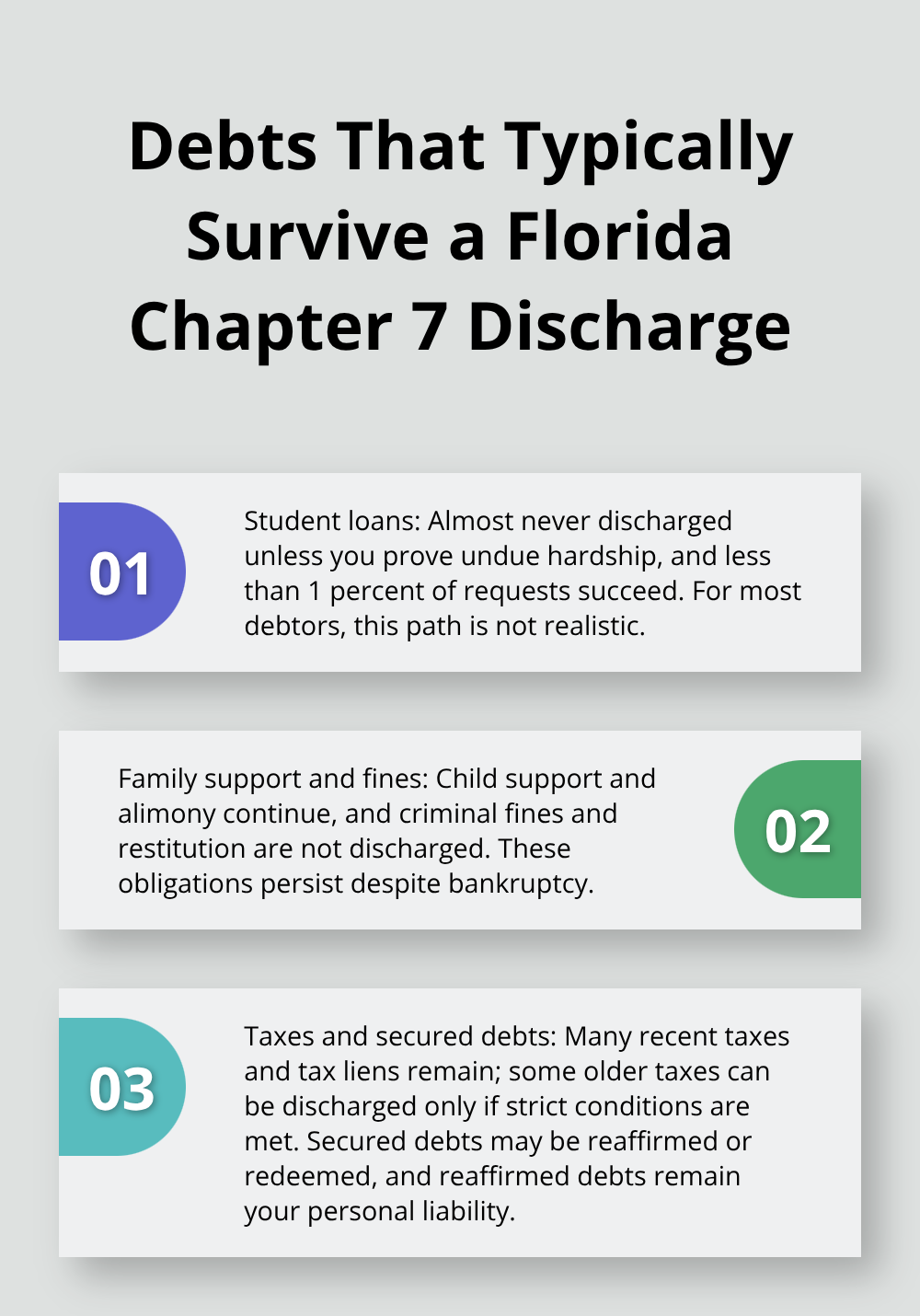
If you owe money to a utility company and that company obtained a lien on your property before filing, that lien survives discharge even though the underlying debt might be eliminated. This distinction matters because the creditor can still enforce the lien against your property later. Secured debts like mortgages and car loans can be handled through reaffirmation agreements, where you agree to keep paying them in exchange for keeping the property, or through redemption, where you pay the trustee the current fair market value of the property. If you reaffirm a debt after discharge, you remain personally liable for it even though other debts were eliminated.
Enforcing Your Discharge and Rebuilding Credit
After your discharge order arrives, creditors must stop all collection efforts against you for discharged debts. If a creditor continues calling or sending collection letters about a discharged debt, that violates the discharge injunction and gives you grounds to file a contempt motion against them. The Federal Trade Commission receives thousands of complaints annually from debtors whose creditors violate discharge orders, so document everything if this happens to you.
Your credit report should be updated to reflect the bankruptcy and the discharged debts, though this process can take several weeks. You can obtain a free credit report through AnnualCreditReport.com to verify that your bankruptcy is accurately reported. Most debtors see their credit scores start recovering within 6 to 12 months after discharge as they demonstrate responsible payment behavior on any remaining obligations.
The financial management course you completed before discharge typically covers rebuilding strategies, including how to use secured credit cards to reestablish credit history and the importance of maintaining an emergency fund to prevent future debt accumulation. Many successful debtors set aside 10 to 15 percent of their monthly income into savings immediately after discharge rather than waiting until debts are paid off, since they no longer have the consumer debt payments that consumed their previous budgets.
Final Thoughts
The Florida Chapter 7 timeline moves through distinct phases, each with hard deadlines that determine whether you reach discharge or face delays. From completing credit counseling before filing through submitting your financial management course certificate within 60 days after your 341 meeting, every step matters. Missing even one deadline postpones your discharge indefinitely or prevents it altogether.
Once your discharge order arrives-typically 3 to 6 months after filing-most unsecured debts vanish permanently. Student loans, child support, recent taxes, and criminal fines survive discharge, so understand which debts will remain your responsibility. If creditors continue calling about discharged debts, document everything and report violations to the Federal Trade Commission, as the discharge injunction legally prohibits collection efforts on eliminated debts.
Moving forward after discharge requires intentional action rather than passive waiting. Your credit score recovers faster if you maintain any remaining obligations on time and avoid accumulating new debt. Contact Harnage Law, PLLC for a free consultation to discuss whether Chapter 7 fits your situation and to navigate the Florida Chapter 7 timeline with confidence.