Filing Chapter 7 bankruptcy in Florida doesn’t mean losing everything you own. State law protects certain assets through exemptions, and understanding these protections is the first step toward financial recovery.
We at Harnage Law, PLLC help clients navigate Florida asset exemptions to keep what matters most. This guide walks you through the specific protections available and how to maximize them.
How Asset Exemptions Shield Your Assets in Florida Chapter 7
Asset exemptions in Florida Chapter 7 work by carving out specific property that creditors cannot touch, even when you file for bankruptcy. When you file, the court creates an estate containing all your assets. Without exemptions, a trustee would liquidate nonexempt property to pay creditors. Exemptions prevent this by declaring certain assets off-limits. Florida law is strict about exemptions because the state opted out of federal bankruptcy exemptions entirely, meaning you rely solely on Florida statutes to protect your belongings. The process requires you to list every asset on your bankruptcy petition and claim exemptions for each one. If you fail to claim an exemption, you lose it-the trustee can sell that asset. This is why accuracy matters from day one.
Your Home Receives Maximum Protection
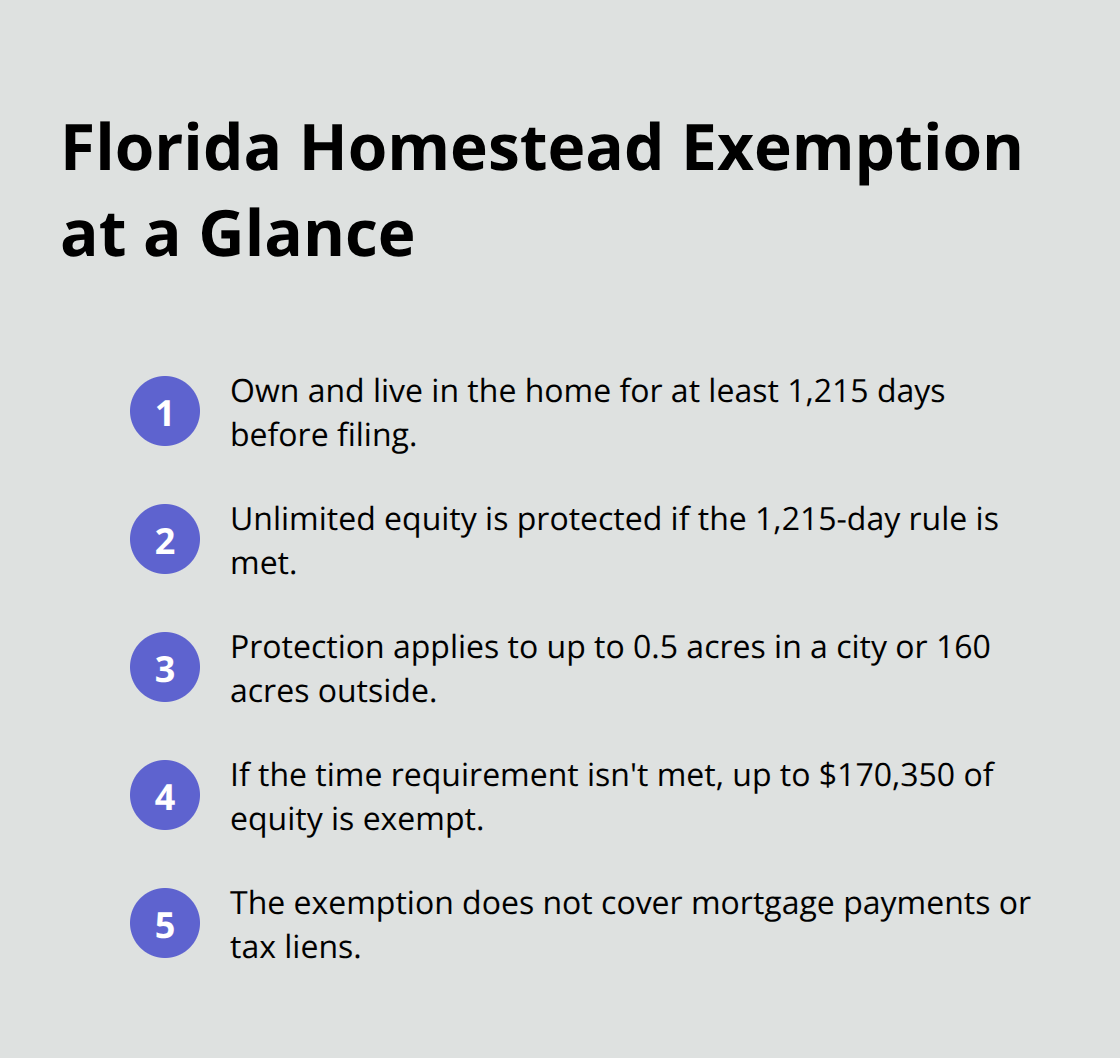
Florida’s homestead exemption stands as the most powerful protection available to you. If you own your primary residence and have lived there continuously for at least 1,215 days before filing, you can exempt unlimited equity in up to 0.5 acres inside a city or 160 acres outside city limits. This means a home worth $500,000 with $200,000 in equity receives full protection if you meet the ownership requirement. If you haven’t owned the home long enough, Florida law still allows you to exempt up to $170,350 of equity. The homestead exemption does not protect you from mortgage payments or tax liens-those secured debts remain your responsibility.
Many Florida homeowners in Chapter 7 keep their homes because the equity falls within these exemption limits.
Personal Property and Vehicles Have Strict Limits
Personal property exemptions in Florida cap at $1,000 per person unless you don’t claim the homestead exemption, in which case the limit rises to $4,000. This covers household items, clothing, furniture, electronics, and jewelry. Vehicle equity receives protection up to $5,000 per vehicle under Florida law. If your car is worth $22,000 and you owe $18,000, your equity is $4,000-fully exempt. If your vehicle has $7,000 in equity, you can protect $5,000 and face potential liquidation of the remaining $2,000 unless other exemptions apply.
Retirement and Insurance Assets Receive Full Protection
Retirement accounts receive 100% protection in Florida Chapter 7, making them among the safest assets you own. Life insurance cash surrender value and term life insurance proceeds are also fully exempt, along with Social Security benefits, VA benefits, and workers’ compensation payments. These protections exist because Florida recognizes that retirement income and insurance cannot be replaced. Understanding which assets fall into these protected categories helps you plan your Chapter 7 filing strategically and identify which assets require additional protection strategies.
Which Florida Exemptions Protect Your Most Valuable Assets
Your Home Receives Unlimited Protection with the Homestead Exemption
Your home represents your largest asset, and Florida law shields it aggressively through the homestead exemption. If you have owned your primary residence for at least 1,215 days before filing Chapter 7, you protect unlimited equity in up to 0.5 acres within city limits or 160 acres outside them. This protection applies regardless of your home’s value-an $800,000 property with $300,000 in equity receives the same full protection as a $200,000 home. If you have not met the 1,215-day requirement, Florida still allows you to exempt up to $170,350 of home equity, which covers most residential properties in the state. The homestead exemption shields only equity, not your mortgage debt or property taxes, so secured debts remain your responsibility. If you stay current on your mortgage, Chapter 7 permits you to reaffirm the loan and continue making payments, which actually helps rebuild your credit score after discharge. Married couples can double homestead protection if both spouses own the property together, though only one spouse needs to file for bankruptcy to claim it.
Vehicle Equity Protection Requires Strategic Planning
Vehicle protection in Florida caps at $5,000 of equity per vehicle, calculated by subtracting your loan balance from the vehicle’s current market value. A vehicle worth $18,000 with a $14,000 loan leaves $4,000 in equity-fully protected under the exemption. If your vehicle has $7,000 in equity, the court may allow the $5,000 exemption while the remaining $2,000 potentially goes to creditors unless you apply the wildcard exemption to cover it. You can exempt more than one vehicle if you document that each one is essential for work or daily transportation, though most filers protect only one primary vehicle.
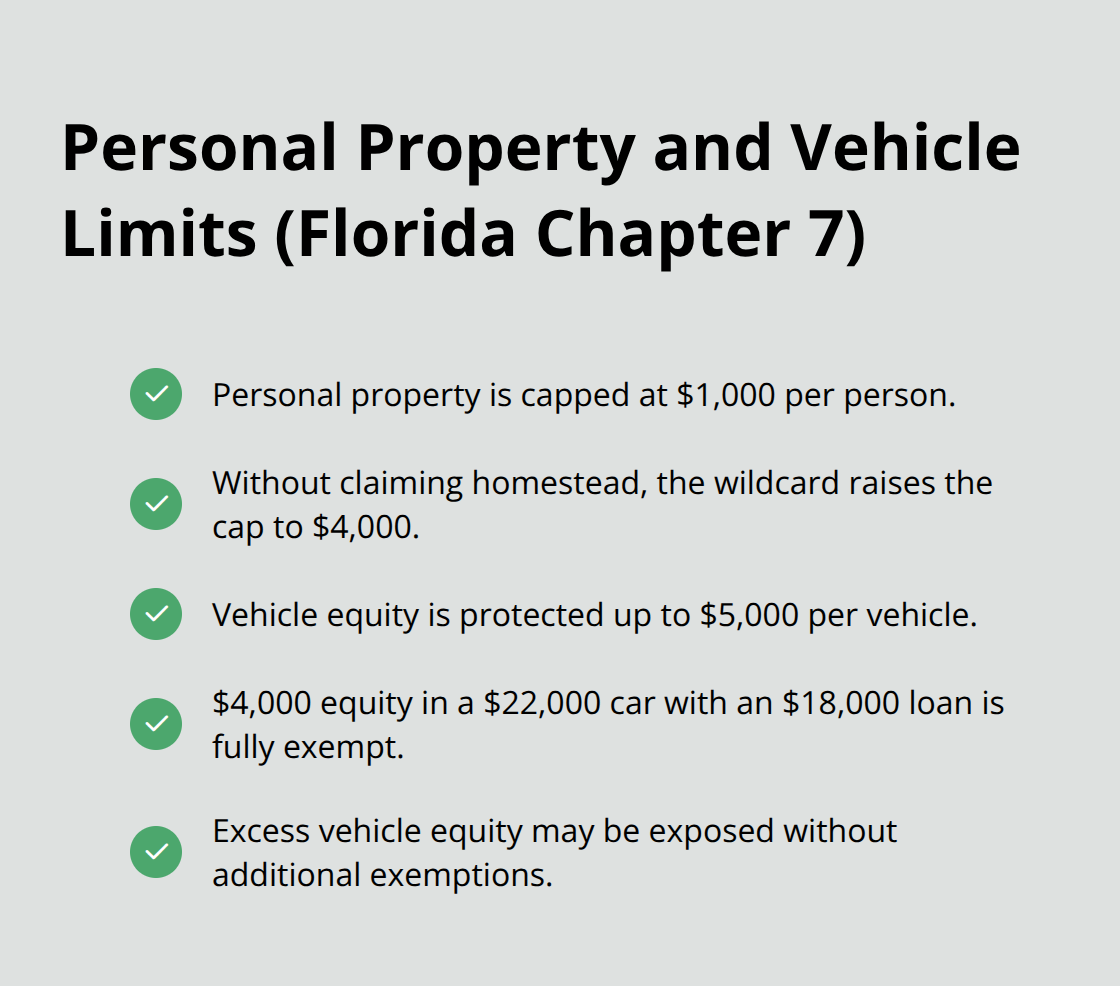
The wildcard exemption provides up to $4,000 of additional personal property protection when you do not claim the homestead exemption, offering flexibility to shield excess vehicle equity or other assets.
Retirement Accounts and Insurance Receive Complete Protection
Retirement accounts receive complete protection regardless of balance, including 401(k) plans, 403(b) plans, IRAs, pension payments, and deferred compensation programs. Life insurance cash surrender value and term life insurance proceeds are also fully exempt, along with Social Security benefits, VA disability payments, and workers’ compensation awards. These assets cannot be touched by creditors or the bankruptcy trustee, making them fundamentally different from personal property like household goods or jewelry, which face the $1,000 exemption limit. The distinction matters because retirement and insurance protections exist because Florida recognizes that retirement income and insurance cannot be replaced once lost. Understanding which assets fall into these protected categories helps you identify which assets require additional protection strategies during your Chapter 7 filing. The next section examines common mistakes that reduce these protections and how proper planning preserves your financial foundation.
How to Protect Your Assets Before Filing Chapter 7
Document Your Asset Values Early
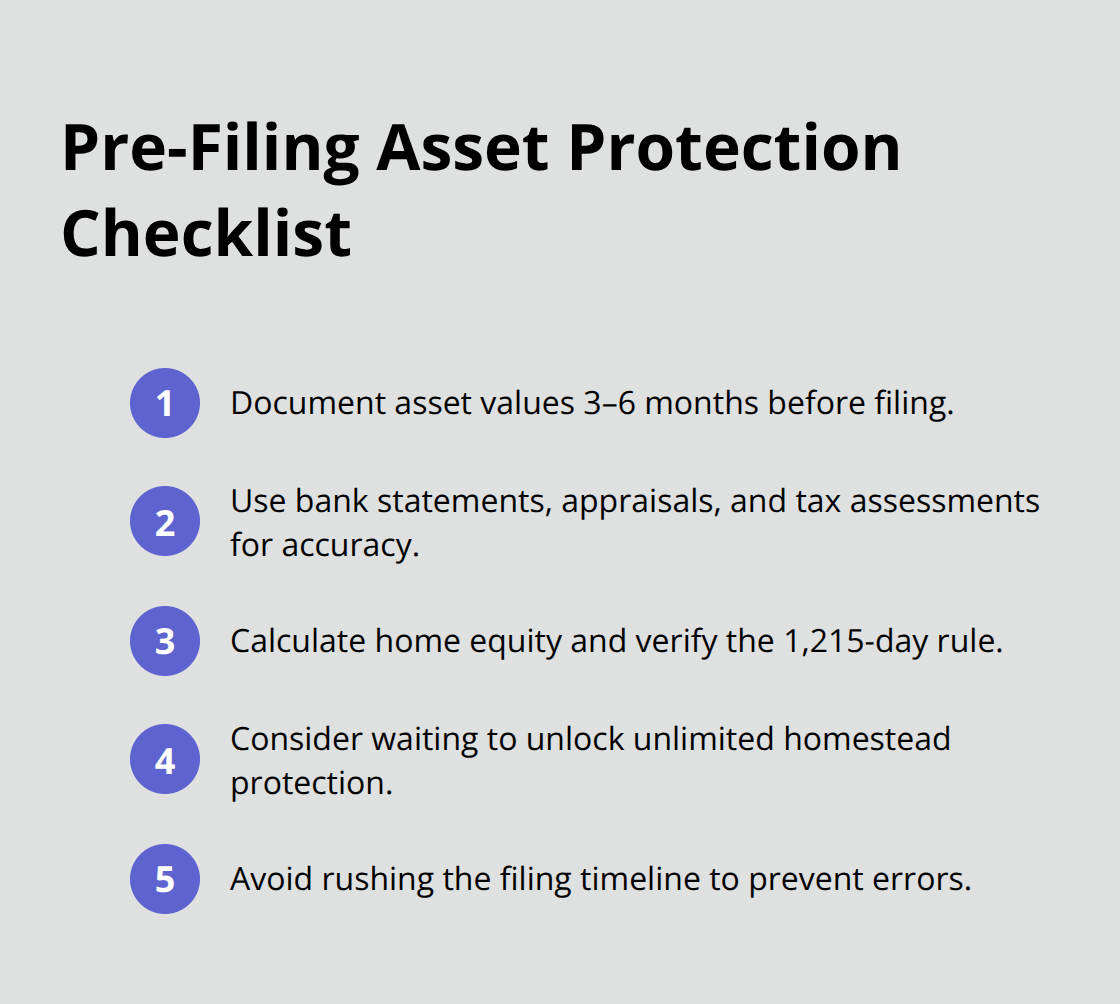
The timing of your Chapter 7 filing matters more than most people realize, and poor planning can erase thousands of dollars in exemption protection. Start by documenting your asset values at least three to six months before filing, using recent bank statements, vehicle appraisals, and property tax assessments to establish accurate equity calculations. Calculate your home equity by subtracting your mortgage balance from your home’s current market value, then verify you meet the 1,215-day ownership requirement before filing. If you own your home for only 800 days, you still protect up to $170,350 in equity under Florida law, but waiting another 400 days unlocks unlimited protection. Don’t rush the filing timeline to avoid this calculation error.
Apply Strategic Exemption Choices
If your vehicle has $7,000 in equity and the $5,000 exemption leaves $2,000 exposed, you could apply the wildcard exemption to cover that gap, but only if you haven’t claimed the homestead exemption. This strategic choice depends on your home equity situation, which is why understanding your complete financial picture upfront prevents costly mistakes. Verify that retirement accounts contain only protected funds and that Social Security or VA benefits haven’t been mixed with taxable income in your bank accounts, since commingling exempt funds with nonexempt money can compromise their protected status.
Avoid Common Exemption Mistakes
One critical error that reduces protection is failing to claim exemptions on your petition, which automatically forfeits those assets to the trustee. Another frequent mistake involves undervaluing personal property to stay below the $1,000 limit, then having the trustee discover higher-value items during the 341 meeting and object to your exemption claims. Accurate valuations based on replacement cost, not sentimental value, protect you from this dispute. If you own multiple vehicles, document why each one is essential for work or transportation before filing, since the exemption typically covers only one vehicle unless you justify additional ones with proof of necessity.
Protect Against Fraudulent Transfer Claims
Some filers attempt to shield nonexempt assets by transferring them to family members shortly before filing, which triggers fraudulent transfer laws and can result in the trustee recovering those assets anyway. Florida law also prevents you from claiming the homestead exemption if you haven’t lived in Florida for at least 730 days before filing, so verify your residency timeline matches the statutory requirement. These rules exist to prevent abuse of the bankruptcy system and protect creditors from intentional asset concealment.
Final Thoughts
Florida asset exemptions protect your home, retirement accounts, and vehicles through specific legal limits that shield you from creditor claims during Chapter 7 bankruptcy. Your primary residence receives unlimited protection if you owned it for at least 1,215 days, retirement accounts stay fully exempt regardless of balance, and vehicle equity up to $5,000 remains yours. Accurate planning before filing-documenting asset values, calculating home equity, and avoiding common mistakes like failing to claim exemptions-determines whether you maximize these protections or lose thousands in nonexempt assets.
We at Harnage Law, PLLC help individuals and families navigate Chapter 7 by protecting assets and discharging qualifying debts while stopping creditor harassment and wage garnishments. Your financial situation deserves a strategy tailored to your specific circumstances, and our team reviews your assets, calculates your exemptions, and determines whether Chapter 7 fits your goals. Contact us today to schedule a consultation and begin your path toward financial recovery with qualified guidance.