Chapter 7 bankruptcy raises plenty of questions for Florida residents facing financial hardship. Many people worry about losing assets, damaging their credit, or navigating complex court procedures.
We at Harnage Law, PLLC understand these concerns and want to provide clear answers. This guide walks through what Chapter 7 actually involves and how it works in Florida courts.
What Chapter 7 Bankruptcy Actually Means in Florida
Chapter 7 bankruptcy is a legal process that allows individuals, partnerships, and corporations to eliminate qualifying debts through the federal court system. When you file Chapter 7 in Florida, you ask the court to discharge debts you can no longer pay. A court-appointed trustee liquidates your nonexempt assets and distributes the proceeds to creditors. In practice, more than 99% of individual Chapter 7 cases in Florida receive a discharge, meaning creditors can no longer pursue collection. The entire process typically takes 60 to 90 days from the creditors meeting to discharge, though the full timeline from filing to final discharge usually spans four to six months.
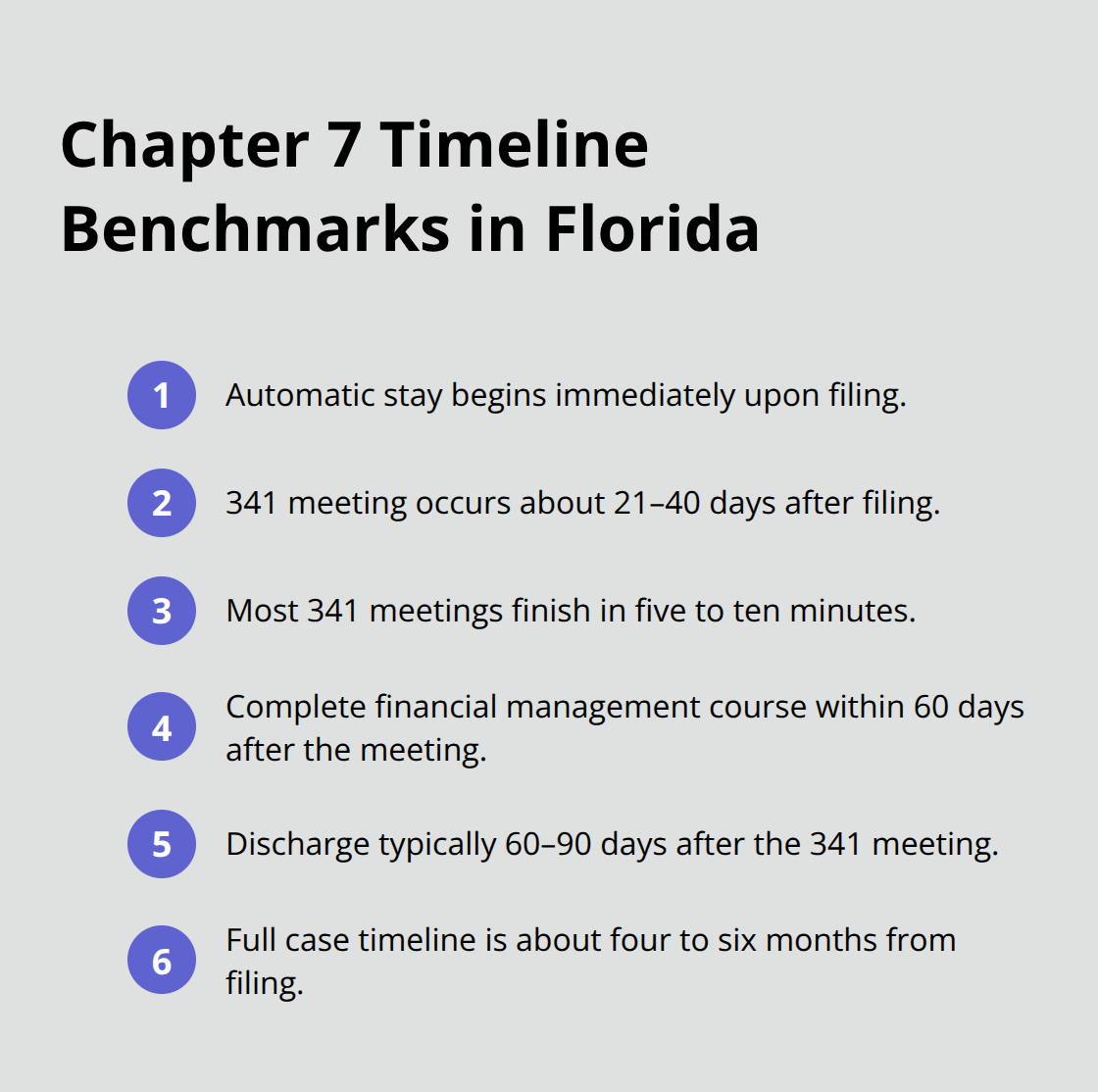
Filing Chapter 7 triggers an automatic stay immediately upon filing, which halts most collection actions, wage garnishments, and lawsuits against you. This breathing room stops creditors from pursuing you while the bankruptcy process unfolds.
How Chapter 7 Differs From Chapter 13 and Chapter 11
Chapter 7 is fundamentally different from Chapter 13, which is designed for individuals with regular income who want to keep their assets and repay debts through a court-approved plan lasting three to five years. Chapter 13 allows you to catch up on mortgage payments or car loans that are behind, making it ideal if you want to save your home from foreclosure or prevent repossession of a vehicle.
Chapter 11, on the other hand, is primarily used by businesses to reorganize and continue operations while restructuring debts. The key distinction is that Chapter 7 is a liquidation bankruptcy where nonexempt property is sold, whereas Chapter 13 is a repayment plan where you keep your assets. Florida residents who cannot afford to repay creditors and have few nonexempt assets often benefit most from Chapter 7. If you own significant nonexempt property or have steady income that could support a repayment plan, Chapter 13 might be the better choice.
Who Can Actually File Chapter 7 in Florida
To file Chapter 7 in Florida, you must first pass the means test, which compares your current monthly income against state median income levels for households of your size. The U.S. Trustee Program uses six months of average income to determine whether you have enough disposable income to repay creditors. If your income falls below the state median, you generally qualify for Chapter 7. If your income exceeds the median, the means test calculates whether you have disposable income available to pay creditors; if you do, a presumption of abuse arises unless you show special circumstances.
You must also complete a credit counseling course from an approved agency before filing. You cannot have had a prior bankruptcy dismissed within the last 180 days for willful nonappearance or failure to comply with court orders. Additionally, you must have resided in Florida for at least 180 days to file in the state, though you need 730 days of Florida residency to use Florida exemptions (if you have not lived in Florida for two years, you use the exemptions of the state where you lived longest during the prior two years).
Filing requires you to provide detailed schedules listing all creditors, assets, income, expenses, and financial affairs, along with tax returns from the prior four years. The filing fee in Florida is $338, though you can request installment payments or a fee waiver if you meet financial criteria by filing Official Bankruptcy Form 103B. Understanding these eligibility requirements and filing procedures sets the stage for what happens next in the Florida bankruptcy courts.
What You Actually Keep and Lose in Chapter 7 Florida Bankruptcy
Florida Exemptions Protect More Than You Think
The fear of losing everything stops many Florida residents from filing Chapter 7, but this fear is largely unfounded. Florida law protects substantial assets through exemptions that shield your property from liquidation. The homestead exemption allows unlimited equity in your primary home as long as the property stays within size limits (half an acre in a municipality or 160 acres elsewhere) and you have owned it for at least 1,215 days before filing. If you have not met the 1,215-day ownership requirement, a federal cap of $214,000 applies to your homestead equity instead. Your vehicle receives protection up to $5,000 of equity, and Florida allows a wildcard exemption of $1,000 for additional personal property, rising to $4,000 if you do not use the homestead exemption.
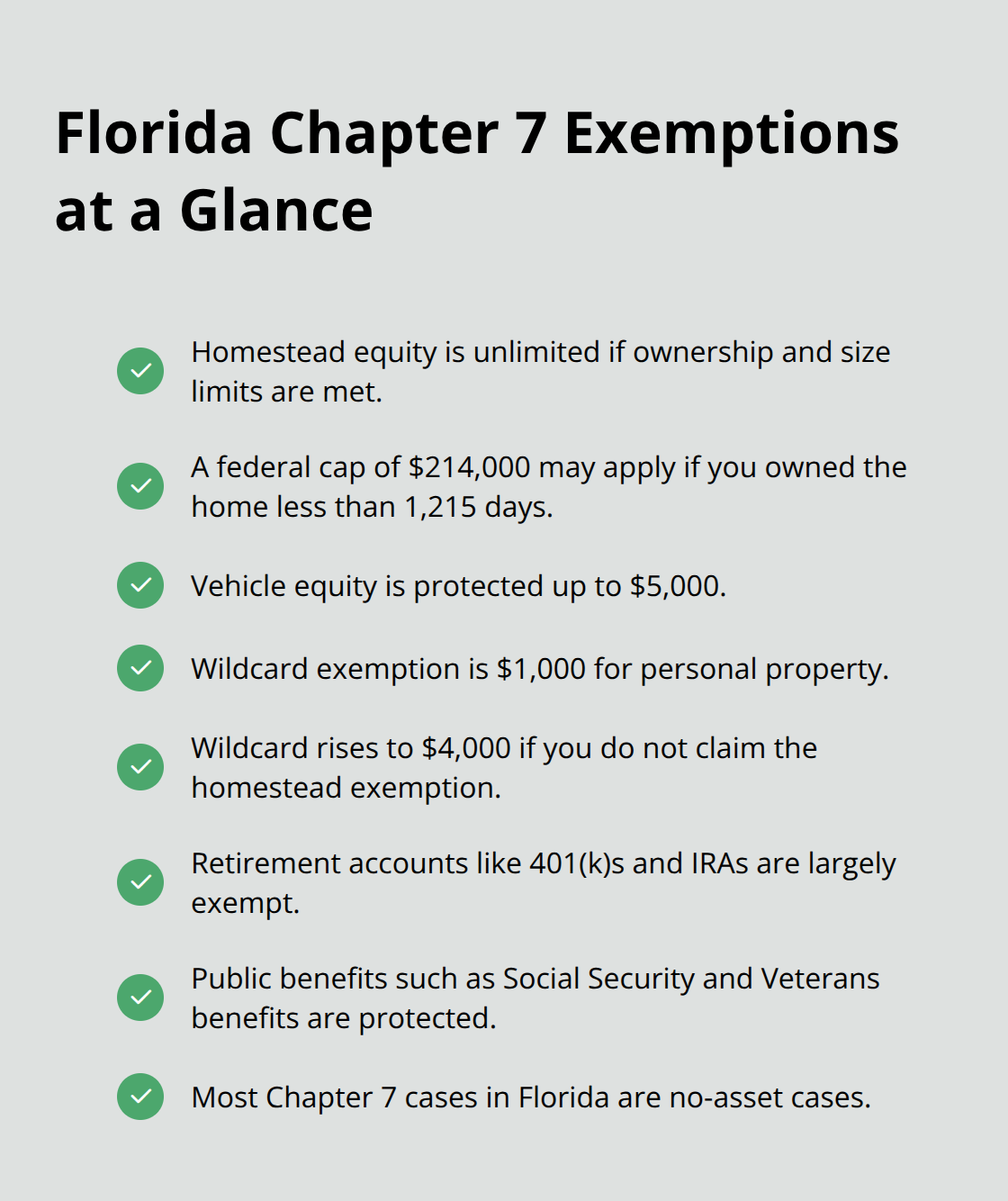
Retirement accounts including 401(k)s and IRAs remain largely exempt with a combined cap of $1,711,975 per person for cases filed between April 1, 2025, and March 31, 2028. Public benefits like Social Security, Veterans benefits, and workers compensation stay fully protected from creditors under Florida law. Most individual Chapter 7 cases in Florida are no-asset cases, meaning the trustee finds no nonexempt property to sell. This outcome occurs because your exemptions cover most or all of what you own.
Debts That Disappear Versus Debts That Remain
Chapter 7 discharge eliminates most debts permanently, but certain obligations survive the bankruptcy process. Credit card debt, personal loans, medical bills, and most unsecured debts vanish after discharge. However, child support and alimony obligations continue, as do most tax debts, certain student loans, debts from fraud or willful misconduct, and DUI-related injury claims. The discharge itself appears on your credit report for up to ten years, but your credit score begins recovering immediately after discharge.
How Your Credit Recovers After Chapter 7
Many Florida residents see credit score improvements within 12 to 18 months because Chapter 7 eliminates the high debt balances that damaged their scores in the first place. The automatic stay triggered by filing stops collection calls, wage garnishments, and lawsuits instantly, giving you immediate relief from creditor harassment. Your credit improves faster after Chapter 7 than if you spend years struggling with debt. Understanding which assets Florida protects and which debts actually disappear allows you to make an informed decision about whether Chapter 7 serves your financial situation. The next section explains how the Florida bankruptcy courts actually process your case from start to finish.
How Florida Courts Process Your Chapter 7 Case
The Means Test Determines Your Eligibility
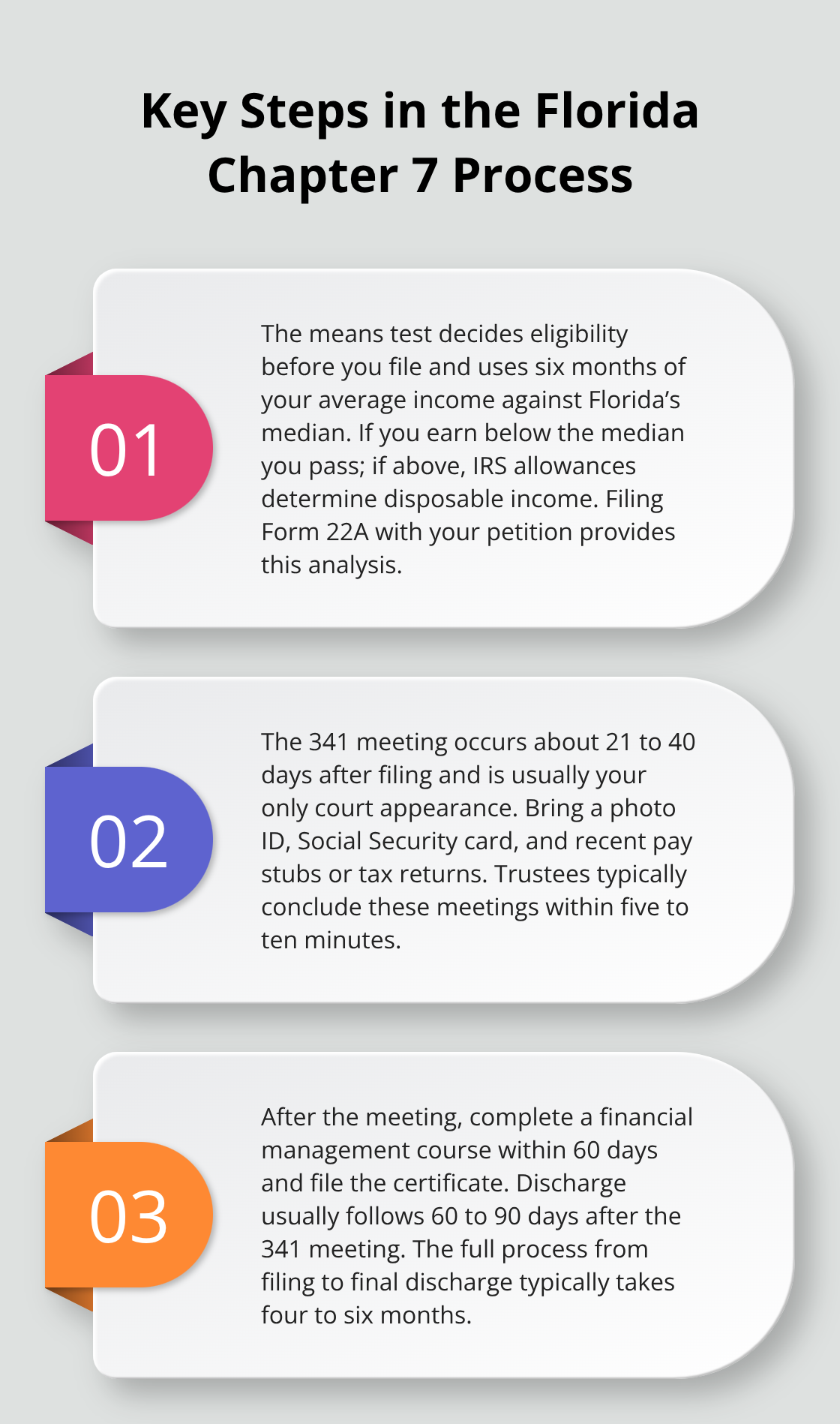
The means test decides your eligibility for Chapter 7 before you file. The U.S. Trustee Program calculates this using six months of your average income and compares it against the state median for your household size in Florida. If you earn below the median, you pass automatically. If you earn above it, the means test performs a second calculation using specific expense allowances set by the IRS to determine if you have disposable income available to repay creditors. This matters because if the calculation shows disposable income, the court may presume your Chapter 7 filing constitutes abuse unless you demonstrate special circumstances like medical expenses or caring for a dependent. Filing Form 22A with your petition provides this analysis. The means test is not theoretical-it directly decides whether you can proceed with Chapter 7 or face conversion to Chapter 13. Many Florida filers pass the means test without issue, while others find themselves in Chapter 13 repayment plans instead.
Your 341 Meeting: What Happens and What You Need
The 341 meeting of creditors occurs approximately 21 to 40 days after you file and represents the only mandatory court appearance for most debtors. You must bring a government-issued photo ID, your Social Security card, and recent pay stubs or tax returns. The trustee assigned to your case conducts this meeting under oath, asking standard questions about your assets, debts, income, and whether you filed accurate schedules. Creditors rarely attend these meetings-the trustee’s primary role is verifying your information and determining if any nonexempt assets exist for liquidation. In most Florida Chapter 7 cases, these meetings conclude within five to ten minutes.
The trustee reviews your Schedule C to confirm you claimed all available exemptions correctly. If exemptions are listed improperly, the trustee will object, and you may lose property you intended to protect. Bring copies of your filed petition and schedules to reference during questioning.
The Final Steps to Your Discharge
After the meeting concludes, you must complete a financial management course from an approved agency within 60 days to remain eligible for discharge. The Southern District of Florida maintains an official list of approved agencies on the U.S. Trustee’s website. Completing this course and filing the certificate removes the final barrier to your discharge. The entire timeline from filing to discharge typically spans 60 to 90 days after your 341 meeting, though the full process from initial filing to final discharge usually takes four to six months depending on whether creditors object to your discharge or file complaints challenging specific debts.
Final Thoughts
Chapter 7 bankruptcy offers Florida residents a legitimate path to eliminate qualifying debts and rebuild their financial lives within four to six months from filing to discharge. More than 99% of individual Chapter 7 cases receive a discharge, and Florida’s generous exemptions protect your home, vehicle, retirement accounts, and public benefits from liquidation. The automatic stay stops collection calls, wage garnishments, and lawsuits the moment you file, providing immediate relief while your case proceeds.
Your credit score begins recovering within months because Chapter 7 eliminates the high debt balances that damaged it in the first place. Most Chapter 7 cases are no-asset cases, meaning creditors receive nothing and you keep your property while debts vanish. The filing fee of $338 can be paid in installments or waived if you meet financial criteria, making bankruptcy accessible regardless of your current financial situation.
If you are considering Chapter 7 bankruptcy in Florida, gathering your financial documents and understanding your specific eligibility marks the next step. Review your income against Florida’s state median, list all your assets and debts, and determine which exemptions apply to your situation. We at Harnage Law, PLLC assist individuals and families in overcoming financial challenges by providing legal guidance through Chapter 7 bankruptcy, helping you discharge qualifying debts, stop creditor harassment, and protect your assets-contact us today to discuss your situation and learn how Chapter 7 can provide the fresh financial start you deserve.