Filing for Chapter 7 bankruptcy doesn’t mean losing everything you own. Florida law provides strong protections that let you keep essential assets while getting a fresh financial start.
We at Harnage Law, PLLC know that understanding Chapter 7 exemptions in Florida is the first step toward protecting what matters most. This guide walks you through which assets you can shield and how to maximize those protections.
How Chapter 7 Exemptions Actually Work in Florida
Chapter 7 exemptions are the legal tools that shield specific assets from creditors when you file for bankruptcy. Florida has its own exemption system, and it’s more generous than what most states offer. When you file Chapter 7 in Florida, you must use Florida state exemptions to protect your property-this is non-negotiable. Florida opted out of the federal bankruptcy exemption system, which means you cannot pick and choose between federal and state protections. However, you can layer Florida state exemptions with federal nonbankruptcy exemptions for certain assets like Social Security benefits and disability payments.
Understanding Florida’s Residency Rules
State bankruptcy exemptions protect assets within the bankruptcy case itself, while federal nonbankruptcy exemptions protect specific income streams that the government already shields from creditors outside bankruptcy. If you’ve lived in Florida for at least two years before filing, you apply Florida exemptions directly. If you haven’t met that two-year residency threshold, you use the exemptions from the state where you lived during the two years immediately before filing. This residency rule catches many people off guard.
You can claim the homestead exemption only after owning your property for 1,215 days (roughly 40 months). If you file before hitting that mark, a federal cap of $214,000 applies to your home equity instead of Florida’s unlimited protection. Most Chapter 7 filers in Florida keep their assets because exemptions typically cover what matters most. The median household income in Orange County was $77,011 in 2023, and most people filing in Florida stay well below state income thresholds for Chapter 7 eligibility.
What Assets Florida Actually Protects
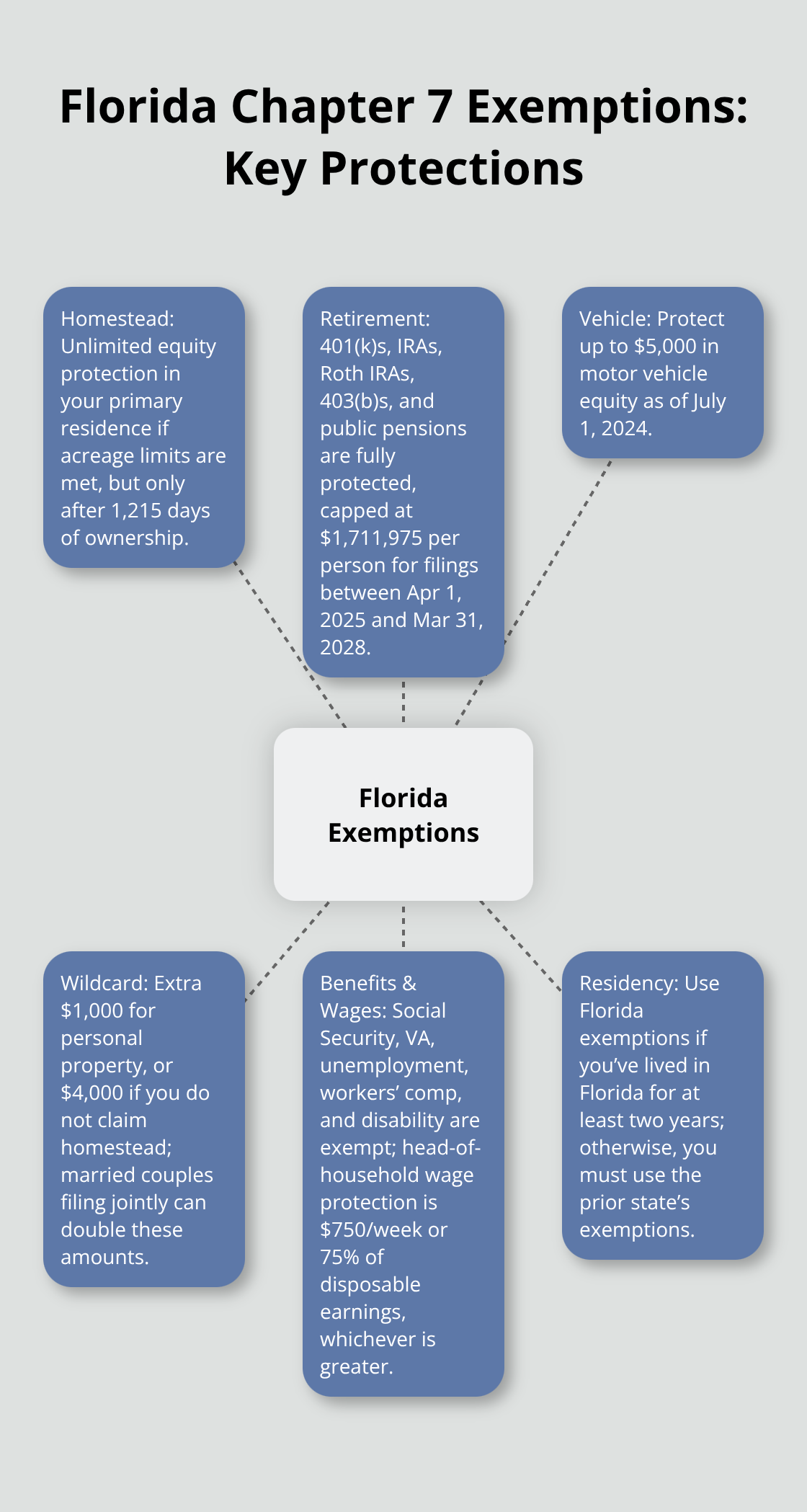
Your primary residence receives unlimited protection if you own it on less than half an acre in a city or less than 160 acres outside city limits. This homestead exemption ranks among the strongest in the nation and shields equity regardless of how much your home is worth. Retirement accounts (401(k)s, IRAs, Roth IRAs, 403(b)s, and public pensions) receive full protection under both federal law and Florida statute, with a cap of up to $1,711,975 per person for filings between April 1, 2025 and March 31, 2028.
Your motor vehicle equity receives protection up to $5,000 as of July 1, 2024, up from the previous $1,000 limit. Personal property like furniture, electronics, and household goods gets covered up to $1,000 under Florida law. Education savings accounts, health savings accounts, and hurricane savings accounts are fully exempt. Life insurance cash surrender values and annuity proceeds paid to a beneficiary receive protection. Social Security, veterans benefits, unemployment compensation, workers compensation, and disability benefits all remain exempt. Wages in your bank account receive protection too, with head-of-household filers shielding up to $750 per week or 75 percent of disposable earnings, whichever is greater.
Maximizing Protection With the Wildcard Exemption
The wildcard exemption gives you an additional $1,000 to protect any personal property you choose, or $4,000 if you don’t claim the homestead exemption. Married couples filing jointly can double these amounts. This flexibility lets you protect items that don’t fit neatly into other categories. If you own jewelry, tools, artwork, or collectibles, the wildcard covers them. If your car is worth more than $5,000, you can use the wildcard to shield additional equity.
This strategic layering of exemptions separates filers who lose assets from those who keep everything. Paired exemptions work best: claim homestead for your house, motor vehicle exemption for your car, retirement exemptions for your 401(k), and wildcard for anything else. The mistake most people make is failing to plan which exemptions to claim before filing. Once you file, your choices lock in, and changing them later becomes difficult and expensive.
Understanding which assets you can protect sets the foundation for your Chapter 7 strategy, but the real power comes from knowing how to combine these protections with your specific financial situation. The next section walks you through the most commonly protected assets and shows you exactly how Florida’s exemptions shield them.
Common Assets Protected by Florida Exemptions
Your Home Equity Receives Unlimited Protection
Your home equity sits at the top of Florida’s protection list, and the numbers justify the attention. Florida’s homestead exemption shields unlimited equity in your primary residence as long as the property stays under half an acre within city limits or under 160 acres outside municipalities. This protection applies whether your home is worth $200,000 or $2 million, making it one of the strongest asset shields in the country. The catch is timing: you must own the property for 1,215 days before filing to access unlimited protection.
If you file before hitting that ownership mark, federal bankruptcy law caps your protection at $214,000 instead. Most filers who’ve owned homes in Florida for three or more years walk through Chapter 7 keeping their entire home equity intact, which means creditors cannot force you to sell your residence to satisfy debts. Mobile homes and condos receive the same protection as traditional houses, so your primary residence type does not limit what you can shield.
Retirement Accounts and Insurance Benefits Stay Fully Protected
Retirement accounts deserve serious attention because they represent the largest protected asset category for most filers. Your 401(k), IRA, Roth IRA, 403(b), and public employee pensions receive full protection under federal law and Florida statute, with a cap of $1,711,975 per person for filings between April 1, 2025 and March 31, 2028. This means you do not raid retirement savings to pay Chapter 7 debts. Life insurance cash surrender values and annuity proceeds paid to beneficiaries stay protected.
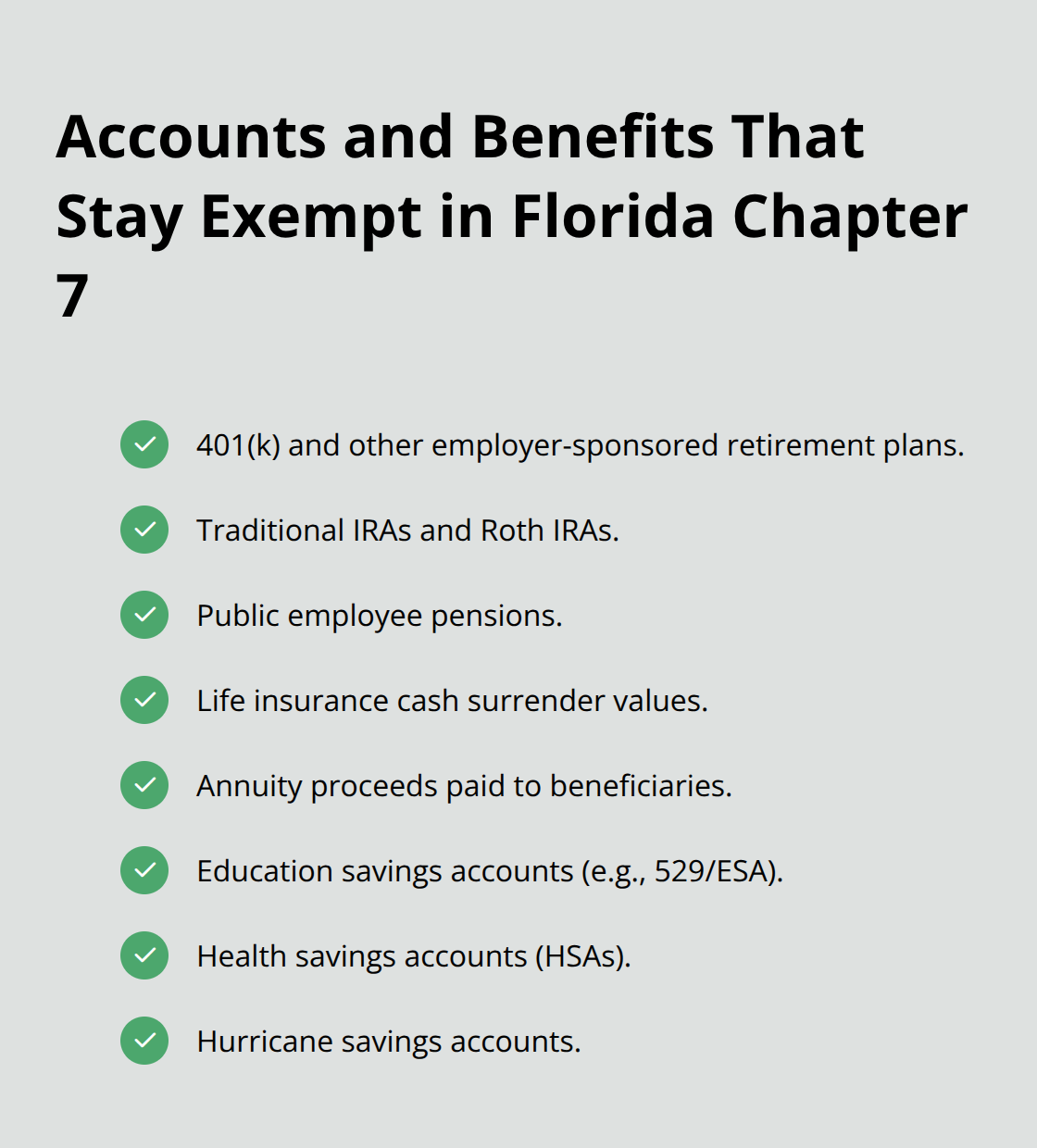
Education savings accounts, health savings accounts, and hurricane savings accounts receive full exemptions as well.
Personal Property and Vehicle Equity Get Meaningful Protection
Personal property protection runs $1,000 for general items like furniture, electronics, artwork, and household goods, but the wildcard exemption lets you boost that to $4,000 if you skip the homestead claim. Your vehicle equity gets protected up to $5,000 as of July 2024, covering the car you drive to work or use for essential transportation. Married couples filing jointly can double these amounts, providing even stronger protection for jointly owned vehicles and personal property.
Government Benefits and Wages Remain Completely Exempt
Social Security benefits, disability payments, unemployment compensation, workers compensation, and veterans benefits all remain completely exempt from creditor claims in bankruptcy. If you’re the head of household, wage garnishment shields preserve income at either $750 per week or 75 percent of your disposable earnings, whichever is greater. This wage protection extends to deposits made within the last six months, protecting income that creditors would normally garnish.
Strategic Layering Maximizes Your Total Protection
The combination of these protections means most Florida Chapter 7 filers keep the assets that matter most to rebuilding their lives. Paired exemptions work best: claim homestead for your house, motor vehicle exemption for your car, retirement exemptions for your 401(k), and wildcard for anything else. The mistake most people make is failing to plan which exemptions to claim before filing. Once you file, your choices lock in, and changing them later becomes difficult and expensive. Understanding exactly which assets you can shield sets the stage for the next critical step-developing a strategic plan that maximizes these protections based on your unique financial situation.
How to Plan Your Exemptions Before Filing
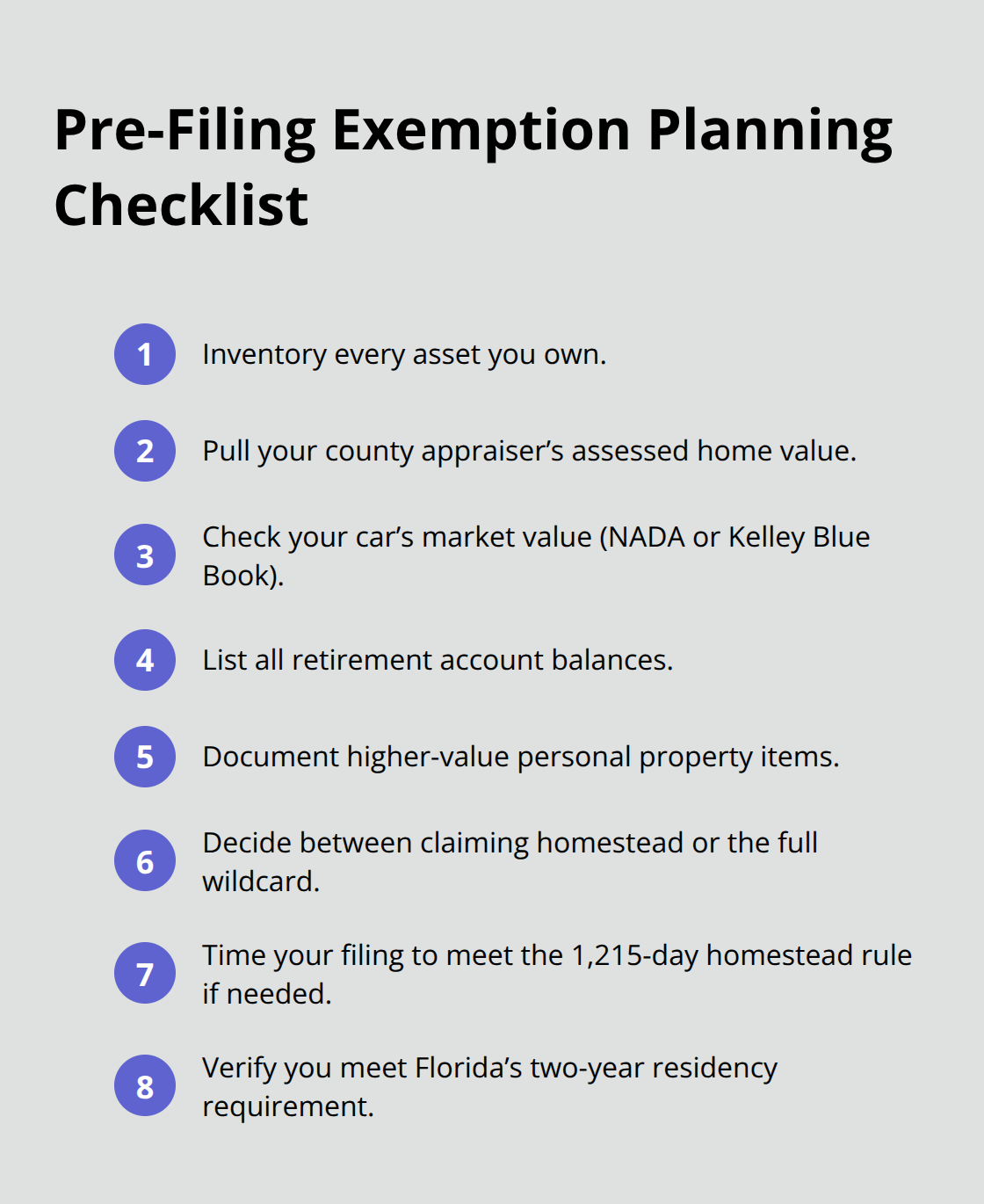
The most expensive mistake you can make in Florida Chapter 7 is filing without a concrete exemption strategy. Once you file, your exemption choices lock in immediately, and correcting errors costs time and money you likely do not have. Start your planning by inventorying every asset you own: your home value, vehicle worth, retirement account balances, cash on hand, jewelry, tools, artwork, and anything else with monetary value.
Document Your Assets and Calculate Equity
Pull your home’s assessed value from your county property appraiser’s website, check your vehicle’s current market value using NADA Guides or Kelley Blue Book, and list your retirement account statements. This inventory reveals which assets fall within exemption limits and which ones exceed them. If your home is worth $400,000 and you owe $300,000 on the mortgage, you have $100,000 in equity that Florida’s unlimited homestead exemption protects entirely. If your car is worth $8,000 and you owe $3,000, you have $5,000 in equity that fits perfectly within Florida’s motor vehicle exemption as of July 2024. If your vehicle equity exceeds $5,000, the wildcard exemption covers an additional portion, but only if you understand this layering beforehand.
Time Your Filing for Maximum Homestead Protection
Timing matters enormously for the homestead exemption. You must own your property for 1,215 days before filing to access unlimited protection; if you file before that date, federal bankruptcy law caps your homestead exemption at $214,000 regardless of your actual home equity. Calculate your ownership date carefully. If you bought your home in January 2021, you cannot file before January 2024 without losing the unlimited protection. If you purchased more recently, waiting those extra months might preserve six figures in home equity.
Verify Retirement Account Balances and Types
For retirement accounts, verify your exact balances and account types, because the $1,711,975 cap per person applies to all ERISA-qualified plans combined through March 31, 2028. If you have multiple IRAs or a 401(k) and a 403(b), add them together to ensure you stay under the cap. For personal property, document higher-value items like jewelry, tools, or collectibles that exceed typical household goods; these items compete for your $1,000 personal property exemption or your $4,000 wildcard exemption if you forgo homestead protection.
Choose Between Homestead and Wildcard Protection
The choice between claiming homestead and maximizing wildcard protection depends entirely on your situation. If you own a home with substantial equity, homestead is non-negotiable. If you rent and own a valuable vehicle or significant personal property, skipping homestead to claim the full $4,000 wildcard makes sense. This strategic decision separates filers who lose assets from those who keep everything. Before your initial consultation with a Chapter 7 bankruptcy attorney, documenting this analysis accelerates the planning process and ensures no asset falls through the cracks.
Final Thoughts
Chapter 7 exemptions in Florida provide real power to protect what matters most while eliminating qualifying debts. Florida’s exemption system ranks among the strongest in the nation, and most filers keep their essential assets because exemptions cover them. Your home receives unlimited protection if you own it for 1,215 days, your retirement accounts stay completely shielded up to $1,711,975 per person through March 2028, and your vehicle equity gets protected up to $5,000.
The difference between filers who lose assets and those who keep everything comes down to planning before you file. Document your assets and calculate which exemptions apply to your situation by pulling your home value from your county property appraiser, checking your vehicle’s current market value, and listing your retirement account balances. Verify your Florida residency status and ownership timeline for your home to avoid costly mistakes that lock in once you file.
We at Harnage Law, PLLC help individuals and families navigate Chapter 7 bankruptcy by providing personalized legal guidance tailored to your specific financial situation. Our firm focuses on discharging qualifying debts, stopping creditor harassment, preventing wage garnishments, and halting lawsuits while protecting your assets. Contact Harnage Law, PLLC today for a consultation and take the first step toward a fresh financial start.