
Wage garnishment can take a significant portion of your paycheck before it even reaches your bank account. We at Harnage Law, PLLC understand how stressful this situation becomes when creditors start pulling money directly from your earnings.
Pausing wage garnishment in Florida is possible through several legal strategies, and Chapter 7 bankruptcy stands as one of the most effective options available. This guide walks you through immediate relief tactics and long-term financial recovery steps.
How Wage Garnishment Actually Happens in Florida
The Court Process That Leads to Your Paycheck Deductions
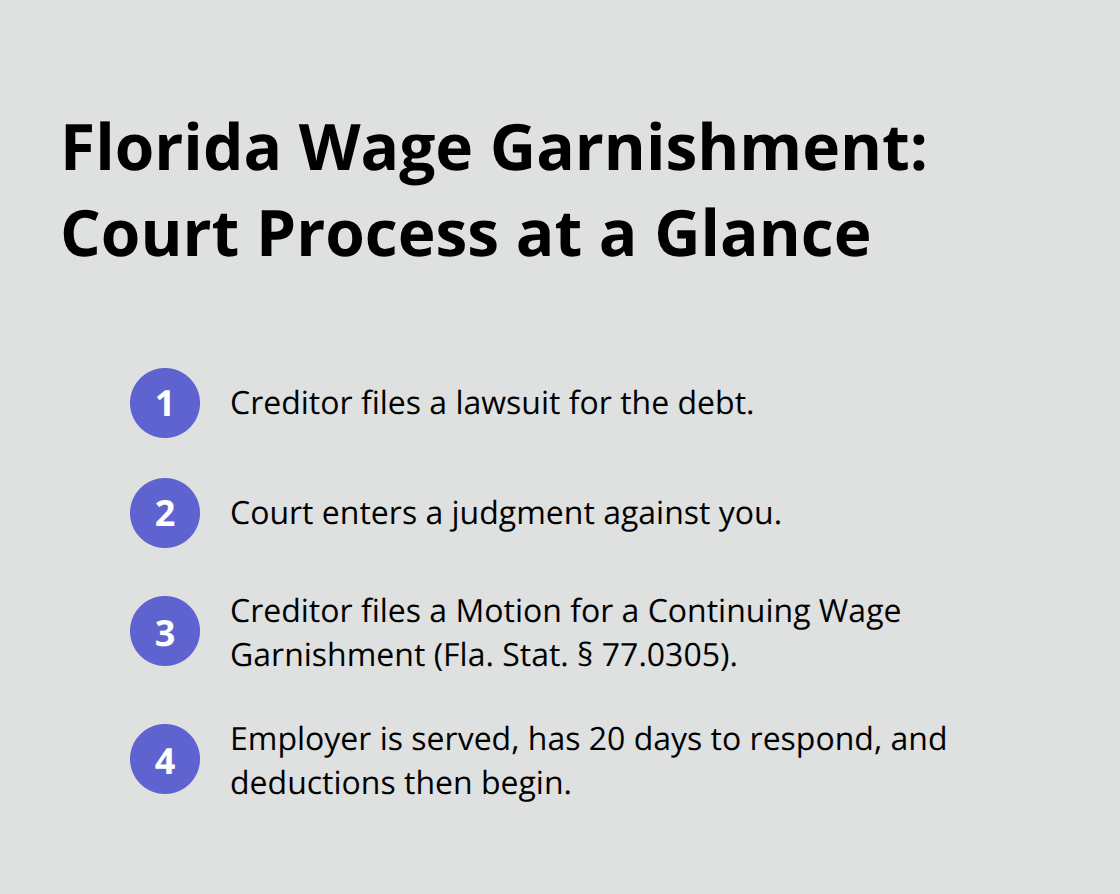
Wage garnishment in Florida follows a specific legal sequence that creditors must complete before money leaves your paycheck. A creditor files a lawsuit against you, obtains a judgment from the court, and then files a Motion for a Continuing Wage Garnishment with the court according to Florida Statutes Section 77.0305. Your employer receives a court order and has 20 days to respond before the garnishment begins. Most people discover the garnishment only when they see the deduction on their paycheck, which means the legal process has already moved forward without your knowledge.
How Much Your Employer Can Withhold
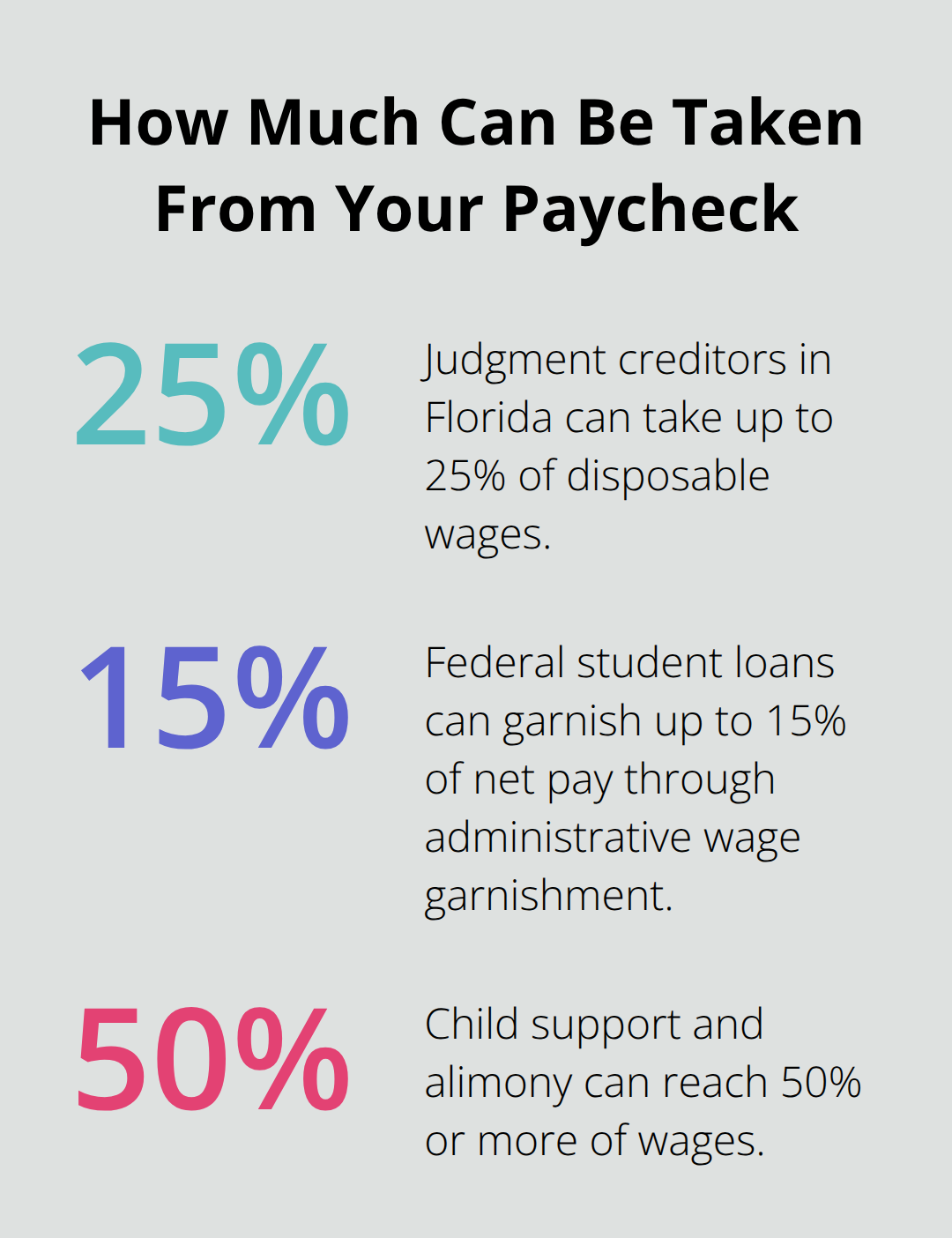
The court order requires your employer to withhold up to 25% of your disposable wages until the judgment is fully paid. Disposable income for these calculations excludes major living expenses like rent, mortgage, utilities, and car payments, but includes mandatory deductions such as Social Security and Medicare taxes. This 25% threshold applies to judgment creditors, though some debts operate under different rules. If your disposable income falls below 30 times the federal minimum wage per week (approximately $217.50), garnishment cannot proceed under federal law.
Debts That Bypass the Court System Entirely
Federal student loans and certain taxes bypass the court judgment requirement entirely. The U.S. Department of Education can garnish up to 15% of your net pay without a lawsuit, using an administrative process instead. Federal income tax garnishment also requires no judgment. Child support and alimony can reach 50% or more of your wages and must be addressed through family court rather than bankruptcy court alone.
Florida Protections You Can Claim
Florida does provide a head-of-household exemption that protects up to $750 per week in wages if you provide more than half the support for a dependent, but you must file an affidavit with the court to claim this protection. Acting quickly after you receive notice of garnishment makes all the difference in stopping it before your employer starts withholding funds. Clients who wait often endure 5 to 9 months of garnishment before relief arrives through the cure process, whereas immediate action can prevent the garnishment from starting in the first place.
How to Stop Wage Garnishment Right Now
The Automatic Stay: Your Fastest Path to Relief
Chapter 7 bankruptcy triggers an automatic stay that halts wage garnishment immediately for most debts, making it the fastest path to relief available in Florida. When you file, the court issues a legal order that forces creditors to stop all collection activities, including wage withholding, within days of filing. This automatic stay applies to judgment creditors, credit card companies, and medical debt collectors-essentially anyone pulling money from your paycheck for consumer debts. The only debts that may continue during bankruptcy are priority obligations like child support and alimony, which operate under different legal rules.
Claiming Exemptions Before Garnishment Starts
If you earn less than 30 times the federal minimum wage per week, you already qualify for a weekly income exemption that prevents garnishment entirely, but claiming this protection requires you to respond to the court within the proper timeframe. Many people never claim exemptions simply because they don’t know the deadline exists or how to file the paperwork correctly. Florida’s head-of-household exemption shields up to $750 per week if you support a dependent, yet this protection is not automatic-you must file an affidavit with the court to activate it. Acting within days of receiving a garnishment notice makes the difference between stopping it before your first paycheck is affected or enduring months of withholding. Curing a default before the garnishment order is entered prevents the problem entirely, and this window closes quickly.
Why Negotiation Fails After Judgment
Negotiating directly with creditors outside bankruptcy rarely stops active garnishment because once a judgment exists, the creditor has already won their legal battle and has no incentive to reverse the court order. Settlement discussions work better before judgment, but after garnishment begins, your leverage disappears. Chapter 7 bankruptcy eliminates most consumer debts entirely, meaning the underlying obligation vanishes and the creditor cannot resume garnishment after discharge. This permanent relief differs fundamentally from temporary payment plans or settlement agreements that require you to keep paying.
Federal and Private Student Loan Garnishment
Federal student loans currently have a pause on involuntary collections through administrative wage garnishment, according to the U.S. Department of Education announcement from January 2026, with new income-driven repayment options launching July 1, 2026. This pause gives federal student loan borrowers time to explore rehabilitation or consolidation without immediate wage withholding, but the relief is temporary. Private student loans require a full lawsuit before garnishment can begin, creating a longer timeline than federal loans but also providing opportunities to assert defenses or negotiate settlement before a judgment is entered. The longer process for private loans means you have more time to act and more legal options to pursue than with federal loans, which makes immediate consultation with a bankruptcy attorney valuable for understanding your specific situation.
Rebuilding Your Financial Life After Wage Garnishment in Florida
Repairing Your Credit Score After Discharge
Chapter 7 bankruptcy discharges your debts, but your financial recovery extends far beyond the discharge date. The months following your bankruptcy completion require deliberate action to repair credit damage and establish spending habits that prevent future garnishment. Your credit score likely dropped significantly during the garnishment period-the average borrower sees a 130 to 200-point decline when accounts enter default, according to credit reporting industry data. Recovery starts immediately after discharge, and the specific steps you take during the first year determine whether you rebuild quickly or remain financially vulnerable for years.
Obtain your credit reports from all three bureaus through the federally mandated free service and verify that discharged debts show zero balance with no remaining obligation. Accounts that appear as still-owed after discharge must be disputed with the credit bureau and the creditor directly. Most creditors update their records within 30 to 60 days after receiving the bankruptcy discharge notice from the court. If they don’t, send a written dispute with a copy of your discharge paperwork attached.
Your credit score begins improving the moment discharged accounts stop showing as delinquent, with most people seeing 50 to 100 points of recovery within six months of discharge if no new negative marks appear. Secured credit cards become your tool for rebuilding-deposit $500 to $1,000 with a bank, receive a card with that credit limit, and use it for small monthly purchases that you pay off immediately. Capital One, Discover, and Navy Federal Credit Union offer secured cards designed specifically for post-bankruptcy rebuilding. After 12 to 24 months of perfect payment history on a secured card, you qualify for an unsecured card with better terms. Avoid the temptation to apply for multiple cards simultaneously; each application triggers a hard inquiry that temporarily lowers your score by 5 to 10 points. Space applications six months apart and focus on demonstrating stability through consistent, on-time payments on whatever credit you do obtain.
Building a Sustainable Budget That Prevents Future Debt
A sustainable budget prevents the debt accumulation that led to garnishment in the first place. Track your actual spending for 30 days before creating your budget-most people discover they spend 15 to 25 percent more on discretionary categories than they estimate. Use free tools like YNAB (You Need A Budget), EveryDollar, or the NFCC’s budgeting worksheets rather than spreadsheets that most people abandon within weeks.
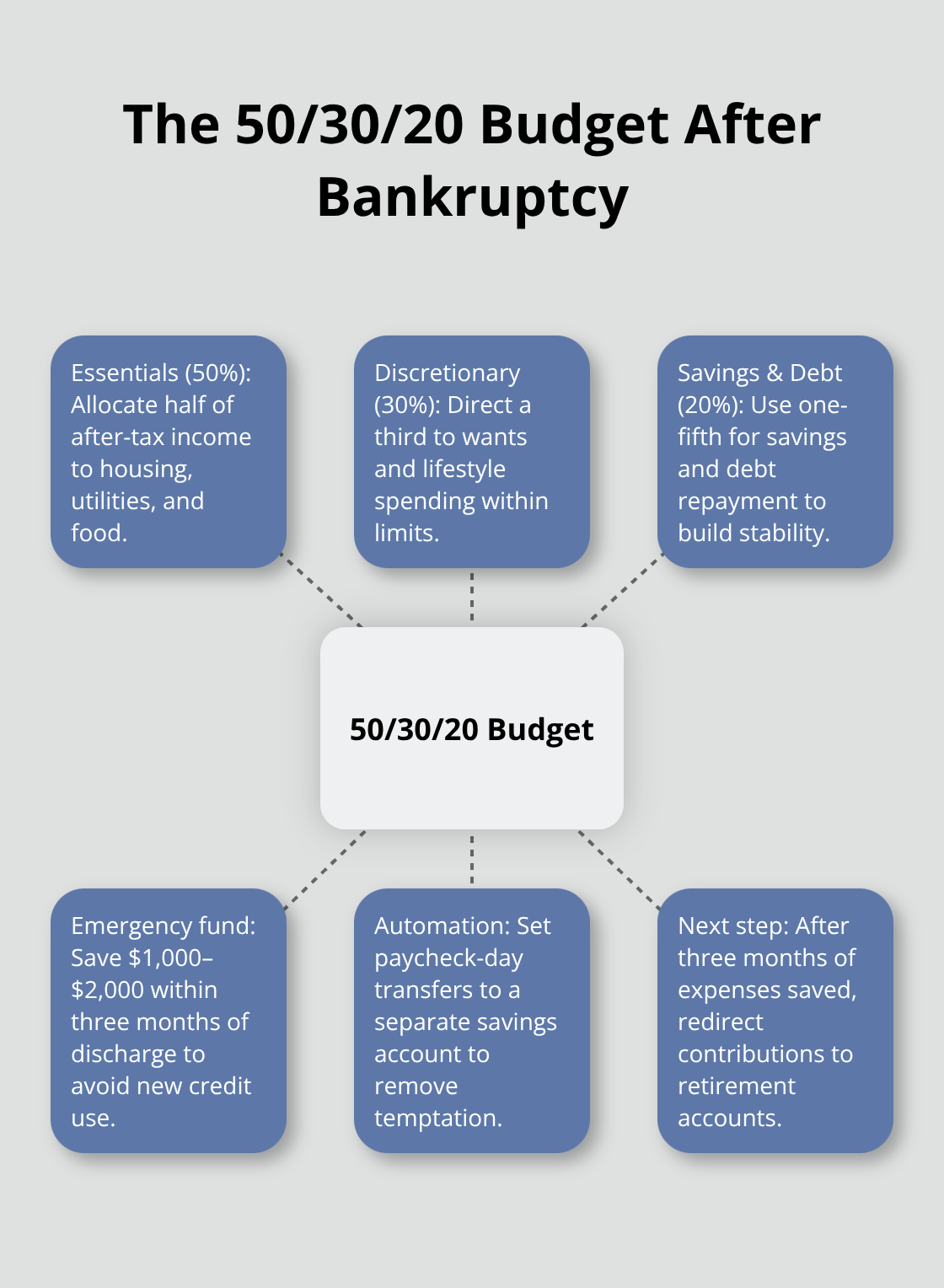
Your budget should allocate 50 percent of after-tax income to essential expenses like housing, utilities, and food; 30 percent to discretionary spending; and 20 percent to savings and debt repayment. This ratio comes from financial planning research showing that budgets matching these percentages have the highest adherence rates. Build an emergency fund of $1,000 to $2,000 within three months of discharge-this prevents you from returning to credit cards when unexpected expenses arise.
Medical bills and car repairs represent the two largest triggers for new debt among post-bankruptcy filers.
Establish automatic transfers to a separate savings account the day your paycheck deposits, treating savings as a bill you must pay. Many employers allow you to split direct deposit between checking and savings accounts, removing the temptation to spend money earmarked for emergencies. After your emergency fund reaches three months of expenses, redirect that 20 percent allocation toward retirement contributions. Fidelity and Vanguard offer low-cost index funds with no minimum investment, and starting retirement savings immediately after bankruptcy demonstrates financial responsibility to future lenders while providing tax advantages.
Working with Financial Counselors for Accountability
Financial counseling through a nonprofit agency provides accountability and education without the sales pressure of for-profit services. The National Foundation for Credit Counseling maintains a directory of agencies offering free or low-cost counseling certified by the U.S. Department of Justice. Many of these agencies operate on a sliding fee scale, charging between zero and $50 for comprehensive counseling.
Counselors help identify spending patterns that led to your financial crisis and teach strategies to prevent returning to those patterns. Monthly check-ins with a counselor-either in person or by phone-provide structure and motivation during the critical first year after discharge when relapse into old habits occurs most frequently.
Final Thoughts
Pausing wage garnishment in Florida requires immediate action, and Chapter 7 bankruptcy remains the most direct path to stopping creditor collection activities. The automatic stay halts wage withholding within days of filing, giving you breathing room to stabilize your finances while the court processes your case. Unlike temporary solutions such as payment plans or settlement negotiations, Chapter 7 discharges most consumer debts entirely, meaning creditors cannot resume garnishment after your discharge is complete.
Your financial recovery begins the moment your discharge is entered, with credit score improvements typically appearing within six months if you avoid new negative marks and establish positive payment history on secured credit cards. Federal student loans currently benefit from a pause on involuntary collections through July 2026, creating a window to explore income-driven repayment options or loan rehabilitation without immediate wage deductions. Three commitments will move you forward: build an emergency fund within three months of discharge to prevent returning to credit cards when unexpected expenses arise, create a sustainable budget allocating 50 percent of after-tax income to essentials and 30 percent to discretionary spending, and work with a nonprofit financial counselor during your first year after discharge to maintain accountability.
Contact Harnage Law, PLLC to discuss your situation and explore how Chapter 7 can provide the fresh start you need.