Filing Chapter 7 bankruptcy in Florida involves seven distinct steps, each with specific requirements and deadlines. We at Harnage Law, PLLC have guided countless Florida residents through this process.
Understanding the Chapter 7 steps Florida requires knowing what documents you need, which courses are mandatory, and when court appearances happen. This guide walks you through each phase so you know exactly what to expect.
Step 1: Gather Your Financial Documents
Documentation forms the foundation of your Chapter 7 bankruptcy filing. You need pay stubs from the last six months to establish your current monthly income, which the court uses to determine if you qualify for Chapter 7 under Florida’s means test. Tax returns for the previous two years become critical because the court averages your income over six months, and your tax filings provide verification of what you actually earned. Bank statements for the past several months show the court your liquid assets and spending patterns. These documents prevent delays and demonstrate to the court that you approached this process seriously.
Your debt list must be comprehensive and accurate because the court requires you to list every creditor in your bankruptcy petition. Include credit card companies with outstanding balances, medical providers who sent bills to collections, personal loans from banks or family members, auto loans, mortgage debt, and any other outstanding obligations. Any creditor you omit might not receive notice of your bankruptcy filing, potentially allowing them to continue collection efforts even after your discharge. Pull your credit reports from Equifax, Experian, and TransUnion to ensure you haven’t overlooked any accounts. Document the balance owed to each creditor, the creditor’s address, and the account number, as the court requires this information on your creditor matrix filing.
With your financial documents and debt list organized, you move into the next critical phase: selecting and completing your mandatory credit counseling course before you can proceed with your petition.
Step 2: Select and Complete Your Credit Counseling
The U.S. Trustee’s website maintains the official list of approved credit counseling agencies for Florida, and you must complete your course with one of these vetted providers before filing your petition. The 180-day window begins from the date you complete the course, so timing matters-finish too early and you’ll need to retake it, finish too late and you’ll miss your filing window. Most approved agencies in Florida charge between $50 and $200 for the course, though some offer free or sliding-scale options if you demonstrate financial hardship. The course itself typically takes two to three hours and covers budgeting basics, debt management alternatives, and the realities of bankruptcy. You’ll receive a certificate immediately upon completion, which becomes a required document in your bankruptcy filing.
Keep your certificate of completion in a safe place because you must submit it with your initial petition when you file. The certificate includes your name, the agency name, the completion date, and a confirmation number that the court will verify. If you lose your certificate, contact the counseling agency immediately to request a duplicate, though this adds unnecessary delays to your filing timeline. Some Florida filers select an agency outside their district or choose a provider that isn’t officially approved, forcing them to retake the course. Verify the agency’s approval status on the U.S. Trustee’s site before enrolling, and confirm they provide the certificate in the format the Florida court requires.
With your credit counseling certificate in hand, you move to the next critical phase: calculating your income and expenses to determine whether you pass Florida’s means test for Chapter 7 eligibility.
Step 3: Understanding Florida’s Means Test
The means test determines whether your income qualifies you for Chapter 7 discharge in Florida. Start by calculating your average monthly income over the six months before filing-add up all earnings from employment, self-employment, rental properties, pensions, and unemployment benefits, then divide by six. The U.S. Department of Justice publishes Florida median income thresholds by household size, and for 2026, a single filer’s median is $41,334 annually while a family of four sits at $63,196. If your average monthly income falls below the state median for your household size, you pass the means test automatically and can proceed with Chapter 7 without further calculation. This represents the fastest path forward, and most Florida filers in financial distress qualify at this stage.
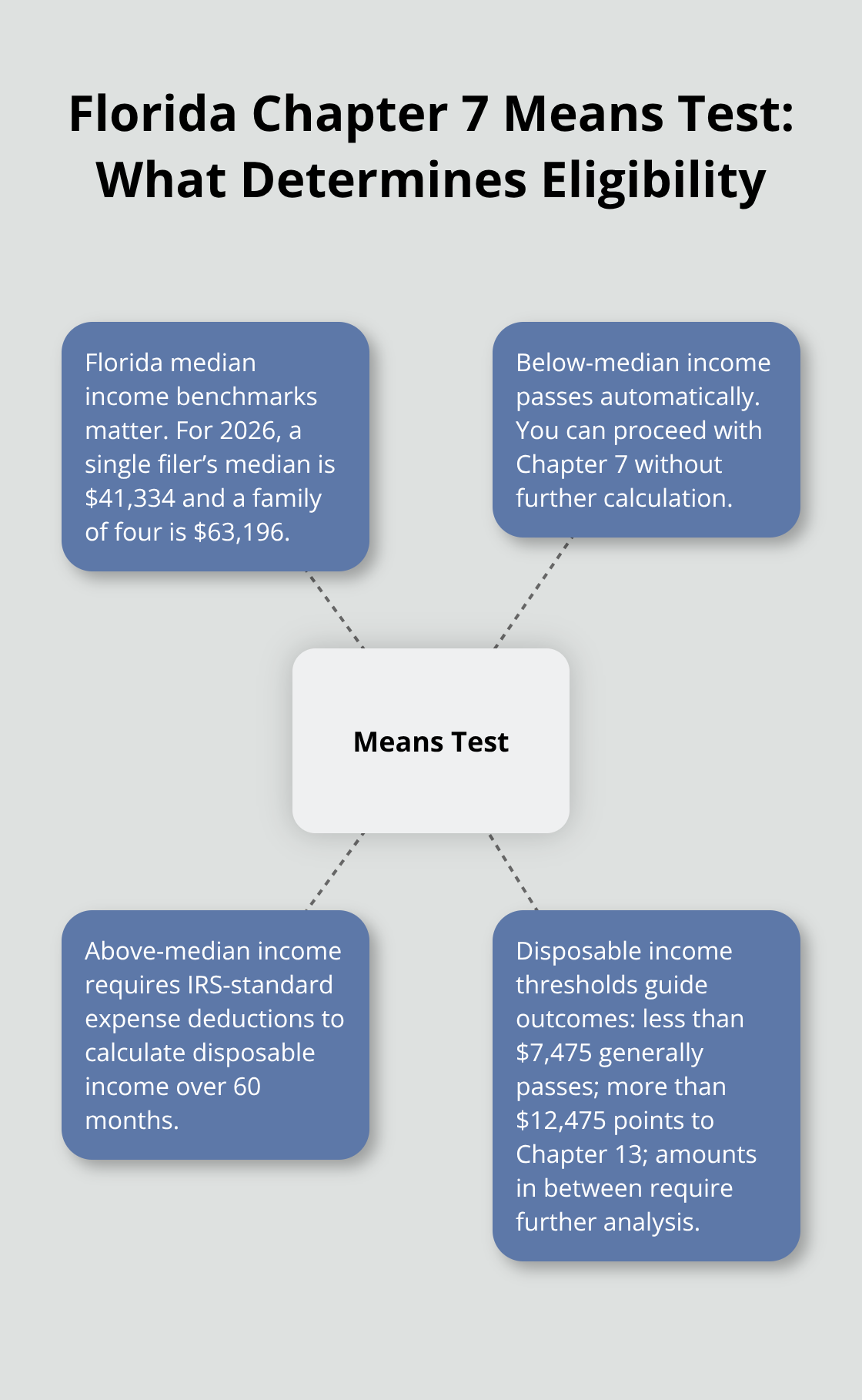
If your income exceeds Florida’s median, you must complete the full means test calculation by deducting allowed expenses from your income to find your disposable income. The court uses national, Florida, and local expense standards set by the Internal Revenue Service-these cover housing, utilities, food, transportation, insurance, and other necessities. You calculate what you could reasonably pay toward unsecured debts over 60 months; if that amount is less than $7,475, you pass and can file Chapter 7, while amounts exceeding $12,475 mean Chapter 7 isn’t available and you’d need Chapter 13 instead. Values between those thresholds require additional calculations that determine your actual disposable income. Gathering your pay stubs and expense documentation now makes this calculation straightforward when you file your petition.
Step 4: File Your Petition and Receive Case Protection
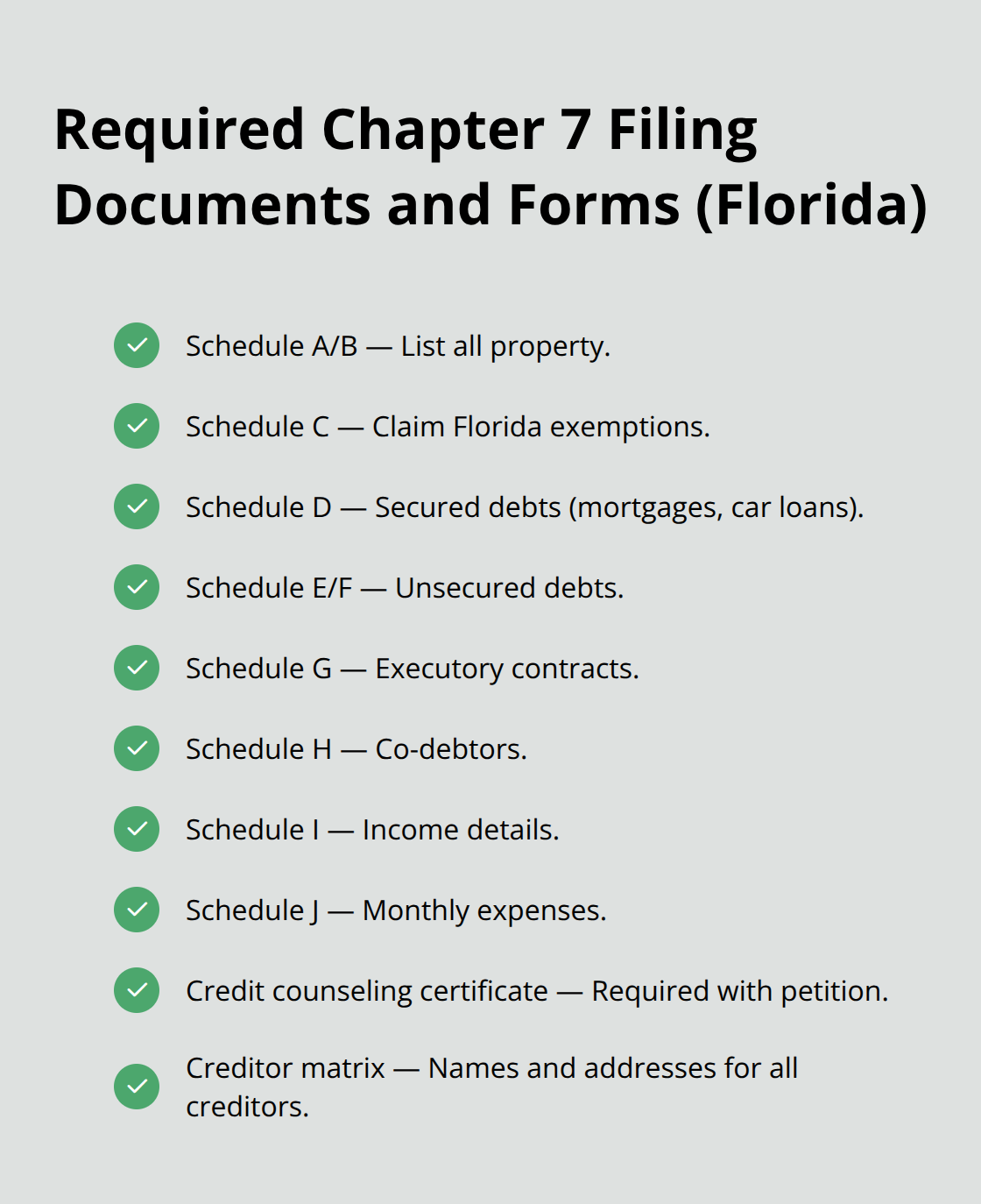
File your petition at your local Florida bankruptcy court by submitting the Voluntary Petition form along with all required schedules and statements in one complete package. The court requires Schedule A/B for your property, Schedule C for exemptions under Florida law, Schedule D for secured debts like mortgages and car loans, Schedule E/F for unsecured debts, Schedule G for executory contracts, Schedule H for co-debtors, Schedule I for your income, and Schedule J for your monthly expenses. You’ll also need the Statement of Your Current Monthly Income, the Means Test Calculation if your income exceeded Florida’s median, your credit counseling certificate, and a creditor matrix listing every creditor’s name and address. The filing fee is $338 as of 2026, though you can request a waiver using Official Form 103B if your income falls below federal poverty guidelines, or pay in installments using Official Form B103A if you qualify.
The court accepts only cashier’s checks or money orders for the filing fee-never cash or personal checks-and if you mail your documents, include a copy of your photo identification.
The moment the court receives your complete petition, the automatic stay takes effect immediately, halting collection calls, wage garnishments, lawsuits, and foreclosure proceedings against you. The court assigns your case a case number that encodes your filing location, year, case type, and assigned judge (this number appears on all future court documents and notices). Creditors receive notice that they cannot pursue collection actions outside the bankruptcy process, and this automatic stay protection applies to nearly all creditors, though some exceptions exist for certain tax debts and family support obligations. Your case now exists in the court system, and the next phase-the 341 meeting of creditors-typically occurs 20 to 40 days after your filing date, where you’ll answer questions from the bankruptcy trustee under oath.
Step 5: Meet the Bankruptcy Trustee
The 341 meeting of creditors occurs 20 to 40 days after you file your petition, and the court will mail you the exact date and location well in advance. This meeting takes place in person at your local Florida bankruptcy court, though many 341 hearings now happen via Zoom video conference depending on your district, so confirm whether you appear remotely or in the courthouse. You must bring an original government-issued photo ID and your Social Security card to verify your identity, as the trustee cannot proceed without these documents. Arrive at least 15 minutes early if attending in person, and test your internet connection 30 minutes before if joining by Zoom. The trustee will place you under oath and ask questions about your petition, your assets, your debts, and your financial situation-these questions are straightforward and designed to verify the information you submitted rather than trap you.
Most creditors do not attend 341 meetings in Florida Chapter 7 cases, so you will primarily interact with the bankruptcy trustee and possibly the court’s staff. The trustee asks standard questions like whether you have reviewed your petition for accuracy, whether you own any property not listed, whether you have had any income changes since filing, and whether you understand the implications of your discharge. Answer honestly and directly without volunteering extra information-if the trustee asks yes or no questions, a yes or no answer suffices. The meeting typically lasts five to ten minutes unless complications arise, and you will receive notice of your discharge status in the mail weeks later. If creditors do appear, they generally ask about your ability to repay debts or challenge your exemptions, but this remains rare in straightforward Chapter 7 cases.
After the 341 meeting concludes, you move into the final educational requirement before the court grants your discharge: completing the mandatory financial management course that the bankruptcy code requires all Chapter 7 filers to finish.
Step 6: Complete Your Financial Management Course
The Personal Financial Management Course stands between you and your discharge order, and you must complete it after filing but before the court grants your discharge. The U.S. Trustee’s office provides an official list of approved debtor education providers for Florida, and you should select only from this list to ensure your certificate counts toward your discharge requirement. Most approved providers in Florida charge between $50 and $150 for the course, though some offer free or reduced-cost options for low-income filers. The course itself typically lasts two to four hours and covers budgeting strategies, credit rebuilding tactics, and how to avoid future financial crises. You have until 60 days after your 341 meeting to complete the course and file the completion certificate with the court.
Once you finish the course, the administering agency issues your certificate of completion immediately, and this document becomes your final required filing before discharge. Submit the certificate to the court within the 60-day window by mailing it to your local bankruptcy court with your case number clearly marked on the envelope, or ask your provider if they file certificates electronically on behalf of their graduates. Failing to submit this certificate delays your discharge indefinitely, so treat this deadline as seriously as your petition filing date. The court reviews your file after receiving the certificate, conducts a final check for any outstanding issues, and then mails your discharge order within weeks. Your discharge eliminates most unsecured debts and completes your Chapter 7 bankruptcy process in Florida, clearing the path to your final step: receiving the discharge order that officially closes your case.
Step 7: Your Discharge Order Arrives
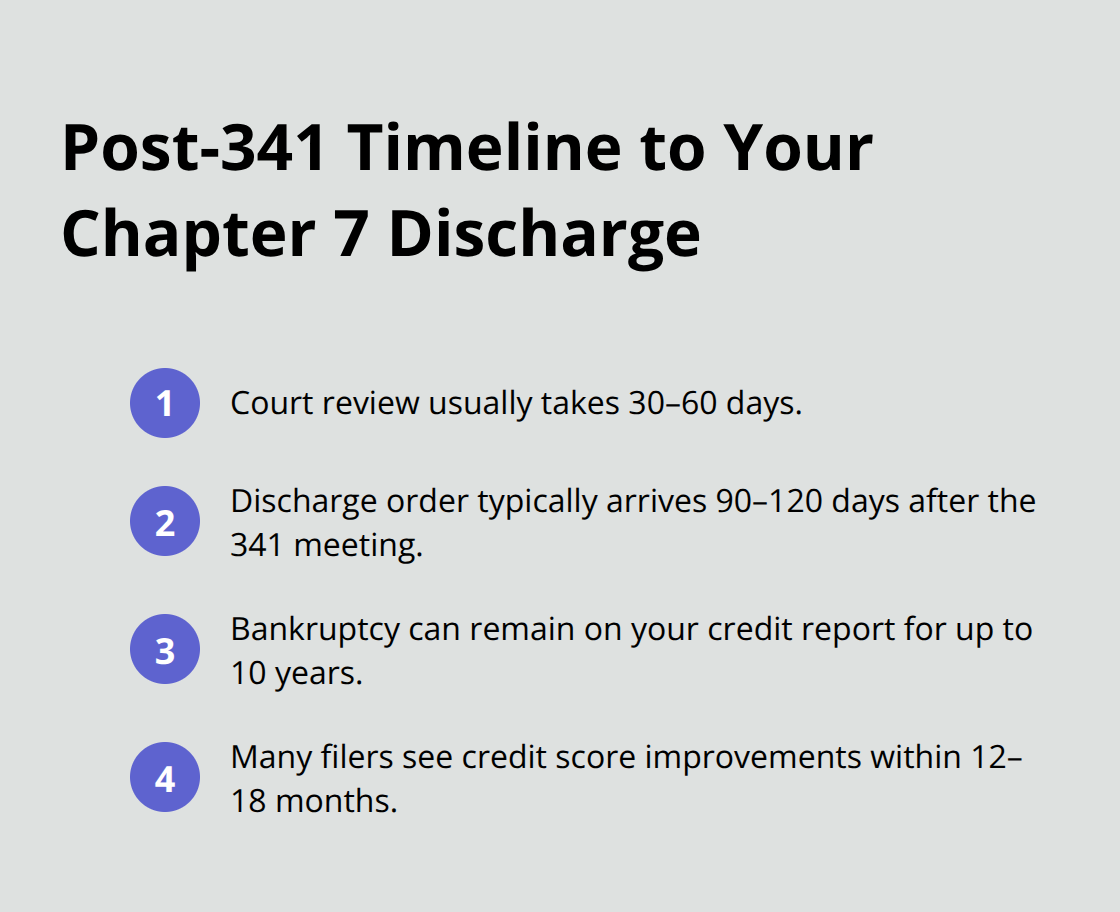
After you submit your financial management course certificate within 60 days of the 341 meeting, the court conducts a final review of your entire case file to check for any outstanding issues or objections from the trustee or creditors. This review period typically takes 30 to 60 days, which means your discharge order usually arrives 90 to 120 days after your 341 meeting, though some cases move faster if no complications exist. The court mails your discharge order directly to you and simultaneously notifies all creditors listed in your petition that their collection rights have been terminated for discharged debts.
Your discharge order identifies which debts were eliminated-typically all unsecured debts like credit cards, medical bills, personal loans, and payday loans disappear completely, while secured debts like mortgages and car loans remain if you wish to keep the collateral. Non-dischargeable debts including recent income taxes, child support, alimony, and government student loans continue as your legal obligation, so review your discharge order carefully to understand exactly which debts survived the bankruptcy process.
Once your discharge order arrives, creditors cannot legally pursue collection activities against you for discharged debts, and they must stop calling, sending bills, or filing lawsuits. The Fair Credit Reporting Act allows the bankruptcy filing to remain on your credit report for up to ten years, but your individual debts that were discharged should be reported as having a zero balance, which gradually improves your credit score over time. Many Florida filers see their credit scores increase within 12 to 18 months after discharge because the bankruptcy removes the burden of past debts and demonstrates you’re no longer overleveraged. Start rebuilding immediately by obtaining a secured credit card with a small deposit, making on-time payments, and monitoring your credit reports from Equifax, Experian, and TransUnion for any errors or fraudulent activity. With your discharge order in hand, you now face important decisions about protecting your fresh start and avoiding common financial mistakes that could undermine your recovery.
Final Thoughts
Your Chapter 7 discharge marks the beginning of your financial recovery, not the end of your responsibilities. The entire Chapter 7 steps Florida process typically spans four to six months from initial filing to discharge, and this clear timeline helps you set realistic expectations as you move forward. You’ve navigated credit counseling, the means test, court filings, the 341 meeting, financial management education, and your discharge order.
Protecting your fresh start requires deliberate action in the months following your discharge. Creditors will test your resolve with new credit offers, and you must resist the temptation to accumulate debt through the same patterns that led to bankruptcy. Monitor your credit reports from Equifax, Experian, and TransUnion for errors or fraudulent accounts, and dispute any inaccuracies immediately with the credit bureaus.
Rebuild your credit intentionally by obtaining a secured credit card with a modest deposit, making small purchases, and paying the balance in full each month (this demonstrates to future lenders that you manage credit responsibly after bankruptcy). Avoid co-signing loans for others, refinancing debts unnecessarily, or taking on new obligations before stabilizing your income and expenses. Contact Harnage Law, PLLC to discuss your specific situation and learn how we can assist with your recovery.