Chapter 7 bankruptcy offers a fresh financial start for many Florida residents, but the process involves specific steps and requirements you need to understand.
We at Harnage Law, PLLC have created this Florida Chapter 7 guidance to walk you through each stage, from eligibility checks to receiving your discharge. This guide covers the practical actions you’ll take and what to expect at every turn.
Step 1: Determine Your Eligibility for Chapter 7 in Florida
Your first step is checking whether your income falls below Florida’s median threshold for your household size. The U.S. Census Bureau and Internal Revenue Service establish these thresholds annually, and for 2026, a single filer must earn below $41,334 annually, while a household of four must stay under $63,196. Calculate your average monthly income over the last six calendar months, then multiply by twelve to get your annualized figure. If you fall below the median, you pass the initial eligibility screen without completing a detailed means test. If your income exceeds the median, you’ll need to complete the full means test calculation, which subtracts allowed living expenses from your income to determine whether you have disposable income available to repay creditors.
Gather your last two years of federal tax returns, your most recent pay stubs covering the last 60 days, and bank statements showing your actual deposits. The court and trustee will verify these documents against what you report on your bankruptcy petition. Common disqualifications include filing Chapter 7 within the required waiting period after a previous bankruptcy discharge (eight years for prior Chapter 7 cases), owing primarily non-consumer debts, or having income high enough that the means test calculation shows you can afford a Chapter 13 repayment plan instead. Disabled veterans who incurred debt during active duty or homeland defense activity are exempt from the means test entirely. Once you confirm your eligibility, your next obligation is completing the mandatory credit counseling requirement before you file your petition.
Step 2: Complete Mandatory Credit Counseling
Credit counseling is a non-negotiable requirement before you file your Chapter 7 petition in Florida. The U.S. Trustee maintains an official list of approved credit counseling agencies on their website, and you must use one of these providers to satisfy the pre-filing requirement. The counseling must occur within 180 days before you file, though emergency exceptions exist if you face imminent foreclosure or wage garnishment. Most agencies offer sessions online or by phone, making it convenient to complete without traveling. The session typically lasts 60 to 90 minutes and covers budgeting basics, debt management alternatives, and whether Chapter 7 is truly your best option.
During your counseling session, the agency will review your income, expenses, and debts to assess your financial situation. They will discuss whether you could manage your debts through a debt management plan or whether bankruptcy is necessary. Upon completion, the agency issues a certificate of completion that you must file with your bankruptcy petition. The certificate serves as proof that you met this mandatory requirement, and without it, the court will not process your case. File the original certificate along with your petition documents, or if you received it electronically, print it and include the hard copy in your filing package. With your credit counseling certificate in hand, you can now move forward to gather the financial documents the court requires for your petition.
Step 3: Organize Your Financial Records
Collect your last two years of federal tax returns immediately, as the court and trustee will cross-reference these against your petition. Gather all pay stubs from the last 60 days to verify your current income, plus bank statements covering the same period to show deposits and spending patterns. The trustee uses these documents to confirm the income figures you report on your means test calculation. You’ll also need statements from every creditor you owe money to, including credit cards, medical bills, personal loans, and any secured debts like mortgages or car loans. Without complete creditor information, the court will reject your petition and you’ll face filing delays.
Create a detailed list of everything you own with estimated values, from real estate and vehicles to furniture and electronics. Document all monthly expenses including rent or mortgage, utilities, groceries, insurance, childcare, and transportation costs. The court requires you to report these expenses on Schedules I and J of your bankruptcy petition, and the trustee will compare your reported spending against national and Florida-specific expense standards from the IRS and Census Bureau. Inaccurate or incomplete expense reporting can trigger trustee questions during your 341 meeting or even result in case dismissal.
Maintain originals of everything you file and keep copies for your records throughout the bankruptcy process. This documentation becomes critical when you sit down with the trustee at your 341 meeting, where you’ll answer questions about your finances and the information you’ve reported.
Step 4: File Your Petition
Complete Official Bankruptcy Forms 106A/B through 106Sum/Ex to list your assets, liabilities, income, and expenses in the precise format the Southern District of Florida requires. The Clerk’s office rejects incomplete or incorrectly formatted petitions, so accuracy matters more than speed. Include your Creditor Matrix with the exact name and address of every creditor you listed on your schedules, formatted exactly as the court specifies-missing or misformatted creditor information delays your case and may require you to refile.
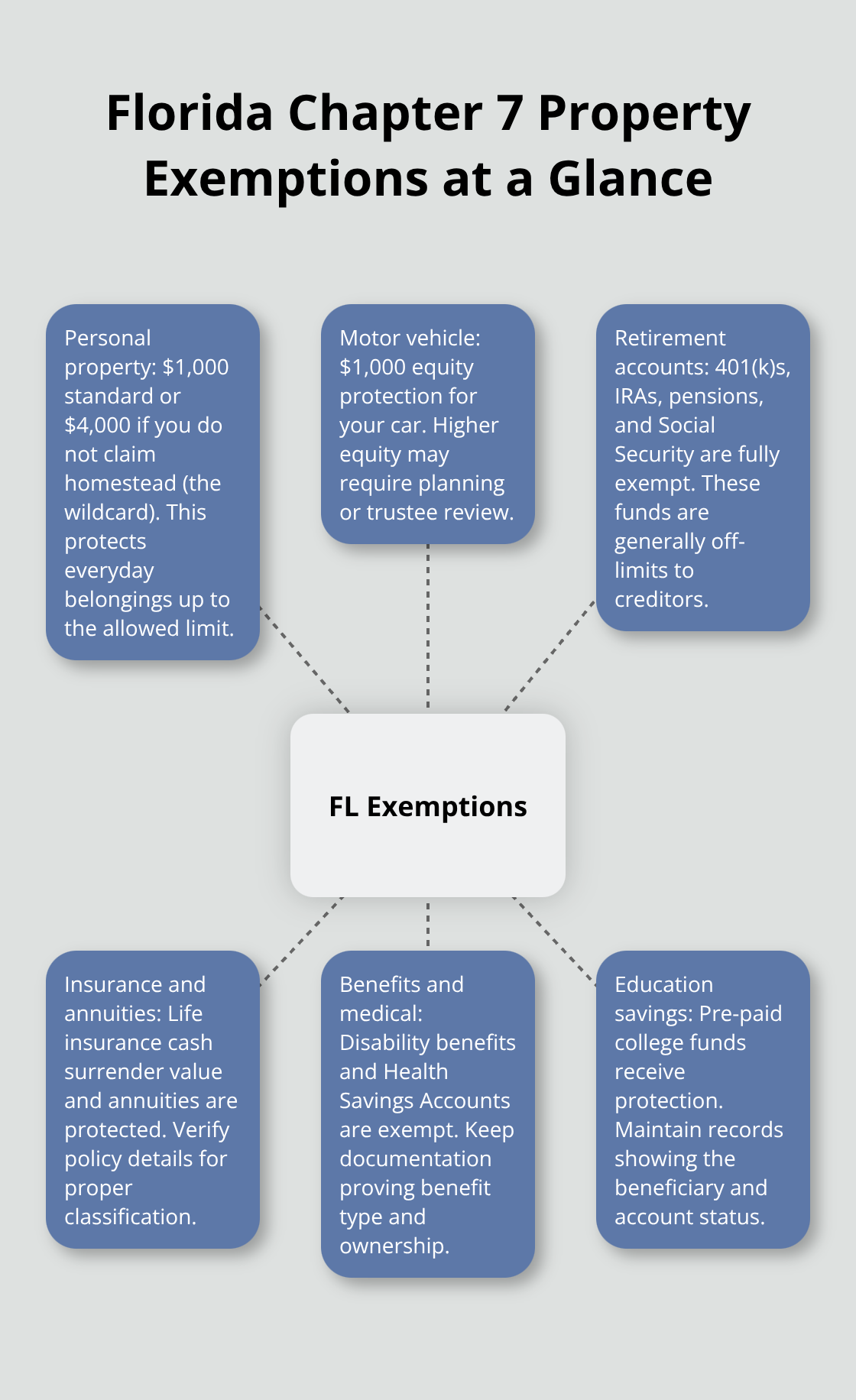
The filing fee totals $338, payable by cashier’s check or money order to Clerk, U.S. Court with your case number included once assigned. You can request installment payments or a fee waiver using Official Bankruptcy Form 103B if your household income falls below the federal poverty guidelines. Florida law requires you to claim exemptions that protect your property from the trustee’s liquidation, and Florida residents use the state exemption list rather than federal exemptions because Florida opted out of the federal exemption scheme. You must have lived in Florida continuously for at least 24 months before filing to claim state exemptions.
The basic personal property exemption covers $1,000 of your belongings but increases to $4,000 if you don’t claim any land as homestead. You also receive a $1,000 motor vehicle exemption, and retirement accounts including 401(k) plans, IRAs, Social Security benefits, and pension payments remain fully exempt. Life insurance cash surrender value, annuities, disability benefits, health savings accounts, and pre-paid college funds are protected from creditors.
File your original petition with wet signatures where required and keep copies of everything you submit for your records and the trustee’s review. With your petition filed and fees paid, you’ll receive notice of your 341 meeting date from the court.
Step 5: Your 341 Meeting
The 341 meeting occurs roughly 21 to 40 days after you file your petition, and the trustee assigned to your case meets with you under oath to verify the information in your bankruptcy documents. Bring your government-issued photo ID, Social Security card, and proof of current income such as recent pay stubs. The trustee will ask straightforward questions about your assets, debts, income sources, and whether you transferred property or incurred unusual expenses in the months before filing. If you filed jointly with your spouse, both of you must attend and answer questions. Most meetings last 5 to 15 minutes, though complex cases with significant assets may run longer.
The trustee’s primary concern is whether nonexempt assets exist that the trustee should liquidate to pay creditors and whether your petition accurately reflects your financial situation. Prepare to explain any large deposits or withdrawals from your bank accounts, any property transfers you made in the past two years, and the current status of your mortgage or vehicle loans. Creditors rarely attend these meetings, but they have the right to appear and ask questions if they believe you hid assets or if they object to your discharge. Answer the trustee’s questions honestly and directly, and avoid volunteering information beyond what the trustee asks.
Once you complete your 341 meeting successfully, you move forward to the final educational requirement before receiving your discharge.
Step 6: Complete Your Financial Management Course
The financial management course you take after filing differs significantly from your pre-filing credit counseling session. Your pre-filing counseling covered budgeting alternatives and whether bankruptcy made sense for your situation, but your post-filing course focuses entirely on rebuilding financial habits after discharge. The U.S. Trustee requires you to complete an approved financial management course within 60 days after your first 341 meeting date to receive your discharge order. This deadline is firm-missing it delays your discharge and leaves you vulnerable to creditor collection actions even after your case concludes. The course typically takes two to three hours and covers credit rebuilding, avoiding future debt problems, and managing money responsibly going forward.
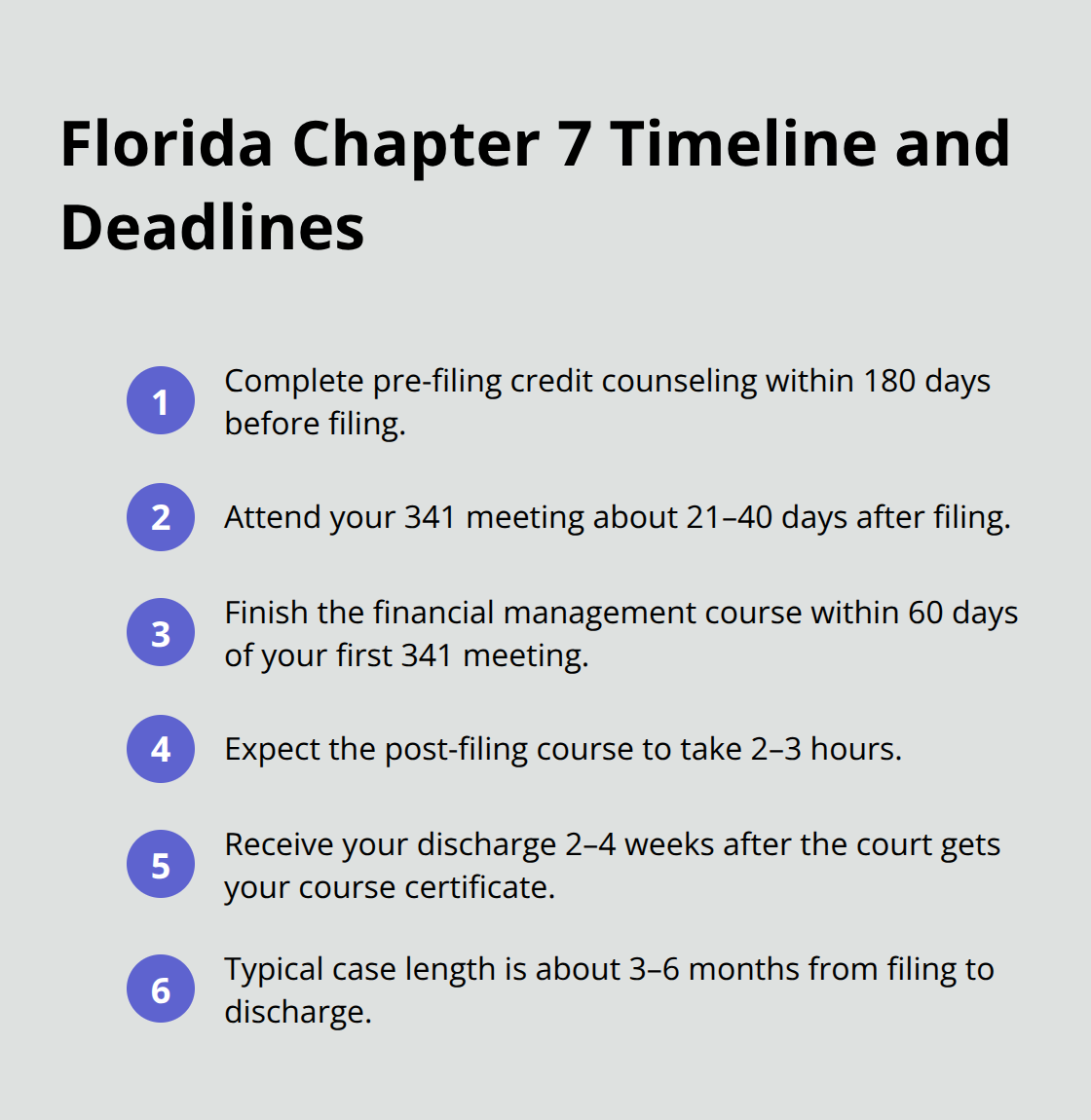
Search the U.S. Trustee’s website for approved providers in Florida, as only courses from listed agencies satisfy the court requirement. Most providers offer online sessions that fit your schedule, with some offering same-day completion options if you need to finish quickly before your 60-day deadline expires. Costs range from $50 to $150 depending on the provider, though some agencies offer discounts for low-income filers. Once you complete the course, the provider files your certificate directly with the court, so you don’t need to submit it yourself. File your certificate before day 60 after your 341 meeting, and the court will issue your discharge order (typically within two to four weeks after receiving proof of completion), which brings you to the final stage of your bankruptcy journey.
Step 7: Receive Your Discharge and Rebuild
Your discharge order arrives two to four weeks after the court receives your financial management course certificate, typically three to six months after you file your petition. This order eliminates your personal liability for most debts, meaning creditors can no longer pursue collection actions against you for those discharged obligations. However, certain debts survive bankruptcy and remain your responsibility, including child support and alimony payments, most federal and state income taxes, most student loans, and debts for willful or malicious injury. Secured debts like mortgages and car loans also survive if you reaffirmed those agreements with the creditor during your bankruptcy case. Review your discharge papers carefully to confirm which debts were eliminated and which require continued payment.
Start rebuilding your credit immediately after discharge by obtaining a secured credit card, which typically requires a cash deposit of $300 to $2,500 that serves as your credit limit. Secured cards help you establish positive payment history when used responsibly, and most cardholders graduate to unsecured cards within 12 to 24 months of on-time payments. Check your credit report from all three bureaus (Equifax, Experian, and TransUnion) to verify that discharged debts now show zero balance and are marked as discharged in bankruptcy rather than charged off or unpaid. Your credit score will initially drop, but borrowers who manage credit responsibly post-discharge typically reach scores of 620 or higher within two years.
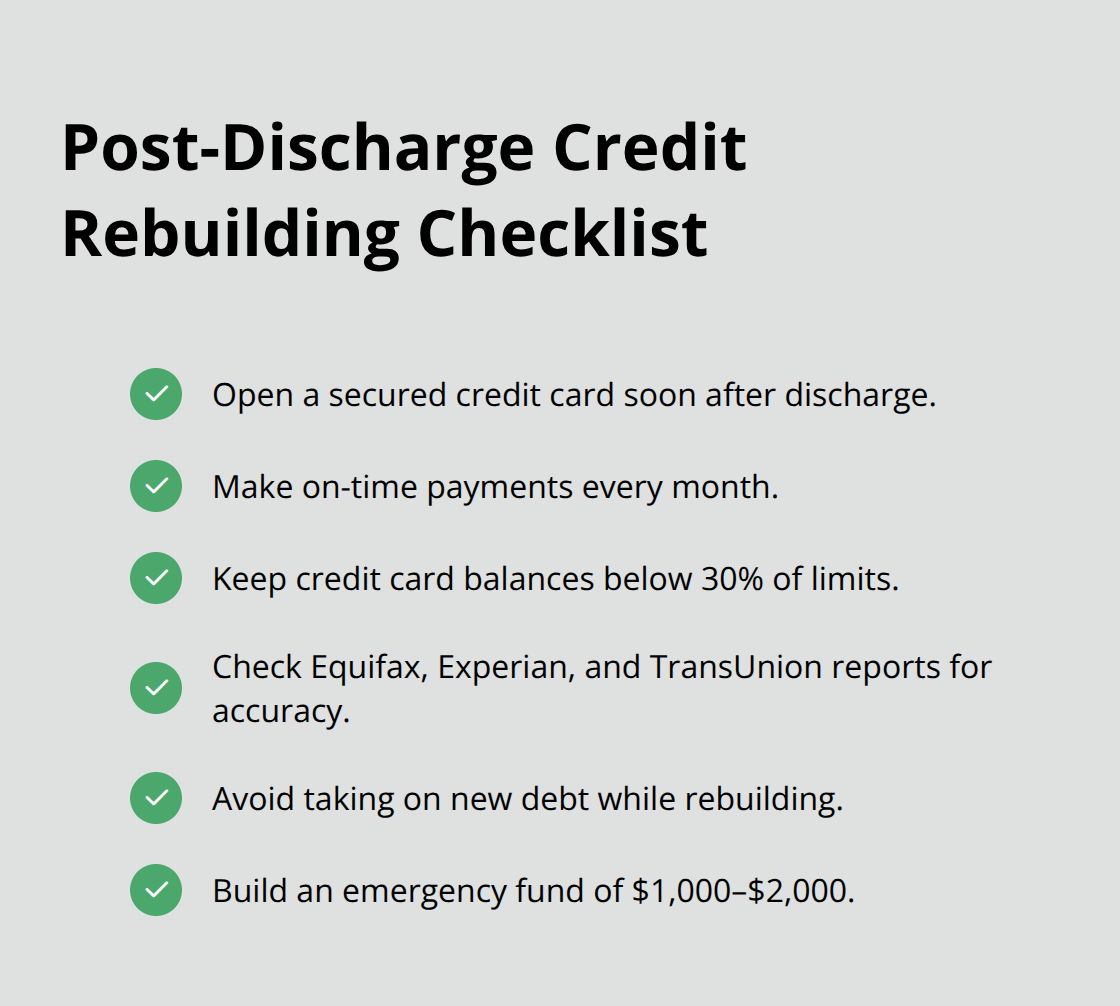
Try paying all bills on time, keeping credit card balances below 30 percent of your limits, and avoiding new debt during this critical rebuilding phase.
Final Thoughts
Your Chapter 7 discharge marks a turning point in your financial life. The fresh start you’ve earned through this Florida Chapter 7 guidance process gives you the opportunity to rebuild, and your actions over the next few years will determine whether you stay on solid ground or repeat past patterns. Bankruptcy appears on your credit report for ten years, but its impact on your borrowing ability fades much faster when you demonstrate responsible financial behavior immediately after discharge.
The first year post-discharge matters most for your credit recovery. A secured credit card with on-time payments for six to twelve months can raise your score by 50 to 100 points, and lenders view recent bankruptcy less harshly when they see consistent positive payment history afterward. Florida residents often face unique financial pressures from housing costs, seasonal employment fluctuations, and hurricane-related expenses, so you should build an emergency fund of at least $1,000 to $2,000 before taking on new debt. Track your spending monthly against your budget, and adjust when circumstances change.
If creditors attempt collection actions on debts that should have been discharged, if you face new legal threats, or if your circumstances change dramatically, contact us for guidance to protect your fresh start. We at Harnage Law, PLLC help Florida residents stop creditor harassment, prevent wage garnishments, and halt lawsuits that threaten the stability you’ve worked to rebuild. Reach out through our website to discuss whether you need continued support as you move forward with your financial recovery.