Filing Chapter 7 bankruptcy in Florida involves specific steps and requirements that can feel overwhelming without proper guidance. We at Harnage Law, PLLC have helped many Floridians navigate this process successfully.
This guide walks you through each stage, from qualifying for Chapter 7 to receiving your debt discharge. You’ll learn what documents you need, which forms to complete, and what to expect at every turn.
Step 1: Check Your Florida Income Against the Means Test
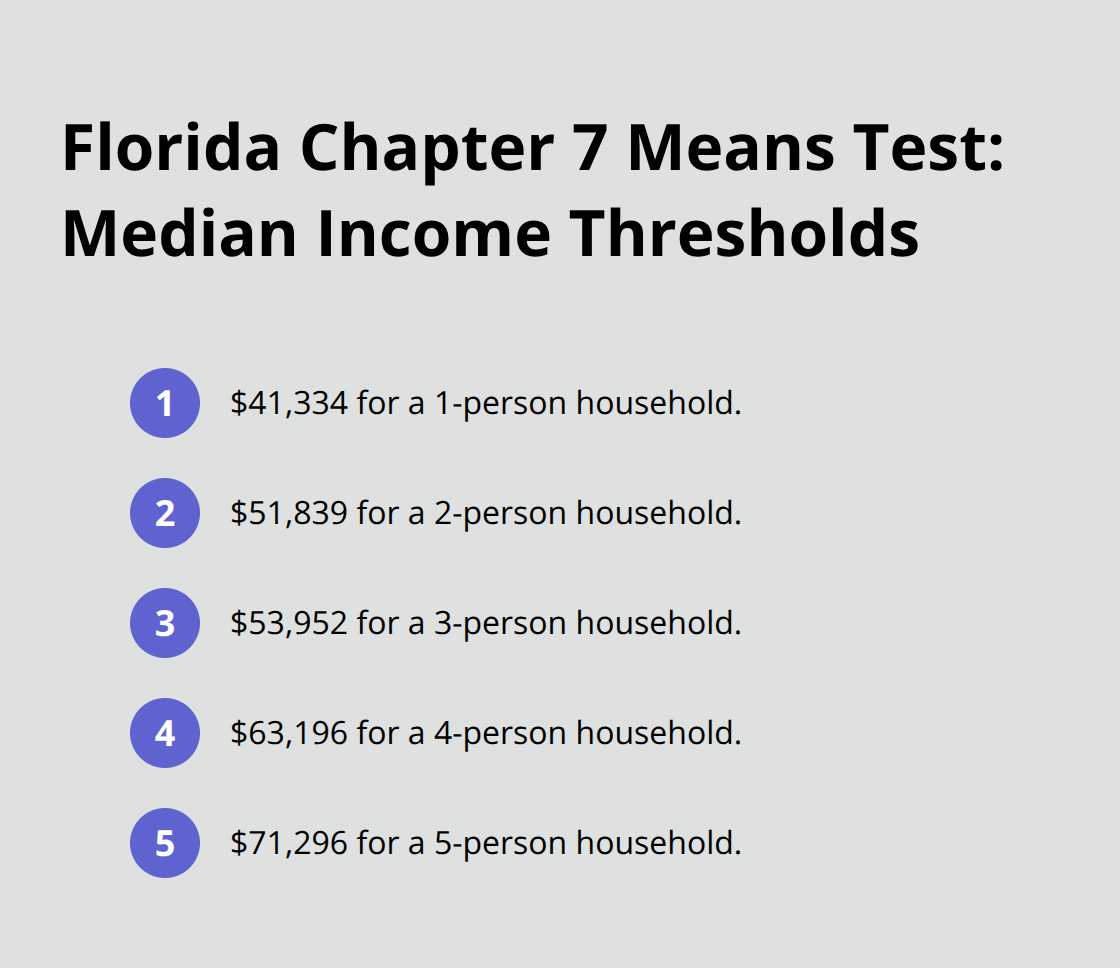
The means test acts as the gatekeeper for Chapter 7 bankruptcy in Florida, and it relies on straightforward math. You calculate your average monthly income over the last six months, then multiply by 12 to compare against Florida’s median income for your household size. Florida’s median income thresholds are $41,334 annually for a single person, $51,839 for two people, $53,952 for three, $63,196 for four, and $71,296 for five. If your annualized income falls below your household size’s threshold, you pass the means test immediately and can file Chapter 7 without further calculation.
This direct path forward eliminates complex expense analysis and accelerates your filing timeline.
If your income exceeds the median for your household size, you must complete the formal means test calculation using Form B122A-2. This form subtracts allowed living expenses-calculated using Census Bureau and IRS data-from your monthly income to determine disposable income. If your 60-month disposable income totals less than $7,475, you pass and can file Chapter 7. If it exceeds $12,475, you fail the means test and must pursue Chapter 13 instead, which involves a three to five-year repayment plan. Income between these thresholds requires additional calculations to determine eligibility.
The means test includes nearly all income sources: wages, rental income, business earnings, pensions, and third-party contributions to household expenses. Timing matters significantly-if your income recently dropped, waiting one or more months could bring you below the median and eliminate the need for the full calculation. Once you confirm your means test status, you move to the next critical requirement: completing mandatory credit counseling before you submit your petition to the court.
Step 2: Complete Mandatory Credit Counseling
Credit counseling is not optional-it’s a federal requirement you must complete within six months before filing your Chapter 7 petition in Florida. The U.S. Trustee maintains a list of approved agencies on their website, and you must use only those agencies to ensure your certificate meets court requirements. Many agencies now offer online counseling sessions that take 60 to 90 minutes, allowing you to complete this step from home without scheduling conflicts.
The counseling session covers budgeting basics, debt management alternatives to bankruptcy, and realistic financial planning for your situation. The counselor will review your income, expenses, and debts to help you understand whether Chapter 7 truly fits your circumstances or if alternatives like debt consolidation might work better. The counselor issues you a certificate of completion immediately after the session ends, either printed or emailed depending on the agency.
This certificate becomes a required attachment to your bankruptcy petition-the court will not accept your filing without it. Some agencies charge fees ranging from $50 to $100, though fee waivers are available if you meet income requirements; ask about this when you contact the agency. Store your certificate in a safe folder with your other bankruptcy documents, as you’ll need to reference it when completing your petition forms. With your certificate in hand, you’re cleared to move forward with gathering the financial documents and information required for your actual Chapter 7 filing.
Step 3: Gather Your Financial Documents
Start collecting documents at least two weeks before you file your Chapter 7 petition. You’ll need your most recent tax return (the IRS requires you to provide a copy to the trustee), your last 60 days of pay stubs to verify current income, and bank statements from the past two months showing all account balances. If you’re self-employed, gather profit and loss statements for the last six months along with quarterly tax filings. Your mortgage statement, car loan documents, and any other secured debt paperwork must be included so the court understands what property you own and what you owe against it.
Create a comprehensive list of every debt you carry, including credit cards, medical bills, personal loans, and outstanding taxes. Pull your credit report from all three bureaus to catch debts you may have forgotten about, as creditors you don’t list still receive notification through the court’s creditor matrix process. For each property asset you own, research its current market value using comparable sales in your area or professional appraisals if the property is valuable; overestimating your home’s equity or underestimating your vehicle’s value can lead to exemption errors that the trustee will challenge at your 341 meeting.
Organize everything into folders by category (income, debts, assets, property) so you can reference documents quickly when completing your bankruptcy schedules. This preparation eliminates delays and prevents the court from requesting missing information that could postpone your filing. With your documents organized and ready, you can now move to the next step: completing the official Chapter 7 bankruptcy petition and schedules that the court requires.
Step 4: Complete Your Bankruptcy Petition and Schedules
The official bankruptcy forms are non-negotiable-the court will reject incomplete or incorrect paperwork, delaying your discharge by weeks or months. You must file the Voluntary Petition for Individuals plus Schedules A through J, listing every asset, debt, income source, and monthly expense in precise detail. Form B122A-1 captures your current monthly income by averaging your last six months of earnings, while Form B122A-2 calculates your disposable income using Census Bureau and IRS expense standards specific to Florida. The Statement of Financial Affairs requires you to disclose any property transfers, lawsuits, or income changes from the past two years. Federal Rule of Bankruptcy Procedure 2017-1 requires you to file a pre-petition statement at the same time as your petition, confirming you understand the bankruptcy process and your rights.
Accuracy prevents the trustee from objecting at your 341 meeting and protects you from fraud allegations that carry penalties up to $250,000 and 20 years in prison. The most common filing mistake is undervaluing assets or omitting debts entirely, which the trustee catches immediately when reviewing your Schedule C exemptions. List your home’s fair market value conservatively using recent comparable sales in your neighborhood, not an inflated estimate-if you claim $400,000 in homestead exemption but your home is worth $350,000, the trustee will challenge your math. Include every creditor on your Creditor Matrix, even accounts you forgot about or believe are time-barred, because the court notifies all listed creditors regardless. Research your vehicle’s actual cash value on NADA Guides or Kelley Blue Book rather than guessing, since overestimating equity reduces your available exemptions.
Missing or incorrect schedules force you to amend your filing, which delays your discharge timeline and increases court costs. Once you submit your completed petition and schedules to the Florida bankruptcy court, the next phase begins immediately.
Step 5: File Your Petition with the Florida Bankruptcy Court
Florida has three federal bankruptcy court districts: the Northern District, the Middle District, and the Southern District. Your filing location depends on where you live-the Middle District covers the Tampa and Orlando areas, the Southern District handles Miami and Fort Lauderdale, and the Northern District serves Jacksonville and surrounding counties. Verify your county’s assignment on the U.S. Trustee website before submitting anything, as filing in the wrong district delays your case and wastes filing fees. The court clerk’s office for your district accepts filings electronically through CM/ECF, the federal court’s electronic filing system, which speeds up processing compared to paper filings.
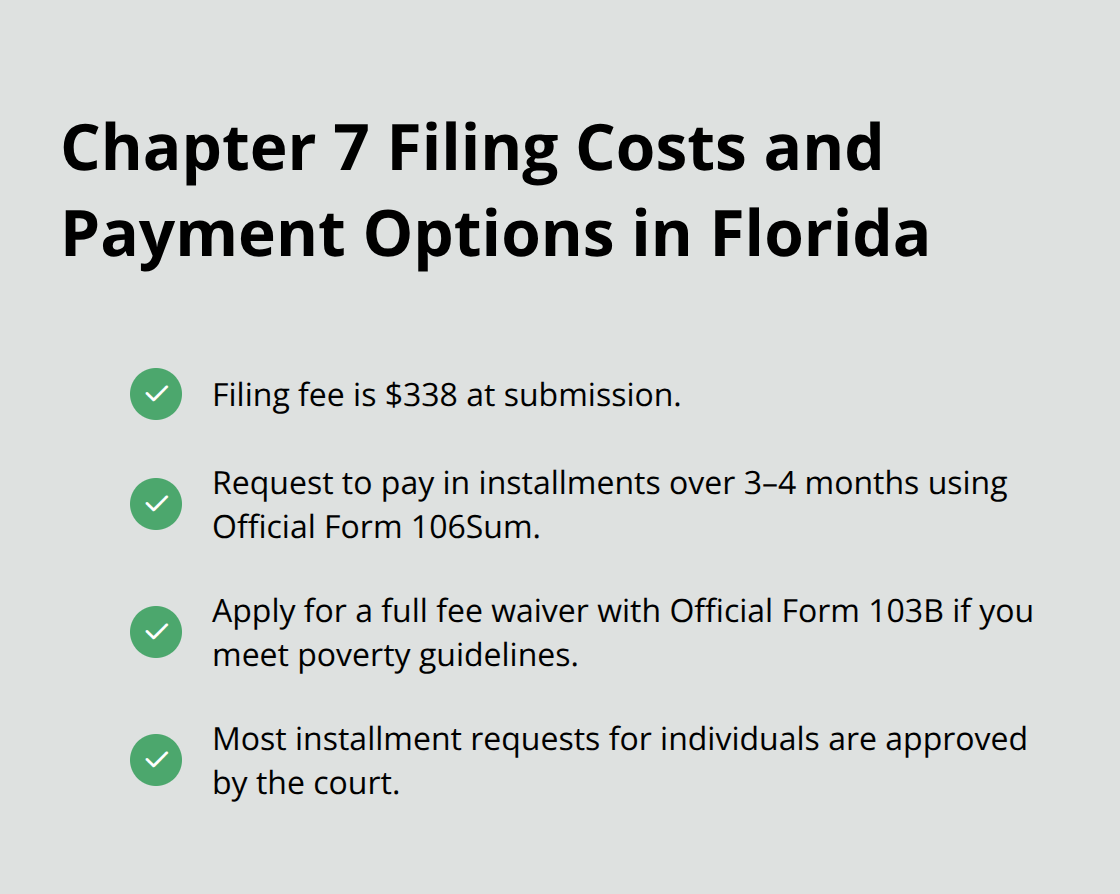
The Chapter 7 filing fee is $338, payable when you submit your petition. If you cannot afford the full amount upfront, you can apply to pay in installments using Official Form 106Sum, spreading payments over three to four months-the court approves most installment requests for individual filers. If your household income falls below the federal poverty guidelines, file Official Form 103B to request a complete fee waiver; the Southern District of Florida grants waivers regularly for qualifying applicants.
After the clerk accepts your petition, you receive a case number immediately, and the U.S. Trustee automatically schedules your 341 meeting of creditors within 21 to 35 days. The court issues a notice of bankruptcy filing to all creditors on your matrix within two business days, which triggers the automatic stay that stops wage garnishments, collection calls, and foreclosure proceedings instantly. This automatic stay protection takes effect the moment the court accepts your filing, giving you immediate relief from creditor pressure as you prepare for your next required step.
Step 6: Your 341 Meeting Explained
The 341 meeting of creditors takes place 21 to 35 days after you file and typically lasts 5 to 10 minutes, though the trustee may extend questioning if your case presents complexities. The trustee will ask you to verify information from your schedules under oath: your current income, whether you own real property or vehicles, and if you transferred any assets within two years before filing. Bring your government-issued photo ID and proof of your Social Security number, as the trustee must verify your identity before proceeding. The trustee may ask why your expenses differ from national standards, whether you plan to reaffirm secured debts, and if you understand the difference between dischargeable and non-dischargeable debts. Most creditors never attend these meetings, though they have the right to question you if they choose.
Prepare for your meeting by reviewing your filed schedules the night before so you can answer questions about asset values, income calculations, and debt amounts without hesitation. Bring copies of documents the trustee might request: your most recent tax return, recent pay stubs, and mortgage or vehicle loan statements if you plan to keep secured property. Dress professionally and arrive 10 minutes early to check in with the trustee’s office, as tardiness reflects poorly on your credibility. Answer questions directly and honestly without volunteering extra information or making excuses for your financial situation. An attorney from Harnage Law, PLLC or another firm attends the meeting with you if you hired representation, handles most questioning, and significantly reduces your stress while protecting your interests throughout the process.
With your 341 meeting completed, you move toward the final requirement before your debt discharge: completing the financial management course that the court mandates.
Step 7: Complete Your Financial Management Course
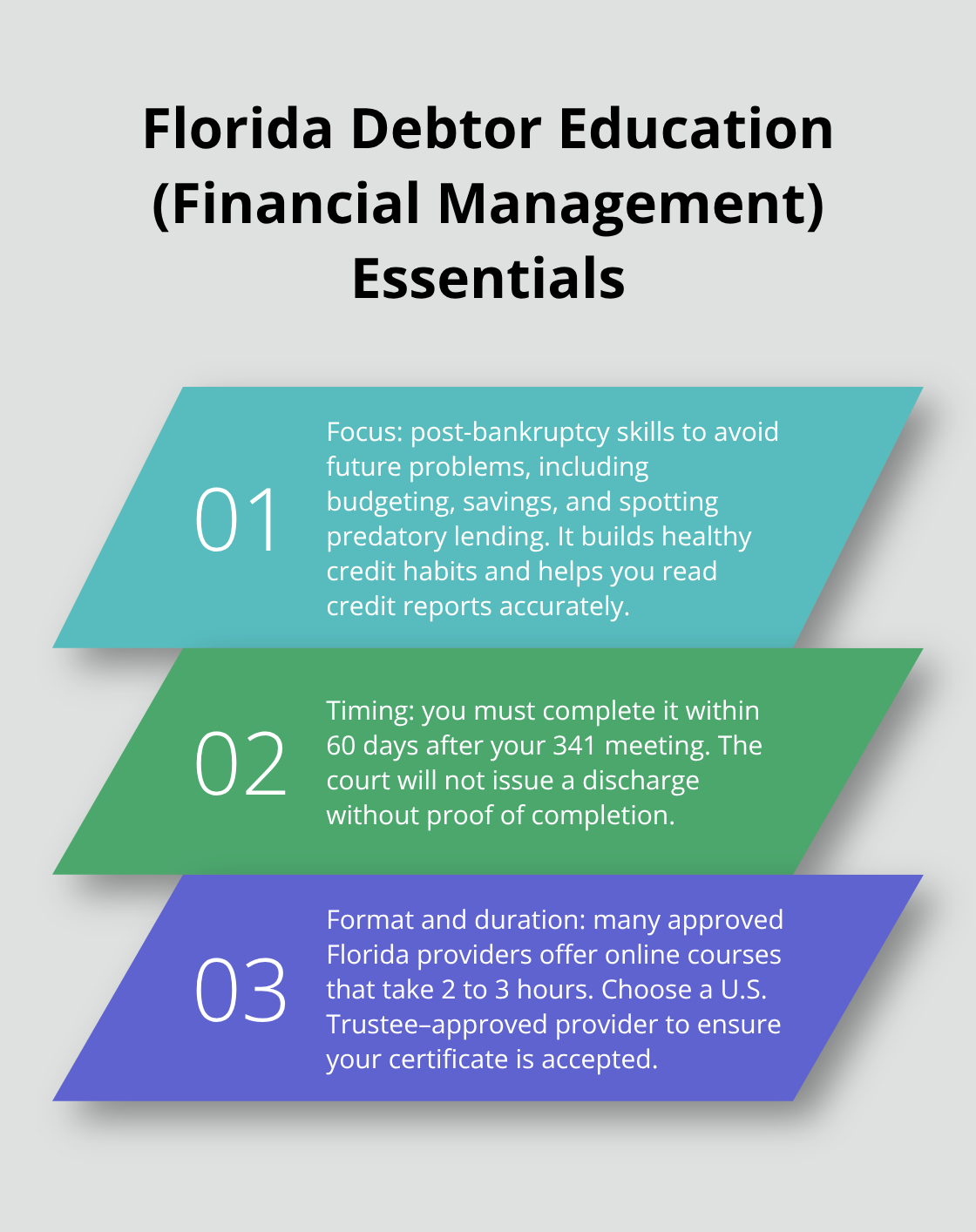
The financial management course differs fundamentally from the credit counseling you completed before filing. Credit counseling focuses on whether bankruptcy suits your situation and explores alternatives, while the financial management course teaches you how to avoid financial problems after your discharge. This post-bankruptcy course covers budgeting strategies, building emergency savings, recognizing predatory lending, and understanding credit reports so you don’t repeat the patterns that led to bankruptcy. The U.S. Trustee requires you to complete this course within 60 days after your 341 meeting, and the court will not issue your discharge without proof of completion. Approved Florida providers include nonprofits like the National Foundation for Credit Counseling and for-profit agencies, many offering online courses that take 2 to 3 hours to finish.
You must file your certificate of completion with the bankruptcy court before your discharge becomes final, as this is a hard deadline the judge enforces. Most providers charge between $50 and $100 for the course, though fee waivers are available if you demonstrate financial hardship. After you complete your course, the provider emails your certificate directly to the court, but confirm this happens by checking your case status on the court’s CM/ECF system within five business days. If the certificate doesn’t appear in your case file, contact the provider immediately to request they resubmit it, as delays here postpone your discharge and extend the period when creditors technically retain collection rights. Once the court receives your certificate, your discharge order issues within days, releasing you from all dischargeable debts and marking the end of your Chapter 7 case.
With your discharge finalized, you transition into the critical phase of rebuilding your financial foundation and protecting the fresh start that Chapter 7 provides.
Conclusion
Your Chapter 7 discharge typically arrives within three to six months of filing, though the exact timeline depends on whether the trustee objects to your exemptions or creditors file complaints. Once the judge signs your discharge order, you are legally released from all dischargeable debts including credit cards, medical bills, personal loans, and most unsecured obligations. Non-dischargeable debts like student loans, recent taxes, child support, and alimony remain your responsibility, but the bulk of your debt burden vanishes immediately upon discharge.
Rebuilding your credit starts the moment your discharge finalizes. Your bankruptcy remains on your credit report for ten years, but its impact weakens significantly after two to three years as newer positive payment history accumulates. Secured credit cards designed for rebuilding require a cash deposit that becomes your credit limit, allowing you to demonstrate responsible borrowing without the risk lenders face with bankruptcy filers.
Protecting your fresh financial start means treating your bankruptcy discharge as a genuine reset rather than permission to repeat old spending patterns. You should build an emergency fund of three to six months of expenses so unexpected costs don’t force you back into debt, and you should review your budget quarterly to catch spending creep before it becomes a problem. Contact Harnage Law, PLLC to discuss your specific situation and ensure your fresh start after filing Chapter Seven Florida remains secure.