
Most people filing Chapter 7 bankruptcy in Florida assume they’ll lose everything. That’s simply not true.
Florida law protects significant assets from creditors, and we at Harnage Law, PLLC help clients understand exactly what they can keep. Your home, retirement accounts, and personal possessions often remain safe during debt elimination through bankruptcy.
What Assets Florida Protects in Chapter 7 Bankruptcy
Your Home Stays Protected Regardless of Value
Your primary residence sits at the top of Florida’s asset protection list, and the homestead exemption is remarkably generous compared to most states. Florida law allows you to exempt your home entirely from creditor claims, regardless of its value, provided it’s your primary residence and you’ve lived there continuously for at least 24 months before filing. This means a $500,000 home or a $2 million property receives the same protection-complete exemption. The only catch is that any mortgage or lien on the property remains, so creditors holding liens can still enforce their claims against the equity.
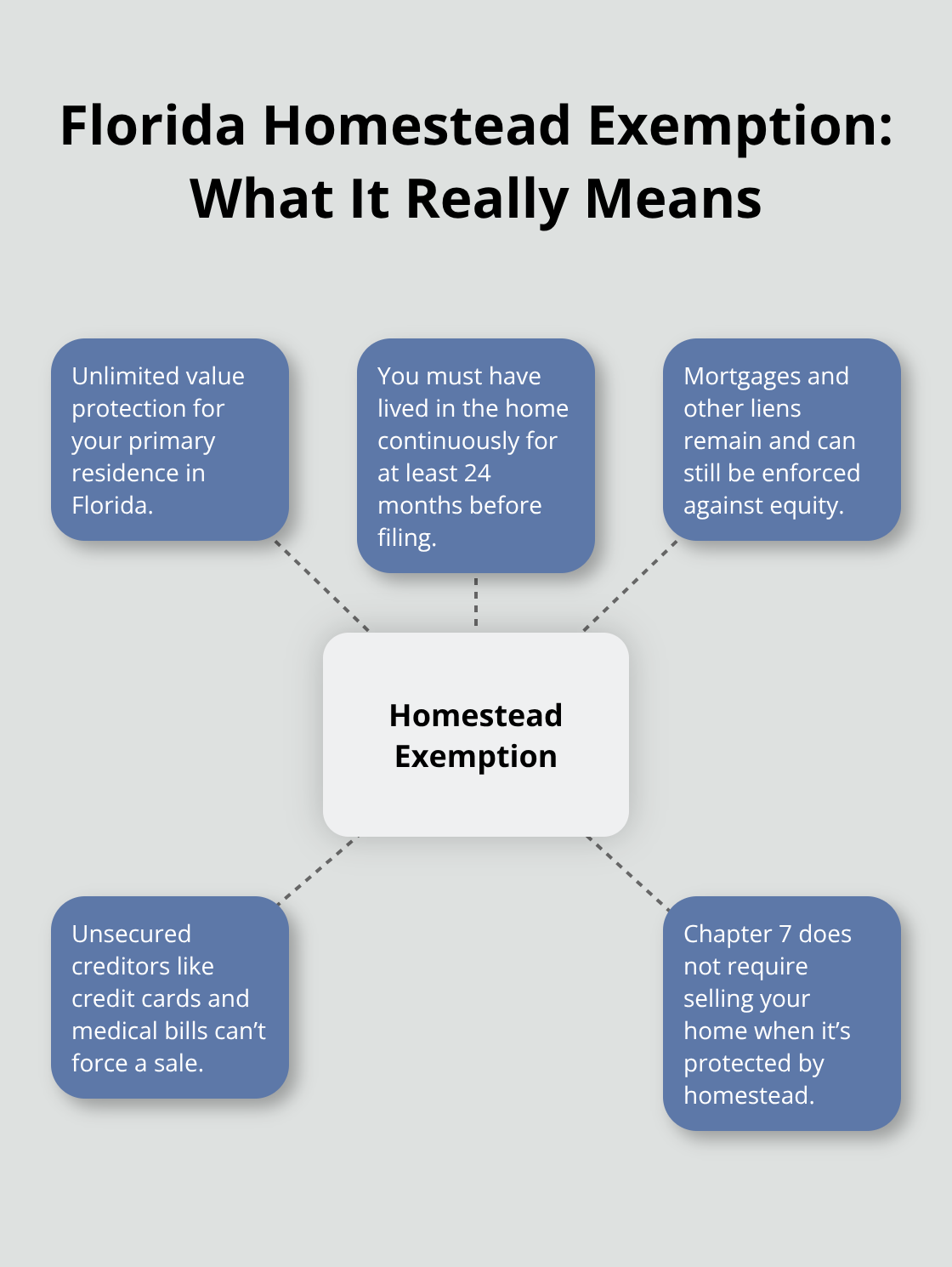
However, Chapter 7 won’t force you to sell your home to pay unsecured creditors like credit card companies or medical debt collectors if your home has significant equity beyond what you owe.
Personal Property and Vehicles Receive Specific Limits
Florida protects up to $1,000 in basic personal property and $4,000 in additional personal property if you don’t claim homestead exemption on land. Motor vehicles receive a $1,000 exemption, which means most used cars stay with you unless they’re worth substantially more than that threshold. Household items, clothing, and everyday possessions fall within these personal property categories, allowing you to maintain the essentials of daily life throughout the bankruptcy process.
Retirement Accounts and Pensions Remain Completely Off-Limits
Retirement accounts and pension plans receive ironclad protection under both Florida state law and federal bankruptcy code. Your 401(k) plans, 403(b) plans, and IRAs are fully exempt, meaning creditors cannot touch these funds even in Chapter 7 liquidation. Traditional pensions, firefighter pensions, and highway patrol pensions all remain protected. Social Security benefits, unemployment benefits, and veteran’s benefits are similarly shielded from creditors. Florida also protects disability benefits, health savings accounts, and pre-paid college funds. Life insurance cash surrender value and annuities also receive exemption protection.
Why These Protections Matter for Your Financial Future
The trustee cannot liquidate retirement accounts to pay creditors because the law explicitly excludes them from the bankruptcy estate. This protection matters significantly because most people filing Chapter 7 in Florida have already depleted liquid savings but maintained retirement contributions over years of employment. Your long-term financial security plan-the money you set aside for retirement-remains intact while unsecured debts disappear through discharge. These protections preserve the foundation you’ve built for your future while eliminating the debts that threaten your present stability.
Understanding which assets Florida protects forms only half the equation. The other half involves knowing how Florida’s exemption system actually works and what role the bankruptcy trustee plays in determining what you keep and what creditors receive.
How Exemptions Actually Work in Florida Chapter 7
Florida Exemptions vs. Federal Exemptions: Making the Right Choice
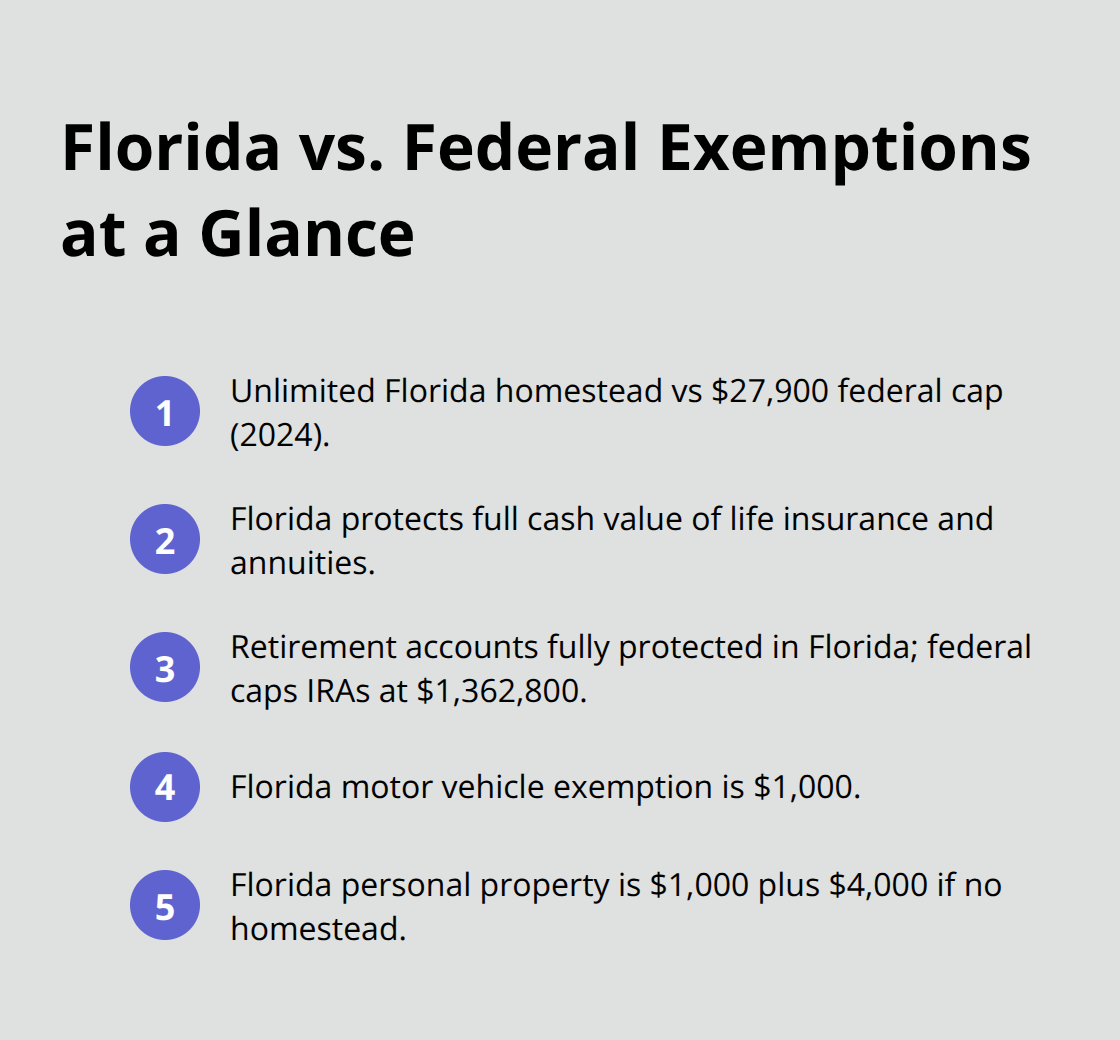
Florida gives you a choice that most debtors don’t realize exists. When you file Chapter 7 in Florida, you can either use Florida’s state exemptions or federal exemptions under 11 U.S.C. § 522(b), but not both. This decision fundamentally shapes what you keep. Florida’s exemptions are significantly stronger than federal alternatives in most situations, which is why nearly every Florida debtor should claim state exemptions. The homestead exemption alone-unlimited protection for your primary residence regardless of value-demolishes the federal homestead cap of $27,900 as of 2024. Florida also protects the full cash value of life insurance policies, annuities, and retirement accounts without dollar limits, whereas federal exemptions cap IRAs at $1,362,800 per person. Your motor vehicle receives $1,000 protection in Florida, and personal property receives $1,000 basic plus $4,000 additional if you skip the homestead exemption.
How the Bankruptcy Trustee Investigates Your Assets
The bankruptcy trustee assigned to your case uses these exemptions to determine what stays with you and what gets liquidated to pay creditors. Section 704 of the bankruptcy code gives the trustee authority to investigate your assets, review your financial disclosures, and question whether exemptions apply correctly. The trustee’s job isn’t to help you-it’s to maximize what creditors receive. This means the trustee will scrutinize large cash withdrawals before filing, examine bank statements for the preceding six months, and cross-reference your asset claims against public records. If you claim a $1,000 motor vehicle exemption but own a $15,000 truck, that $14,000 difference becomes available for liquidation unless you can increase encumbrances through strategic exemption planning.
Strategic Exemption Planning Protects More Value
Exemption planning separates successful Florida Chapter 7 cases from problematic ones. An experienced bankruptcy attorney can apply exemptions strategically to protect more value than a straightforward calculation suggests. For example, if you own a $100,000 house with a $70,000 mortgage, you have $30,000 in equity. Without planning, a trustee might pursue that equity. But if you apply exemptions to increase the effective encumbrance to $92,000, you’re left with only $8,000 in equity-often too small for a trustee to justify the cost of selling the property. This isn’t asset hiding; it’s lawful exemption application under Florida statute.
The 341 Meeting and Trustee Verification
The trustee conducts thorough investigations during the 341 meeting of creditors, where you answer questions under oath about your finances, income sources, and asset locations. Trustees verify information through tax returns, bank records, public property records, and online searches. They can subpoena financial records from brokerage houses, employers, and financial institutions if they suspect undisclosed assets. Most Chapter 7 cases in Florida become no-asset cases, meaning creditors receive nothing because assets are either exempt or don’t exist. This outcome happens when exemptions are properly applied and all assets are fully disclosed.
The Critical Difference Between Planning and Concealment
The distinction between proper exemption planning and asset concealment matters significantly. Proper planning leads to asset retention and discharge, while concealment leads to fraud investigations, case dismissal, and potential criminal charges under Title 18 of the U.S. Code, which carries penalties up to five years in prison and $500,000 in fines. Understanding how exemptions work in Florida forms the foundation for protecting your assets, but knowing what misconceptions exist about asset loss helps you navigate the process with confidence.
What You Actually Keep in Chapter 7 Bankruptcy
Florida debtors file Chapter 7 believing they’ll lose their homes, drain their retirement accounts, and surrender every possession worth owning. This fear stops many people from pursuing bankruptcy, even when it offers their best path forward. The reality contradicts this catastrophic narrative. Most Chapter 7 filers in Florida keep their primary residence, maintain full retirement account balances, and retain essential personal property. The bankruptcy trustee doesn’t seize everything-the law explicitly protects certain assets, and understanding which ones matters enormously for your financial decision-making.
Your Home Remains Protected Under Florida Law
Your primary residence stays protected under Florida’s unlimited homestead exemption, meaning a property worth $300,000 or $1 million receives identical protection as long as it’s your primary residence and you’ve lived there continuously for at least 24 months before filing. The trustee cannot force you to sell your home to pay unsecured creditors like credit card companies or medical debt collectors. Any mortgage or lien on the property remains in place, but Chapter 7 eliminates your personal liability for other debts while you keep the home.
Retirement Accounts and Benefits Remain Completely Off-Limits
Retirement accounts including 401(k) plans, 403(b) plans, and IRAs remain completely off-limits because federal bankruptcy code excludes them from the estate available for liquidation. Social Security benefits, veteran’s benefits, and disability payments also stay protected. Your long-term financial security plan-the money you set aside for retirement-remains intact while unsecured debts disappear through discharge.
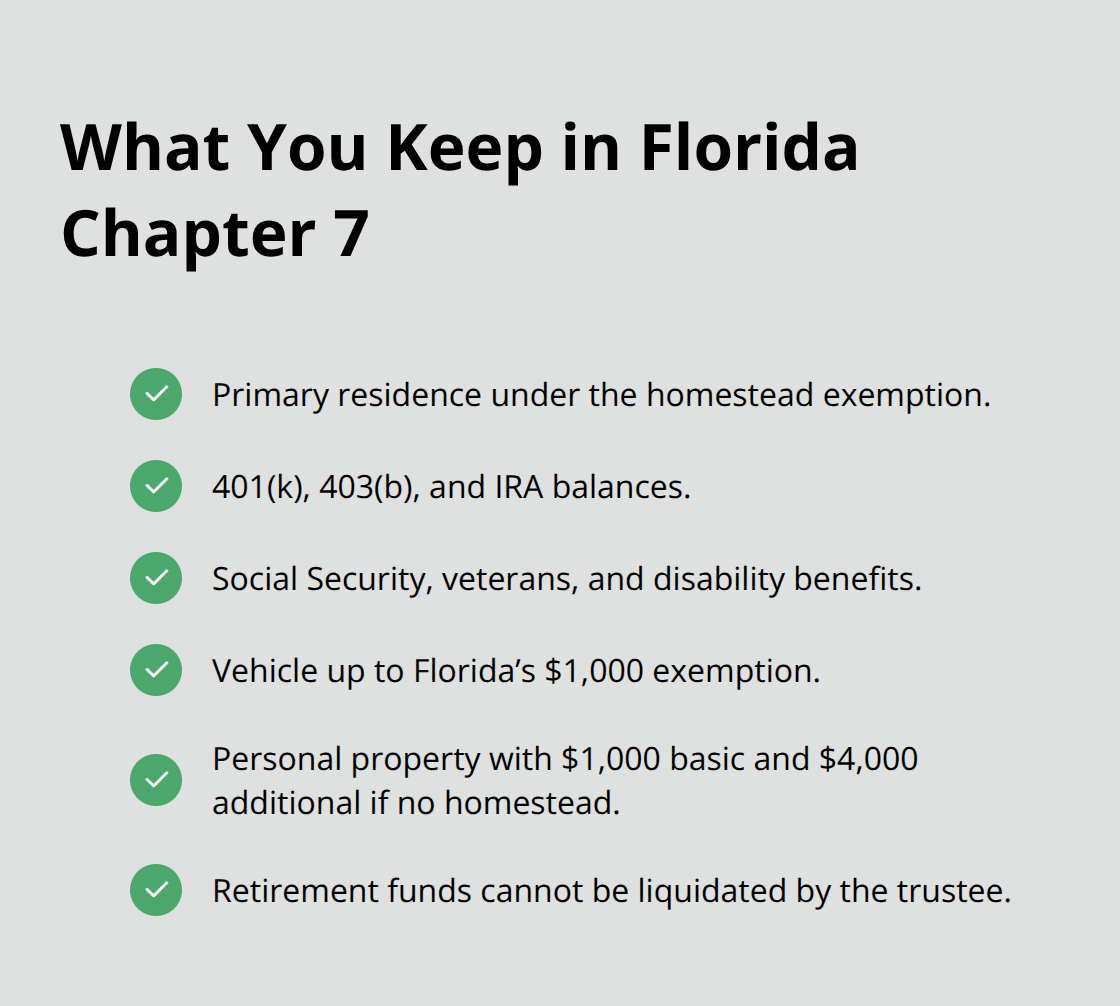
The trustee cannot liquidate these funds to pay creditors under any circumstances.
Personal Property and Vehicles Stay With You
Personal property up to $1,000 basic coverage plus $4,000 additional coverage remains with you, covering household items, clothing, and everyday possessions. Your vehicle receives $1,000 in exemption protection. Most used cars fall within this threshold, allowing you to maintain transportation throughout the bankruptcy process. These protections ensure you keep the essentials of daily life.
How Exemptions Transform the Bankruptcy Estate
The misconception that bankruptcy equals total asset loss stems from confusion about how exemptions operate. When you file Chapter 7, the bankruptcy estate technically includes nearly all your property under 11 U.S.C. section 541, but exemptions immediately remove protected assets from what creditors can claim. This distinction-between what enters the estate and what stays exempt-confuses many debtors who assume filing means losing everything. In reality, most Florida Chapter 7 cases become no-asset cases where creditors receive nothing because assets are fully exempt or nonexistent. The trustee liquidates only nonexempt assets, which in properly planned cases means liquidating nothing.
Real Outcomes for Florida Debtors
A person filing Chapter 7 with a $250,000 home, a $150,000 401(k), and $3,000 in household goods keeps all three because Florida law protects every dollar. The trustee’s investigation focuses on whether assets exceed exemption limits, not whether you own assets at all. This distinction transforms how you view bankruptcy-it shifts from perceived financial destruction to strategic debt elimination while preserving what matters most.
Final Thoughts
Chapter 7 bankruptcy in Florida protects far more than most people realize. Your primary residence remains safe under the unlimited homestead exemption, retirement accounts stay completely off-limits regardless of balance, and essential personal property remains with you throughout the process. These protections exist by law, not by luck, and understanding them transforms how you approach debt elimination and financial recovery.
The bankruptcy trustee’s role isn’t to strip you bare-it’s to liquidate only nonexempt assets while respecting Florida’s generous exemption framework. Most Chapter 7 cases in Florida become no-asset cases, meaning creditors receive nothing because your assets are fully protected. Strategic exemption planning amplifies these protections further, allowing you to retain even more value while remaining completely compliant with bankruptcy law.
The distinction between proper planning and concealment matters enormously. Honest disclosure combined with smart exemption application produces the best outcomes, while attempting to hide assets invites federal fraud investigations, case dismissal, and criminal penalties. Contact us at Harnage Law, PLLC to learn how Chapter 7 can offer you a fresh financial start while preserving the assets that matter most to your family’s stability and future.