Filing Chapter 7 bankruptcy in Florida doesn’t mean losing everything you own. State law protects certain assets through exemptions, and understanding these protections is the first step toward rebuilding your financial life.
We at Harnage Law, PLLC help clients navigate Florida exemptions in Chapter 7 cases every day. This guide walks you through what you can keep, from your home to your car to your personal belongings.
Your Home and the Florida Homestead Exemption
Unlimited Protection for Your Primary Residence
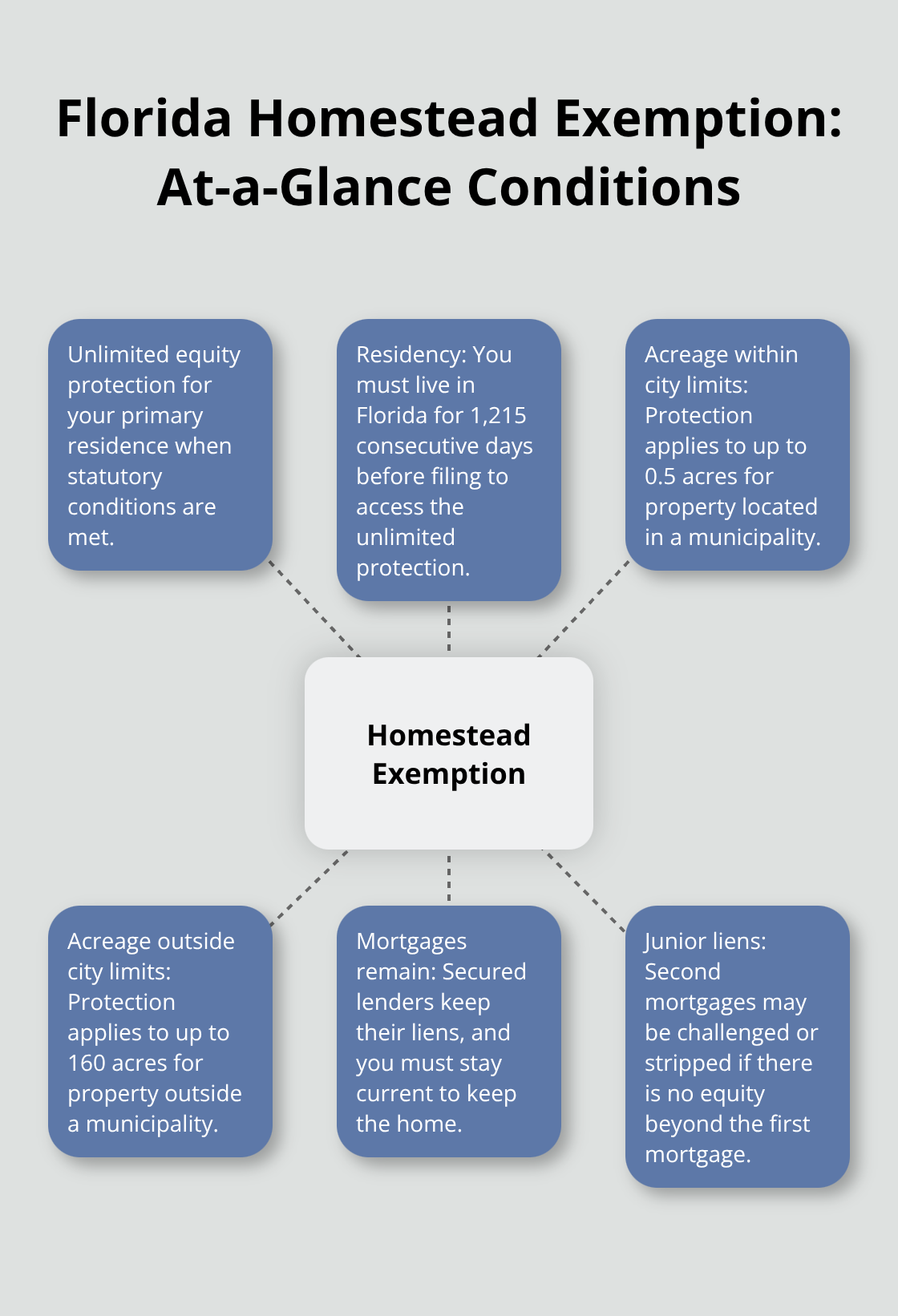
Florida’s homestead exemption stands apart from most states because it offers unlimited protection for your primary residence. This means if you own a home and meet Florida’s residency requirements, the equity in that home cannot be seized to pay creditors in Chapter 7. The protection applies regardless of how much equity you have accumulated, making it one of the strongest asset protections available in bankruptcy.
However, the exemption comes with specific conditions. You must have lived in Florida continuously for at least 1,215 days before filing for bankruptcy, and your property cannot exceed 160 acres if located outside a municipality or 0.5 acres if located within city limits.
The 1,215-Day Residency Requirement
This time requirement matters significantly. If you moved to Florida within the past three years, you may not qualify for the unlimited homestead exemption under Florida law. Instead, you would be subject to a federal exemption cap of approximately $27,900 as of 2024, according to federal bankruptcy exemption amounts.
Clients often find that their filing timing directly impacts how much home equity they can protect. The 1,215-day clock starts from your first day of continuous Florida residency, so understanding where you stand on this timeline before you file becomes essential to your asset protection strategy.
How the Homestead Exemption Functions in Chapter 7
The homestead exemption works differently in Chapter 7 than many people expect. When you file, the trustee assigned to your case cannot force a sale of your home to repay creditors, even if substantial equity exists. Instead, your mortgage lender retains its secured interest, and you continue making payments to keep the property.
If you have a second mortgage or home equity line of credit, the trustee may challenge that lien if the home’s value does not exceed the first mortgage balance, potentially stripping the junior lien entirely. This distinction matters because homeowners sometimes carry second mortgages that can be eliminated through bankruptcy, freeing monthly cash flow.
For example, if your home is worth $400,000 and your first mortgage balance is $350,000, a second mortgage of $60,000 may be vulnerable to lien stripping in Florida Chapter 7 cases. The homestead exemption protects the property itself from forced sale, but it does not eliminate your obligation to pay the first mortgage or other secured liens on the home.
Moving Forward With Your Asset Protection Plan
Proper planning before filing can preserve both your home and your financial stability. Understanding how your home equity interacts with the homestead exemption-and whether lien stripping applies to your situation-shapes the entire outcome of your Chapter 7 case. With this foundation in place, you can now examine what other personal property Florida law protects beyond your residence.
What Personal Property Can You Actually Keep
Motor Vehicle Equity Protection
Florida law protects up to $5,000 in equity for one motor vehicle in Chapter 7. If your car is worth $7,000 and you owe $3,000 on it, you have $4,000 in non-exempt equity that could theoretically be liquidated. You calculate vehicle equity by subtracting any loan balance from its fair market value. If you own multiple vehicles, Florida allows exemption for additional ones only if you can document that each serves an essential purpose for work or family obligations. You should gather recent appraisals and loan statements to support these claims because the trustee will scrutinize any attempt to protect more than one vehicle without solid justification.
Household Goods and Personal Property Limits
Your personal property exemption covers up to $1,000 of items like furniture, clothing, electronics, and household equipment. However, if you do not claim the homestead exemption, this amount increases to $4,000, which gives renters and those ineligible for homestead protection substantially more flexibility. This wildcard exemption allows you to apply protection strategically to whatever assets matter most to your situation, whether that means preserving a laptop essential for remote work, protecting tool collections necessary for self-employment, or sheltering cash reserves in bank accounts.
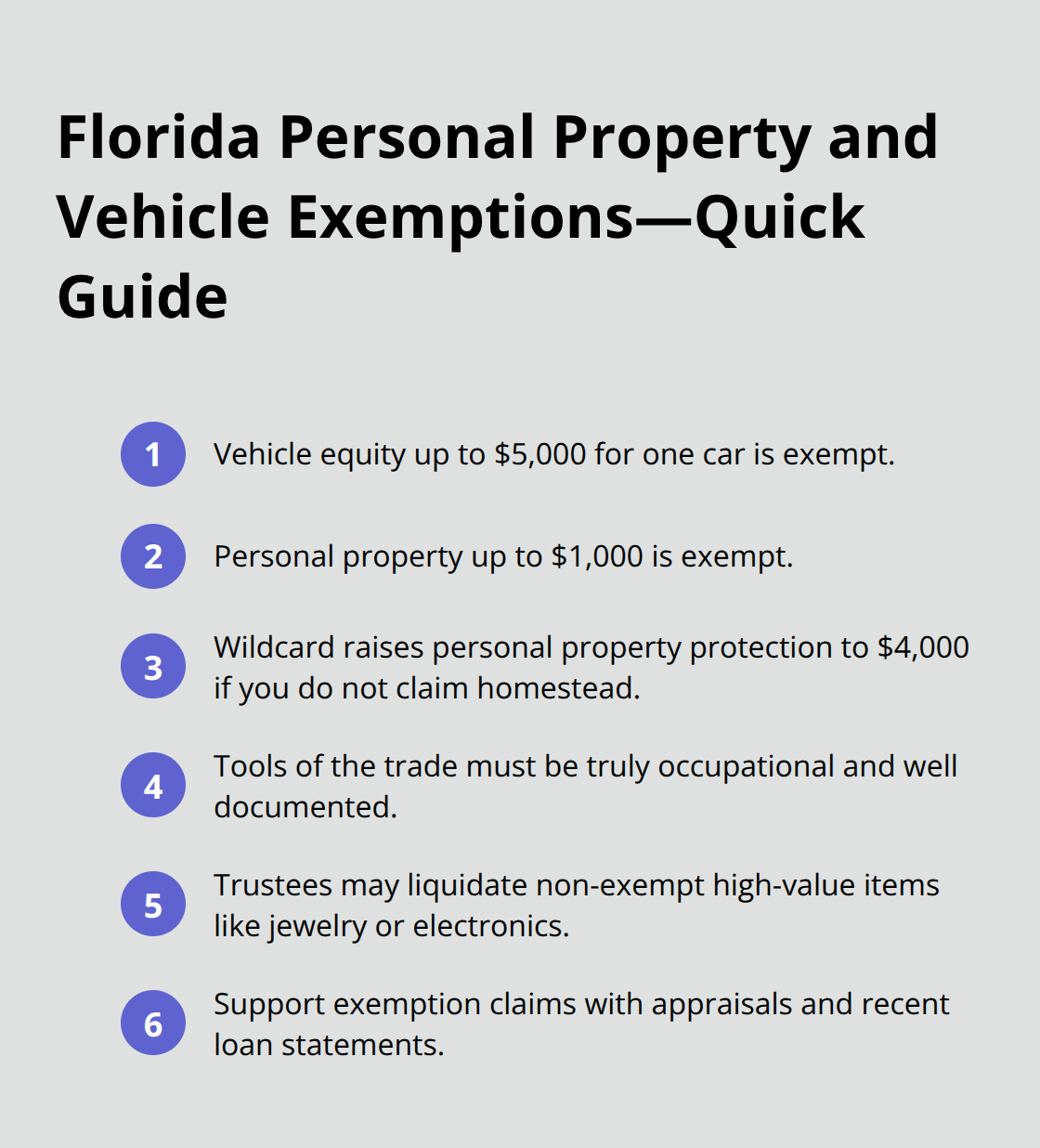
Many filers make the mistake of assuming all household items are automatically protected, then face liquidation of higher-value goods like jewelry, electronics, or musical instruments that exceed exemption limits. The trustee can and will sell non-exempt personal property to pay creditors in Chapter 7, so accurate asset valuation and strategic exemption allocation directly impact whether you keep what matters.
Professional Tools and Occupational Equipment
Tools of the trade used in your profession receive protection under Florida law, but you must demonstrate their genuine connection to your occupation. A carpenter’s tools qualify; a collection of decorative tools does not. You should document the fair market value of each tool and its direct use in generating income, as this evidence becomes critical if the trustee questions whether items are truly occupational equipment or simply personal property that exceeds exemption limits.
The distinction between professional tools and personal property can determine whether you retain equipment essential to your livelihood after Chapter 7 concludes. Proper documentation now prevents disputes later and protects your ability to work and earn income during your financial recovery. With your personal property protection mapped out, the next section examines how to strategically combine these exemptions to maximize your overall asset protection in Florida Chapter 7 cases.
Protecting Your Assets: Strategies to Maximize Florida Exemptions
Timing Your Chapter 7 Filing for Maximum Protection
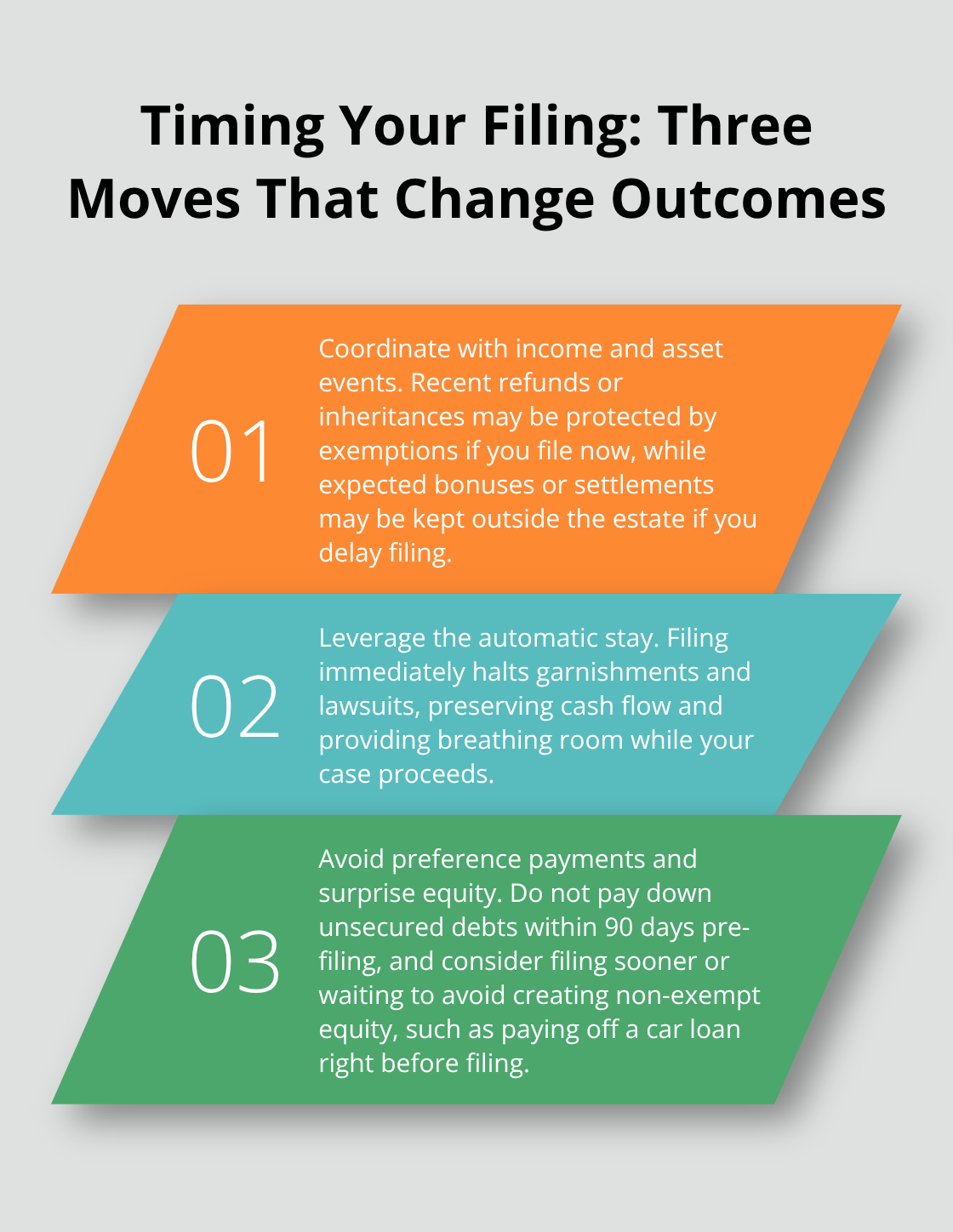
The timing of your Chapter 7 filing directly determines how much property you can protect under Florida law. Most people focus on the homestead exemption’s 1,215-day residency requirement, but timing affects far more than just your home. If you own a vehicle with a loan balance approaching payoff, waiting until that loan disappears increases your non-exempt equity and invites trustee liquidation. If you received a tax refund or inheritance recently, filing immediately protects these funds through exemptions before creditors can reach them.
Conversely, if you anticipate receiving a bonus or settlement within the next few months, delaying your filing allows those assets to remain outside the bankruptcy estate entirely. The automatic stay, which takes effect the moment you file, freezes all creditor collection efforts, so timing your filing to coincide with wage garnishment cycles or pending lawsuits can preserve cash flow you would otherwise lose.
One critical mistake occurs when people pay down debt before filing, thinking this improves their position. In reality, any payment made within 90 days before filing to a creditor may be treated as a preference payment that the trustee can recover and redistribute to other creditors. This means paying off a credit card in the weeks before filing could actually backfire and reduce your fresh start. If you have non-exempt assets, filing sooner rather than later prevents those assets from liquidation as you continue struggling with debt payments.
Understanding Exemption Stacking and Strategic Allocation
Florida’s exemption framework allows you to combine protections strategically, but improper stacking of exemptions wastes your protection. The homestead exemption and the wildcard exemption cannot both apply to real estate simultaneously, forcing you to choose whether your unlimited home protection matters more than a $4,000 wildcard for other assets. If you own a home with significant equity and minimal personal property, claiming homestead makes sense. If you are a renter with no home equity but substantial bank accounts or a vehicle with excess value, the $4,000 wildcard exemption provides better protection.
Joint filers can double their wildcard protection by each claiming their own $4,000 exemption, totaling $8,000 for combined personal property protection. Many filers incorrectly assume retirement accounts require exemption claims, but 401(k) and 403(b) plans are protected automatically under federal law regardless of whether you list them on your exemption schedule. IRAs receive protection up to approximately $14,425 per person under the 2024 federal limits, as established by the Bankruptcy Code.
Avoiding Common Exemption Mistakes
Failing to properly list and claim exemptions on Schedule C creates unnecessary risk because assets not explicitly exempted may be treated as non-exempt even if they qualify for protection. A common error involves undervaluing assets to avoid exceeding exemption limits, which constitutes fraud if the trustee discovers the deception and can result in case dismissal or conversion to Chapter 13. Accurate asset valuation, combined with strategic exemption allocation, protects what matters most and prevents the trustee from challenging your filing based on incomplete or misleading information.
Final Thoughts
Florida exemptions in Chapter 7 protect far more than most people realize. Your home receives unlimited protection if you meet the 1,215-day residency requirement and acreage limits, your vehicle equity up to $5,000 stays safe from liquidation, and personal property, retirement accounts, and government benefits receive specific protections under Florida law. When you combine these protections strategically, you often keep most or all of your essential property while eliminating qualifying debts.
The key to maximizing your protection lies in understanding how these exemptions interact and timing your filing appropriately. Assets you don’t properly claim on your exemption schedule risk liquidation, and undervaluing property to fit within limits constitutes fraud. Accurate valuation and complete disclosure of all assets builds a solid foundation for your case, and the difference between a well-planned filing and a rushed one often determines whether you retain your home, vehicle, and personal belongings.
Your next step involves gathering documentation of all assets, debts, income, and expenses-collect recent pay stubs, bank statements, mortgage and loan statements, retirement account statements, and any garnishment notices. We at Harnage Law, PLLC help Florida residents navigate Chapter 7 bankruptcy and protect their assets through proper exemption planning, and our team guides you through every step from initial consultation through discharge. Contact us to discuss how Florida exemptions Chapter Seven protections apply to your case and begin your path toward financial recovery.