Chapter 7 bankruptcy offers Florida residents a path to eliminate qualifying debts and get a fresh financial start. At Harnage Law, PLLC, we guide clients through this complex process with clarity and support.
A Florida Chapter 7 lawyer helps you understand your options, navigate filing requirements, and protect your assets under state law. This guide covers what you need to know.
What Chapter 7 Bankruptcy Actually Does
How Chapter 7 Eliminates Your Debts
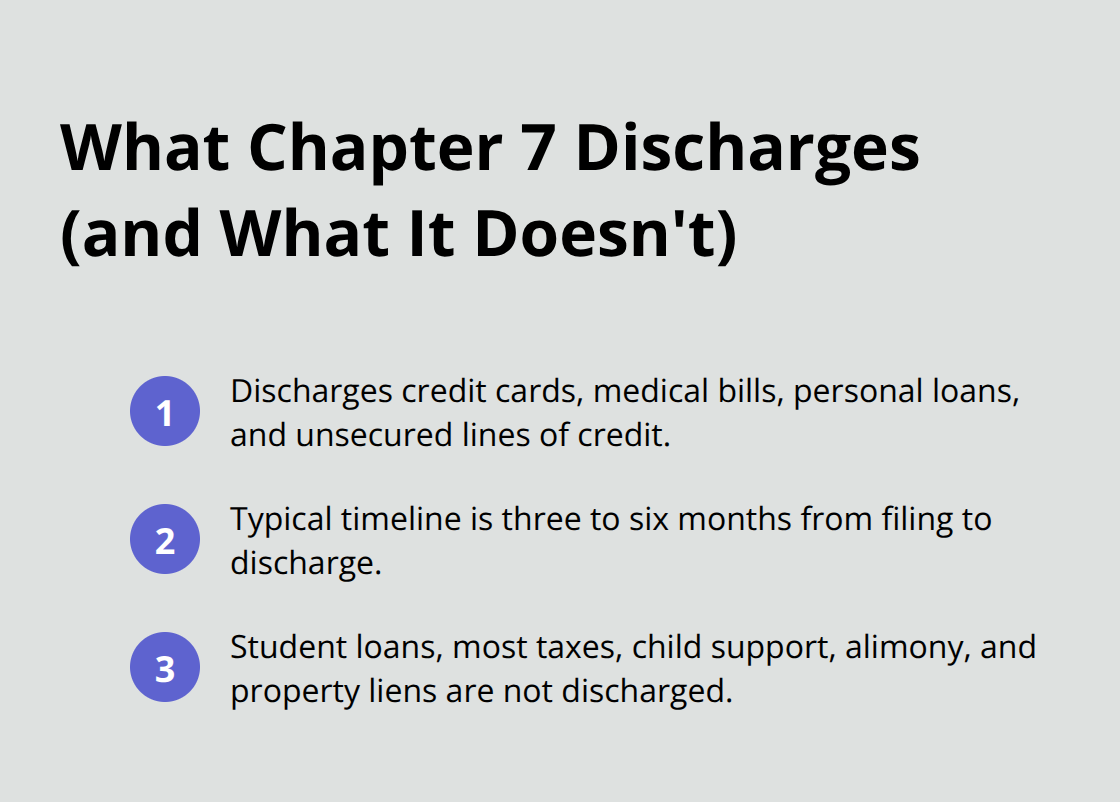
Chapter 7 bankruptcy eliminates most unsecured debts, and this happens faster than many Florida residents expect. When you file, the court discharges debts like credit cards, medical bills, personal loans, and unsecured lines of credit. The process typically takes three to six months from filing to discharge. However, some debts cannot be eliminated: student loans, most taxes, child support, alimony, and liens on property all survive Chapter 7.
Qualifying for Chapter 7: The Means Test
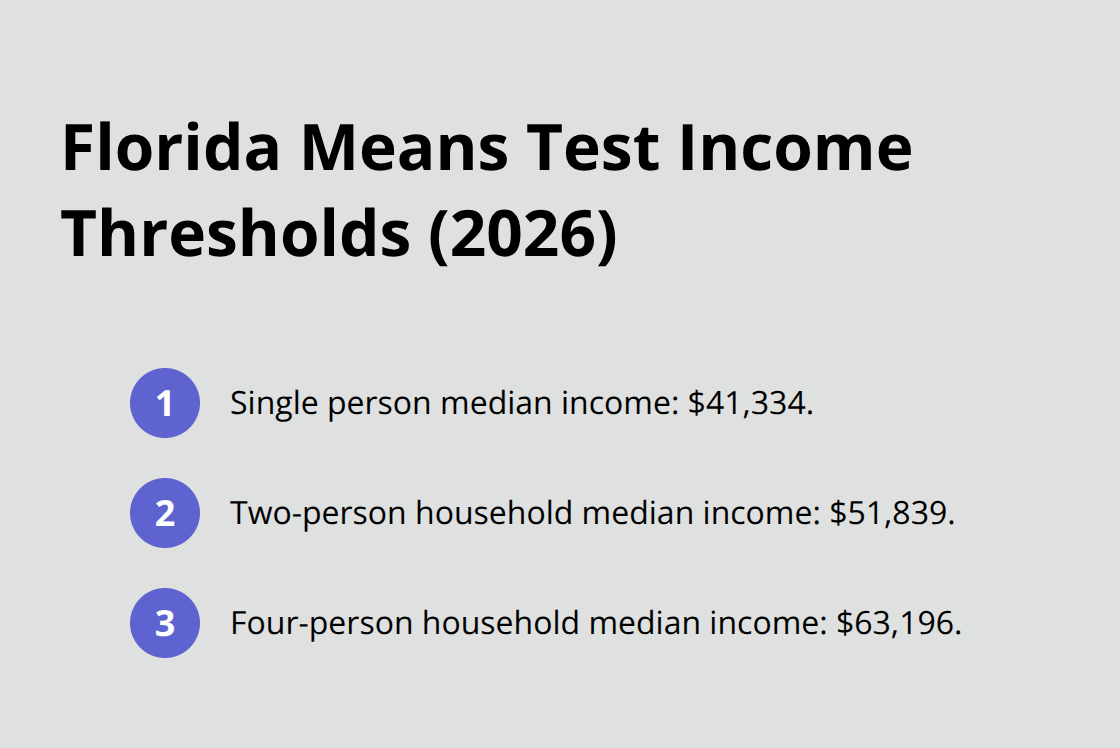
The Florida means test determines whether you qualify to file Chapter 7 in the first place. If your average monthly income over the last six months falls below the Florida median for your household size, you pass the test automatically. For a single person, the 2026 median income is $41,334 annually; for a family of four, it’s $63,196. If your income exceeds these thresholds, you must complete detailed means test calculations comparing your income to allowable expenses based on IRS and Census Bureau standards. This calculation determines whether you have disposable income available to repay creditors through a Chapter 13 plan instead.
The Automatic Stay: Your Immediate Protection
Filing Chapter 7 triggers the automatic stay immediately, which stops wage garnishments, lawsuits, foreclosure proceedings, and most creditor collection calls within days. Creditors who violate the stay face penalties and damages. This protection applies to nearly all debts except criminal fines and domestic support obligations. The automatic stay gives you breathing room to assess your situation without constant collection pressure.
Documentation and Court Proceedings
At the filing stage, you submit extensive documentation: your last tax return, pay stubs from the past 60 days, bank statements, a complete creditor list, and detailed schedules of income and expenses. Missing documents delay your case significantly. The court requires you to complete a pre-filing credit counseling course from an approved agency listed on the U.S. Trustee website within 180 days before filing. After filing, you attend the meeting of creditors, called the 341 meeting, which occurs 20 to 40 days after your petition is filed. This meeting is brief and occurs under oath; most creditors do not attend. The trustee asks questions about your assets, debts, and finances. After the 341 meeting, you must complete a debtor education course before receiving your discharge.
Protecting Your Assets Under Florida Law
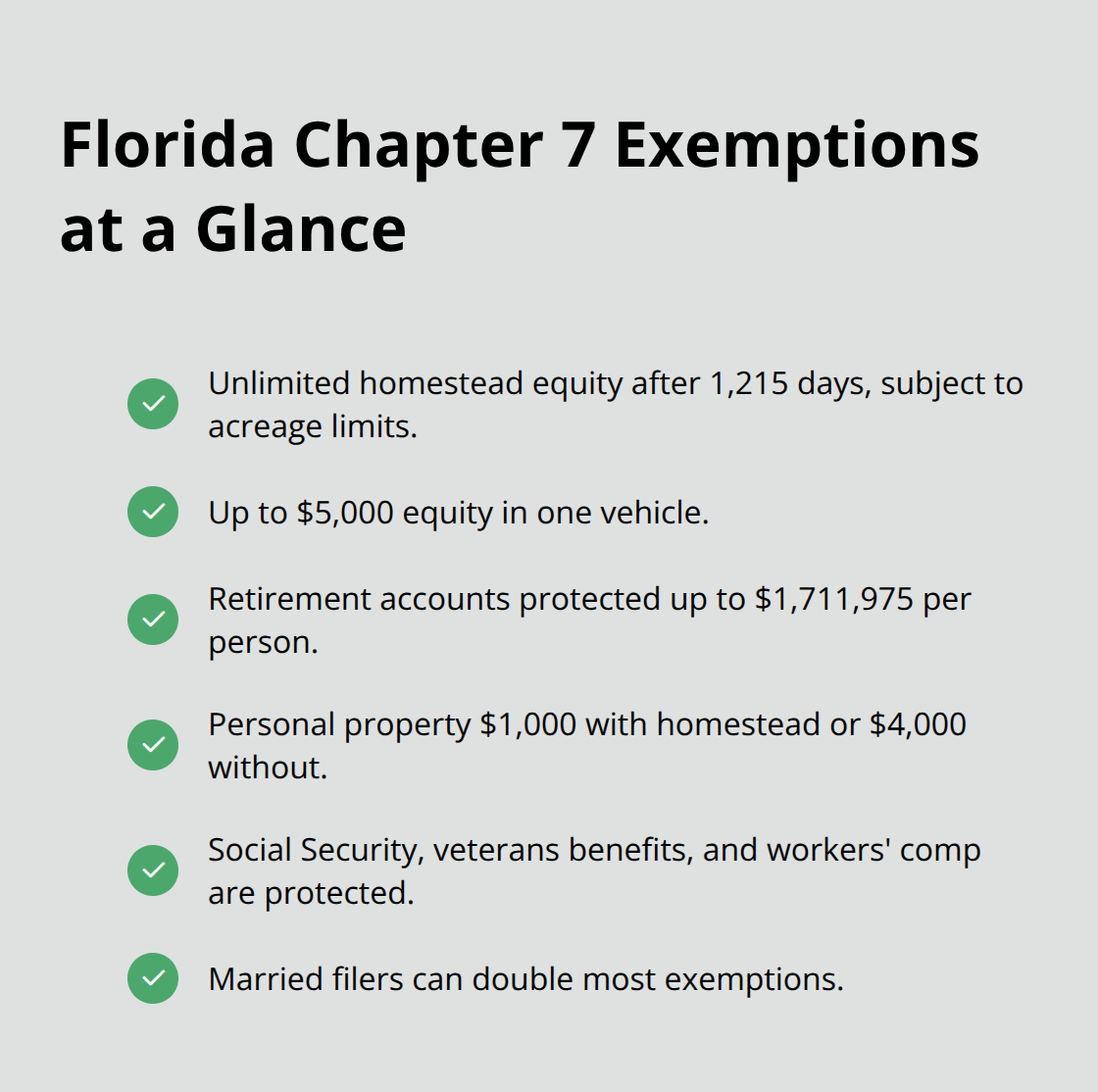
The entire process moves quickly for most cases, and nonexempt property-assets not protected by Florida exemptions-may be sold by the trustee to pay creditors. Florida law protects unlimited equity in your primary residence if you’ve owned it for at least 1,215 days, up to $5,000 equity in one vehicle, and retirement accounts like 401(k)s and IRAs. Understanding these specifics before filing prevents costly mistakes. The next section covers how these exemptions work and what assets you can actually keep through the bankruptcy process.
How a Florida Chapter 7 Lawyer Guides You Through the Process
Gathering the Right Documentation
Getting Chapter 7 right requires handling dozens of forms, meeting strict deadlines, and understanding rules that vary by court. A Florida Chapter 7 lawyer prevents the mistakes that derail cases or cost you assets you could have kept. The filing process starts with documentation: you need your last tax return, pay stubs from the past 60 days, bank statements for the last two months, and a complete list of every creditor with their addresses. The court requires this creditor matrix to be exact-missing or incorrect addresses delay your case. You also complete extensive schedules detailing your income, expenses, assets, and debts.
According to the U.S. Trustee, you must finish a pre-filing credit counseling course from an approved agency within 180 days before filing; the U.S. Trustee website lists which agencies qualify in Florida. The Chapter 7 filing fee is $338 as of 2026. If you cannot afford it upfront, you can request installment payments with a minimum initial payment of half the fee, or apply to waive it entirely if you meet poverty guidelines using Official Bankruptcy Form 103B.
Why Accuracy Matters in Your Petition
Many filers underestimate how detailed these forms must be. Mischaracterizing property or omitting assets can trigger fraud penalties up to $250,000 and 20 years in prison, so accuracy matters. Each schedule connects to others, and the trustee cross-checks your information against your tax returns and bank statements. Small errors compound into larger problems during the 341 meeting.
Understanding the Means Test
The means test determines whether you actually qualify to file Chapter 7 or whether you must file Chapter 13 instead. Calculate your average monthly income over the last six months, then multiply by 12 to get your annual income. If that figure falls below the Florida median for your household size, you pass automatically and skip the detailed calculation. For 2026, Florida medians are $41,334 for a single person, $51,839 for two people, and $63,196 for a family of four.
If your income exceeds the median, you complete a full means test that subtracts allowable expenses based on IRS and Census Bureau standards from your income. The calculation determines your disposable income over the next 60 months. If that total is less than $7,475, you pass and can file Chapter 7. Between $7,475 and $12,475 requires further analysis. Over $12,475 means Chapter 13 is your only option.
The 341 Meeting and What Happens Next
After filing, the meeting of creditors happens 20 to 40 days later. You attend under oath with your government-issued photo ID and Social Security number. The trustee asks questions about your assets, debts, and finances; most creditors never show up. The meeting typically lasts 10 to 15 minutes. Before you receive your discharge, you must complete a debtor education course and file the certificate within 60 days after the 341 meeting date. Discharge usually arrives 60 to 90 days after the meeting, ending most of your debt obligations.
Understanding what assets you can protect through Florida exemptions shapes your entire strategy going forward. The next section explains which assets the law shields from the trustee and how to maximize what you keep.
Protecting Your Assets and Rebuilding After Florida Chapter 7
Understanding Florida’s Asset Protection Laws
Florida law shields more of your assets than you might think, and understanding these protections before filing prevents you from losing property unnecessarily. Your primary residence receives unlimited protection if you’ve owned it for at least 1,215 days before filing, regardless of equity amount, as long as the property doesn’t exceed half an acre in a municipality or 160 acres elsewhere. If you haven’t met the 1,215-day requirement, a federal cap of $214,000 applies instead. One vehicle can retain up to $5,000 in equity, which means if your car is worth $12,000 and you owe $8,000, you keep it entirely.
Retirement Accounts and Personal Property Exemptions
Retirement accounts including 401(k)s, IRAs, and pensions receive broad protection under federal law up to $1,711,975 per person for cases filed between April 1, 2025 and March 31, 2028. Household goods, electronics, and personal property up to $1,000 are exempt if you claim your homestead; that amount jumps to $4,000 if you don’t use the homestead exemption. Social Security benefits, veterans benefits, workers’ compensation, and most public assistance remain completely protected. Married couples filing jointly can double these exemptions in most categories.
Identifying Nonexempt Assets Before Filing
The critical step involves identifying which assets are nonexempt before filing so you and your attorney can develop a strategy to protect them. You can negotiate with the trustee or pay their value through a Chapter 13 plan if Chapter 7 becomes problematic. This advance planning prevents costly surprises during the bankruptcy process.
Rebuilding Your Credit After Discharge
After discharge arrives 60 to 90 days following your 341 meeting, your credit score has already taken a hit, but rebuilding happens faster than most people expect. Chapter 7 remains on your credit report for 10 years, but your score can improve within 12 to 24 months with responsible behavior. Start by obtaining your free credit report from each of the three bureaus at annualcreditreport.com and check for errors that the bankruptcy filing may have introduced. Open a secured credit card with a $300 to $500 deposit and use it for one small purchase monthly, then pay the full balance immediately to establish a positive payment history.
Keep your credit utilization below 30 percent on any cards you retain or reaffirm during bankruptcy. Avoid new debt aggressively for the first 12 months after discharge; every new account temporarily lowers your score. After 18 months of on-time payments, you become eligible for conventional mortgage products again, though interest rates will reflect your recent bankruptcy. The Federal Reserve’s 2024 data shows that bankruptcy filers who maintain consistent payments rebuild their scores to the 620 range within two years, making homeownership attainable again.
Creating a Post-Bankruptcy Financial Plan
A post-bankruptcy budget that allocates 10 to 15 percent of monthly income to savings prevents the debt spiral that led to bankruptcy initially. Many filers return to old spending patterns immediately after discharge; instead, track every expense for three months to identify where money actually goes. Build your emergency fund to cover three months of expenses before pursuing new credit or investments.
Conclusion
Florida Chapter 7 bankruptcy eliminates qualifying debts within three to six months, stops creditor harassment immediately through the automatic stay, and protects far more of your assets than most people realize. Your primary residence receives unlimited protection if you’ve owned it long enough, retirement accounts stay completely shielded, and one vehicle can retain up to $5,000 in equity. The means test determines your eligibility, and Florida’s exemption laws shield your most valuable possessions from the trustee.
Success in Chapter 7 depends on attention to detail at every step. Missing documents delay your case, inaccurate creditor information creates complications, and mischaracterized assets trigger fraud penalties up to $250,000 and 20 years in prison. A Florida Chapter 7 lawyer prevents these mistakes and helps you discharge qualifying debts while keeping everything the law allows you to keep.
We at Harnage Law, PLLC guide clients through this complex process with clarity and support. Contact us for a consultation to discuss your specific situation and determine whether Chapter 7 or Chapter 13 makes sense for your circumstances.