The means test is the first hurdle in any Chapter 7 bankruptcy filing in Florida. It determines whether you qualify to discharge your debts or must repay some of them through a Chapter 13 plan instead.
At Harnage Law, PLLC, we’ve seen countless people struggle with this calculation because they don’t understand what income counts, which expenses qualify, or how the numbers affect their case. This means test Florida guidance walks you through each step so you know exactly what to expect.
What the Means Test Actually Measures in Florida
The means test is a federally mandated calculation that Congress introduced through the Bankruptcy Abuse Prevention and Consumer Protection Act in 2005. Its purpose is straightforward: prevent high-income earners from using Chapter 7 to walk away from debts they could realistically repay. The test compares your six-month average income against Florida’s median income for your household size, then analyzes whether you have disposable income available after accounting for necessary living expenses. If your income falls below the state median, you pass automatically. If it exceeds the median, the test forces a detailed calculation of what you can afford to pay back. This gatekeeping function is why getting the means test right matters more than almost any other aspect of your Chapter 7 filing.
Understanding Your Income Calculation
The means test includes nearly all money you receive, not just wages. Business income, rental income, pensions, Social Security benefits received by dependents, unemployment payments, workers’ compensation, disability payments, and spousal support all factor into the calculation. The critical detail most people miss is the six-month lookback period. The bankruptcy court averages your income from the six calendar months before filing, then annualizes that figure. This matters significantly if your income recently dropped. A job loss three months ago could pull your six-month average below Florida’s median, allowing you to qualify for Chapter 7 even if your current job pays well.
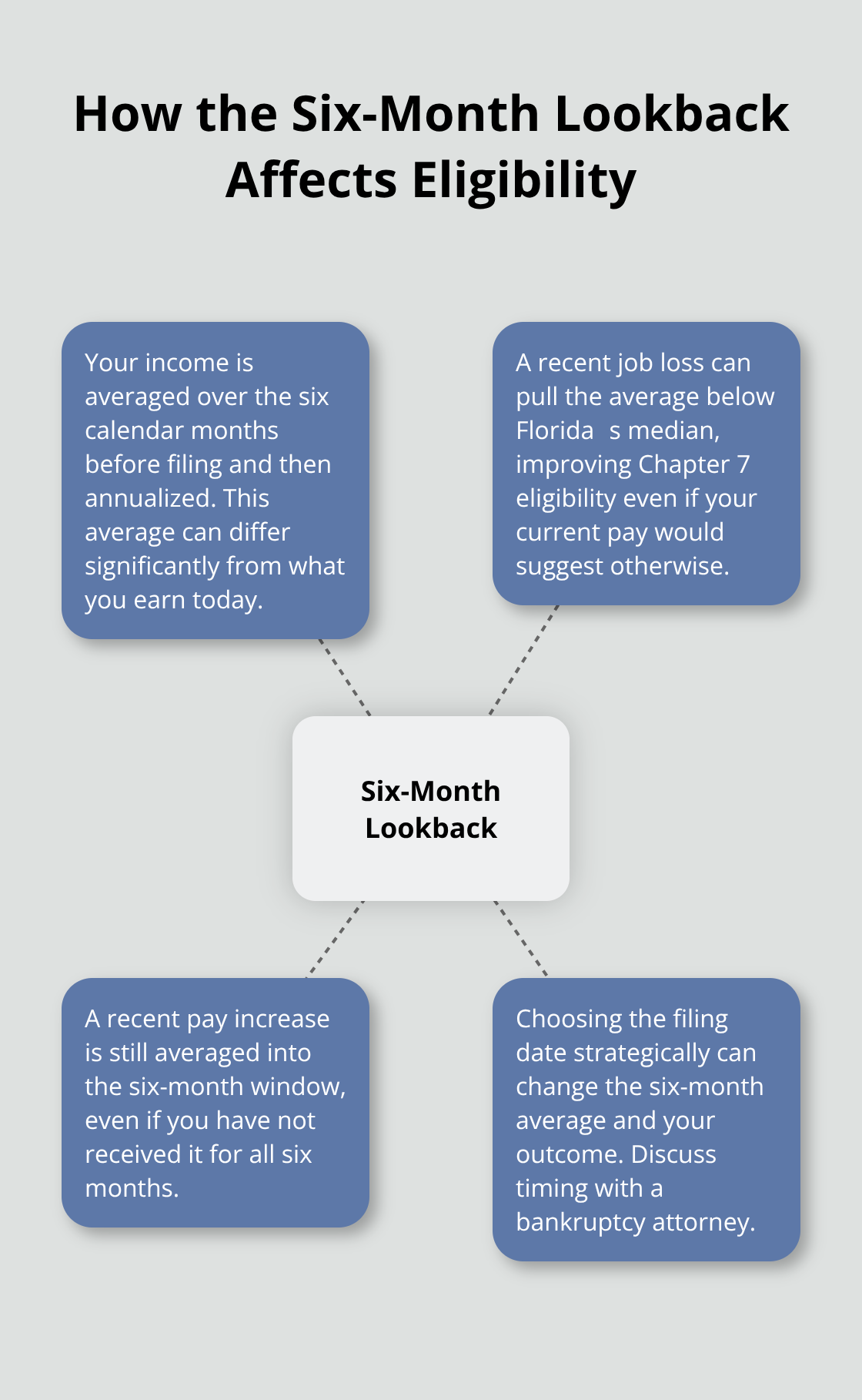
Conversely, if you started a higher-paying position recently, that income gets averaged in even though you haven’t earned it for a full six months yet. Understanding this timing can change whether you qualify, making strategic filing dates worth considering with an attorney.
How Expenses Shape Your Results
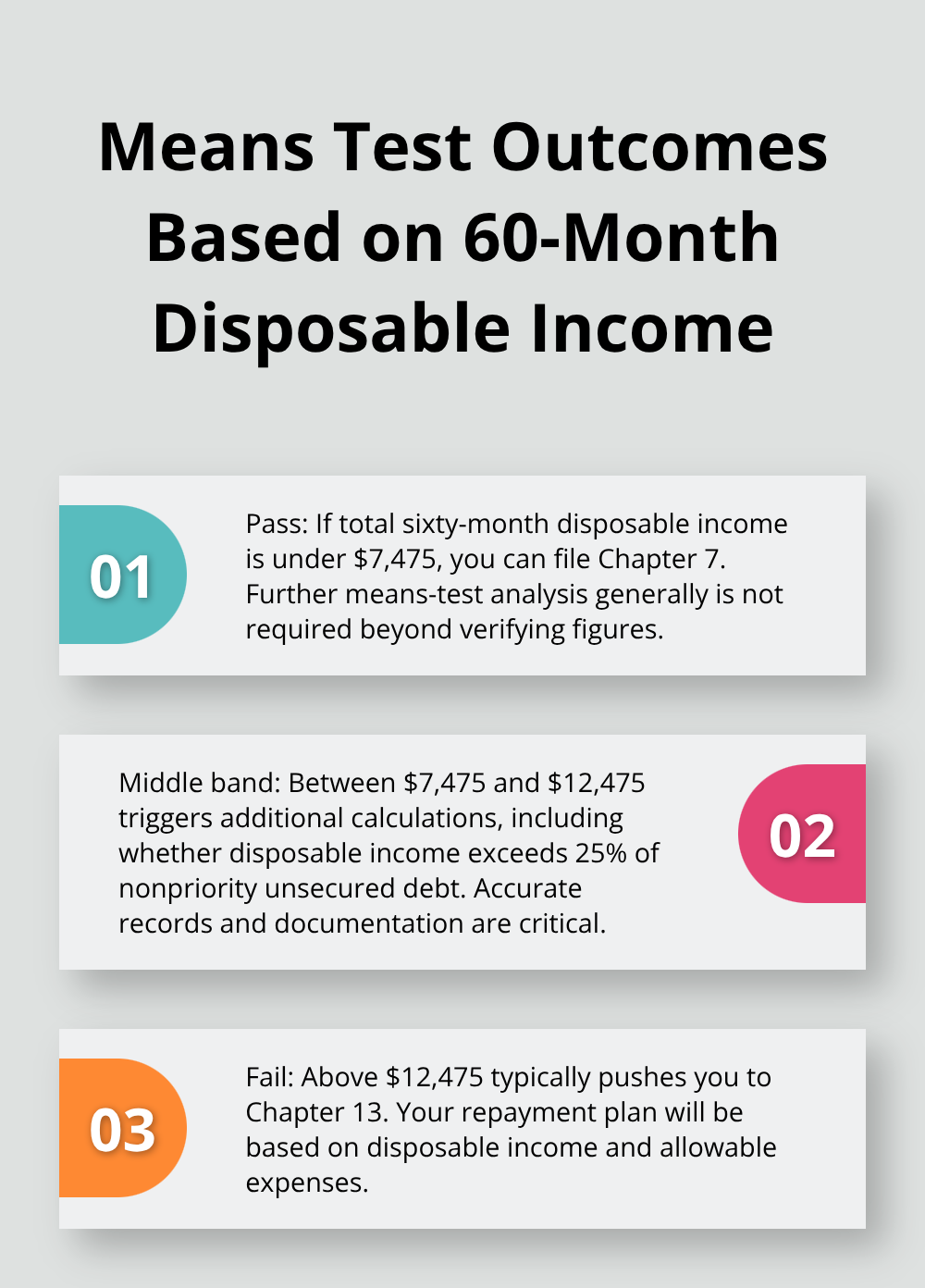
Once your income is established, the means test subtracts allowable expenses using IRS Collection Financial Standards and local cost-of-living data. The test recognizes housing costs, transportation, food, clothing, healthcare, childcare, insurance premiums, and debt payments on secured or priority obligations. Here’s where the test becomes rigid: you cannot claim your actual expenses if they exceed the standards. If the IRS National Standard allows $400 monthly for food and clothing but you spend $250, you claim $400. If you spend $600, you still claim only $400. This standardized approach prevents people from inflating living expenses. The result is disposable income projected over 60 months. If that 60-month total falls below $7,475, you pass the means test and can file Chapter 7. If it exceeds $12,475, you fail and Chapter 13 becomes your path forward. Amounts between these thresholds require additional calculations that few debtors understand without professional guidance.
What Happens Next With Your Results
The disposable income calculation determines your Chapter 7 eligibility and shapes your entire bankruptcy strategy. Courts project your monthly disposable income over the next 60 months to reach a total figure. This projection uses your current monthly income minus the allowable expenses we discussed. The numbers tell a clear story: pass below $7,475 and Chapter 7 remains available; fail above $12,475 and Chapter 13 becomes mandatory; land in between and you face complex additional analysis. Many filers make mistakes at this stage because they don’t account for how the court calculates current monthly income differently from the six-month average used initially. The means test shifts from a simple income comparison to a detailed expense analysis, and that shift trips up people who try to navigate it alone. Your next step involves calculating your actual numbers with precision, which we’ll cover in the following section.
Calculating Your Means Test Step by Step
Start With Your Six-Month Income Average
The means test calculation starts with your six-month income average, but this is where most people get it wrong. You need to gather your actual gross income from the six calendar months immediately before filing, not what you earn today. If you file in March 2026, you pull income records from September 2025 through February 2026. Add all six months together and divide by six to get your average monthly income. Then multiply that average by twelve to annualize it.
This annualized figure is what the court compares against Florida’s median income for your household size. According to the U.S. Census Bureau data used by the federal courts, Florida’s median income thresholds as of 2026 are $41,334 annually for a single person, $51,839 for a household of two, $53,952 for three, and $63,196 for four. If your annualized six-month average falls below your household’s median, you pass the means test immediately and can file Chapter 7 without further calculation.
Apply the IRS Standards to Your Expenses
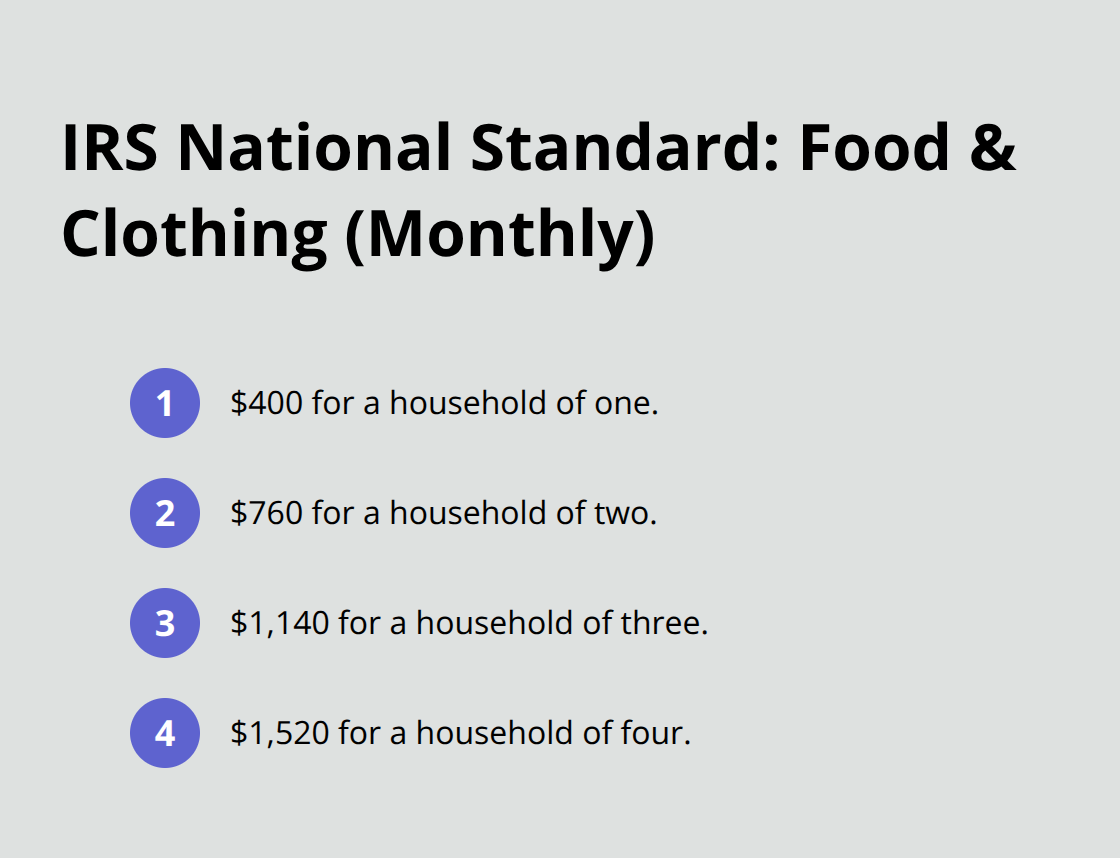
The IRS Collection Financial Standards form the backbone of the expense calculation that follows if your income exceeds the median. These standards set fixed amounts you can claim for food, clothing, and personal care regardless of what you actually spend. The National Standard allows $400 monthly for food and clothing combined for a household of one, $760 for two, $1,140 for three, and $1,520 for four.
Local standards for housing, utilities, and transportation vary by county in Florida and are updated regularly by the U.S. Trustee Program. Duval County, which includes Jacksonville, uses different housing allowances than Miami-Dade County or Hillsborough County. You cannot claim actual expenses that exceed these standards, even if you can document spending more.
Calculate Your Disposable Income
Healthcare expenses, childcare costs, insurance premiums, and debt payments on mortgages or car loans are added separately using actual amounts or additional standardized figures. The court subtracts all allowable expenses from your current monthly income to calculate disposable income. Project this monthly disposable income forward sixty months.
If your total sixty-month disposable income is less than $7,475, you pass and can file Chapter 7. If it exceeds $12,475, you fail the means test and must pursue Chapter 13 bankruptcy instead. Amounts between these thresholds require you to calculate whether your disposable income is greater than 25 percent of your total nonpriority unsecured debt, which adds another layer of complexity that demands careful documentation and calculation accuracy.
This precision matters because courts scrutinize every number on your means test forms. Small errors in income calculation or expense deductions can shift your results from passing to failing, which is why the next section covers the mistakes that most filers make when completing this critical calculation.
Common Mistakes People Make on the Means Test
The means test calculation demands precision, yet most people miss critical income sources or misapply expense standards because they treat it like a basic tax return. Income underreporting happens constantly. Many filers fail to include rental income from a property they own, business income from side work, or spousal income if filing jointly. The bankruptcy court reviews your six months of bank statements and tax documents, so omissions surface quickly, leading to case dismissals or forced conversions to Chapter 13. Social Security benefits paid to dependents must be included, even though your own Social Security is excluded. Unemployment benefits, workers’ compensation, and disability payments all count toward your income level calculation.
Income Sources You Cannot Afford to Overlook
One filer initially reported only wage income and overlooked the $800 monthly pension from a previous employer, which pushed his six-month average above the median and changed his entire filing strategy. That single mistake nearly cost him Chapter 7 eligibility. The bankruptcy court catches these omissions through document review, making honesty and completeness non-negotiable. Spousal income presents another trap for joint filers. If you file together, both incomes count toward the means test calculation. If you file separately, the non-filing spouse’s income may be excluded only if you meet specific criteria about separate households and independent finances. Most joint filers do not qualify for this exclusion, so they must account for both incomes from the start.
Expense Deduction Mistakes That Flip Your Results
The expense deduction mistakes are equally damaging. People claim actual spending amounts when they should use IRS National Standards, which flips the result from passing to failing. If you spend $350 monthly on food but the standard allows $400, you claim $400, not $350. Conversely, if you spend $550, you still claim only $400. Many filers try to claim personal entertainment, gym memberships, or streaming services as allowable expenses when these do not qualify under federal guidelines. Housing costs can be claimed using actual amounts if you have documentation, but local standards set the ceiling in most counties. Duval County’s local housing standard for a single filer is approximately $1,100 monthly, which includes mortgage or rent, property taxes, insurance, and utilities combined. Claiming $1,400 because your actual costs run higher violates the standard and invites court scrutiny.
Transportation and Vehicle Expense Pitfalls
Transportation expenses create another common pitfall. The IRS allows operating costs for one or two vehicles depending on your situation, but filers often claim vehicle payment amounts that exceed the actual operating cost standard, inflating their expense deductions. You must distinguish between the vehicle payment itself and the operating cost allowance. The court recognizes operating expenses (fuel, maintenance, insurance) but applies strict limits to what you can claim. A vehicle payment of $400 monthly does not automatically mean you can deduct $400 from your disposable income calculation. The IRS standard for vehicle operation in Florida varies by county and covers actual fuel, maintenance, and insurance costs within a defined range.
Missing Documentation and Incomplete Financial Disclosure
You must also account for all required financial information on your Official Forms 122A-1 and 122A-2. Courts reject incomplete filings that omit bank account information, fail to list all creditors, or skip documentation of special circumstances like recent job loss or medical emergencies. If your income dropped significantly in the months immediately before filing, you need medical records, termination letters, or other proof to overcome the presumption that your six-month average represents your ongoing earning capacity. Without this documentation, the court assumes your historical income continues and calculates disposable income based on that assumption, potentially disqualifying you from Chapter 7 even though your actual current circumstances support eligibility. Special circumstances require concrete evidence-not explanations or promises that your situation has changed.
Final Thoughts
The means test Florida guidance we’ve covered shows that Chapter 7 eligibility rests on precise calculations and accurate documentation. Your six-month average income determines whether you pass immediately or face detailed expense analysis, and your disposable income projection over 60 months becomes the deciding factor if you exceed Florida’s median. Strategic timing matters-if your income recently declined, waiting a month or two could shift your six-month average below the median and simplify your entire filing.
We at Harnage Law, PLLC understand that navigating the means test alone leads most people to errors that jeopardize their Chapter 7 eligibility. Our firm helps individuals and families discharge qualifying debts and achieve a fresh financial start by guiding you through every step of the bankruptcy process. Rather than risk miscalculations that could derail your case, contact us to review your means test calculations with someone who understands Florida bankruptcy law.