Overwhelming debt can feel like it controls your life, but Chapter 7 bankruptcy basics offer a legitimate path to financial relief. We at Harnage Law, PLLC understand that many Florida residents struggle with credit card debt, medical bills, and other obligations they cannot pay.
This guide walks you through what Chapter 7 bankruptcy actually is, how it works in Florida, and whether it makes sense for your situation. You’ll learn about the real benefits, common myths, and concrete steps to move forward.
How Chapter 7 Bankruptcy Actually Works in Florida
Chapter 7 bankruptcy is a legal process that eliminates most unsecured debts, giving you a genuine fresh start. Unlike Chapter 13, which requires a three to five-year repayment plan, Chapter 7 allows qualifying debtors to discharge debts like credit cards, medical bills, and personal loans without repaying them. The process takes about three to six months from filing to discharge.
Income Tests Determine Your Florida Eligibility
In Florida, you must pass an income test to qualify for Chapter 7. If your average monthly income over the last six months falls below the Florida median for your household size, you automatically qualify. According to 2025 data, the Florida median for a single person is $58,000 annually, $73,000 for two people, $85,000 for three, and $98,000 for four.
If your income exceeds these thresholds, you move to the means test, which calculates whether you have enough disposable income to repay debts. The means test subtracts allowable expenses like mortgage payments, utilities, taxes, and childcare from your income. If your disposable income over 60 months falls below $7,475, you pass and can file Chapter 7.
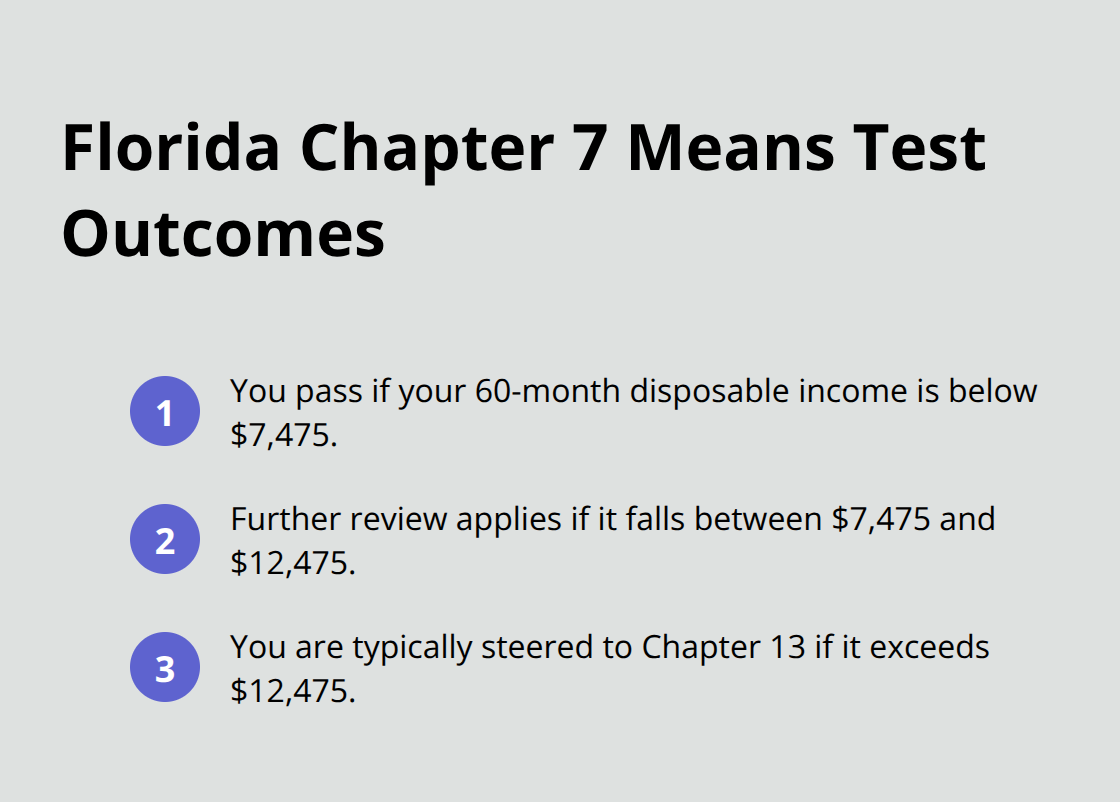
Between $7,475 and $12,475 requires further analysis. Above $12,475 typically disqualifies you from Chapter 7, pushing you toward Chapter 13 instead.
What Happens When You File in Florida
Filing Chapter 7 in Florida involves submitting official bankruptcy forms to the federal court, including schedules detailing your assets, debts, income, and expenses. You must complete a credit counseling course from an approved agency before filing and pay a $338 filing fee (though fee waivers exist for low-income filers).
Within days of filing, an automatic stay takes effect, which immediately stops creditor calls, wage garnishments, and collection lawsuits. A bankruptcy trustee reviews your paperwork to identify any nonexempt property that could be sold to pay creditors. Most Florida residents protect their assets through exemptions, which allow you to keep your home (with unlimited equity under Florida’s homestead exemption), up to $5,000 in vehicle equity, retirement accounts up to $1,711,975 per person, and essential personal property.
About 60 days after filing, you attend a brief meeting with the trustee and creditors where you answer questions about your finances. If no issues arise, you receive your discharge order, typically within four to six months, eliminating your legal obligation to repay qualifying debts.
Strategic Timing Affects Your Qualification
Timing your Chapter 7 filing strategically can determine whether you qualify. Since the means test uses your average income from the previous six months, filing during a month when your six-month average is lowest maximizes your chances of passing. If you received a large bonus, inheritance, or settlement recently, waiting a few months allows that income to drop off your six-month average, potentially lowering your qualifying threshold.
Self-employed individuals and those with variable income must calculate their six-month average carefully, as underreporting leads to dismissal or fraud charges. Florida courts take income calculations seriously, and misrepresenting your finances can result in fines up to $250,000 and 20 years in prison. Understanding these income rules sets the foundation for the next critical step: preparing your actual bankruptcy paperwork and gathering the documents the court requires.
Why Chapter 7 Bankruptcy Offers Real Financial Relief in Florida
Debt Elimination Happens Fast in Florida
Chapter 7 bankruptcy eliminates unsecured debts entirely, meaning you walk away owing nothing on credit cards, medical bills, personal loans, and similar obligations. This differs fundamentally from Chapter 13, where you repay a portion of what you owe over three to five years. The discharge happens within four to six months, not years. Florida residents who file Chapter 7 can discharge an average of $30,000 to $100,000 or more in qualifying debts, depending on their situation. The moment the bankruptcy trustee files your discharge order with the court, those debts vanish legally. Creditors cannot pursue you afterward, and wage garnishments stop immediately.
This clean break matters because it allows you to redirect money toward essentials like housing, food, and savings instead of paying debts that have already consumed years of your income.
The Automatic Stay Stops Creditor Harassment Instantly
The automatic stay takes effect the moment you file, halting all collection calls, lawsuits, and wage garnishments within hours. Federal law prohibits creditors from contacting you once the bankruptcy court notifies them of your case. If a creditor calls after receiving notice, you can report them to the U.S. Trustee, and they face penalties. Many Florida residents report that stopping the constant phone calls and collection letters alone makes the filing worthwhile, even before considering debt elimination.
Florida Exemptions Protect Your Essential Assets
Florida’s exemptions protect more assets than most states, which is why filing Chapter 7 here preserves your financial foundation rather than stripping it. Your home receives unlimited protection under Florida’s homestead exemption if you own it and have lived there at least 1,215 days before filing, provided the property doesn’t exceed half an acre in a city or 160 acres elsewhere. Retirement accounts like 401(k)s and IRAs stay protected up to $1,711,975 per person for cases filed between April 2025 and March 2028 under federal law.
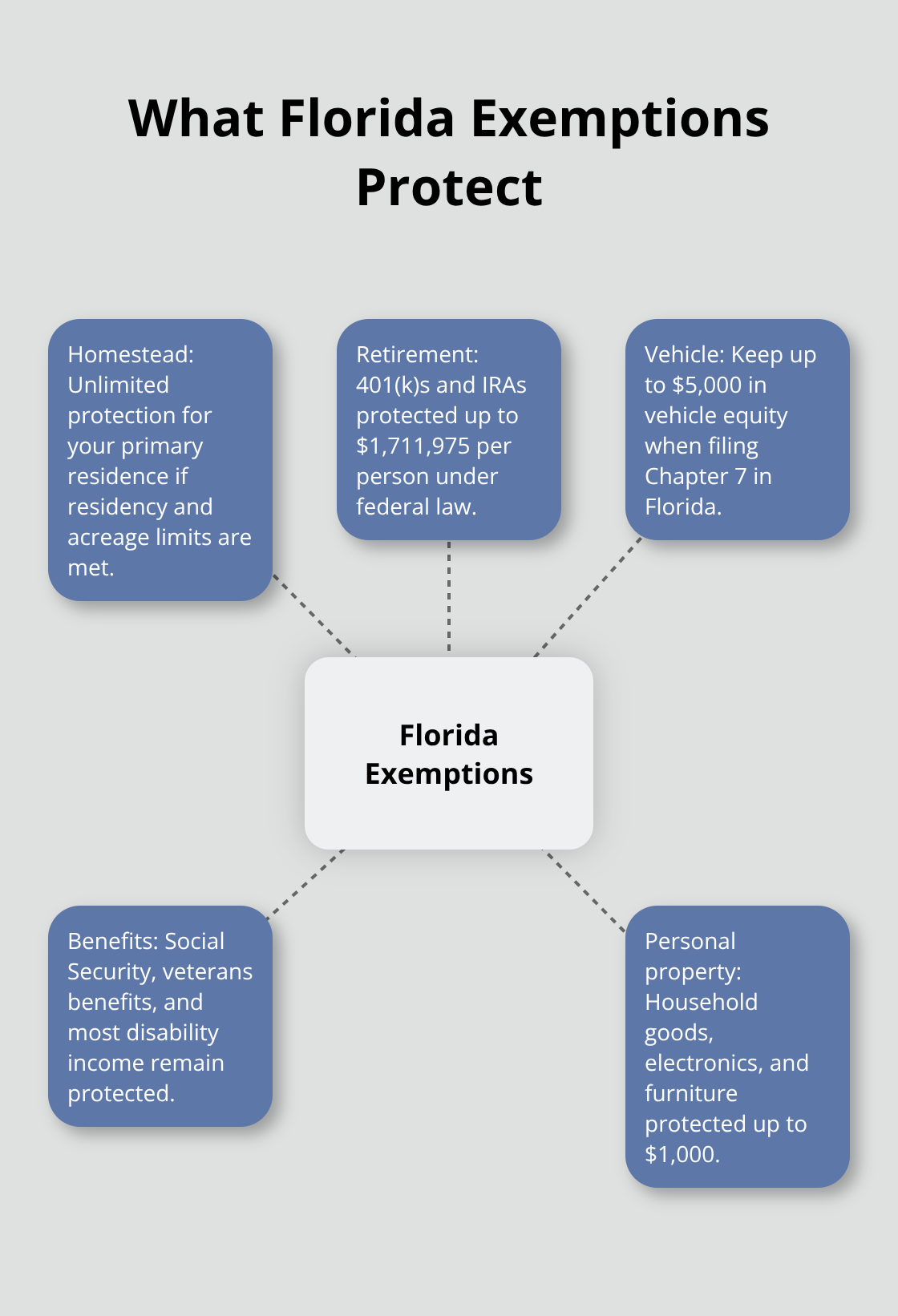
You keep up to $5,000 in vehicle equity, Social Security benefits, veterans benefits, and most disability income. Personal property including furniture, electronics, and household goods receive protection up to $1,000 through exemptions.
What You Actually Keep After Filing
Many Florida residents incorrectly believe Chapter 7 means losing everything, but the reality is that most people keep their essential assets. The trustee only sells nonexempt property, and in many Chapter 7 cases, there is no nonexempt property to liquidate at all. Understanding which assets qualify for protection allows you to see exactly what you’re keeping before filing. This clarity removes much of the fear surrounding the process and helps you make an informed decision about whether Chapter 7 makes sense for your financial situation. With your debts eliminated and your essential assets protected, the next critical step involves preparing your bankruptcy paperwork and gathering the documents the court requires. A Chapter 7 bankruptcy attorney can guide you through this process and answer questions specific to your case.
What Really Happens to Your Credit and Life After Chapter 7
Your Credit Score Takes a Hit, But Recovery Happens Fast
Filing Chapter 7 bankruptcy damages your credit score immediately, but this damage proves far less catastrophic than most people fear. Your credit score will drop 130 to 200 points depending on your starting score, according to data from credit reporting agencies. A person with a 750 score might drop to 550, while someone at 650 might hit 450. This sounds devastating until you understand the reality: your credit was already destroyed by the debts you could not pay. Late payments, charge-offs, and collection accounts have been dragging your score down for months or years. Chapter 7 actually provides a cleaner slate than continuing to default on debts.
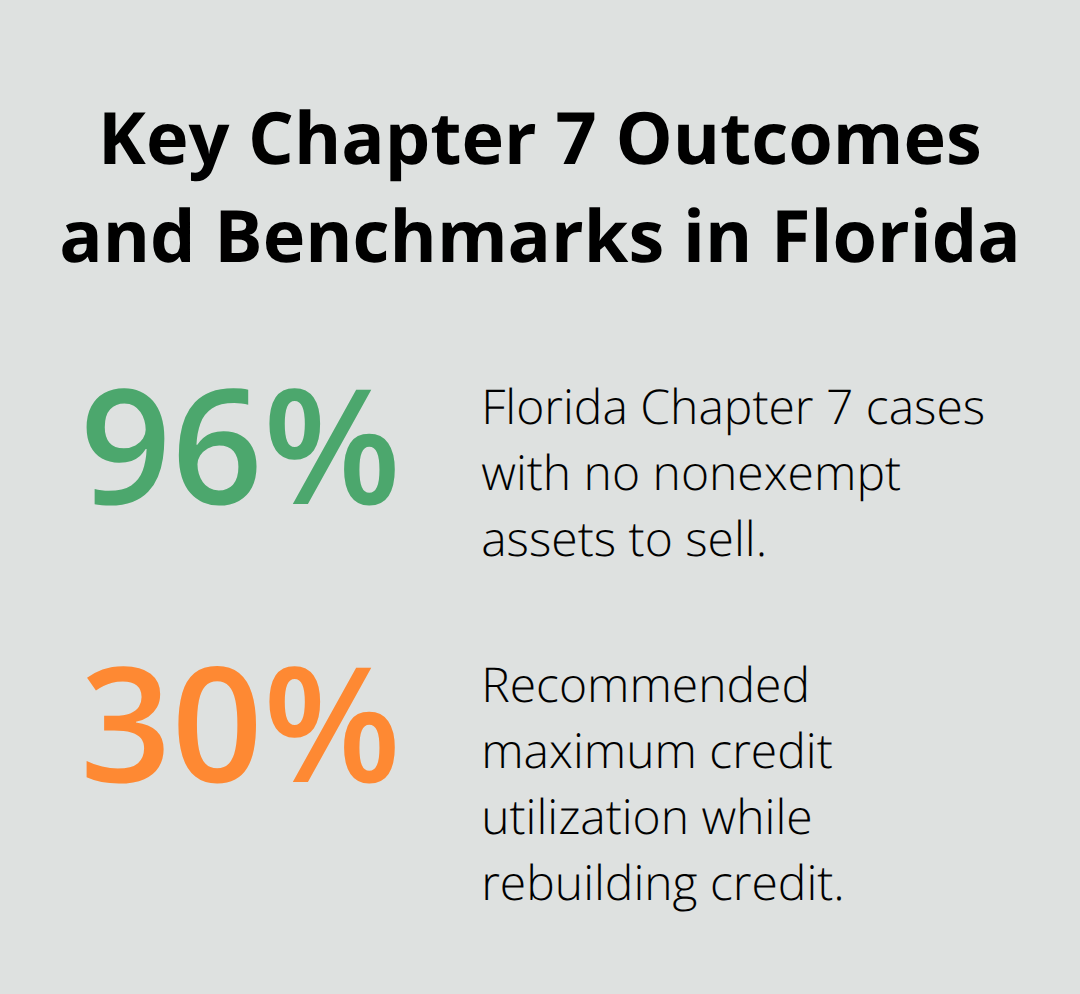
The bankruptcy notation remains on your credit report for ten years, but creditors care far more about recent payment history than old bankruptcies. Within two to three years of filing, you can rebuild your score to 650 or higher by securing a credit card with a deposit, making on-time payments, and keeping credit utilization below 30 percent. Florida residents who file Chapter 7 report that obtaining new credit within 18 months is entirely realistic, and many receive mortgage pre-approvals within three to four years. The key difference is that you are now rebuilding from a position of financial stability rather than drowning in debt payments.
Employment and Professional Licenses Remain Protected
Federal law prohibits employers from firing you solely because you filed bankruptcy. The Fair Credit Reporting Act prevents bankruptcy from appearing on employment background checks after ten years, and many industries never see bankruptcy records at all. Government agencies, security clearance positions, and certain financial institutions may review bankruptcy filings, but private employers cannot access this information through standard background screening.
Professional licenses in Florida rarely face revocation due to Chapter 7 bankruptcy alone. Medical licenses, law licenses, nursing licenses, and contractor licenses remain intact as long as you disclosed the bankruptcy honestly during renewal. Dishonesty or fraud during the bankruptcy process can trigger license issues, but the bankruptcy itself does not. Contractors, accountants, and real estate professionals in Florida continue their careers after Chapter 7 without license suspension. Your financial stability actually improves your professional reliability and allows you to focus on work rather than managing financial chaos.
You Keep Your Home, Retirement, and Essential Possessions
The most damaging myth is that Chapter 7 strips you of all possessions. You keep your home under Florida’s unlimited homestead exemption if you meet residency requirements. You retain retirement accounts up to $1.7 million per person, vehicles up to $5,000 in equity, furniture, electronics, and personal property. Bankruptcy trustees only liquidate nonexempt assets, and in approximately 96 percent of Florida Chapter 7 cases, there are no nonexempt assets to sell.
The trustee reviews your property schedules and identifies anything beyond exemption limits. Most people own nothing beyond what Florida law protects. You keep your essential possessions, your home equity, and your retirement savings. The discharge order eliminates your legal obligation to repay qualifying debts while you retain the assets that matter. This combination of debt elimination and asset protection creates genuine financial relief rather than the devastation many imagine.
Final Thoughts
Preparing properly before filing and understanding what comes next determines whether you truly achieve financial stability or repeat past mistakes. Collect six months of bank statements, two years of tax returns, six months of pay stubs, credit reports, bills, vehicle titles, mortgage documents, and collection letters before you file. Complete an approved credit counseling course from an agency listed on the U.S. Trustee website before filing, then complete a financial management course within 60 days of your first creditor meeting to receive your discharge.
The Chapter 7 bankruptcy basics require precise paperwork completion because missing signatures, inconsistent information across forms, or incomplete schedules cause delays or dismissals. Misrepresenting your income or assets can result in fines up to $250,000 and 20 years in prison, which is why working with a bankruptcy attorney in Florida protects you from costly errors. We at Harnage Law, PLLC guide Florida residents through every step of the bankruptcy process, from initial eligibility assessment through discharge and beyond.
After discharge, rebuild by obtaining a secured credit card with a deposit, making all payments on time, and keeping credit utilization below 30 percent. Within two to three years, your credit score can reach 650 or higher, and you can focus on building an emergency fund covering three to six months of expenses. Contact Harnage Law, PLLC to discuss your situation and learn whether Chapter 7 makes sense for your circumstances.