
Chapter 7 bankruptcy in Florida offers significant protections for your most valuable assets, including your home, vehicles, and retirement savings. The state’s generous exemption laws mean you may keep far more than you realize during the bankruptcy process.
We at Harnage Law, PLLC help clients understand how asset protection in Chapter 7 works and what they can realistically preserve. This guide walks you through Florida’s exemption rules and practical strategies to safeguard your financial future.
What Assets You Can Protect in Florida Chapter 7
Your Home and the Homestead Exemption
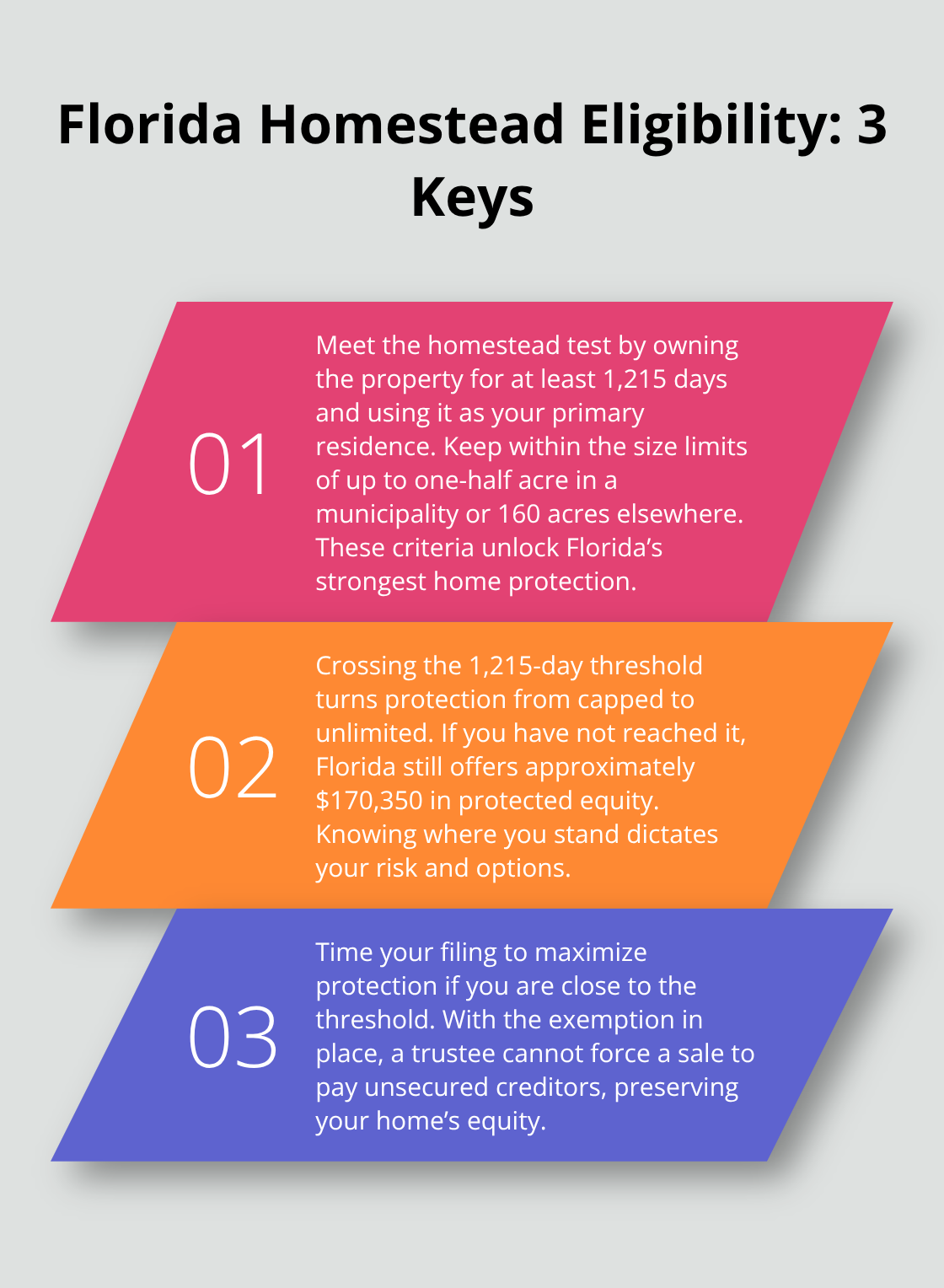
Florida’s homestead exemption protects unlimited home equity if you meet three requirements. You must own the property for at least 1,215 days before filing, live in it as your primary residence, and keep it within size limits of half an acre in a municipality or 160 acres elsewhere. Once you hit that 1,215-day mark, the state shields every dollar of equity, no matter how much your home is worth.
This protection exists nowhere else in the country at this scale.
If you fall short of 1,215 days, Florida still protects approximately $170,350 in home equity, which covers most residential properties in the state. Many people time their bankruptcy filing to reach the 1,215-day ownership threshold, and that strategy makes financial sense. Your mortgage obligation remains yours, but the exemption means the bankruptcy trustee cannot force a sale to pay unsecured creditors like credit card companies or medical providers.
Vehicles, Personal Property, and the Wildcard Exemption
Florida allows you to shield up to $1,000 in equity in a single motor vehicle, and married couples can double this to $2,000. Most financed vehicles have little or no equity because depreciation and loan balances consume the value, so this exemption covers many cars completely. If your vehicle has excess equity beyond $1,000, the wildcard exemption provides an additional $4,000 in personal property protection per person (available only in Chapter 7 and usable for that extra vehicle equity or anything else).
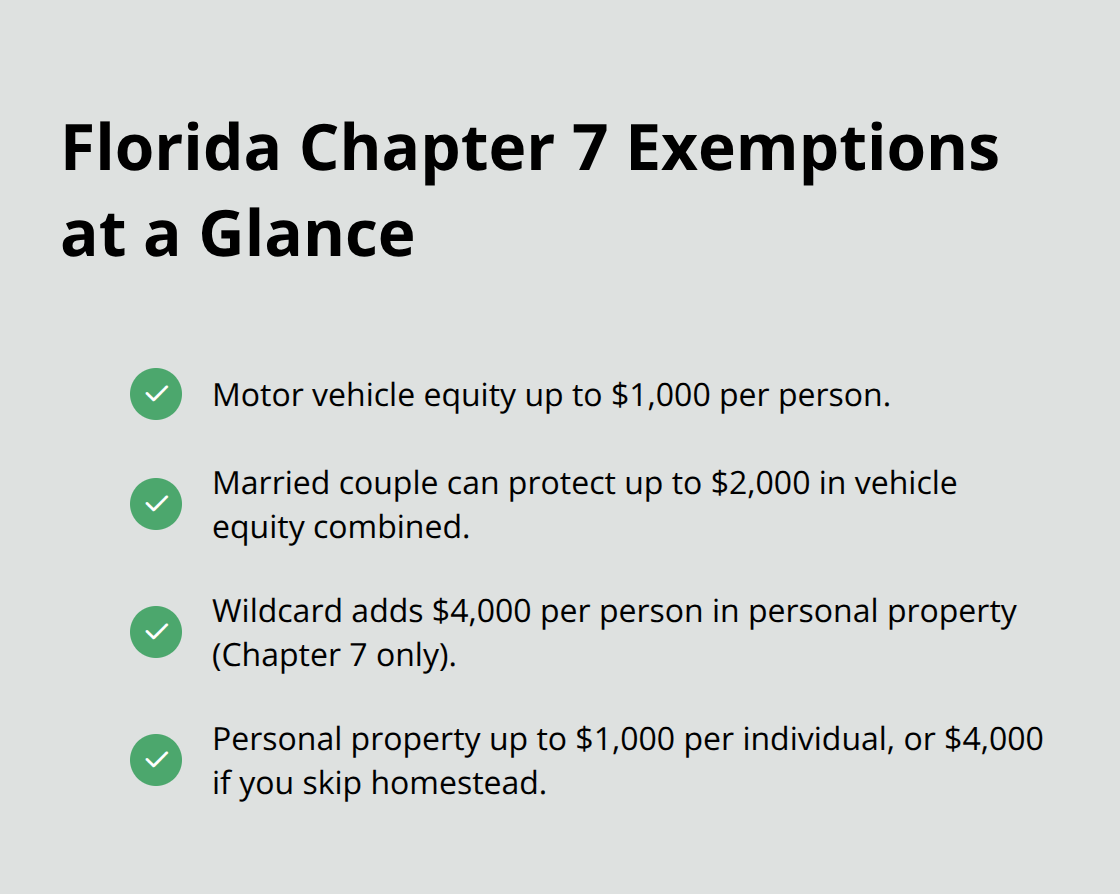
Personal property like furniture, electronics, clothing, and jewelry receives protection up to $1,000 per individual unless you skip the homestead exemption, which then increases your personal property allowance to $4,000. This flexibility means renters and those without significant home equity can still protect their essential possessions.
Retirement Accounts and Government Benefits
Retirement accounts receive full protection under federal law regardless of balance size, covering 401(k)s, IRAs, and similar tax-qualified accounts. Social Security, disability benefits, workers compensation, and Veterans Administration benefits remain completely exempt and separate from the bankruptcy estate. These protections mean most Floridians keep their essential possessions and future income sources intact through the bankruptcy process, positioning them to rebuild after discharge.
Understanding which assets qualify for protection sets the foundation for strategic planning for effective bankruptcy planning. The next section explains how Florida’s exemption framework actually works and what steps you take to claim these protections.
How Florida’s Exemption Laws Actually Work
Claiming Your Exemptions on Schedule C
Florida’s exemption system operates on a straightforward principle: you claim protections on Schedule C of your bankruptcy filing, and those claims shield your assets from the trustee. The state does not automatically protect anything. You must list each asset, identify its value, and apply the correct exemption category. If you claim the homestead exemption, you state the property address, the equity amount, and reference Florida Statute Chapter 222.04. The trustee reviews your claims and can object if they believe you overstated exemptions or mischaracterized property.
Courts take exemption disputes seriously. Misstating exemptions or hiding assets triggers bankruptcy fraud penalties up to $250,000 and 20 years in prison under federal law. This is why accuracy matters far more than aggressive claiming.
The 1,215-Day Homestead Rule and Timing Strategies
Many people assume the homestead exemption applies automatically to any home they own, but it requires documented ownership of 1,215 days before filing. If you purchased your home 1,000 days ago, you do not yet qualify for unlimited protection. You can still claim approximately $170,350 in equity under the partial homestead exemption, which protects most homes in Florida.
Some filers time their bankruptcy filing specifically to cross the 1,215-day threshold and gain unlimited protection. If you own property with a spouse, both spouses can double exemption amounts if both own the asset and both file together. A married couple can protect up to $8,000 in personal property if neither spouse claims homestead, or double the vehicle exemption to $4,000 combined. This doubling rule applies across nearly all Florida exemptions and creates significant planning opportunities for married filers.
Using the Wildcard Exemption for Flexible Asset Protection
The wildcard exemption functions as the most flexible protection tool in Florida Chapter 7. You receive $4,000 per individual to protect any personal property, not real estate, and married couples receive $8,000 combined. If your vehicle has $3,500 in equity and the standard $1,000 motor vehicle exemption falls short, you apply $2,500 of your wildcard to cover the gap. You can also use wildcard funds to protect excess jewelry, art, electronics, or collectibles.
Many filers mistakenly believe they must use wildcard protection for vehicles only. Actually, wildcard covers anything moveable, and you allocate it however your situation demands. The wildcard exemption vanishes if you file Chapter 13 instead of Chapter 7, making it exclusive to Chapter 7 filers.
Federal Protections for Retirement Accounts and Government Benefits
Retirement accounts receive 100 percent protection under federal law codified at 11 U.S.C. Section 522(b)(3)(C), regardless of account size. A 401(k) worth $500,000 receives the same protection as one worth $50,000. This federal protection overrides state exemption limits and applies nationwide. IRAs and Roth IRAs receive full protection up to $1,711,975 per person for bankruptcy cases filed between April 1, 2025 and March 31, 2028.
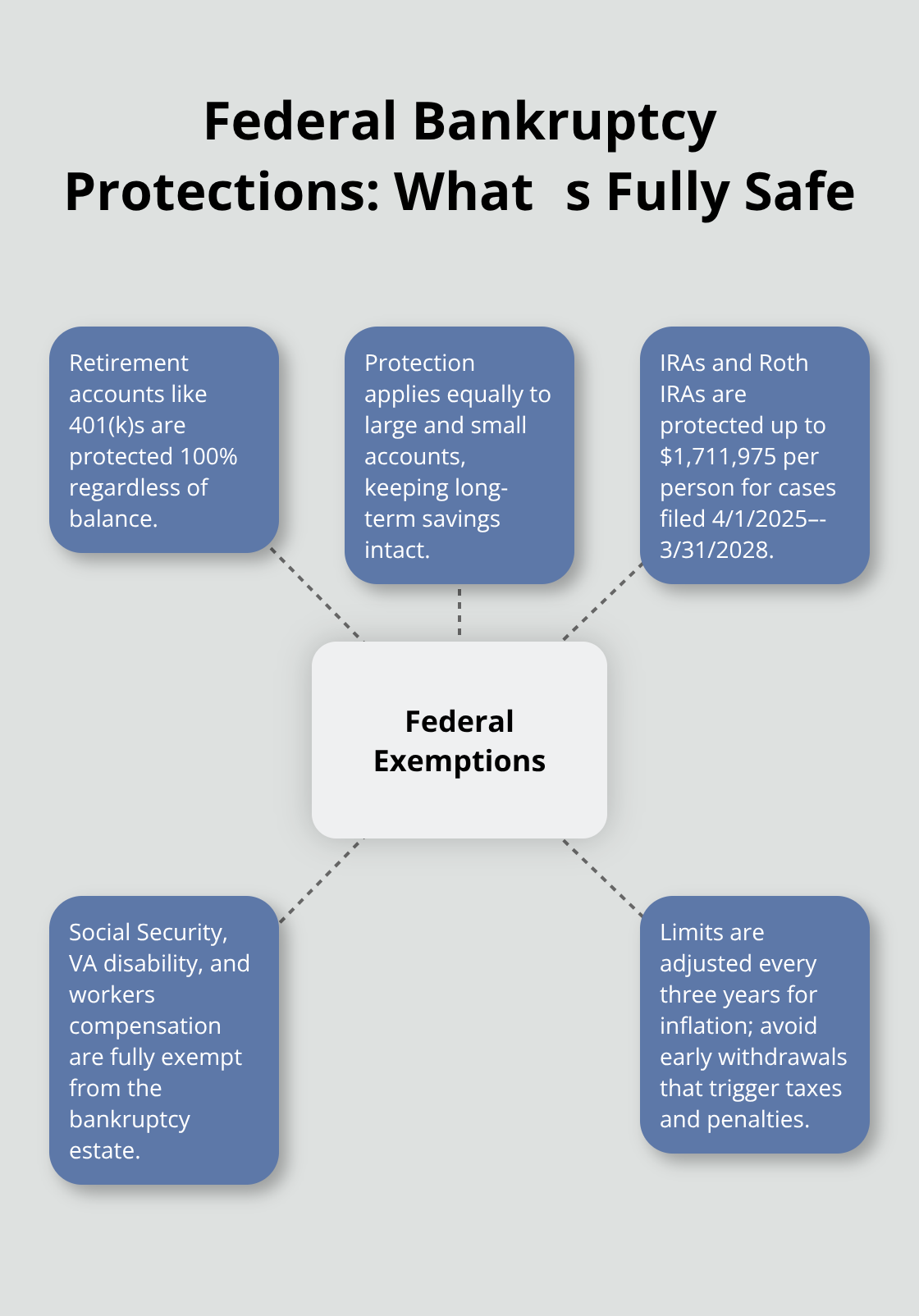
These figures adjust every three years based on inflation.
Social Security benefits, VA disability payments, and workers compensation also receive 100 percent federal protection. Do not liquidate retirement accounts or drain Social Security to pay creditors before filing. These funds protect themselves once bankruptcy starts, and early withdrawal triggers taxes and penalties that waste money unnecessarily. Understanding how exemptions create a shield around certain assets sets the stage for the next critical step: timing your bankruptcy filing strategically to maximize what you keep.
When to File Chapter 7 Bankruptcy in Florida and How to Avoid Costly Mistakes
Timing Your Filing for Maximum Homestead Protection
Timing your Chapter 7 filing matters far more than most people realize, and the difference between filing at the right moment versus the wrong moment costs you thousands in unnecessary losses. Bankruptcy filings peak in March and April each year, driven largely by tax season when people finally see their full financial picture. If you own property approaching the 1,215-day homestead threshold, waiting a few weeks or months to cross that line transforms unlimited home protection into capped protection worth roughly $170,350. A homeowner with $300,000 in equity gains $130,000 in additional protection simply through proper timing. Conversely, filing too early wastes that advantage entirely.
Understanding the 90-Day Lookback and Fraudulent Transfers
The trustee scrutinizes all financial activity in the 90 days before filing, looking for red flags like large transfers, asset sales, or unusual payments. Moving money between accounts, liquidating investments to pay down debt, or transferring property to family members within that window triggers fraud investigations and results in criminal penalties up to $250,000 and 20 years imprisonment under federal law. One common mistake involves liquidating retirement accounts to pay credit card debt right before filing. Federal law protects retirement accounts completely during bankruptcy, so that money was already safe. Withdrawing it early triggers income taxes, penalties, and permanently removes funds you could have kept.
Another critical error occurs when people pay family members or close friends more aggressively than other creditors in the months before filing. The trustee views these preferential payments with suspicion and can force repayment to the bankruptcy estate. The safest approach involves stopping all unusual financial activity at least six months before you plan to file, keeping detailed records of routine expenses, and maintaining consistent spending patterns.
Managing Assets and Inheritance Before Filing
If you receive a tax refund or inheritance, avoid making large purchases or transfers without understanding how those funds affect your bankruptcy. Many filers mistakenly believe they must hide assets or lie about their financial situation. In reality, full disclosure protects you. The bankruptcy court knows you have assets; your job involves claiming the correct exemptions and letting the law shield them. Honesty combined with proper exemption claims keeps you safe from fraud allegations while maximizing what you retain.
Professional Guidance Transforms Strategy Into Results
A bankruptcy attorney transforms this process from guesswork into strategy. An attorney reviews your specific assets, ownership timeline, and financial situation to identify the optimal filing date and structure. The attorney assesses whether Chapter 7 or Chapter 13 better protects your particular assets and identifies exemption planning opportunities unique to your circumstances. Some clients benefit from waiting to reach the homestead threshold; others should file immediately to stop wage garnishment or foreclosure. An attorney catches mistakes before they happen rather than after the trustee objects. The cost of professional guidance typically ranges from $1,500 to $2,500 for Chapter 7, which represents a fraction of the protection you gain through proper exemption planning and filing strategy. Without guidance, filers routinely miss exemptions, claim protections incorrectly, or file at the wrong time, resulting in asset loss that proper planning would have prevented.
Final Thoughts
Florida’s asset protection framework in Chapter 7 bankruptcy provides real tools to preserve what matters most. Your home receives unlimited protection once you meet the 1,215-day ownership requirement, vehicles and personal property stay shielded through motor vehicle and wildcard exemptions, and retirement accounts remain completely untouched regardless of balance. Government benefits like Social Security and VA payments continue flowing without interruption, meaning most Florida filers retain their essential assets while discharging unsecured debts.
The path forward requires three concrete steps: gather documentation of your asset ownership dates, current values, and any recent financial activity; identify which exemptions apply to your specific situation by reviewing your home equity, vehicle balances, retirement account totals, and personal property; and determine the optimal timing for your filing by calculating when you reach the homestead threshold or when creditor pressure demands immediate action. Waiting a few months to cross the 1,215-day mark can mean the difference between unlimited home protection and capped protection, but stopping foreclosure or wage garnishment immediately may outweigh that timing advantage. Asset protection Chapter 7 strategy works best when paired with professional guidance that catches mistakes before they cost you money.
Contact us for a free consultation to discuss your specific assets and filing timeline. We help you understand exactly what you keep, when you should file, and how to rebuild after discharge.