Florida’s homestead exemption in Chapter 7 bankruptcy can save your home from creditors. Most states limit this protection, but Florida offers unlimited coverage for your primary residence-one of the strongest protections in the nation.
At Harnage Law, PLLC, we’ve seen homeowners lose their homes because they didn’t understand the rules or missed critical filing deadlines. This guide walks you through what you need to know to protect your property.
What Makes Florida’s Homestead Exemption Unlimited in Chapter 7
Florida’s homestead exemption stands apart because it protects unlimited equity in your primary residence during Chapter 7 bankruptcy. The Florida Constitution enshrines this protection, and it applies regardless of how much your home is worth. If you own a home valued at $500,000 with $300,000 in equity, that entire $300,000 stays shielded from creditors in Chapter 7, provided you meet the eligibility requirements. This unlimited protection exists nowhere else to this degree. Most states cap homestead exemptions at specific dollar amounts-Texas offers unlimited protection too, but few others do. Federal bankruptcy law allows states to set their own exemptions, and Florida chose to protect homeowners aggressively. The legal foundation rests on Florida Statutes sections 222.01 and 222.02, which work in tandem with the federal Bankruptcy Code to determine what you keep.
Three Core Requirements for Unlimited Protection
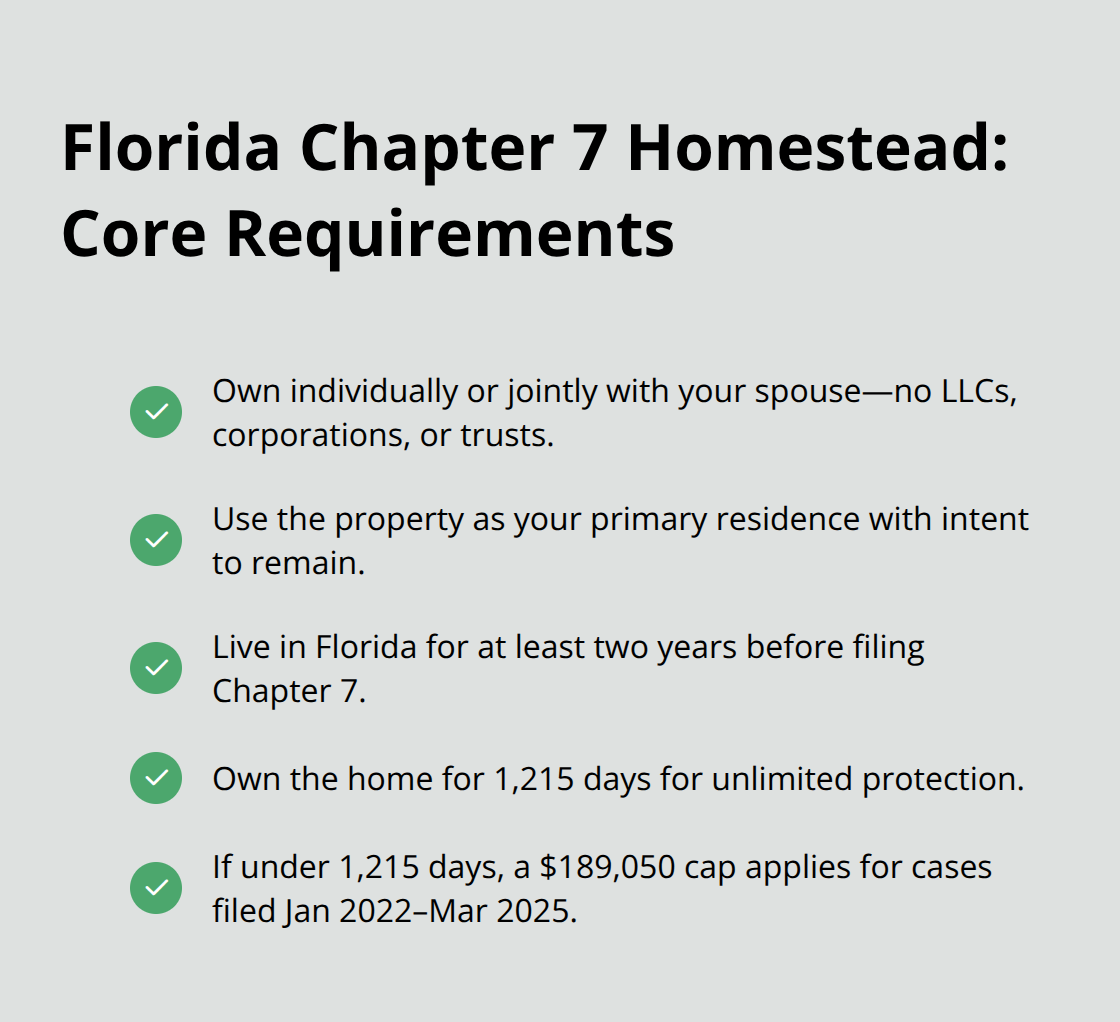
You must satisfy three non-negotiable conditions to access the unlimited exemption. First, the property must be your primary residence-not a vacation home, rental property, or investment real estate. Second, you must own it in your individual name or jointly with your spouse. Ownership through an LLC, corporation, or irrevocable trust disqualifies you from the exemption entirely. Third, you must have owned the home for at least 1,215 days (roughly 40 months) before filing Chapter 7. If you have owned it for fewer than 1,215 days, federal law caps your exemption at $189,050 for cases filed between January 2022 and March 2025. Additionally, you must have lived in Florida for at least two years before filing to claim Florida exemptions. These residency and ownership requirements exist because the exemption protects long-term homeowners, not people attempting to shield property through last-minute transfers.
How the Exemption Protects Equity, Not Mortgage Debt
A critical distinction separates what the homestead exemption covers and what it doesn’t. It shields your equity-the difference between your home’s market value and what you owe on the mortgage-but it does not protect the mortgage itself. If your home is worth $400,000 and you owe $250,000, the exemption protects the $150,000 in equity.
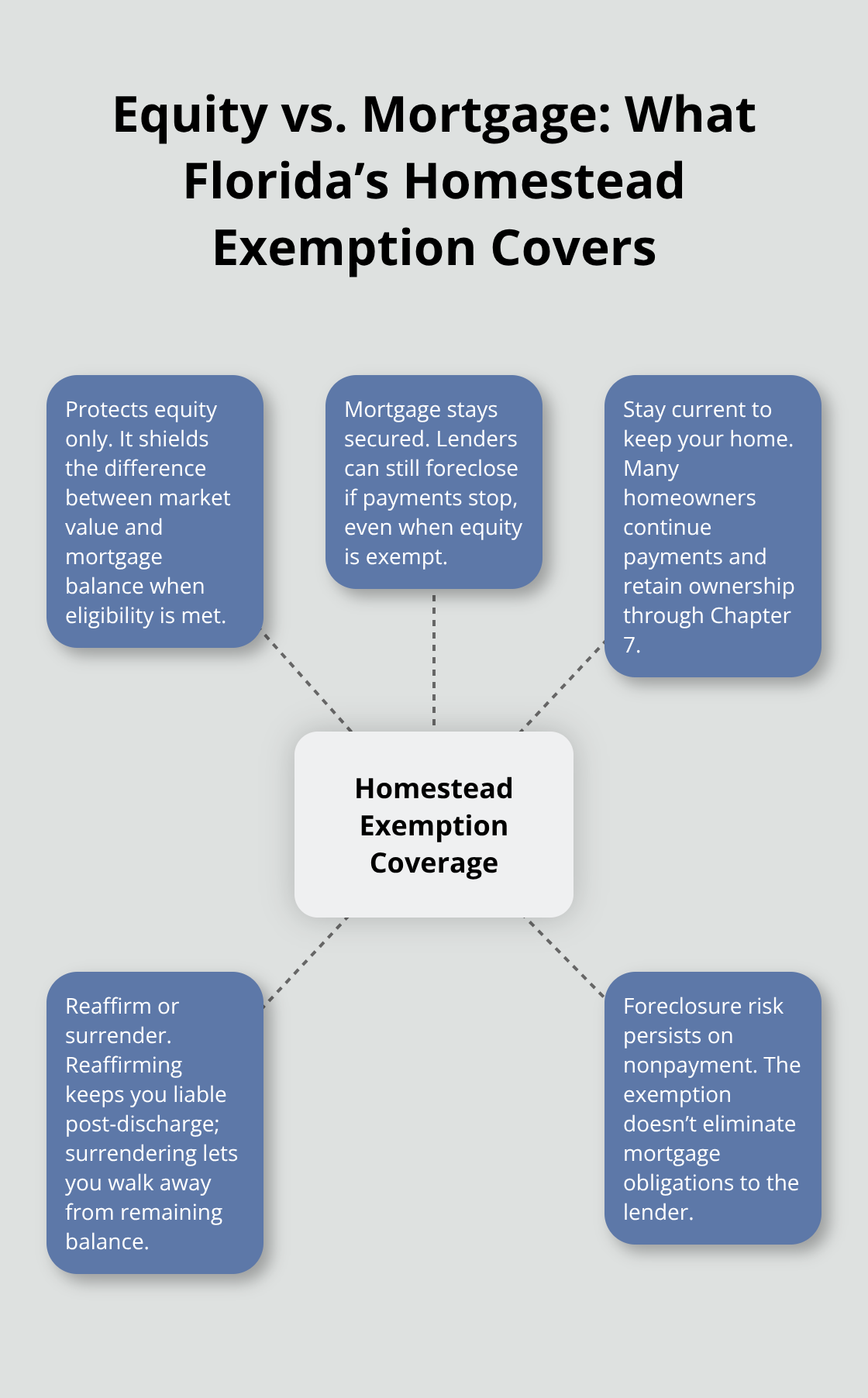
The mortgage remains a secured debt, and your lender can still foreclose if you stop making payments. In Chapter 7, you have three options: stay current on payments and keep the home, reaffirm the mortgage debt to remain obligated after discharge, or surrender the property and walk away with the remaining mortgage balance discharged. Most homeowners choose to stay current and keep their homes because they want to maintain ownership.
Why the Trustee Cannot Liquidate Your Home
The trustee assigned to your case cannot force a sale of your home to pay unsecured creditors if all your equity is protected by the homestead exemption. This is why the exemption matters so much-it prevents the trustee from liquidating your largest asset. When you file Chapter 7, the trustee’s job is to collect nonexempt property and sell it to repay creditors. Your home, however, falls into the exempt category (assuming you meet all requirements). The trustee simply cannot touch it. This protection applies even if you have substantial equity in the property. As long as the homestead exemption covers all your equity, unsecured creditors receive nothing from your home’s value. The exemption creates a legal barrier that the trustee must respect, which is why understanding your eligibility matters before you file.
What Happens When You Don’t Meet the Requirements
If you fail to meet even one requirement-primary residence status, individual ownership, or the 1,215-day ownership period-you lose access to the unlimited exemption. Instead, you fall back to the federal cap of $189,050 (for cases filed January 2022 through March 2025). This cap still protects most Florida homes, but it leaves substantial equity vulnerable if your home is worth significantly more. Ownership structure mistakes prove especially costly. Many people place their homes in an LLC or trust for asset protection purposes, only to discover that this structure disqualifies them from the homestead exemption entirely. The exemption applies only to individual or spousal ownership, period. If your home sits in a trust or corporation, you cannot claim the unlimited protection, and the trustee may have the right to liquidate equity above the federal cap. Understanding these boundaries before you file prevents costly surprises during your bankruptcy case.
The path forward requires careful attention to your specific situation. Your residency timeline, ownership structure, and home value all determine whether you can protect your property fully or face limitations. The next section walks you through the exact eligibility requirements and how to verify that you meet them before filing Chapter 7.
Eligibility Requirements for Homestead Exemption in Florida Chapter 7 Bankruptcy
Four Core Requirements You Must Meet
You must satisfy four concrete requirements before you can claim the homestead exemption in Chapter 7 bankruptcy. First, you need to own your home individually or jointly with your spouse-not through an LLC, corporation, trust, or any other entity structure. Second, the property must serve as your primary residence, meaning you actually live there and intend to keep living there. Third, you must have resided in Florida for at least two years before filing Chapter 7. Fourth, if you want unlimited protection, you need to have owned the home for 1,215 days (about 40 months) before filing. If you fall short on the ownership timeline, federal law caps your exemption at $189,050 for Chapter 7 cases filed between January 2022 and March 2025.
This cap still covers most Florida homes, but it creates a serious problem if your equity exceeds that amount.
Property Size and Acreage Limits
The acreage limits also matter: your property cannot exceed half an acre within a municipality or 160 acres outside city limits. These aren’t arbitrary rules-they exist to prevent people from shielding massive estates or attempting last-minute property transfers to dodge creditors. If your property sits on more land than these limits allow, you lose access to the homestead exemption entirely, even if you meet all other requirements. This restriction applies regardless of how much equity you have in the oversized parcel.
Ownership Structure Determines Everything
Verify your ownership structure right now. If your home sits in a trust or LLC, you have a major problem that cannot be fixed once you file. The exemption applies only to individual or spousal ownership, period. Moving the property out of a trust before filing might work, but this requires careful legal planning because improper transfers can trigger fraud allegations or void the exemption entirely. Many people place their homes in an LLC or trust for asset protection purposes, only to discover that this structure disqualifies them from the homestead exemption completely.
Filing the Homestead Claim Correctly
You must list the homestead exemption on Schedule C of your bankruptcy petition, providing the property address, your ownership percentage, and the equity amount you claim as exempt. Courts scrutinize homestead claims heavily, especially when substantial equity is involved, so accuracy matters enormously. Gather your deed, mortgage statement, recent property tax assessment, and proof of residency (utility bills, lease, or tax returns showing Florida address) before meeting with a bankruptcy attorney. The attorney will verify your residency timeline, confirm your ownership structure matches exemption requirements, and calculate your home’s current market value accurately. Underestimating or overestimating equity can trigger trustee objections that delay your case.
Common Calculation Mistakes That Hurt Homeowners
If you have owned your home fewer than 1,215 days, document the exact purchase date from your closing documents so your attorney can calculate whether the cap applies. Some homeowners incorrectly assume they can claim the unlimited exemption when they actually fall under the federal cap-this mistake costs them thousands in unprotected equity. If you live in Florida but own property in another state, that out-of-state property does not qualify for Florida’s homestead exemption regardless of how much equity you have in it. You must use your state’s exemptions or federal exemptions for any property outside Florida. The next section examines the mistakes that cost Floridians their homes and how to avoid them before you file.
Mistakes That Destroy Your Homestead Protection in Florida Chapter 7
Ownership Structure Errors That Eliminate Your Exemption
Floridians lose homestead protection not because the law is unfair, but because they make preventable mistakes before filing Chapter 7. The first and most common error involves ownership structure. If your home sits in an LLC, trust, or corporation when you file, the homestead exemption vanishes entirely. You cannot fix this after filing-courts will not allow you to transfer property out of these structures mid-bankruptcy to claim an exemption retroactively. Verify your deed right now. If your name alone or your name jointly with your spouse does not appear as the owner, contact an attorney immediately. Moving property from an LLC to individual ownership requires careful legal work because improper transfers can trigger fraud allegations or creditor objections that void the exemption. Some people intentionally place homes in trusts for estate planning purposes, only to realize too late that this structure disqualifies them from unlimited homestead protection. The federal cap of $189,050 suddenly applies instead, leaving significant equity exposed if your home exceeds that value. This mistake is permanent once you file.
The 1,215-Day Ownership Timeline
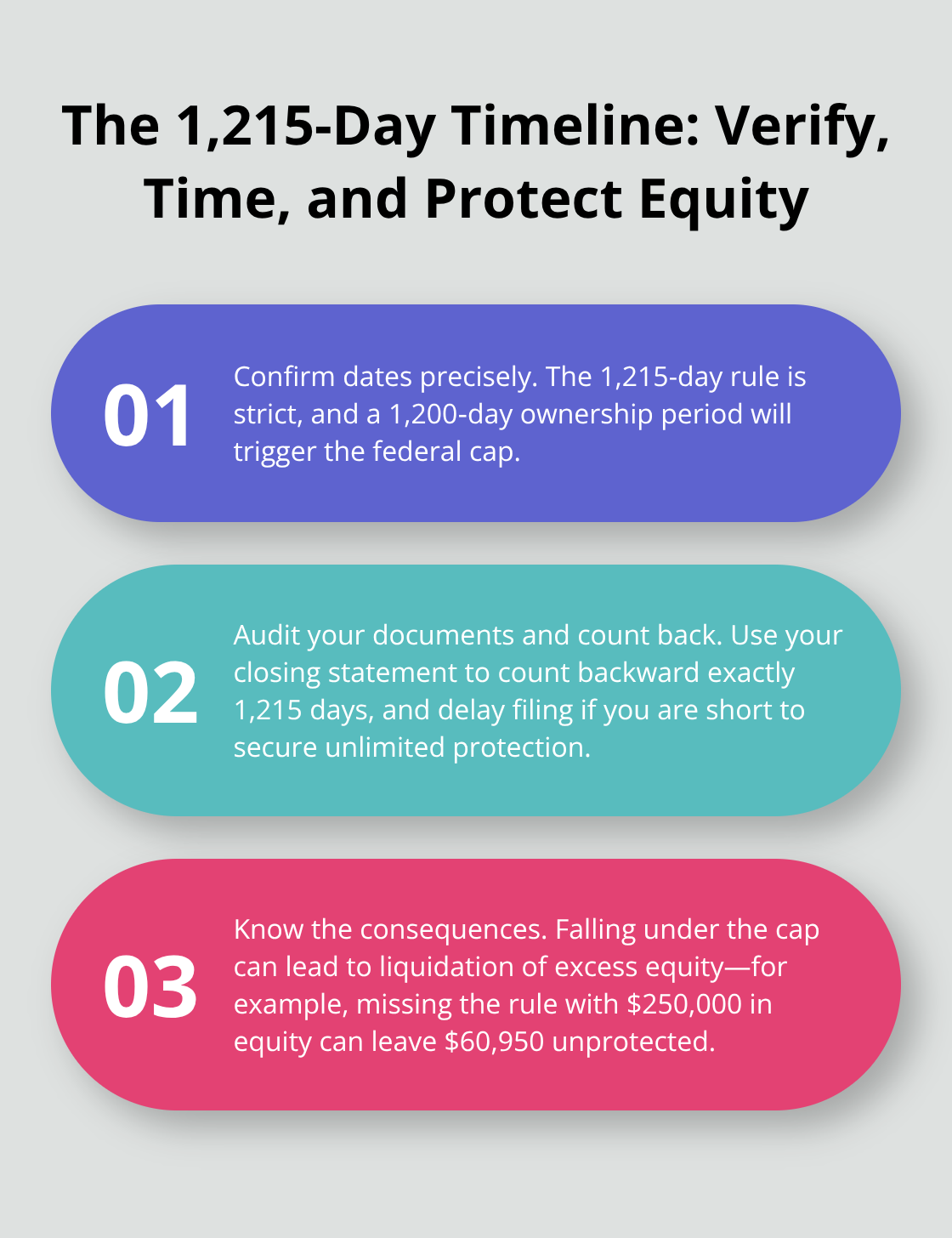
You must have owned your home for 1,215 days before filing to access unlimited protection. If you purchased your home 1,200 days ago, you fall short by 15 days, and the federal cap applies. Many homeowners underestimate this requirement or miscalculate their ownership period. Pull your closing documents today and count backward exactly 1,215 days from your planned filing date. If you fall short, delay filing by several months until you meet the requirement-this costs nothing and protects thousands in equity. The federal cap of $189,050 covers most Florida homes, but if your equity exceeds this amount, the trustee can liquidate the excess. A homeowner with $250,000 in equity who misses the 1,215-day requirement loses $60,950 in unprotected equity.
Property Transfers Within Two Years of Filing
Property transfers shortly before filing create serious problems. If you transferred your home to a family member or restructured ownership within two years of filing, the trustee will scrutinize this transaction closely. Transfers can trigger fraud findings that void exemptions or extend your bankruptcy case. Courts presume transfers made within two years of filing are attempts to shield assets, and you must prove otherwise-a difficult and expensive position to defend. Avoid any property transfers for at least two years before considering Chapter 7. If you must transfer property for legitimate reasons like estate planning, do it well before you face financial hardship, and document your intent carefully.
Primary Residence Status Requirements
Your primary residence status also requires ongoing attention. If you move out of your home after filing Chapter 7, you risk losing homestead protection because the exemption requires continuous occupancy and intent to remain. Renting out your home or using it as a vacation property while claiming it as your primary residence exposes you to trustee objections. The exemption applies only to properties where you actually live and intend to stay. Maintaining this status throughout your bankruptcy case protects your exemption claim and prevents costly disputes with the trustee.
Final Thoughts
Florida’s homestead exemption in Chapter 7 bankruptcy protects unlimited equity in your primary residence, but only if you meet every requirement before filing. Your ownership structure, residency timeline, and property status determine whether you keep your home or lose thousands in unprotected equity. Verify your deed shows individual or spousal ownership, confirm you have lived in Florida for at least two years, and document that you have owned your home for 1,215 days if you want unlimited protection.
The mistakes discussed throughout this guide are preventable, and filing Chapter 7 with proper planning transforms the process from a financial disaster into a manageable fresh start. Homeowners who understand the homestead exemption Chapter Seven rules protect their most valuable asset while discharging unsecured debts. Those who ignore these requirements often lose their homes unnecessarily or face trustee objections that delay their cases and drain their resources.
We at Harnage Law, PLLC help Florida homeowners navigate Chapter 7 bankruptcy with personalized guidance tailored to your specific situation. We stop creditor harassment, prevent wage garnishments, and halt lawsuits while protecting your assets and helping you discharge qualifying debts. Contact us for a free consultation to review your homestead exemption eligibility and develop a strategy that preserves your home.